Bitdefender vs Webroot
Bitdefender and Webroot are both powerful antivirus solutions, but they use wildly different architectures. Bitdefender is a security giant offering comprehensive, feature-rich protection and identity safeguards. Webroot focuses on extreme speed using cloud technology for minimal system impact. Your choice depends on prioritizing deep features versus pure performance.
Best for: Consumers prioritizing the highest anti-malware efficacy ratings, Users who need unlimited VPN access for privacy quickly
Best for: Users seeking lightning-fast scans and near-zero system resource usage, Families or individuals needing to cover 10 devices simultaneously
World-Class Security, Administrative Hurdles
We find that Bitdefender delivers exceptionally strong security efficacy across all major platforms, setting a high industry standard for protection with comprehensive feature sets. Overall, while the core product is world-class and lightweight, we note that the inconsistent support and difficult subscription renewal process slightly diminish the overall user experience.
Pros
- Core security engine offers best-in-class efficacy for threat detection.
- Protects multiple devices (PC, mobile, tablet) across different operating systems.
- Comprehensive higher-tier plans include unlimited VPN, identity protection, and Dark Web monitoring.
- Generally lightweight and low-impact on system performance compared to competitors.
Cons
- The subscription renewal process is often unclear and difficult to manage.
- Reports of automatic renewal failures and unexpected price increases are frequent.
- Performance of specific features, like the SafePay browser and VPN, is sometimes inconsistent.
- Customer support response times are highly variable and sometimes frustratingly slow.
Effective Security, Difficult Customer Experience
We found Webroot provides robust, cloud-based digital security that keeps devices running remarkably fast. While the core technology excels in speed and offers comprehensive features like identity monitoring, we noted pervasive user dissatisfaction regarding complicated renewals, unresponsive customer support, and extremely difficult uninstallation processes. Overall, Webroot provides powerful defense but struggles significantly with customer operational transparency and service responsiveness.
Pros
- Extremely fast, cloud-based scans ensure the software doesn't slow down the computer.
- Simple user interface is great for users who are new to cybersecurity.
- Available comprehensive protection tiers include VPN, identity monitoring, and fraud reimbursement.
- Reliable, always-on protection against complex threats like viruses and ransomware.
Cons
- Major recurring complaints about non-existent or unresponsive customer support via phone and email.
- Users report high difficulty when trying to delete or uninstall the software from their computer.
- Problems with aggressive auto-renewal charges and confusing renewal prompts were frequently cited.
- Renewal pricing is often significantly higher after the discounted first year.
AboutBitdefender
Bitdefender is globally recognized as a leader in the cybersecurity industry. They provide robust solutions focusing on threat prevention, detection, and response worldwide. Their products offer leading security efficacy, strong performance, and excellent ease of use. This makes it an ideal fit for consumers, mid-market enterprises, and small to medium businesses alike. 💡
AboutWebroot
Webroot provides comprehensive digital life protection. This means keeping all parts of your online world safe. It shields your devices, personal data, privacy, and identity from various online threats. Whether you only need device protection or require comprehensive internet security, Webroot has tailored plans. You can usually find options for every device and every budget. 💡
Highlights
Feature Comparison
Features Overview
We highlight the main differences and pick a winner for each feature.
Efficacy & Threat Defense
Bitdefender is a recognized global security leader with high detection efficacy ratings.
Bitdefender provides 24/7, AI-powered real-time protection designed to stop threats immediately. Its core security engine is best-in-class across prevention, detection, and threat response. Users consistently praise Bitdefender’s reliability in neutralizing complex threats like ransomware. Webroot's protection is highly reliable but relies on cloud-based threat intelligence. This method allows for fast operation and always-on security against threats and phishing. Webroot constantly monitors network traffic and uses a Web Threat Shield to block risky sites. The primary difference lies in the architecture and industry standing; Bitdefender is the proven, traditional power house. Webroot innovates with a cloud-first approach prioritizing speed but lacking some deep-scan features. If security reporting is important, Bitdefender's global leadership position inspires more confidence in its core defense mechanism.
System Performance
Webroot’s cloud-based model makes it significantly faster and lighter than Bitdefender.
Bitdefender is generally considered lightweight and low-impact on system performance compared to many competitors. It achieves strong efficacy without sacrificing the device's responsiveness or speed. Most users report satisfactory operating speed while running Bitdefender in the background. Webroot utilizes the cloud for threat detection, meaning it avoids massive local updates and heavy resource usage. Users experience lightning-fast scans that won't interrupt their workflow or slow down their applications at all. This cloud design is Webroot’s key selling point for speed-sensitive users. Webroot is the clear winner if maintaining maximum computer speed is your absolute top priority. Bitdefender is fast, but Webroot is designed for near-zero impact on system resources. If you use an older PC or a Chromebook, Webroot’s cloud processing ensures stable performance regardless of local machine power.
Identity Protection
Bitdefender offers a deeper identity monitoring suite including SSN and credit tracking.
Bitdefender's top-tier plans offer comprehensive financial safeguards for up to two adults. This includes continuous dark web monitoring, 1-Bureau Credit Monitoring, and a Smart SSN Tracker. Users also get Identity Theft Restoration services and security advice from Bitdefender Experts. Webroot offers identity monitoring for up to 10 individuals in family plans, covering dark web and financial monitoring. It focuses heavily on remediation, offering up to $1M fraud expense reimbursement coverage. Bitdefender provides more granular and proprietary tools focused on prevention, like the SSN Tracker and Identity Protection Score. Webroot scales its identity monitoring across more family members significantly more easily. Choose Bitdefender if high-level credit reporting and SSN protection are critical concerns for you.
VPN & Privacy Tools
Bitdefender provides unlimited VPN access sooner and includes dedicated anti-tracking features.
Bitdefender Premium Security includes unlimited VPN traffic with access to over 4,000 servers in 50+ countries. It also bundles dedicated Anti-Tracker technology to block data collection by advertisers and external parties. These features start in the mid-range plan ($79.99). Webroot reserves its integrated VPN service exclusively for the highest-tier Total Protection plans. This VPN covers either 5 or 10 devices, depending on the individual or family plan chosen. Webroot offers parental controls as a unique privacy feature in this tier instead of anti-tracking. Bitdefender is the better choice for users prioritizing extensive, restriction-free anonymous browsing right away. Its dedicated anti-tracker adds a key privacy layer Webroot lacks. If you frequently use unsecured public Wi-Fi networks, Bitdefender provides stronger privacy tools earlier in its plan lineup.
Customer Experience
Both companies face major support complaints, but Webroot users report extreme difficulty reaching assistance.
Bitdefender user reviews frequently complain about highly variable customer support response times and confusing renewal processes. However, some users still report helpful, knowledgeable technical staff resolving complex issues directly. The core complaint is administrative difficulty, not a total lack of support access. Webroot receives widespread, critical complaints about non-existent or unresponsive technical support via phone and email. Users report aggressive auto-renewal charges and finding the software extremely difficult to delete or uninstall (acting like malware). While neither offers five-star support, Bitdefender's reviews suggest a higher likelihood of eventually resolving issues. Webroot's operational failures surrounding billing and removal are a major concern. If you value quick, predictable access to help, Bitdefender presents slightly less risk, despite its known flaws.
Device Coverage
Webroot covers 10 devices and 10 identities, offering better scalability for large families.
Bitdefender focuses on providing excellent security for individuals, covering five devices across Windows, Mac, Android, and iOS. Bitdefender’s Family plan jumps to 25 total devices, but distributed among only five separate user accounts. The identity monitoring features usually cover only one or two adults. Webroot is ideal for complex families or households needing high device and identity counts under one roof. The Total Protection Family plan secures 10 devices and proactively monitors the identities of 10 different people. This is a huge benefit for multi-generational or large families. Webroot is superior if you need to monitor the identity of multiple individuals, not just devices. Bitdefender is better if you only need coverage for many devices on a single account. If you are securing a family of four using 8 devices, Webroot offers perfectly tailored plans for that simultaneous coverage limit.
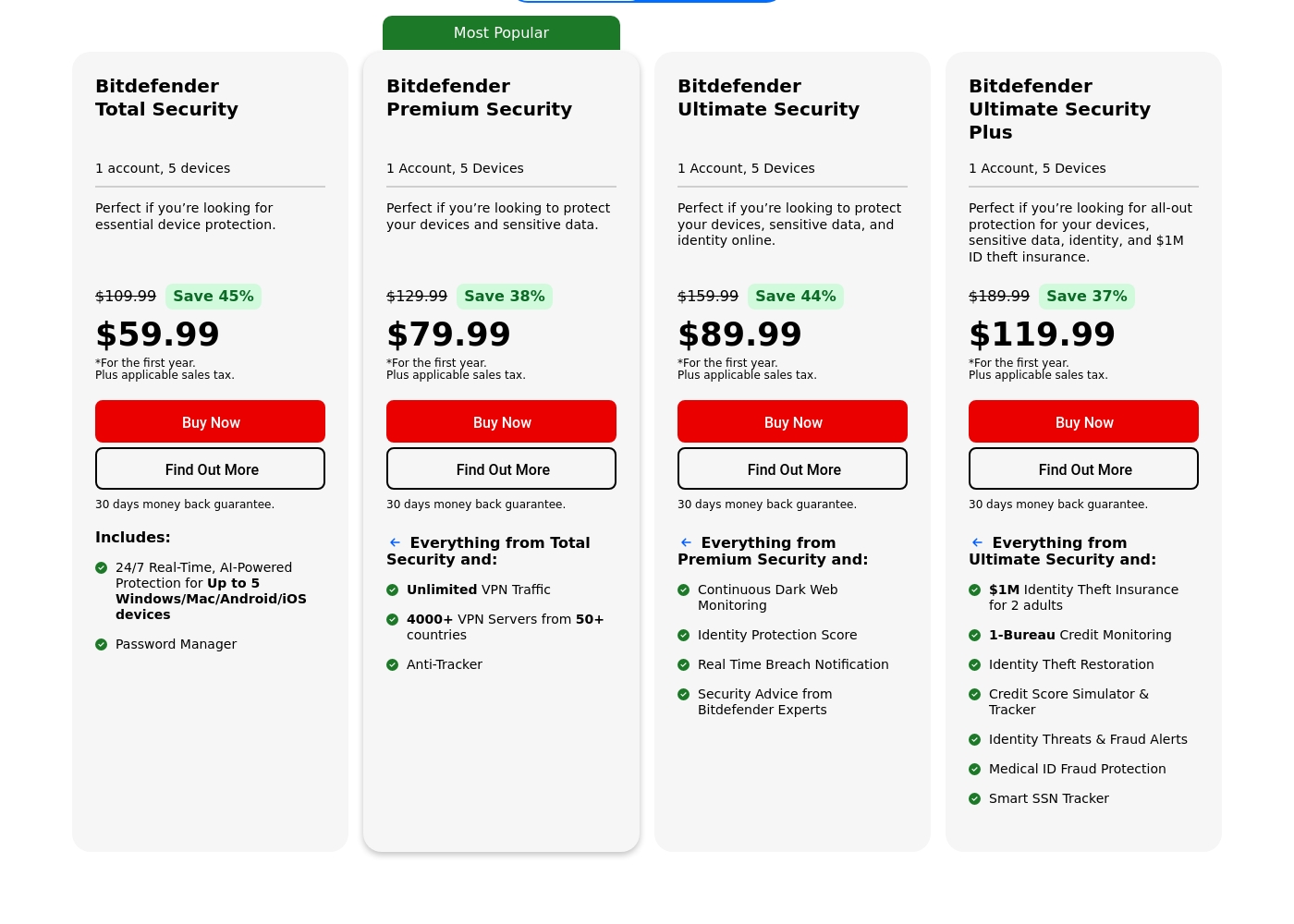
Bitdefender's consumer security suite costs between $59.99 and $119.99 per year with four individual plans: Bitdefender Total Security at $59.99, Bitdefender Premium Security at $79.99, Bitdefender Ultimate Security at $89.99, and Bitdefender Ultimate Security Plus at $119.99.
These prices reflect discounted introductory rates for the first year of protection. Here is a quick look at what each plan includes for your five devices.
Bitdefender Total Security
Price: $59.99 per year Best For: essential device protection Refund Policy: 30-day money-back Other Features:
- 24/7 Real-Time, AI-Powered Protection for Up to 5 Windows/Mac/Android/iOS devices
- Password Manager
- 24/7 Real-Time, AI-Powered Protection
- Password Manager
- Unlimited VPN Traffic
- 4000+ VPN Servers from 50+ countries
- Anti-Tracker
- Everything from Premium Security
- Continuous Dark Web Monitoring
- Identity Protection Score
- Real Time Breach Notification
- Security Advice from Bitdefender Experts
- Everything from Ultimate Security
- $1M Identity Theft Insurance for 2 adults
- 1-Bureau Credit Monitoring
- Identity Theft Restoration
- Smart SSN Tracker
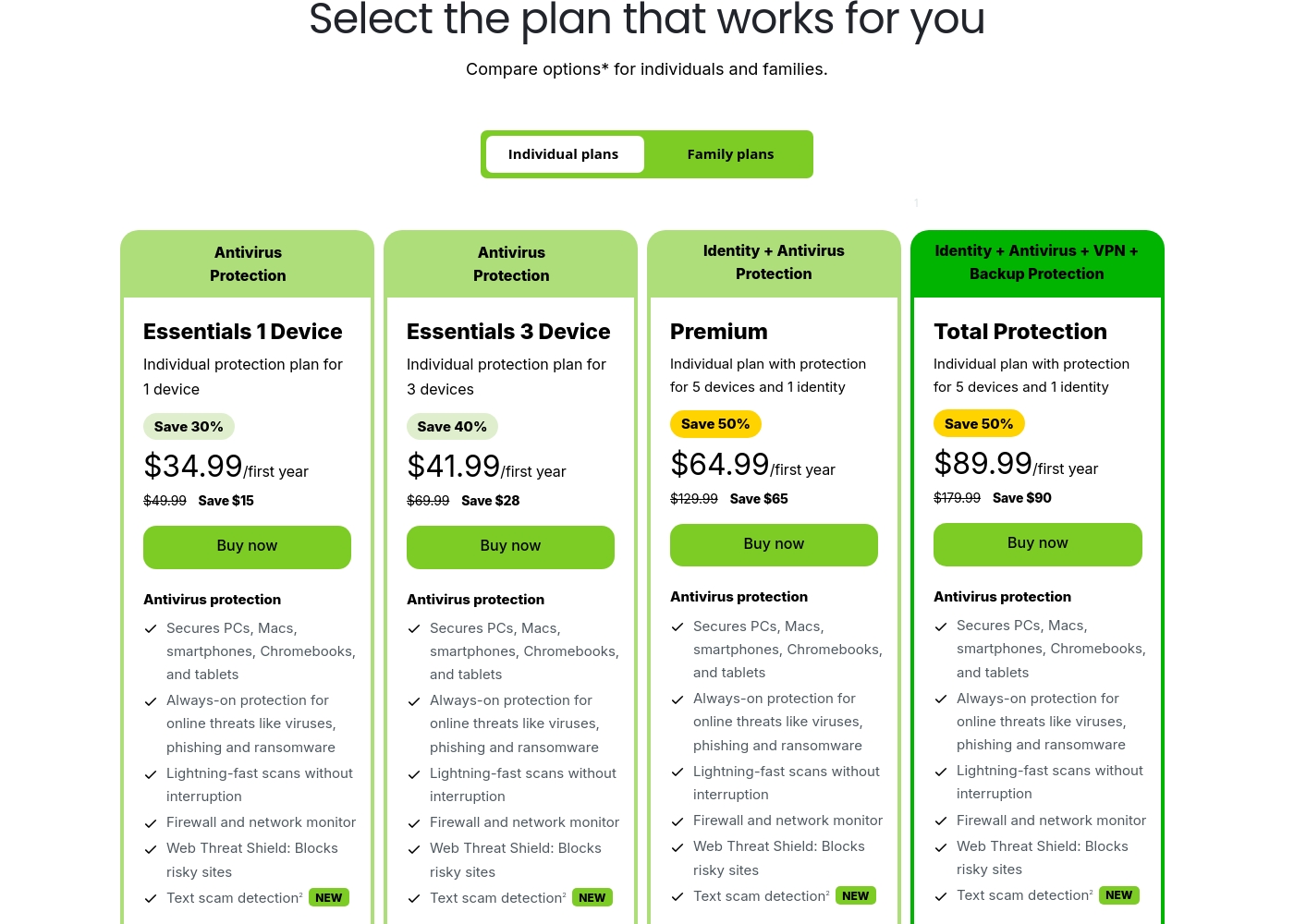
Webroot costs between $34.99 and $149.99 per year with 7 plans: Essentials 1 Device at $34.99, Essentials 3 Device at $41.99, Family Essentials 5 Device at $53.99, Premium Individual at $64.99, Total Protection Individual at $89.99, Premium Family at $124.99, and Total Protection Family at $149.99.
These prices reflect a special discount for the first year of service. You'll find options tailored specifically for individual use or for protecting an entire family. Refer to the plan details below to see which package fits your needs and budget best.
Essentials 1 Device
Price: $34.99 /first year Websites Supported: 1 Best For: Individual users requiring basic device antivirus Other Features:
- Always-on protection against ransomware and viruses
- Lightning-fast scans without interruption
- Firewall and network monitor
- Web Threat Shield
- Text scam detection (NEW)
- Secures PCs, Macs, smartphones, Chromebooks, and tablets
- Always-on protection for online threats like viruses, phishing and ransomware
- Lightning-fast scans without interruption
- Firewall and network monitor
- Web Threat Shield: Blocks risky sites
- Secures PCs, Macs, smartphones, Chromebooks, and tablets
- Always-on protection for online threats like viruses, phishing and ransomware
- Lightning-fast scans without interruption
- Firewall and network monitor
- Web Threat Shield: Blocks risky sites
- Secures PCs, Macs, smartphones, Chromebooks, and tablets
- Always-on protection for online threats like viruses, phishing and ransomware
- Lightning-fast scans without interruption
- Firewall and network monitor
- Web Threat Shield: Blocks risky sites
- Antivirus protection (as above)
- Eliminates traces of online activity
- Cleans up digital clutter
- Identity monitoring for one individual
- Dark web monitoring
Pricing Notes
- Both Bitdefender and Webroot utilize heavily discounted introductory rates for the first year of service.
- Webroot offers a significantly lower entry price point ($34.99) compared to Bitdefender's starting price ($59.99).
- Renewal prices for both Bitdefender and Webroot are notably higher after the initial discounted term expires.
- Bitdefender explicitly offers a reliable 30-day money-back guarantee on all consumer plans.
- Webroot does not explicitly state a free trial or money-back period on its product pages.
Pricing Head-to-Head
User Reviews
Overall user sentiment for Bitdefender is highly mixed, yet there is a strong consensus that the core product is an excellent security solution. Customers consistently praise its effectiveness in combating malware and viruses, noting its lightweight performance compared to competitors, and its ability to protect multiple devices (PC, mobile, tablet) without interference.
This makes it a reliable defense against online threats. However, customer experience is often diminished by administrative hurdles.
I've been using Bitdefender for many years and never had a problem or been disappointed. They are constantly improving their software and have been there when I needed help. This is the best security software for multiple devices.
Webroot receives highly polarized feedback across review platforms. Many enthusiasts view it as the best antivirus solution available, praising its powerful, always-on protection and competitive first-year pricing.
Users consistently highlight its cloud-based architecture, which ensures lightning-fast scans and low system resource impact. For those new to cybersecurity, the platform is simple and easy to navigate.
An amazing and affordable online security product that has had my exclusive patronage for many, many years. It is cloud-based with a low impact on system resources, which I really appreciate. I recommend it highly to everyone needing protection.
Our Verdict
Choosing between Bitdefender and Webroot means picking between ultimate security depth and maximum possible speed. Both offer robust protection suites, but Bitdefender is the proven powerhouse for comprehensive defense. Webroot is the champion of performance and maximum device quantity. Bitdefender’s superpower is its world-class, multi-layered security engine recognized globally for efficacy. It provides a superior identity suite, including credit monitoring and SSN trackers in its top plans. When you choose Bitdefender, you are prioritizing the deepest possible defense and privacy features like unlimited VPN access. Webroot excels by using a unique cloud-based architecture, resulting in incredibly fast, resource-light operations. It’s perfect if your device runs slowly or you need to secure a large 10-device household easily. Webroot also offers unique extras like unlimited cloud storage for one computer and digital clutter cleanup tools. The deciding factor here is the notorious customer experience around billing and uninstallation. Webroot users report critical failures in support and aggressive renewal tactics that are frustrating and potentially costly. Bitdefender's administrative flaws are annoying, but generally less catastrophic than Webroot's reported issues. Pick Bitdefender if you demand the best protection and deep identity features, accepting slightly inconsistent customer service. Choose Webroot if lightning-fast speed and covering 10 devices is non-negotiable, but be very cautious about the renewal process.
Frequently Asked Questions
Which is better for minimizing system impact: Bitdefender or Webroot?
Webroot is the clear winner for low system impact due to its cloud-based architecture. It provides lightning-fast scans and avoids the heavy local updates Bitdefender requires. If speed is your main concern, Webroot is engineered for maximum efficiency.
Does Bitdefender offer parental controls like Webroot?
No, parental controls are not explicitly listed in Bitdefender’s standard consumer security plans. Webroot offers integrated parental controls, but they are reserved for its highest-tier Total Protection Family plan. If family management is vital, choose Webroot's high-tier offering.
How does Bitdefender's identity theft coverage compare to Webroot's?
Bitdefender offers specialized tools like 1-Bureau Credit Monitoring and a Smart SSN Tracker in its top plan. Webroot provides broader identity monitoring for up to 10 individuals and $1M in fraud expense reimbursement. Bitdefender focuses on proactive surveillance; Webroot focuses on wide family coverage and reimbursement.
Which software has a better customer support experience: Bitdefender or Webroot?
While both Bitdefender and Webroot receive many complaints about support responsiveness, Bitdefender fares slightly better. Webroot users widely report aggressive auto-renewals and being unable to reach support for billing or cancellation issues. Bitdefender reviews show high efficacy, even with mixed support.
Which one covers more devices for an individual plan: Bitdefender or Webroot?
For individual or small family accounts, Webroot covers up to 10 devices and 10 monitored identities. Bitdefender’s standard individual plans cover 5 devices per account. If device count is crucial, Webroot offers better per-person coverage.
Can I get unlimited cloud backup with Bitdefender?
No, Bitdefender’s consumer plans do not explicitly include cloud backup and restore features. Webroot does offer backup with unlimited cloud storage, but it is limited to securing only one PC or one Mac machine in its Total Protection plan.
Ready to Choose?
Both tools have their strengths. Choose based on your specific needs.