BILLmanager vs DualEntry
BILLmanager and DualEntry solve very different problems. BILLmanager automates hosting and cloud service delivery. DualEntry unifies financial operations for multi-entity businesses. Choosing depends on your core need: service automation vs. financial consolidation.
Best for: Hosting companies selling VPS, cloud, or dedicated servers, Cloud providers automating VDC and virtual resource provisioning
Best for: Finance teams at mid-market companies, Businesses with 3+ entities needing consolidated reporting
Powerful automation, but watch the costs.
We find BILLmanager to be a comprehensive and capable platform for automating hosting and cloud services. However, the external feedback highlights significant concerns about price volatility and post-sale support that potential buyers must carefully consider.
Pros
- Comprehensive automation for service provisioning, billing, and support.
- Supports a wide range of payment gateways and infrastructure integrations.
- Includes built-in tools for CRM, marketing, and business intelligence.
- Offers a 30-day free trial for hands-on evaluation.
Cons
- External reviews report substantial and unexpected price increases after purchase.
- Customer support responsiveness is criticized, particularly for resolving bugs.
- Users feel some reported bugs are dismissed, impacting service performance.
- The platform's complexity may require significant setup and configuration.
Powerful but unproven at scale
We find DualEntry to be a comprehensive, AI-driven ERP solution aimed at simplifying multi-entity financial operations. Overall, it promises significant efficiency gains like faster closes and unified reporting, but the lack of accessible external user reviews prevents us from validating core claims about reliability, support, and real-world performance.
Pros
- Claims to unify multi-entity financials into a single view
- Promises AI-powered automation for tedious tasks like transaction categorization
- Advertises a dramatic reduction in month-end close time
- Offers 13,000+ native integrations to connect with existing tools
Cons
- Pricing is not transparent and requires a custom quote
- No accessible external user reviews to validate claims of reliability or support
- Specific details on implementation complexity or training are not provided
- The platform's actual performance and stability are unverified from user feedback
AboutBILLmanager
BILLmanager is a comprehensive platform designed for hosting providers, cloud businesses, and IT service companies. It automates the sale, provision, and management of services like VPS, dedicated servers, domains, and SSL certificates.
Think of it as your business's central nervous system. It integrates with your infrastructure and tools, manages customer accounts, and handles all the financial transactions. 💡
AboutDualEntry
DualEntry is a modern, cloud-based ERP system built for finance teams, especially those handling multiple entities. 🧠 It's an all-in-one platform that consolidates your financial operations—from the general ledger and accounts payable to revenue recognition and reporting. It's designed for companies that have outgrown basic accounting software but need a more intuitive, integrated solution than traditional ERPs.
Highlights
Feature Comparison
Features Overview
We highlight the main differences and pick a winner for each feature.
Core Purpose
BILLmanager automates hosting sales. DualEntry manages corporate finance. They serve entirely different industries.
BILLmanager is built for hosting and cloud businesses. It automates the entire lifecycle from ordering VPS or domains to provisioning servers and handling recurring bills. DualEntry is a financial ERP for multi-entity companies. It consolidates general ledgers, automates accounting tasks like transaction categorization, and accelerates month-end closes. The key difference is vertical specialization. BILLmanager understands hosting infrastructure. DualEntry understands complex financial consolidation. A hosting provider needs BILLmanager's service provisioning. A company with 20 subsidiaries needs DualEntry's unified financial view.
Automation
BILLmanager automates service delivery. DualEntry automates accounting chores. Both automate, but for different jobs.
BILLmanager automates creating servers when a customer orders. It sends invoices, processes payments through 30+ gateways, and triggers support tickets. It handles the full order-to-support cycle. DualEntry uses AI to categorize thousands of transactions. It automates bank fee reconciliation and manages expense approvals. It focuses on closing books faster. BILLmanager's automation is infrastructure-driven. DualEntry's is finance-data-driven. For a cloud business, BILLmanager eliminates manual provisioning. For a finance team, DualEntry eliminates manual data entry and reconciliations.
Integration Ecosystem
DualEntry boasts 13,000+ integrations. BILLmanager focuses on hosting-specific connections. Scale vs. specificity.
DualEntry connects to over 13,000 banks and tech apps natively. This includes payment processors, CRMs, and payroll systems. It aims to be a central hub for all financial data. BILLmanager integrates with virtualization platforms like VMware and OpenStack. It connects to hosting control panels, domain registrars, and specific payment gateways. It uses an API for custom needs. DualEntry's ecosystem is vast for general business. BILLmanager's is deep for hosting operations. If you run a hosting company, BILLmanager's integrations with VMmanager or cPanel are critical. For a multi-national, DualEntry's 13,000 bank connections are essential.
Reporting & Analytics
Both offer built-in BI. BILLmanager tracks business metrics. DualEntry tracks financial consolidation.
BILLmanager includes dashboards to visualize server utilization, customer acquisition costs, and revenue forecasts. You can build custom reports from your service data. DualEntry provides real-time consolidation across all entities. You see combined P&L, balance sheets, and cash flow without exporting to spreadsheets. The difference is data scope. BILLmanager reports on service operations. DualEntry reports on consolidated financial health. A hosting CEO uses BILLmanager's BI to predict infrastructure costs. A CFO uses DualEntry's to report to the board.
Pricing & Value
BILLmanager's cost scales with your turnover. DualEntry's scales with entities. One is usage-based, the other tiered.
BILLmanager Hosting&Cloud starts at €50/month. The fee is a percentage of your annual turnover. The Enterprise plan is custom-priced based on server count. Users report unexpected price hikes later. DualEntry has three tiers: base, Plus, and Ultra. Pricing is custom but includes unlimited users and transactions. The main difference is the number of entities you can manage. BILLmanager's model ties cost to your revenue. DualEntry's ties cost to your company's complexity. BILLmanager's value comes from automating sales. DualEntry's comes from reducing close time from 20 days to 1.
Implementation & Support
DualEntry offers guided setup. BILLmanager is self-hosted. One hands-on, one DIY.
DualEntry includes implementation in all plans. Their team ingests your data in 24 hours and goes live in 4-6 weeks. Support includes Slack, phone, and dedicated accountant help. BILLmanager offers a 30-day self-hosted trial. You install and configure it on your infrastructure. ISPsystem provides demos and documentation but support reviews are mixed. DualEntry is a managed service. BILLmanager is a self-managed platform. If you want a white-glove setup, DualEntry provides it. If you prefer to control your own infrastructure, BILLmanager is designed for that.
Security & Compliance
DualEntry highlights specific certifications. BILLmanager's security details are less transparent.
DualEntry is SOC 2, PCI, and CCPA certified. It uses AES-256 encryption and supports IFRS/GAAP compliance standards. Security is a core marketing point. BILLmanager's official site doesn't list specific security certifications. It's focused on service automation. Compliance is more about your own infrastructure setup. DualEntry provides built-in compliance for financial data. With BILLmanager, you must ensure your hosting environment meets all regulatory requirements. For a public company, DualEntry's certifications are non-negotiable. For a private hosting business, BILLmanager's security relies on your own practices.
Learning Curve
Both are complex platforms. DualEntry offers guided training. BILLmanager relies on documentation.
BILLmanager is a comprehensive platform for complex businesses. The initial setup for service provisioning and billing rules likely requires significant configuration. ISPsystem offers a demo stand to evaluate. DualEntry also handles complex multi-entity accounting. However, they provide hands-on training sessions with an accountant as part of onboarding. Implementation is included. The learning curve is steep for both. DualEntry mitigates this with guided help. BILLmanager expects more technical self-sufficiency. A tech-savvy hosting provider might prefer BILLmanager's control. A finance team might prefer DualEntry's structured onboarding.
BILLmanager pricing: BILLmanager offers flexible subscription plans tailored to your company's turnover and infrastructure scale. A 30-day free trial lets you test its full service automation capabilities directly on your own infrastructure. Plans range: €50+/month Billing options: Free trial, Monthly subscription, Yearly subscription, Usage-based pricing 30-day free trial
- Automation of service sales: VPS, VDC, dedicated server, colocation, SSL, and more
- Integration with over 20 payment services (PayPal, Skrill, Stripe, Alipay)
- Automated document flow and billing calculations
- Marketing and CRM systems including white label features
- Built-in support system and BI analytics tools
- Internal billing and resource consumption tracking
- Virtual resource provisioning integrations (VMmanager, VMware vSphere, OpenStack)
- Dedicated server configuration via DCImanager integration
- Virtual resource quota management
- Support for geo-distributed IT infrastructure

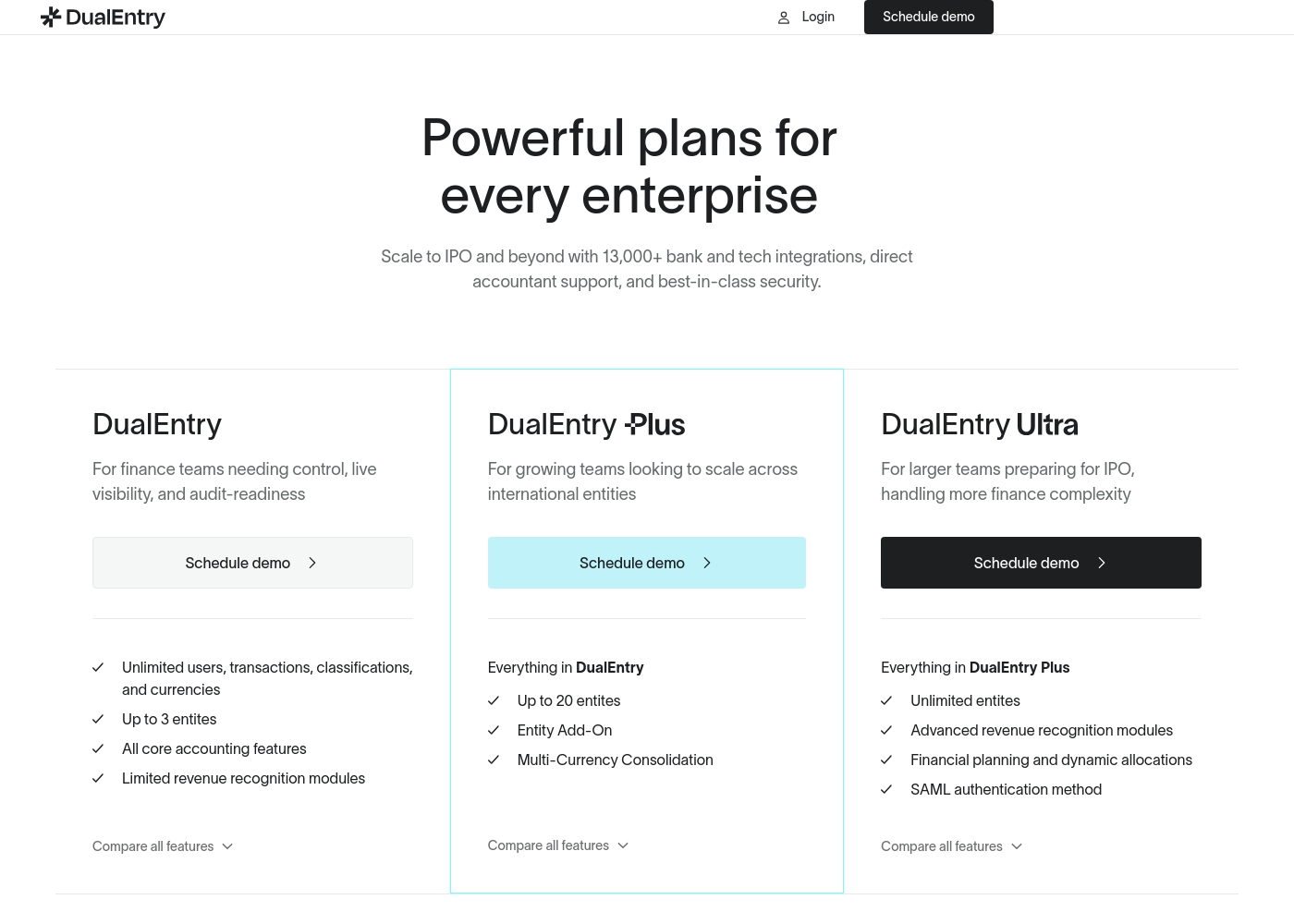
DualEntry pricing: DualEntry provides enterprise-grade accounting software with three distinct tiers designed to scale with your business. While specific rates are available via custom quotes, all plans include unlimited users and transactions to support growth without penalty fees or extra costs for implementation support and training sessions with an accountant team member and more for you and your business and more and more and more more more more more more more more more more more more more more more more more more more more more more more more more more more more more more more more more more more more and more more more more and more and more more more and more more more more more more more more and more more more and more more more more more more more more more more more more more more more more more more more more more more more more more more more more more more more more more more more more and more more more more and more and more more more and more more more more more more more more and more more more more more more more more more more more more more more more more more more more more and more more more and more more more more more more more more more more more more more more more more more more more more more more more more more more more more more more more more more more more more more and more more more more and more and more more more and more more more more more more more more and more more more more more more more more more more more more more more more more more more more more and more more more and more more more more more more more more more more more more more more more more more more more more more more more more more more more more more more more more more more more more more and more more more more and more and more more more and more more more more more more more more and more more more more more more more more more more more more more more more more more more more more and more more more and more more more more more more more more more mo
Pricing Notes
- BILLmanager's pricing is tied to your annual turnover. A minimum of €50/month applies for turnovers up to €5,000.
- DualEntry pricing is not public. You must schedule a demo for a custom quote based on your number of entities.
- BILLmanager users report significant and unexpected price increases after the initial purchase.
- DualEntry includes unlimited users and transactions in all plans. BILLmanager's cost is not per-seat.
- DualEntry includes implementation and training at no extra cost. BILLmanager is self-hosted.
Pricing Head-to-Head
User Reviews
External sentiment for ISPsystem (which develops BILLmanager) is notably mixed. On Trustpilot, the overall rating is a low 2.4/5.
Users frequently praise the software's core functionality and feature set, with one reviewer noting they "really enjoy" VMmanager and found BILLmanager's initial price reasonable. However, major recurring themes are significant price increases after purchase, leading to feelings of being trapped, and unresponsive or unhelpful support, especially when dealing with bugs or licensing issues.
Been using VMmanager now for over a month and have been really impressed, the support team is on hand and helpful with any issues. It is cheaper than Solus.io and has many of the features we wanted.
We attempted to gather user feedback from Trustpilot and Capterra, but both sources were currently inaccessible due to security verification errors, preventing the collection of specific review snippets. This means we cannot synthesize external sentiment or identify recurring themes like accuracy, ease of use, or support responsiveness from user reviews. 🤔 Without these concrete data points, our final assessment relies solely on the provided product information from DualEntry's website.
Our Verdict
There's no single winner here. BILLmanager and DualEntry serve completely different masters. The right choice depends entirely on whether you're running a hosting business or a multi-entity finance department. BILLmanager's superpower is automating the entire hosting lifecycle. It connects your website to server provisioning, handles complex usage-based billing across 30+ payment methods, and manages customer support—all in one platform. If you sell VPS or domains, it's built for your workflow. DualEntry's superpower is financial consolidation and speed. It unifies all your entities into a single view, uses AI to automate tedious accounting tasks, and promises to cut your month-end close from 20 days down to just 1. For a finance team drowning in spreadsheets, this is transformative. The deciding factor is your core business. Choose BILLmanager if you need to automate the sale and delivery of technical services. Choose DualEntry if you need to consolidate financial operations and accelerate accounting processes. In short: BILLmanager is for hosting and cloud providers. DualEntry is for finance teams at growing companies. They don't compete; they solve different problems. Know your pain point, and the answer is clear.
Frequently Asked Questions
Which is better for a hosting business: BILLmanager or DualEntry?
BILLmanager is designed specifically for hosting and cloud businesses. It automates service provisioning, billing, and support for VPS, domains, and servers. DualEntry is a financial ERP and doesn't handle these operational tasks. For a hosting business, BILLmanager is the relevant choice.
Does DualEntry work like BILLmanager for billing?
No, they work differently. BILLmanager handles complex, usage-based billing for technical services. DualEntry handles standard corporate accounting, invoicing, and financial reporting. They are not direct competitors in billing functionality.
Is BILLmanager cheaper than DualEntry?
It depends on your revenue vs. entity count. BILLmanager starts at €50/month but is a percentage of your turnover. DualEntry's custom pricing is based on the number of entities. Without specific quotes, a direct comparison isn't possible.
Can I migrate from BILLmanager to DualEntry?
Migration isn't straightforward because they serve different functions. BILLmanager manages hosting operations. DualEntry manages finances. You would typically use both in different parts of your business, not replace one with the other.
Which has better customer support?
DualEntry offers dedicated accountant support via Slack, phone, and email. External reviews for BILLmanager's support are negative, citing unresponsiveness and unresolved bugs. Based on available data, DualEntry's support appears stronger.
Which platform is more secure?
DualEntry highlights SOC 2, PCI, and CCPA compliance. BILLmanager's site does not list specific security certifications. For regulated financial data, DualEntry's certifications are clearer. For hosting, security often depends on your own infrastructure setup.
Ready to Choose?
Both tools have their strengths. Choose based on your specific needs.