BigCommerce vs Payhip
BigCommerce and Payhip target two radically different e-commerce markets. BigCommerce serves established mid-market brands needing robust scaling and B2B features. Payhip is the go-to platform for individual digital creators and coaches. The choice relies entirely on your business size and product complexity.
Best for: Established mid-market companies needing high availability infrastructure., Businesses requiring robust B2B and wholesale features (customer groups).
Best for: Solo digital creators selling courses, ebooks, or design templates., Experts monetizing knowledge through 1:1 coaching or paid memberships.
Robust tools meet customer service disconnect.
We observe BigCommerce heavily emphasizing high-level enterprise tools, like guaranteed 0% transaction fees and robust infrastructure for scalability. However, user reviews detail severe service issues, including unexpected server outages and deeply unresponsive customer support, even for priority users. Overall, BigCommerce provides impressive technical capability that is unfortunately undermined by inconsistent stability and poor customer experience.
Pros
- Guaranteed 0% transaction fees on the Enterprise plan.
- High reliability with 99.99% reported uptime.
- Industry-leading optimized one-page checkout available.
- Customizable, non-cookie cutter themes compared to competitors.
Cons
- Customer service is frequently reported as unhelpful, non-existent, or indifferent.
- Specific users mention significant, unexpected server downtime (e.g., 25-hour outages).
- Platform infrastructure (CMS, blog system) reportedly struggles with SEO and formatting.
- Essential features like product filters are locked behind high-tier plans.
Exceptional value for digital creators.
We find Payhip delivers an outstanding value proposition: it eliminates feature-gating across all tiers and handles complex global tax compliance automatically. User feedback consistently validates the platform's ease of use and the quality of its human support staff. Overall, we recommend Payhip highly for anyone selling digital goods, courses, or coaching.
Pros
- Access to all features is included even on the Free Forever plan.
- Customer support is prompt, responsive, and provided by real people.
- Setup is remarkably user-friendly with a clean, easy-to-customize interface.
- Automatically handles complex EU and UK VAT calculation and compliance.
Cons
- Does not permit the sale of Private Label Rights (PLR) products.
- Some specialized functions required by highly ambitious course creators may be absent.
AboutBigCommerce
BigCommerce Essentials is a top-rated ecommerce platform designed specifically for fast-growing businesses, including high-volume operations and B2B SMBs. It operates as a high-performance platform that truly scales with you. Built-in flexibility means you have the freedom to customize your store and save money at the same time. You get robust features that ensure efficient operation, allowing you to focus on expanding your brand and attracting more shoppers. ✅
AboutPayhip
Payhip is a user-friendly platform designed for creators who want to turn their passion into profit. It makes selling online easy and accessible for everyone. You can create a free, fully customizable website within minutes, with absolutely no coding required ✨. Whether you sell ebooks, software, online courses, or physical inventory, Payhip provides the robust features you need. This platform helps you start, scale, and manage your business effectively, joining over 130,000 trusted creators.
Highlights
Feature Comparison
Features Overview
We highlight the main differences and pick a winner for each feature.
Target User & Focus
BigCommerce serves high-volume product retailers; Payhip is for solo digital creators.
BigCommerce is built for complex B2B and massive physical goods operations. Its infrastructure handles immense traffic reliably for peak sales periods. Payhip is designed specifically for creative entrepreneurs selling digital products easily. It simplifies selling courses, memberships, and coaching services natively. BigCommerce offers enterprise features like Multi-Storefront capabilities. Payhip focuses intensely on making digital sales effortless worldwide. If you are a small team selling physical goods, Payhip may be too simple.
Pricing Structure
Payhip has a transparent free tier; BigCommerce’s enterprise pricing is custom.
BigCommerce Enterprise guarantees 0% platform transaction fees on high-volume sales. Starter tier pricing is not publicly disclosed, requiring contact. Payhip’s Free Forever plan includes all features but charges a 5% transaction fee. The $99/month Payhip Pro plan eliminates this fee entirely. Payhip offers clear transparency, relating cost directly to your sales volume. BigCommerce focuses on feature sets rather than pure transaction fee thresholds. Payhip is the cheaper, clearer option to get started immediately.
Digital Sales Tools
Payhip offers native course and membership tools; BigCommerce requires third-party apps.
Payhip includes built-in course creation, membership features, and live coaching sales. These digital tools are fundamental to the Payhip platform experience. BigCommerce primarily focuses on physical products and complex retail operations. It relies heavily on external partners for digital delivery features. Payhip also automatically manages tricky digital EU/UK VAT compliance. This greatly simplifies international sales for creators using Payhip. Payhip wins easily for creators monetizing knowledge.
Scalability & Uptime
BigCommerce guarantees high reliability for peak traffic. Payhip scales well for creators.
BigCommerce reports 99.99% uptime and maintains 100% Cyber Week reliability for 10 years. It provides stability built for global enterprise scale. Payhip states unlimited products and revenue capacity on all plans. Its structure supports continuous growth efficiently for independent creators. BigCommerce offers robust Multi-Storefront features for managing several brands. Payhip is generally focused on efficiently managing a single storefront. BigCommerce infrastructure is the safest choice for high-volume, mission-critical operations.
Customer Support
Payhip has excellent, praised support; BigCommerce support reviews are poor.
Payhip users widely praise the 24/7 support for being prompt, knowledgeable, and genuinely helpful. The team reportedly assists actively with migration. BigCommerce users frequently report that their 24/7 support is unresponsive or indifferent. This negative sentiment is consistent even among high-paying Enterprise clients. Payhip offers reliable, human-centric assistance to all sellers. BigCommerce technical capability is often undermined by its reported service shortcomings. Quality and response time clearly favor Payhip here.
Ease of Use
Payhip is simple and fast for non-technical beginners. BigCommerce has a complex learning curve.
Payhip lets you launch a professionally branded store in minutes with no required coding knowledge. Its interface is highly accessible. BigCommerce requires significant configuration and customization from the outset. Many users need paid Launch Coaches for efficient setup. Payhip stores can be easily embedded directly into an existing blog or website. BigCommerce operates strictly as a large, standalone commerce solution. For beginners who value speed and simplicity, Payhip is far superior.
B2B Features
BigCommerce has robust B2B wholesale tools. Payhip focuses only on DTC sales.
BigCommerce includes dedicated features essential for B2B selling like customer groups and customized price lists. This is vital for managing wholesale accounts efficiently. Payhip does not advertise specific B2B features; its architecture is strictly designed for direct-to-consumer transactions. BigCommerce also supports headless commerce and expansive API integrations. Payhip’s design is simpler and more monolithic than that. For transactional complexity beyond simple retail, BigCommerce is the required tool.
Tax Compliance
Payhip automates digital EU/UK VAT handling. BigCommerce makes compliance the merchant’s duty.
Payhip automatically handles the complex digital EU+UK VAT requirements for cross-border sales. This removes a major compliance risk for creators. BigCommerce ensures high security standards (Tier 1 PCI/ISO) but typically requires integrations for complex VAT calculation. Payhip's built-in tax management is a huge operational advantage for any seller with international buyers. Focus on sales, not on confusing global tax paperwork. Simplicity is essential when selling digital goods worldwide.
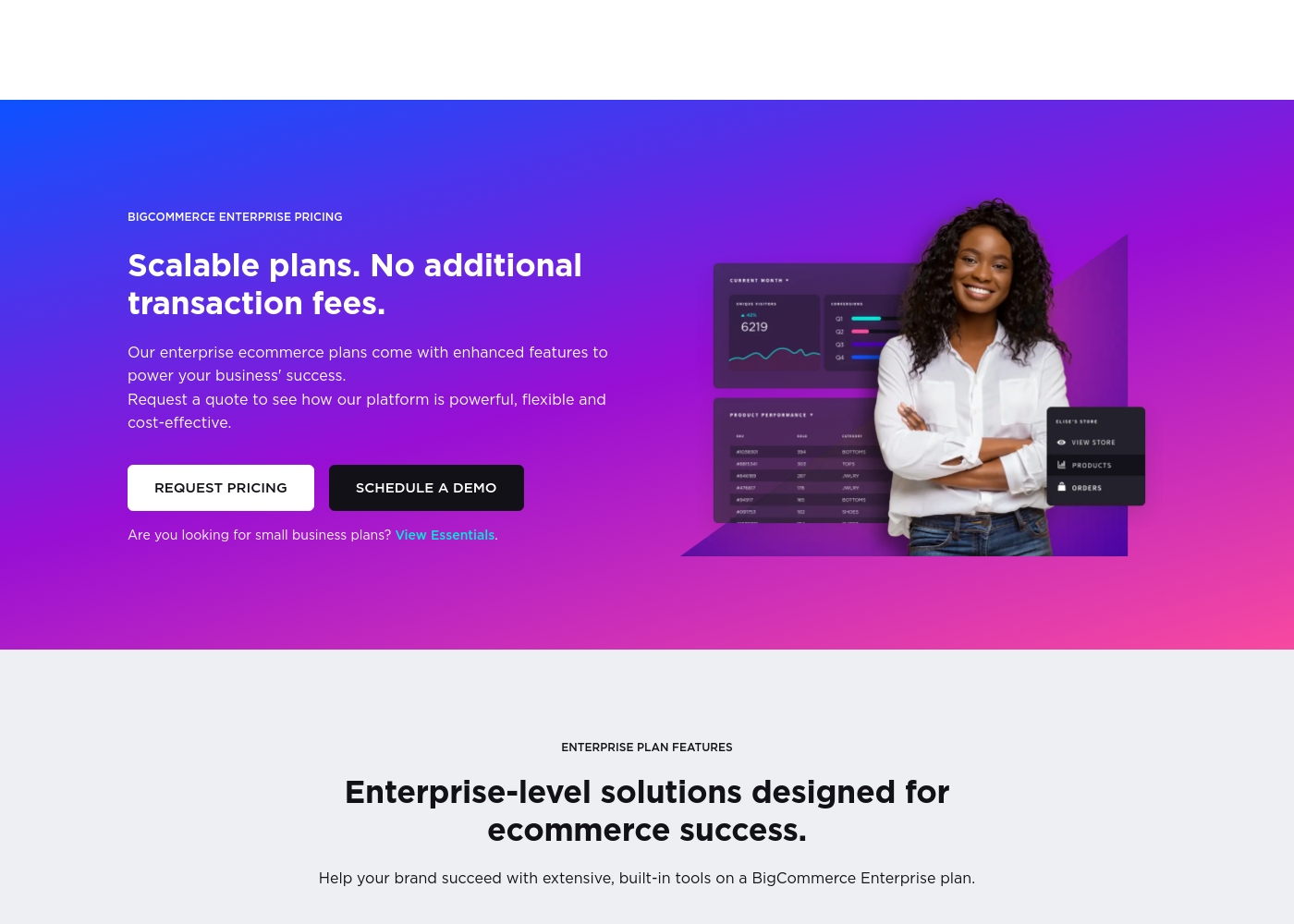
Since pricing for the most scalable options is custom, the UI requests a quote. The detailed information below relates specifically to the features included in the Enterprise service level. If you are looking for small business solutions, BigCommerce points you toward their Essentials plans.
Enterprise
Price: Request a quote Websites Supported: Multiple (via Multi-Storefront feature) Best For: Ecommerce success for mid-market and enterprise brands Other Features:
- No additional transaction fees (0%)
- Unlimited staff accounts and API calls
- 24/7 priority support (phone, chat, and ticket)
- Multi-currency support and Price lists
- Migration assistance
The Enterprise plan is tailored for large-scale operations that require maximum performance and flexibility. You benefit from highly specific features like comprehensive migration assistance and fully customizable checkout options. This plan ensures your operations run smoothly, offering robust security standards and dedicated customer success management.
- 0% additional transaction fees
- Unlimited staff accounts
- 24/7 priority support
- Multi-Storefront access
- Unlimited API calls
- Start free trial available
- Ecommerce for Growing Brands
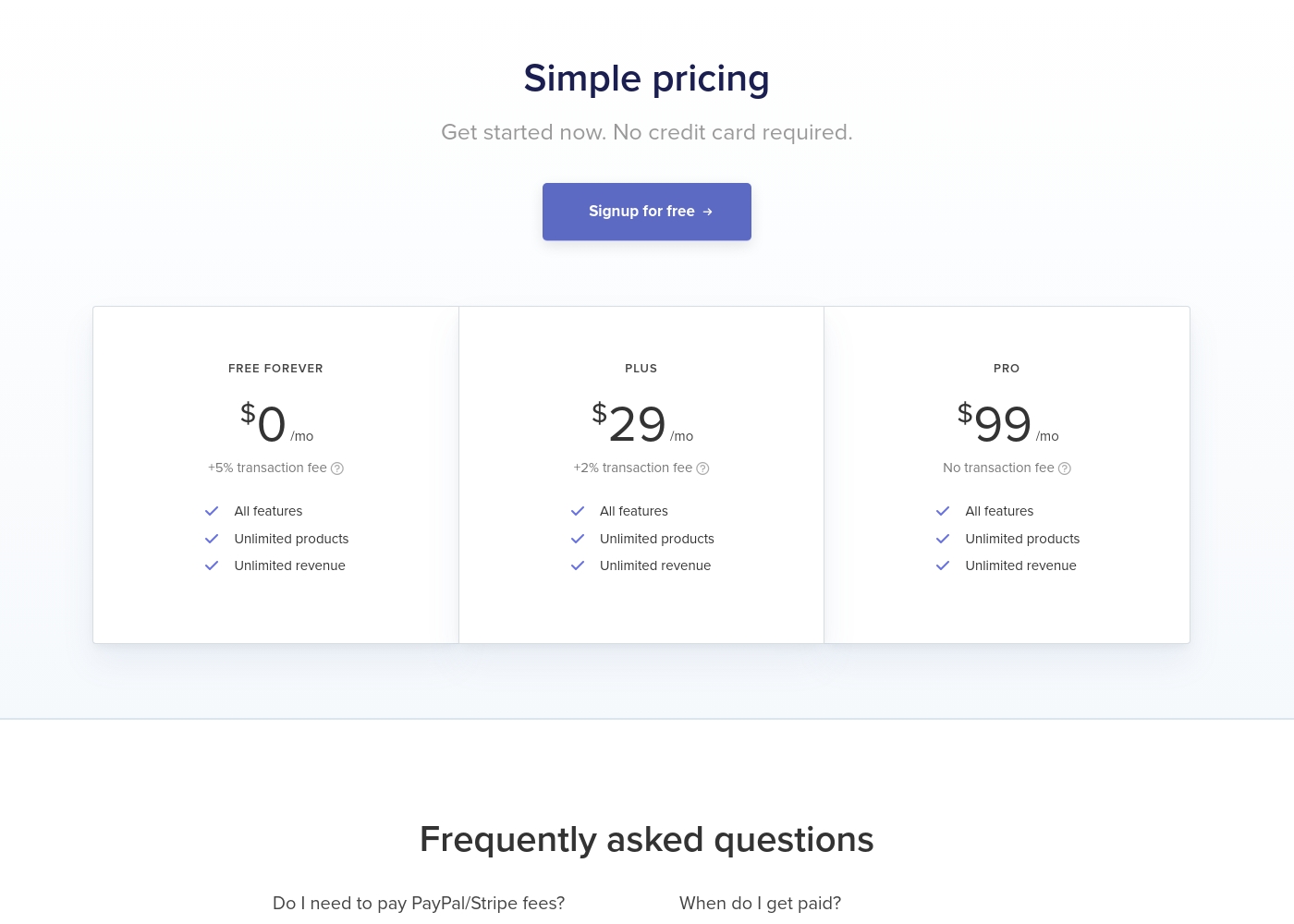
Payhip costs between $0 and $99 per month with three plans: Free Forever at $0/month, Plus at $29/month, and Pro at $99/month.
Here are the details for each tier available through Payhip's simple pricing structure.
Free Forever
Price: $0/mo Best For: Creators starting out Other Features:
- 5% transaction fee
- All features included
- Unlimited products
- Unlimited revenue
- All features
- Unlimited products
- Unlimited revenue
- All features
- Unlimited products
- Unlimited revenue
- All features
- Unlimited products
- Unlimited revenue
Pricing Notes
- BigCommerce uses a custom quote model for its top-tier Enterprise plan, which guarantees 0% platform transaction fees.
- Payhip is transparent, offering a permanent Free Forever plan with all features enabled (5% platform fee).
- Payhip's monthly subscription tiers ($29 and $99) exist primarily to reduce or eliminate the platform transaction fee.
- BigCommerce’s high-cost tiers unlock critical enterprise features like Multi-Storefront management and unlimited staff accounts.
- Both BigCommerce and Payhip require users to pay standard third-party payment processor fees (Stripe/PayPal) on all transactions.
Pricing Head-to-Head
User Reviews
User reviews for BigCommerce show a sharp division in experience, reflected by the low Trustpilot score (1.4). While some users find the platform intuitive and highly customizable compared to standard competitors, the dominant sentiment focuses on major technical and support failures.
Recurring complaints highlight unexpected and significant unreliability issues, with multiple reports of severe, multi-hour server outages. Furthermore, customer service is frequently described as the "worst," often failing to solve problems or responding with indifference, even for Enterprise customers.
I am on the enterprise plan and the support is completely non-existent. This platform has simply been an absolute disaster, wasting both time and money for our business. I would strongly advise others to stay away from it.
Payhip receives exceptional feedback for its comprehensive and user-friendly platform, consistently praised across hundreds of reviews. A key draw is the transparent and affordable pricing structure, particularly the powerful Free Forever plan, which allows new creators to start selling digital products without a significant monthly subscription burden.
Users frequently commend the platform's ease of use and simple setup, noting that customization is straightforward and quick, making the onboarding process effortless. However, the most universally lauded aspect is the customer support.
This is a great resource for people entering the online business space with digital products. The platform is well designed, remarkably user friendly, and immediate to launch. The variety of page templates makes getting started really simple and stress-free.
Our Verdict
This comparison is a clear choice based purely on your business goals and size. BigCommerce and Payhip serve radically different ends of the e-commerce spectrum. You should decide if you are a large, scaling retailer or an independent digital entrepreneur. Both platforms are excellent, but they optimize for distinct priorities. BigCommerce is the champion of high-volume, complex e-commerce operations. It offers guaranteed 99.99% uptime, which is crucial during peak sales events like Cyber Week. BigCommerce includes superior B2B tools like customer groups and dedicated price lists. Enterprise clients benefit dramatically from powerful multi-storefront management capabilities. If you need serious, future-proof infrastructure, BigCommerce delivers technical muscle. However, Payhip is the perfect solution for digital creators and knowledge entrepreneurs. Its simplicity is truly unmatched; you can start selling immediately on the Free Forever plan. Payhip includes native, core features for courses, memberships, and coaching, which BigCommerce lacks built-in. Plus, Payhip takes the headache out of complex global digital tax compliance automatically. The critical difference hinges on operational complexity versus sheer ease of use. Choose BigCommerce if you are a scaling brand needing powerful B2B features and deep catalog management. Choose Payhip if you want an easy, all-in-one system focused specifically and expertly on selling digital products. Final Verdict: If you are a beginner or a creator, Payhip offers the clearest, low-risk path to profitability immediately. If your business is already doing high-volume sales and requires robust enterprise reliability, then BigCommerce provides the necessary infrastructure.
Frequently Asked Questions
Which is easier for selling online courses, Payhip or BigCommerce?
Payhip is built specifically for digital creators and includes native tools for courses. Payhip also handles memberships and coaching sessions natively. BigCommerce requires substantial third-party apps for similar specialized functionality.
Does BigCommerce offer a permanent free plan like Payhip?
Payhip features a very generous Free Forever plan with all selling features included. BigCommerce offers a free trial period for the Essentials plan. BigCommerce does not offer a permanent, ongoing free tier.
How does customer service compare between BigCommerce and Payhip?
Payhip receives phenomenal reviews for having responsive and knowledgeable 24/7 support. BigCommerce users frequently report its 24/7 support is poor or unhelpful. For reliable support, Payhip is the clear winner.
Which platform is better for serious scaling: BigCommerce or Payhip?
BigCommerce is engineered for massive enterprise scale and B2B flexibility. It backs this with a 99.99% uptime guarantee. Payhip scales well for creators but lacks this mission-critical enterprise infrastructure.
How do the transaction fees differ between BigCommerce and Payhip?
BigCommerce Enterprise clients pay 0% platform transaction fees. Payhip sellers can reach 0% fees on the $99/month Pro plan but start at 5% on the Free Forever tier. Both still charge standard payment processor fees.
Can BigCommerce handle multiple brands or stores?
Yes, BigCommerce offers Multi-Storefront access specifically for Enterprise clients. This allows managing several brands from one central backend. Payhip is designed primarily for single-brand selling.
Ready to Choose?
Both tools have their strengths. Choose based on your specific needs.