BigCommerce vs Etsy
BigCommerce and Etsy represent two entirely different paths to selling online successfully. BigCommerce provides a powerful, scalable standalone platform for serious, growing brands. Etsy offers an instant marketplace specifically for unique, handmade, or vintage items. The core decision is trading full site control versus accessing a massive, built-in audience.
Best for: Brands needing 99.99% uptime for peak season reliability, Mid-market businesses selling high-volume, standardized products globally
Best for: Solo entrepreneurs selling unique, handmade goods or vintage items, Sellers prioritizing immediate access to a massive existing search audience
Robust tools meet customer service disconnect.
We observe BigCommerce heavily emphasizing high-level enterprise tools, like guaranteed 0% transaction fees and robust infrastructure for scalability. However, user reviews detail severe service issues, including unexpected server outages and deeply unresponsive customer support, even for priority users. Overall, BigCommerce provides impressive technical capability that is unfortunately undermined by inconsistent stability and poor customer experience.
Pros
- Guaranteed 0% transaction fees on the Enterprise plan.
- High reliability with 99.99% reported uptime.
- Industry-leading optimized one-page checkout available.
- Customizable, non-cookie cutter themes compared to competitors.
Cons
- Customer service is frequently reported as unhelpful, non-existent, or indifferent.
- Specific users mention significant, unexpected server downtime (e.g., 25-hour outages).
- Platform infrastructure (CMS, blog system) reportedly struggles with SEO and formatting.
- Essential features like product filters are locked behind high-tier plans.
Unique finds, operational headaches.
We recognize Etsy’s powerful concept of offering unique, handmade goods and strong personalization options. However, external reviews reveal chronic operational issues, particularly concerning system stability and customer care responsiveness. Overall, the platform’s valuable market niche is severely undermined by widespread failures impacting key reliability factors for both buyers and sellers.
Pros
- Access to a vast selection of unique, handmade, and vintage items.
- Enables strong product personalization (engraving, embroidery).
- Pricing model uses low listing fees rather than mandatory monthly subscriptions.
- Effective platform for supporting independent and small businesses.
Cons
- Customer support is widely reported as unhelpful, inadequate, or entirely nonexistent.
- Both buyer and seller accounts are frequently suspended without clear reason or explanation.
- High incidence of misleading product listings and scam sellers (poor accuracy).
- Widespread reliability issues concerning delivery, shipping delays, and faulty tracking.
AboutBigCommerce
BigCommerce Essentials is a top-rated ecommerce platform designed specifically for fast-growing businesses, including high-volume operations and B2B SMBs. It operates as a high-performance platform that truly scales with you. Built-in flexibility means you have the freedom to customize your store and save money at the same time. You get robust features that ensure efficient operation, allowing you to focus on expanding your brand and attracting more shoppers. ✅
AboutEtsy
Etsy is a vibrant online marketplace dedicated to all things distinctive and handmade or vintage. It is where you find items beyond the typical store purchase, ensuring your shopping feels personal. This destination is perfect for shoppers looking for original items, spanning from mugs and home goods to jewellery and apparel. Etsy focuses on delivering gifts as special as the recipient, prioritizing unique craftsmanship. It's a great place to discover essential items tailored to specific hobbies too. 💡
Highlights
Feature Comparison
Features Overview
We highlight the main differences and pick a winner for each feature.
Scalability & B2B Tools
BigCommerce is built for large operations; Etsy serves the unique, small-scale seller.
BigCommerce provides robust tools necessary for serious growth and expansion. Features include Multi-Storefront management from a single, centralized back-end dashboard. It also offers advanced B2B tools like customer groups and tailored price lists for wholesale. Etsy's infrastructure is not designed for complex, high-volume operational scale. Sellers who scale significantly risk complex challenges and eventually face mandatory external advertising fees. It better suits sellers focused solely on B2C individual transactions. If you plan to enter B2B, wholesale, or operate multiple sites, BigCommerce is the superior, professional choice. Etsy forces high volume sellers into high percentage fees with limited infrastructure support. BigCommerce ensures your platform won't limit your brand's future ambitions or growth plans.
Platform Reliability
BigCommerce guarantees near-perfect uptime; Etsy sellers report severe instability.
BigCommerce guarantees best-in-class 99.99% operational uptime throughout the year. They reported maintaining 100% uptime during the critical Cyber Week period for ten consecutive years. This extreme reliability prevents huge revenue losses during the busiest periods. Etsy users frequently report frustrating technical failures during key operations like payment processing or checkout. Arbitrary account suspensions are also widespread and represent a major stability threat to sellers. Etsy exposes sellers to significant technical operational vulnerability. This difference is stark: BigCommerce offers enterprise-grade stability you can trust. Etsy's noted instability makes relying on it for high-volume sales risky. Selling high volume requires BigCommerce's stable foundation.
Product Niche Focus
Etsy has a ready-made audience for unique products; BigCommerce is for general scale.
The Etsy platform thrives on its specific mandate for unique, handmade, or vintage items only. This focus ensures creators connect instantly with millions of motivated, niche buyers. Buyers actively search Etsy for customized and personalized items. BigCommerce accommodates all product types and focuses instead on providing robust tools for high-volume sales. It is ideal for standardized inventory that requires strong API integration and high transaction throughput. The brand must generate its own traffic. If your product is one-of-a-kind, vintage, or needs heavy customization, Etsy is the immediate fit. If you sell bulk, standardized products, BigCommerce is the correct e-commerce host. The right environment depends entirely on the inventory type you carry.
Store Customization
BigCommerce provides total site control; Etsy keeps you locked inside their template.
BigCommerce grants full sovereignty over your store's design and features. Users can customize themes, utilize a drag-and-drop Page Builder, and even go headless. This flexibility allows for truly unique, branded storefronts. Etsy sellers operate within a defined, uniform marketplace structure mandated by the platform. Branding is limited primarily to your shop name and limited visual elements. The overall look and feel mirror the rest of the marketplace. If brand differentiation is critical to your growth strategy, BigCommerce is necessary. Etsy provides brand recognition through its own marketplace visibility, not through site design control. BigCommerce allows you to own 100% of the customer experience.
Transaction Fees
BigCommerce offers 0% added fees at scale; Etsy applies a high mandatory percentage fee.
BigCommerce Enterprise clients benefit from guaranteed 0% additional transaction fees on sales. You only pay competitive rates imposed by your preferred third-party payment providers (55+ options). This maximizes profit retention during peak sales volume. Etsy charges a mandatory 6.5% transaction fee on the total sale price, including shipping costs. Sellers must then pay an additional 3% + $0.25 payment processing fee. This high percentage cuts into margins significantly. Scaling revenue rapidly on BigCommerce leads to fee-based efficiencies and higher retained profit. Scaling on Etsy means handing over substantial, non-negotiable cuts to the platform. BigCommerce is better designed for high-margin execution.
Customer Support
BigCommerce provides reliable live support; Etsy support is notoriously unresponsive.
BigCommerce offers reliable 24/7 live, US-based support via phone, chat, and ticket for all growing brands. Enterprise customers receive dedicated priority support and expert migration assistance. Launch Coaches are also available for setup help. Etsy users consistently cite customer support as inadequate, generic, or totally non-existent in reviews. Sellers report critical issues, like unexplained account suspensions, receiving only automated, useless replies. The support system is a major failure point. If operational stability and swift resolution of critical errors are important, BigCommerce is the only viable option. You cannot rely on Etsy support to save you when things go wrong. BigCommerce takes professional support seriously.
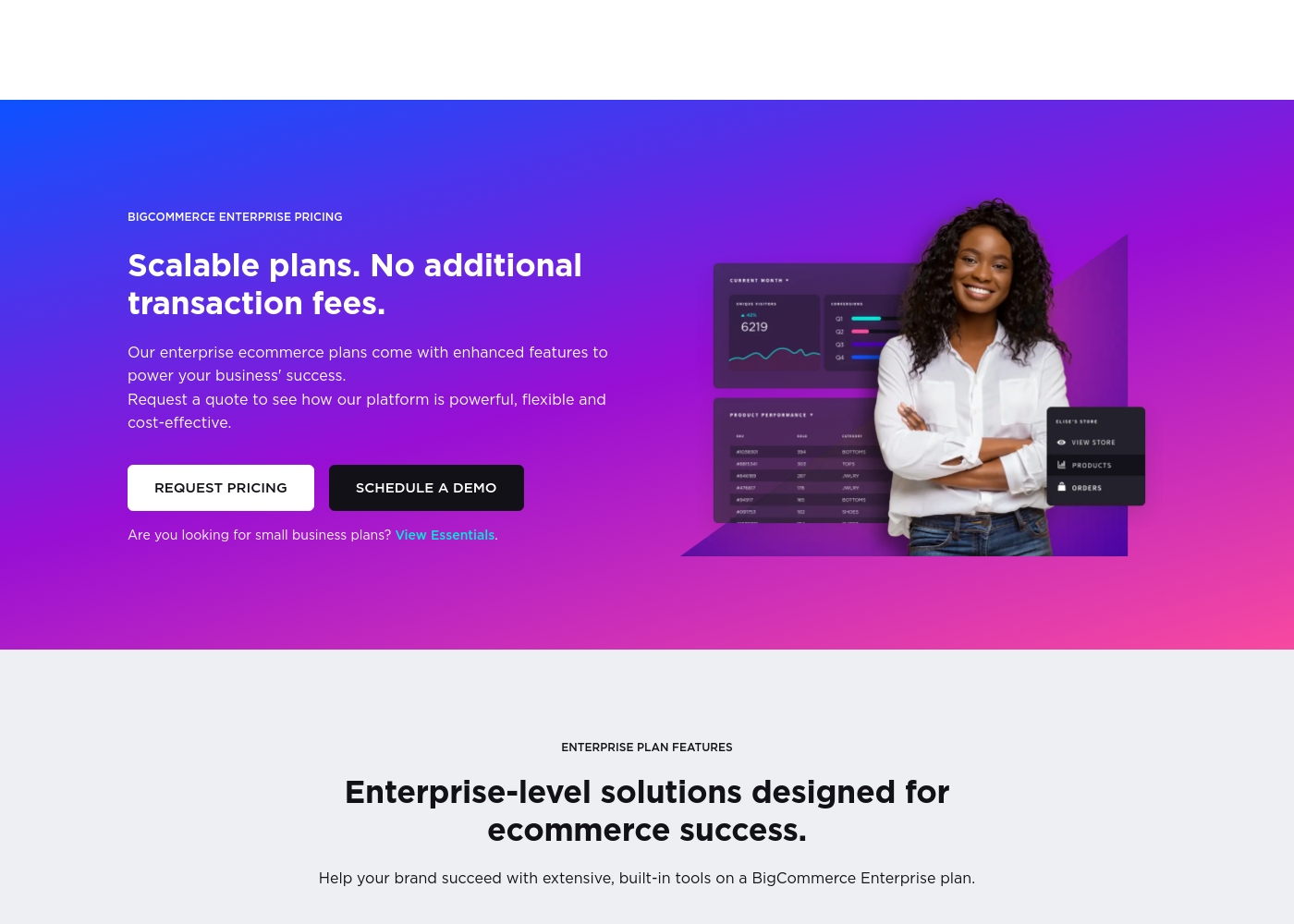
Since pricing for the most scalable options is custom, the UI requests a quote. The detailed information below relates specifically to the features included in the Enterprise service level. If you are looking for small business solutions, BigCommerce points you toward their Essentials plans.
Enterprise
Price: Request a quote Websites Supported: Multiple (via Multi-Storefront feature) Best For: Ecommerce success for mid-market and enterprise brands Other Features:
- No additional transaction fees (0%)
- Unlimited staff accounts and API calls
- 24/7 priority support (phone, chat, and ticket)
- Multi-currency support and Price lists
- Migration assistance
The Enterprise plan is tailored for large-scale operations that require maximum performance and flexibility. You benefit from highly specific features like comprehensive migration assistance and fully customizable checkout options. This plan ensures your operations run smoothly, offering robust security standards and dedicated customer success management.
- 0% additional transaction fees
- Unlimited staff accounts
- 24/7 priority support
- Multi-Storefront access
- Unlimited API calls
- Start free trial available
- Ecommerce for Growing Brands
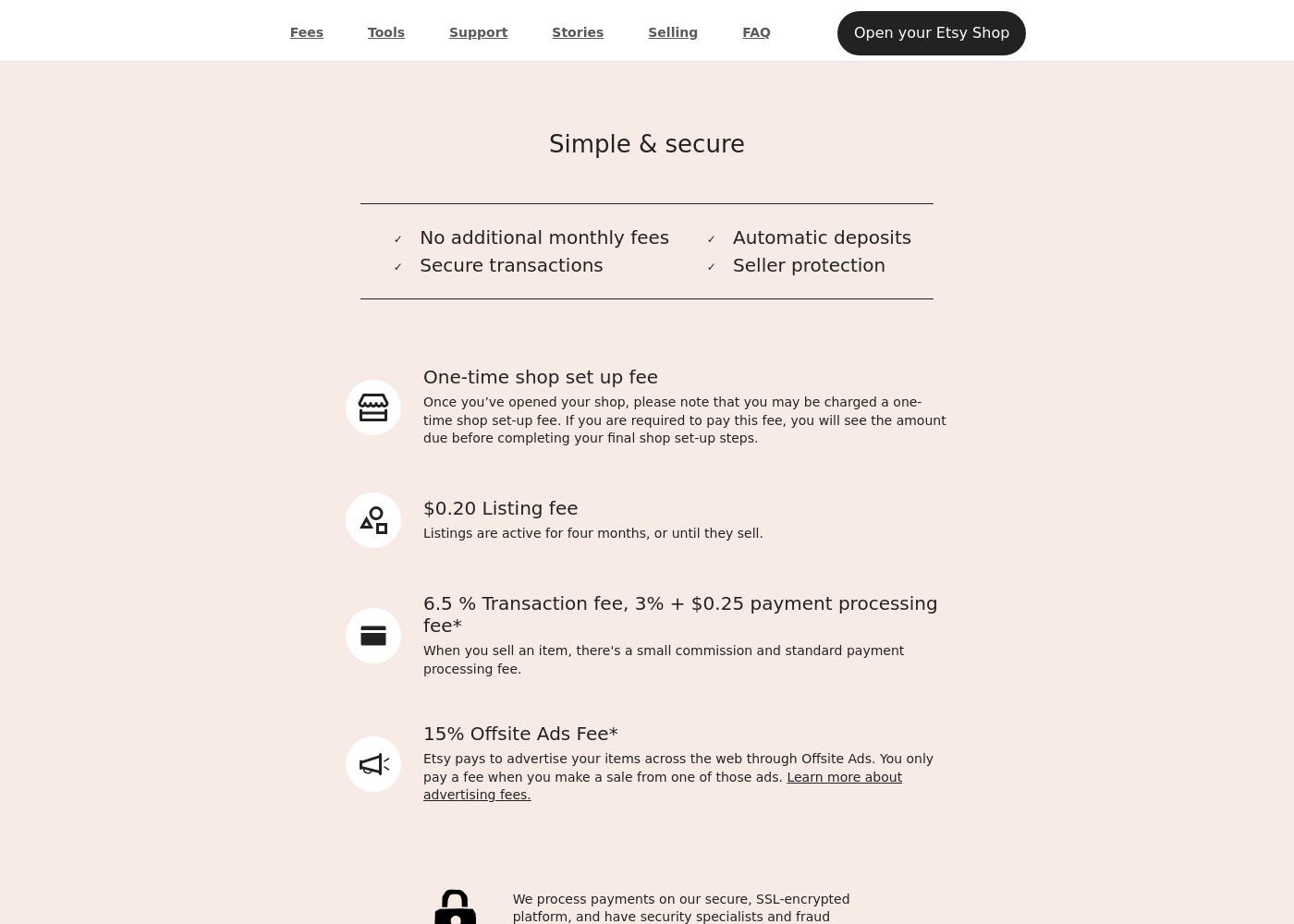
Etsy costs primarily involve fees when you list items or make a sale, with no mandatory additional monthly fees. The minimum fixed fee is $0.20 per listing, and transaction fees start at 6.5% plus a payment processing fee.
To understand how selling on Etsy works, we break down the necessary fees you should expect when setting up your shop and selling products.
Listing Fee
Price: $0.20 per listing Best For: All sellers who want to publish items on the platform Other Features:
- Listings are active for four months
- Fee applies until the item sells
- $0.20 USD per listing
- Active for four months or until sold
- Required to publish item
- 6.5% Transaction fee on sale price
- 3% + $0.25 Payment processing fee
- Only paid upon successful sale
- 15% fee when a sale is generated by an ad
- Etsy handles advertising on major external sites
- Optional for most sellers
Pricing Notes
- BigCommerce Enterprise guarantees 0% additional transaction fees, maximizing profit retention for large volumes.
- Etsy operates on performance-based fees, charging a minimum 6.5% transaction fee plus a payment processing fee on sales.
- BigCommerce offers a free trial for Essentials plans but requires negotiation via quote for Enterprise pricing.
- Etsy sellers who pass a sales threshold are subject to a mandatory 15% Offsite Ads fee, greatly impacting margins.
Pricing Head-to-Head
User Reviews
User reviews for BigCommerce show a sharp division in experience, reflected by the low Trustpilot score (1.4). While some users find the platform intuitive and highly customizable compared to standard competitors, the dominant sentiment focuses on major technical and support failures.
Recurring complaints highlight unexpected and significant unreliability issues, with multiple reports of severe, multi-hour server outages. Furthermore, customer service is frequently described as the "worst," often failing to solve problems or responding with indifference, even for Enterprise customers.
I am on the enterprise plan and the support is completely non-existent. This platform has simply been an absolute disaster, wasting both time and money for our business. I would strongly advise others to stay away from it.
The public sentiment regarding Etsy is highly critical, ranking extremely low with a multitude of negative experiences reported by both buyers and sellers. While the core idea of supporting independent creators is valued, the platform’s execution is consistently criticized.
A major theme is the failure of support responsiveness: users find customer service unhelpful, inaccessible, and often described as providing only generic responses. Reliability is another significant issue; many buyers report items arriving late, tracking numbers failing, or not receiving their purchases at all.
My account was permanently banned for absolutely no reason, and they will not specify why. I tried contacting support repeatedly about the suspension, but I only received generic, unhelpful messages in return. It’s frustrating.
Our Verdict
BigCommerce and Etsy aren't true competitors; they serve radically different parts of e-commerce. Choosing between them is simple: do you prioritize full control or built-in shoppers? BigCommerce is the clear choice if you are building a proper brand destined for rapid, industrial scale. Its enterprise-grade infrastructure guarantees reliable 99.99% uptime, even during Black Friday demand. Etsy is absolutely perfect for selling one-of-a-kind art or vintage items right now, leveraging a huge marketplace audience. BigCommerce’s superpower is its robust, professional, enterprise-grade backbone and scalability features. It provides powerful B2B tools and allows central management of multiple retail storefronts efficiently. The Enterprise option even guarantees 0% additional transaction fees, maximizing retained profit as sales revenue climbs quickly. BigCommerce is built for established businesses with complex technical demands. Etsy’s superpower is its gigantic, pre-existing audience of specialized buyers. Creators can instantly list unique, personalized products and access millions of shoppers globally without spending on marketing. Its fee structure means zero mandatory monthly fees, making it incredibly cheap and fast to start. Etsy provides the lowest barrier to entry for focused product sellers and hobbyists. The deciding factor is infrastructure risk versus instant traffic. If your products are high-volume, standardized, and require absolute uptime, pick BigCommerce. If you sell unique handmade crafts and value immediate audience access, choose Etsy. Do not rely on Etsy for complex, multi-site B2B sales or massive peak traffic. Ultimately, BigCommerce offers a reliable, supportive, and professional environment for high-stakes growth and brand development. Etsy offers a vital marketplace for unique creations, despite major, reported support and reliability issues. If you need stability and scale, BigCommerce is the professional platform.
Frequently Asked Questions
Which is better for small sellers: BigCommerce or Etsy?
Etsy is likely better for small sellers of unique goods due to zero mandatory monthly fees. BigCommerce Essentials requires a subscription, which drives up initial overhead costs. Etsy lets you pay only a small fee when you list and sell an item.
Does BigCommerce guarantee uptime like Etsy?
BigCommerce guarantees 99.99% uptime and maintained 100% uptime during Cyber Week for ten years. Etsy reviews report frequent, severe technical instability issues for both buyers and sellers. BigCommerce is significantly more reliable and professionally managed.
Which platform has lower transaction fees at high volume?
BigCommerce Enterprise often offers 0% additional transaction fees, making it cheaper for high volume sellers. Etsy charges a mandatory 6.5% transaction fee plus a payment processing fee on every sale. BigCommerce provides better fee efficiency when scaling.
How does customer support compare between BigCommerce and Etsy?
BigCommerce offers dedicated, 24/7 live, US-based support channels for quick problem resolution. Etsy support is widely criticized by users as unresponsive, unhelpful, and generic across many review sites. BigCommerce clearly wins on support.
Can I manage multiple stores on both BigCommerce and Etsy?
BigCommerce supports managing multiple distinct storefronts from one centralized back-end with its Multi-Storefront feature. Etsy does not have an integrated tool for seamless multi-store management. BigCommerce provides better centralized control.
Is one platform easier to set up a shop than the other?
Etsy is generally easier due to its quick, marketplace-driven interface and minimal technical requirements. BigCommerce demands more upfront effort in store design, configuration, and traffic generation for a standalone site.
Ready to Choose?
Both tools have their strengths. Choose based on your specific needs.