Benchmark Email vs Cakemail
Benchmark Email and Cakemail serve very different masters in the email platform space. Benchmark Email focuses on effortless, AI-driven campaign design and simplicity for marketers. Cakemail aims for developers who require deep API expertise and embedded email functionality. The key difference is polish and ease-of-use versus specialized technical integration.
Best for: Small marketing teams needing fast, branded campaign creation, Users who prioritize integrated lead capture tools (Forms, Landing Pages)
Best for: Developers seeking robust Email APIs for customized infrastructure, SaaS companies needing to embed email functionality directly into their product offerings
Simple interface, solid support, mixed reliability.
We recognize Benchmark Email for its highly intuitive user interface and excellent technical support staff, noting they make complex setup tasks manageable. Overall, while the usability is strong across all plans, the documented issues surrounding email reliability for large sends and inconsistent feedback resolution slightly reduce our final rating.
Pros
- Intuitive, user-friendly web interface and email builder.
- Responsive and high-quality technical support, including assistance with API.
- Flexible editor supporting both drag-and-drop and direct HTML code.
- Permanent $0 Free plan is available for users with small contact lists.
Cons
- Reported issues with email deliverability, especially on large mailing lists.
- Customer support inconsistently responds to delivery failure complaints.
- Concerns regarding strict policy enforcement leading to sudden account termination.
Specialized Email API for Product Integration.
We assessed Cakemail based on its defined market position: an email platform designed for deep product integration, offering embedded solutions and robust APIs. The pricing is accessible, featuring a permanent Free tier and low costs for smaller lists. Overall, this is a highly specialized tool best suited for developers or companies needing to bake email functionality directly into their existing software products.
Pros
- Permanent Free plan is available for continuous use and testing.
- Specific focus on embedded email capabilities and Email API access.
- Strong integration support via Zapier connections.
- Premium plan offers unlimited users and unlimited audiences.
Cons
- Pricing scales strictly based on total contact count.
- Monthly send limits are relatively conservative for paid tiers (e.g., 7,500 sends).
- Specialized focus on API/embedded use may limit appeal for general marketing needs.
- Lack of external user reviews makes reliability and support assessment difficult.
AboutBenchmark Email
Benchmark is an email marketing platform designed for speed and usability across various industries. Whether you are a solo entrepreneur or run a non-profit, the platform helps you connect with subscribers and drive sales.
It provides core tools like the Email Builder, Landing Pages, and a Marketing CRM. This system allows you to attract more leads, manage customer relationships, and launch campaigns that are ready to delight subscribers in the inbox. 💡
AboutCakemail
Cakemail is described fundamentally as an Email Marketing Platform. It is designed for businesses looking to enhance their existing offerings. This includes integrating options like embedded email, automation, or resale products directly into their services. It supports scaling companies by providing robust capabilities such as Email APIs and dedicated Professional Services. 💡
Highlights
Feature Comparison
Features Overview
We highlight the main differences and pick a winner for each feature.
Core Audience Focus
Benchmark Email is built for marketers seeking speed and ease. Cakemail targets developers needing deep API integration.
Benchmark Email is geared toward entrepreneurs and small teams wanting simple, effective marketing communication. Benchmark Email prioritizes an intuitive interface and AI-driven campaign creation for fast results. Cakemail positions itself as a tool for powering up products with specialized, embedded email functionality. Cakemail offers advanced Email APIs for engineers building custom infrastructure. If you prioritize easy campaign building, choose Benchmark Email over Cakemail.
Design & Templates
Benchmark Email offers Smart Design AI and extensive templates. Cakemail focuses less on visual design tools.
Benchmark Email uses its Smart Design AI to build professional, branded emails in just a few clicks. This tool automatically pulls in your logos and colors for instant polish. Benchmark Email offers a large template library categorized for various industries and occasions. Cakemail emphasizes its API access, meaning the front-end email builder is not its highlighted strength. Benchmark Email is the superior choice for users who need a visually rich design experience quickly. Cakemail users might rely more on custom code or basic templates.
Integration Depth
Cakemail offers robust Email APIs for developers. Benchmark Email provides seamless, general marketing connections.
Cakemail is application-focused, prioritizing reliable, deep integration via its robust Email APIs. This capability allows businesses to embed email functionality directly into their services. Benchmark Email provides great connectivity options, working well with your existing sales and marketing ecosystem. Benchmark Email users will find integration easy via Zapier or general APIs for list syncing. If you need high-volume, custom sending logic baked into your software, Cakemail is the specialized answer.
Testing & Optimization
Benchmark Email includes specific A/B testing tools. Cakemail focuses on smarter targeting and insights.
Benchmark Email’s Pro and Enterprise plans unlock mandatory A/B testing for superior performance tuning. It also offers simplified ‘if/then’ automation sequences for tailored outreach. Cakemail offers marketing automation and performance insights delivered to your inbox. Cakemail doesn't overtly mention A/B testing as a core feature for optimizing campaign variables. Benchmark Email wins for scientific, explicit campaign testing before a major send. This allows Benchmark Email users to continuously improve results.
Team Collaboration
Cakemail offers unlimited users on its top plan. Benchmark Email requires specific features for multi-user access.
Cakemail provides maximum user flexibility, offering unlimited users on its Premium plan for $14/month (500 contacts). Cakemail supports multiple audiences even on its budget-friendly Growth plan (5 users, 3 audiences). Benchmark Email requires a plan with 1,000+ contacts to activate the Subaccounts needed for teams. For small or expanding firms where user count is important, Cakemail provides significantly better value and flexibility. Benchmark Email prioritizes contact list size over team access flexibility.
Lead Generation Tools
Benchmark Email has integrated landing pages and forms. Cakemail relies on external tools for lead capture.
Benchmark Email is designed to help users grow their lists using dedicated Landing Pages, Signup Forms, and Pop-ups. Its integrated Marketing CRM helps manage those new leads effectively. Cakemail focuses mainly on managing and segmenting existing audience lists for smarter targeting. Cakemail does not advertise its own built-in tools for physically acquiring new leads. Choose Benchmark Email if you need an all-in-one system for both lead capture and email deployment. Cakemail assumes you already have your list.
Pricing Structure
Cakemail’s paid entry price is lower. Benchmark Email offers more comprehensive features at its starting tier.
Cakemail offers the cheapest entry to a paid plan at $9/month for Growth (500 contacts). Benchmark Email’s Pro plan starts slightly higher at $13/month (annual price). Benchmark Email provides higher monthly sends (7,500) and A/B testing at its starting paid tier. Benchmark Email also provides a substantial 25% discount for registered non-profit organizations. Cakemail is better for users on a strict budget who need multiple users immediately.
Customer Review Sentiment
Benchmark Email has mixed reviews outlining reliability issues. Cakemail lacks sufficient external user data.
Benchmark Email users praise the intuitive interface and great technical support for API issues. However, critics point out serious concerns regarding deliverability failures and sudden account termination. Cakemail currently lacks substantial external user testimonials to assess real-world performance or support responsiveness. Benchmarking reliability is impossible without more Cakemail data. Both platforms allow free testing before commitment.
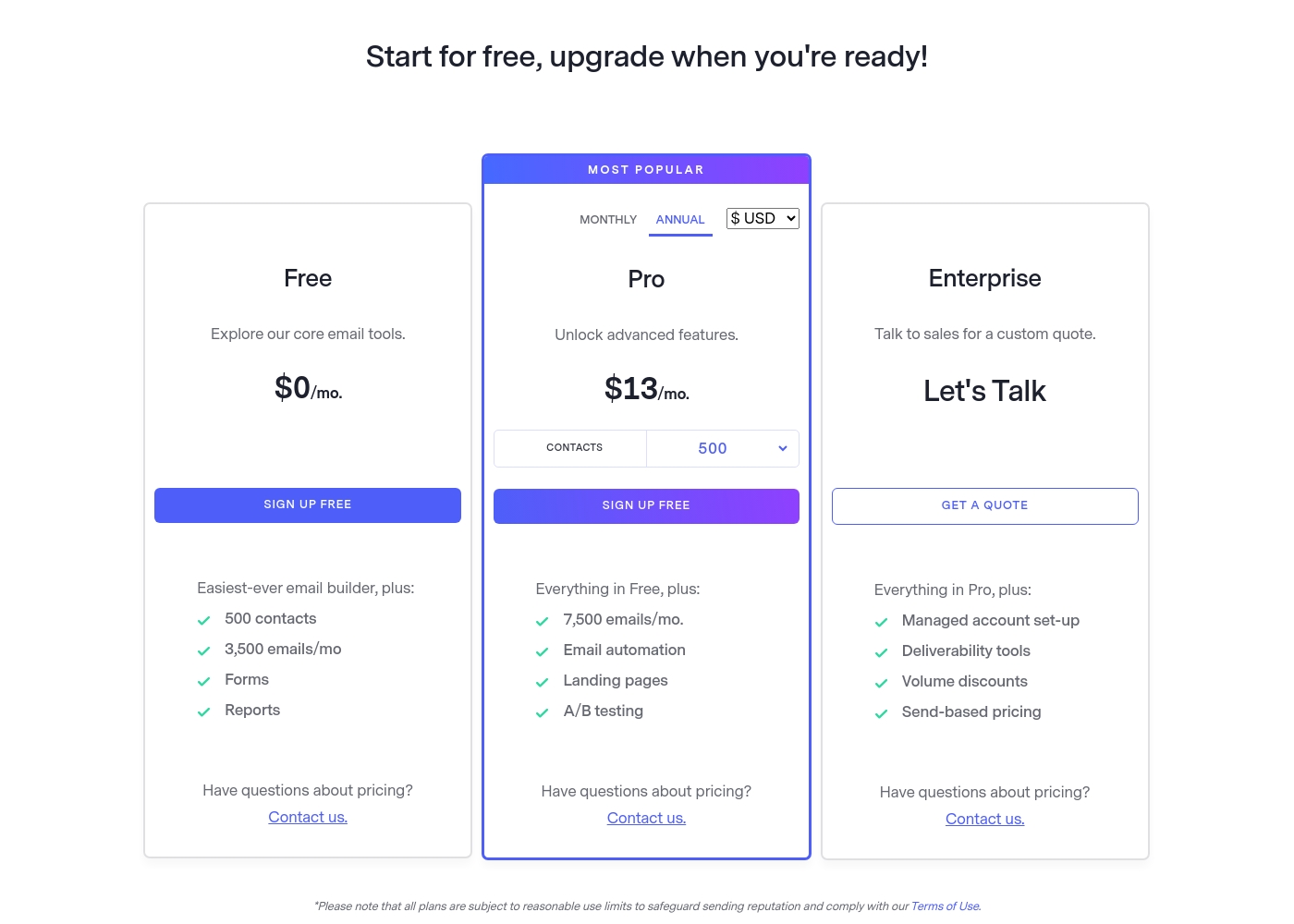
Benchmark Email costs between $0 and a custom quote per month with three main plans: Free at $0/mo, Pro starting at $13/mo (annually), and Enterprise (custom quote).
It's important to remember that prices for paid plans scale up as your contact list grows, so the initial shown prices are for the minimum contact tier.
Free
Price: $0/mo Best For: Exploring core email tools and small lists Other Features:
- The easiest-ever email builder
- Supports up to 500 contacts
- Send up to 3,500 emails per month
- Access to signup Forms and Reports
- 500 contacts
- 3,500 emails/mo
- Easiest-ever email builder
- Forms
- Reports
- 7,500 emails/mo (at 500 contacts)
- Email automation
- Landing pages
- A/B testing
- Full features from Free plan
- Managed account set-up
- Deliverability tools
- Volume discounts
- Send-based pricing
- Custom quote
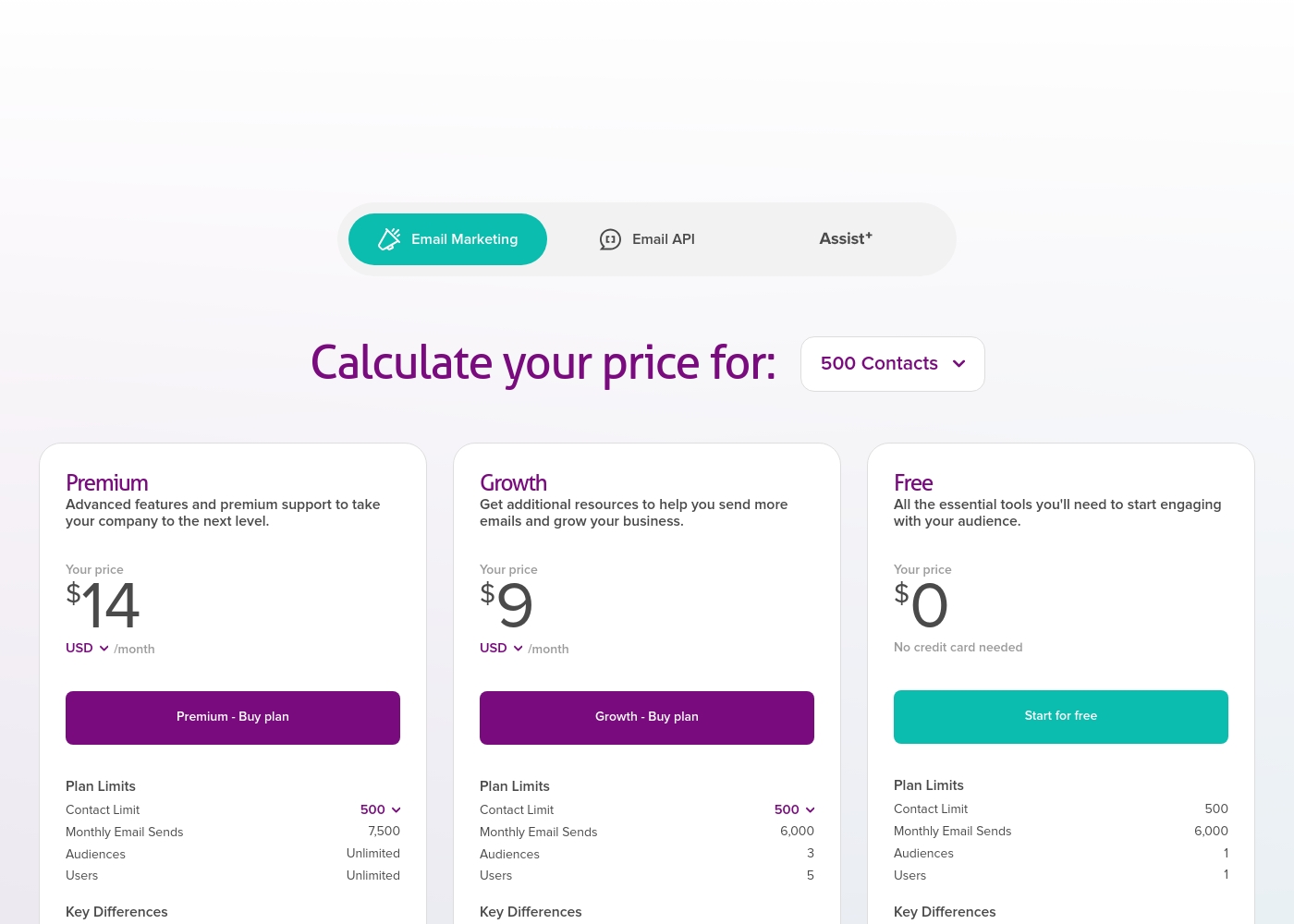
Cakemail costs between $0 and $14 per month for up to 500 contacts with three plans: Free at $0, Growth at $9, and Premium at $14.
The prices shown below are specifically for accounts managing up to 500 contacts. Prices will increase if you need higher contact limits or greater sending volumes.
Free
Price: $0 /month Best For: New businesses or teams just starting out with email marketing Other Features:
- No credit card required to sign up
- Allows 1 user and 1 audience
- 6,000 monthly email sends
- Advanced features and premium support
- Unlimited Audiences
- Unlimited Users
- Additional resources to grow your business
- 3 Audiences
- 5 Users
- Essential tools to start engaging with your audience
- 1 Audience
- 1 User
- No credit card needed
Pricing Notes
- Benchmark Email and Cakemail both offer excellent permanent Free plans for beginners and testing.
- Cakemail’s paid plans start cheaper at $9/month than Benchmark Email’s equivalent at $13/month (annual pricing).
- Benchmark Email offers a significant 25% discount specifically for registered non-profit organizations.
- Both platforms use usage-based pricing that scales up substantially as your total contact list grows.
- Benchmark Email offers custom 'Send-based pricing' under its Enterprise plan for extremely high-volume users.
Pricing Head-to-Head
User Reviews
Benchmark Email receives mixed feedback regarding its core functionality and service delivery. Users frequently praise the platform’s ease of use, noting that the web interface is super-intuitive.
They appreciate the flexibility of the drag-and-drop editor and the option for advanced HTML code editing. Technical support often gets high marks; several users report that the team provided excellent, step-by-step assistance, even helping troubleshoot complex API and endpoint integration issues.
We had immense trouble starting with the API, but the web interface is super-intuitive. Support helped us map endpoints and even showed us how to create emails this way. Now our application works exactly as we envisioned.
We currently do not have specific user feedback snippets available for Cakemail from Trustpilot or Capterra to establish recurring themes regarding user experience. Based solely on the product description, Cakemail positions itself as a platform focused on embedded email solutions for products and services, featuring robust Email APIs and Zapier integrations.
Their pricing structure is usage-based, scaling with contacts, offering a permanent Free plan alongside Growth ($9/month) and Premium ($14/month) tiers (for 500 contacts). While the tool aims to offer smarter targeting and professional services, we cannot provide concrete details on user satisfaction regarding ease of use, support responsiveness, or system reliability.
Our Verdict
If you are a working marketer, **Benchmark Email** is generally the superior choice for your needs. The comparison between Benchmark Email and Cakemail is truly a fight between usability and specialized functionality. Most general businesses should lean toward the tool focused on campaign creation. Benchmark Email is a polished platform built for speed, simplicity, and engagement optimization. Its superpower is the Smart Design AI, which instantly creates professional, perfectly branded emails. Benchmark Email includes crucial marketing tools like A/B testing and integrated landing pages for effective lead generation. If you prioritize quick campaigns and measuring results, Benchmark Email offers the fastest path. Cakemail’s superpower is robust, deep-level specialization, making it a stellar developer tool. Cakemail thrives when integrating specialized email functionality directly into an existing product using advanced APIs. Cakemail also offers unmatched value for scaling teams, allowing unlimited users on its $14/month Premium plan. The deciding factor is your primary business need: are you running external marketing campaigns or building internal infrastructure? Benchmark Email gives marketers an all-in-one suite to optimize and acquire leads. Cakemail gives developers the back-end control required for customized, embeddable email services. If you need integrated lead tools, choose Benchmark Email always. Final verdict: Pick **Benchmark Email** for ease of use, lead generation, and key optimization features like A/B testing. Choose **Cakemail** if your priority is accessing Email APIs, reselling services, or providing unlimited access to large internal teams.
Frequently Asked Questions
Which is cheaper for a small audience: Benchmark Email or Cakemail?
Both offer permanent Free plans supporting 500 contacts, which is a great start. Cakemail’s paid Growth plan begins at $9/month, slightly undercutting Benchmark Email’s Pro plan start of $13/month annually. Cakemail is marginally cheaper for the lowest paid entry point.
Does Cakemail include built-in A/B testing like Benchmark Email?
Benchmark Email explicitly includes A/B testing capabilities in its Pro and Enterprise plans for optimization. Cakemail does not prominently list A/B testing as a core feature of its plans. If optimization testing is critical, Benchmark Email is safer.
Which is better for developers focusing on product integration: Benchmark Email or Cakemail?
Cakemail is specifically designed for developers needing deep integration using robust Email APIs. Cakemail markets itself on embedded email functionality, making it ideal for product companies. Benchmark Email provides API access, but its main focus is on marketer usability.
Does Benchmark Email or Cakemail offer unlimited users?
Cakemail offers unlimited users on its Premium plan, making it ideal for agencies or large organizations. Benchmark Email requires purchasing Subaccounts, which are typically available only for users managing 1,000 or more contacts.
Is the Benchmark Email Smart Design AI feature better than Cakemail's design options?
Yes, Benchmark Email heavily features its Smart Design AI to instantly create branded, polished, and mobile-responsive emails. Cakemail focuses more on back-end functionality, providing less emphasis on automated, visual design tools. Benchmark Email simplifies the entire design process.
Does Benchmark Email offer a non-profit discount?
Yes, Benchmark Email supports non-profit organizations by offering a substantial 25% discount on its standard pricing plans. Cakemail does not explicitly advertise a similar non-profit incentive.
Ready to Choose?
Both tools have their strengths. Choose based on your specific needs.