Aweber vs Kit (formerly ConvertKit)
Aweber and Kit (formerly ConvertKit) are both email marketing platforms, but they serve different audiences. Aweber focuses on small business automation and ecommerce. Kit is built for creators who want to grow and own their audience. Let's see which fits your goals.
Best for: Small businesses needing a simple online store, Users who want pre-built automation templates
Best for: Authors and writers building a reader community, Newsletter creators focused on subscriber growth
Feature-rich, hampered by operational flaws.
We find AWeber provides a functional email marketing platform targeting small businesses with strong automation and AI tools. However, external feedback detailing unexpected billing practices and unannounced account suspensions raises significant concerns about user trust and service reliability. Overall, the reported operational and customer service drawbacks severely counteract the platform's solid feature set.
Pros
- Access to 24/7 support via phone, chat, and email (as advertised).
- Robust AI assistants available for drafting emails and refining subject lines.
- Flexible pricing tiers starting low for 500 contacts, available with a free trial.
- Unlimited features provided on the Plus plan, including automations and landing pages.
Cons
- Numerous reports of 'sneaky billing,' including charging for unsubscribed or inactive lists.
- Customer accounts or essential features often suspended without prior email notification.
- Users report significant difficulty securing refunds, even when canceling during the trial period.
- Arbitrary rejection of imported customer lists, leading to account suspension risks.
Creator-friendly, but check support.
We find Kit a capable and intuitive email marketing platform tailored specifically for creators, offering strong automation and a clean interface. Overall, it's a great starting point for growing an audience, though users should weigh the mixed customer support reviews and potential pricing scale against their needs.
Pros
- Intuitive, clean interface designed for creators and non-technical users.
- Powerful visual automations and sequences to nurture audiences.
- Generous free plan for up to 10,000 subscribers.
- Strong focus on deliverability and building owned audiences.
Cons
- Customer support responsiveness and quality receive frequent criticism.
- Pricing can become steep as subscriber counts increase significantly.
- Some users report unexpected account suspensions or deliverability issues.
- Advanced analytics and collaboration features are limited.
AboutAweber
AWeber is a dedicated email and automation solution created to support small businesses. Their goal is to provide powerful tools that help you grow at a fraction of the cost of other systems. The platform focuses on making it easy to grow your customer base and increase your total revenue. ✅
It offers ready-made, eye-catching landing pages and sign-up forms that you can effortlessly add to your website. If you're ready to sell directly, you can also set up your own online store in just minutes. This complete system is designed to take your business to the next level.
AboutKit (formerly ConvertKit)
Kit is an email marketing platform specifically for creators like authors, podcasters, YouTubers, and entrepreneurs. It's the hub for growing your email list, sending beautiful newsletters, and selling digital products—all while keeping the experience intuitive and straightforward. 💡
Highlights
Feature Comparison
Features Overview
We highlight the main differences and pick a winner for each feature.
Ease of Use
Aweber is straightforward but can feel dated. Kit is known for its clean, creator-focused interface.
Aweber provides a simple drag-and-drop editor for emails and landing pages. The interface is functional but some users find it less modern. Setup is quick with pre-built templates. Kit (formerly ConvertKit) has an intuitive, minimal interface designed for creators. It avoids clutter, making it easy to build automations without technical skills. Many users praise its simplicity. Kit wins for its modern, uncluttered design that feels purpose-built. Aweber is still easy to use, but Kit feels more polished for its target audience. If you're a creator who values a clean workspace, Kit's interface will feel like home.
Automation Power
Both offer visual automations, but Kit provides more on lower tiers.
Aweber's automation builder is robust. However, its Lite plan limits you to just 3 automations. You need the Plus plan for unlimited workflows. Kit (formerly ConvertKit) gives you unlimited visual automations starting with the Creator plan. The free Newsletter plan allows one basic automation. This is more generous than Aweber's limits. The key difference is access. Kit lets you automate more without jumping to a top-tier plan. Aweber gates unlimited power behind its Plus pricing. For a solopreneur building complex email sequences, Kit offers more flexibility sooner.
Ecommerce & Sales
Aweber is built for direct sales. Kit focuses on digital products.
Aweber has a dedicated ecommerce feature to build a simple online store. It supports one-time purchases and subscriptions in 100+ currencies. Transaction fees are 1.0% (Lite) or 0.6% (Plus). Kit (formerly ConvertKit) excels at selling digital products like ebooks, courses, and memberships. It handles checkout and delivery seamlessly. It charges a 3.5% + $0.30 fee per sale. Aweber is better for physical product sales or building a full store. Kit is optimized for creators monetizing their digital content and expertise. Choose Aweber if you sell physical goods. Choose Kit if your business is digital products.
Deliverability & Deliverability Tools
Kit leads with strong deliverability claims. Aweber's stats are less prominent.
Aweber is a established platform with generally good deliverability, but it doesn't prominently feature specific rates. Its focus is on the tools to send emails. Kit (formerly ConvertKit) publicly claims a 99.8% deliverability rate and average open rates over 40%. It provides a deliverability report on its Pro plan to help you monitor inbox placement. Kit makes deliverability a core selling point and provides tools to track it. Aweber assumes deliverability but offers less transparency. For a creator whose entire business depends on emails landing in the inbox, Kit's focus and tools provide extra peace of mind.
Pricing & Value
Kit's free plan is generous. Aweber's paid plans offer more features at entry-level.
Aweber's Lite plan starts at $12.49/month for up to 500 subscribers (annual billing). It includes limited automations and landing pages. The Plus plan is $19.99/month for unlimited features. Kit (formerly ConvertKit) offers a free Newsletter plan for up to 10,000 subscribers with basic features. The Creator plan starts at $39/month (annual) for 1,000 subscribers. It removes limits and adds support. Kit's free tier is unbeatable for beginners. Aweber's paid plans are cheaper for very small lists but become more expensive as you grow. Value depends on your list size. Kit wins for starting out; Aweber can be cheaper for small, active lists.
Customer Support
Aweber offers 24/7 support on higher plans. Kit's support gets mixed reviews.
Aweber provides 24/7 phone, chat, and email support on its Plus plan. Lite plan users get standard chat and email support. They also offer a 'Done For You' setup service. Kit (formerly ConvertKit) offers 24/7 email and chat support on all paid plans. The Pro plan gets priority support. However, user reviews often cite slow response times and unhelpful agents. Aweber's support structure is clearer with phone access on higher tiers. Kit's support is available to more users but has a poor reputation based on reviews. If direct phone support is critical, Aweber's Plus plan is the only option.
Content Creation & SEO
Kit's Recommendation feature helps grow your list. Aweber has basic SEO for landing pages.
Aweber provides basic SEO tools for its landing pages to help them get found in search engines. The focus is more on the email and automation features than content discovery. Kit (formerly ConvertKit) has a unique Recommendations feature. It connects you with other creators for cross-promotion, helping you grow your list organically. One user gained 22,000 subscribers this way. Kit offers a built-in growth channel that Aweber lacks. This is a powerful differentiator for creators in the same niche. For a writer looking to find new readers, Kit's network effects are a game-changer.
Scalability
Kit's unlimited users on Pro plan help teams scale. Aweber's scalability is subscriber-based.
Aweber's pricing and features scale with your subscriber count. Team access is limited to 3 users on the Lite plan, but the Plus plan offers unlimited seats. Kit (formerly ConvertKit) also scales pricing by subscriber count. Its Pro plan includes unlimited team members at no extra cost. This is ideal for growing teams. Both tools handle list growth well. Kit's unlimited user seats on the Pro plan give it an edge for collaborative teams. If you're building a team around your creator business, Kit's Pro plan removes a common bottleneck.
Integrations & Ecosystem
Aweber boasts more integrations. Kit's are curated for creators.
Aweber integrates with over 750 business tools like Shopify, PayPal, and WordPress. This wide ecosystem connects with almost any software you use. Kit (formerly ConvertKit) has an App Store with over 100 curated integrations. Key tools like Shopify, Canva, and Circle are featured. It also offers an API for custom builds. Aweber wins on sheer quantity and breadth of connections. Kit's integrations are more focused but essential for the creator stack. If you need to connect niche or enterprise tools, Aweber's 750+ integrations are hard to beat.
Reporting & Analytics
Kit's Pro plan offers deeper insights. Aweber's analytics are more basic.
Aweber provides simple analytics on subscriber and message performance on the Lite plan. The Plus plan adds more advanced audience insights. Kit (formerly ConvertKit) offers a dedicated Insights dashboard and deliverability reporting on its Pro plan. The lower plans have basic analytics. Kit's analytics are more advanced at the top tier. Aweber's are sufficient for basic needs but less detailed. For data-driven creators optimizing campaigns, Kit's Pro analytics provide an edge.
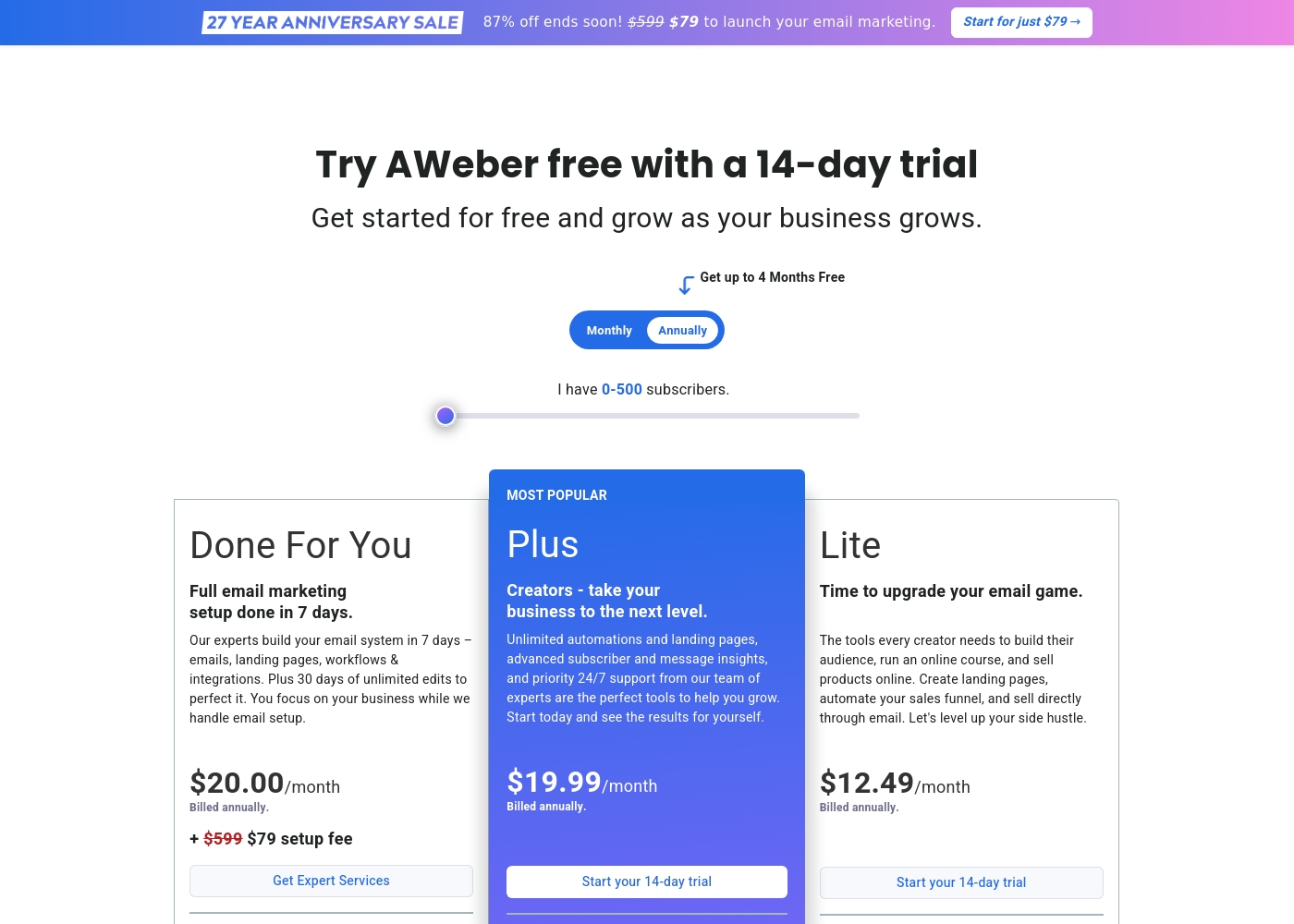
Aweber costs between $12.49/month and $20.00/month (billed annually) for 0-500 subscribers with three options: Lite at $12.49/month, Plus at $19.99/month, and Done For You at $20.00/month plus a $79 setup fee.
These pricing points reflect the annual billing option for the entry-level subscriber count. Your monthly cost will increase as your list grows beyond 500 subscribers.
Lite
Price: $12.49/month (Billed annually) Best For: Creators starting a side hustle or selling courses Other Features:
- Limited to 3 Landing pages and 3 Email automations
- 1.0% Ecommerce transaction fees
- Includes Web Push Notifications service
- Send to basic segments only
- Create landing pages, automate sales funnels, and sell directly through email
- Web Push Notifications (up to 50,000 subscribers/sends)
- Simple subscriber and message analytics
- AWeber Ecommerce (1.0% transaction fee)
- Unlimited automations and landing pages
- Advanced subscriber and message insights (analytics)
- Priority 24/7 Phone, Chat, and Email support
- Remove AWeber branding
- AWeber Ecommerce (0.6% transaction fee)
- Full email marketing setup done in 7 days by experts
- Includes emails, landing pages, workflows, and integrations built
- 30 days of unlimited edits to perfect the system
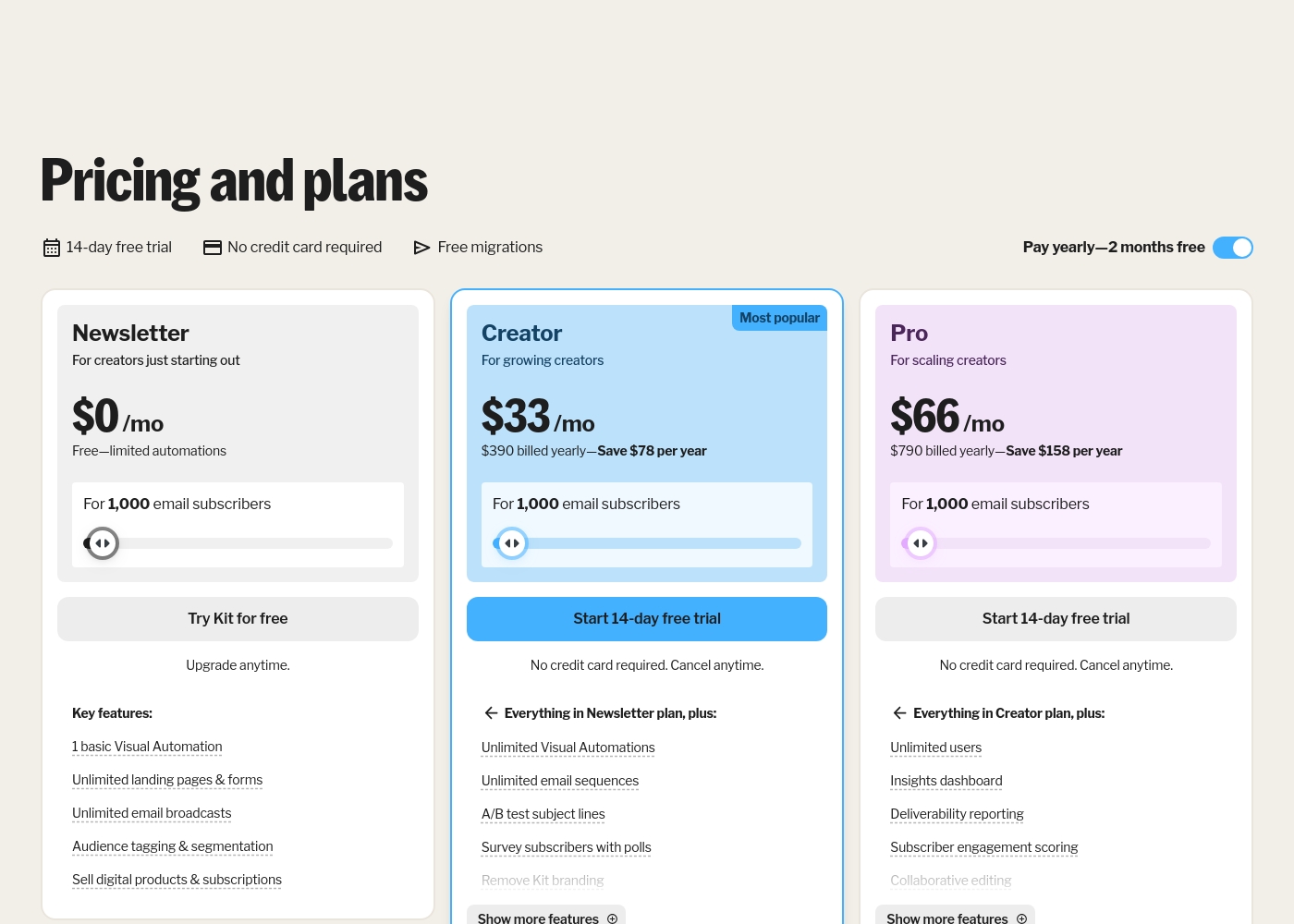
Kit (formerly ConvertKit) costs between $0 and $790 per year for 1,000 subscribers with 3 plans: Newsletter at $0, Creator at $390 billed yearly, and Pro at $790 billed yearly.
Take a look at the breakdown below to see which features fit your current creative goals.
Newsletter
Price: $0 per month Best For: New creators starting out Other Features: Unlimited landing pages, Audience tagging, Digital product sales, 1 basic Visual Automation
- 1 basic Visual Automation
- Unlimited landing pages & forms
- Unlimited email broadcasts
- Audience tagging & segmentation
- Sell digital products & subscriptions
- Everything in Newsletter plan
- Unlimited Visual Automations
- Unlimited email sequences
- A/B test subject lines
- Remove Kit branding
- Everything in Creator plan
- Unlimited users
- Insights dashboard
- Deliverability reporting
- Newsletter referral system
Pricing Notes
- Aweber's advertised prices are for up to 500 subscribers on annual billing. Costs increase with list size.
- Kit's free Newsletter plan supports up to 10,000 subscribers but lacks automation sequences.
- Aweber's Plus plan includes unlimited features but starts at $19.99/month.
- Kit's Creator plan starts at $39/month (annual) for 1,000 subscribers, making it more expensive for small paid lists.
- Both offer 14-day free trials on paid plans. Kit's trial doesn't require a credit card.
- Transaction fees differ: Aweber charges 0.6%-1.0%, while Kit charges 3.5% + $0.30 on all sales.
Pricing Head-to-Head
User Reviews
User feedback drawn from Trustpilot highlights significant issues, focusing primarily on billing transparency and account management practices. Users frequently cite instances of unexpected charges and "sneaky billing," such as being billed for unsubscribed contacts or experiencing price jumps after promotional periods ended.
Some customers reported that charges continued well after they attempted to cancel annual subscriptions. Customer support experiences are highly polarized; although AWeber advertises award-winning 24/7 service, several reviewers detail unhelpful interactions, arbitrary account suspensions (often related to list importing issues), and frustrating difficulty obtaining refunds even during specified trial periods, leading to claims of "unethical" practices.
I have been an AWeber client for a while and usually I'm quite happy with their offering. Their helpline is reliable and quick whenever I do need assistance with campaigns. This long-term relationship suggests consistent service quality has been provided.
On Trustpilot, Kit (formerly ConvertKit) receives mixed feedback. Users frequently praise its ease of use, highlighting a simple, intuitive interface perfect for creators and beginners.
Many appreciate the automation features and clean design for emails and landing pages. However, a significant number of reviews cite poor customer support, with long response times and unhelpful agents.
ConvertKit is super easy to use. I love how simple it is to set up automations and sequences without any tech headaches. It's perfect for my newsletter.
Our Verdict
This isn't a one-size-fits-all battle. Your choice between Aweber and Kit (formerly ConvertKit) depends entirely on your business model. Aweber's superpower is its all-in-one approach for small businesses. It combines email marketing with a built-in online store and over 750 integrations. If you sell physical products and need to connect lots of tools, Aweber is the plug-and-play option. Kit's superpower is its creator-focused ecosystem. It offers beautiful automations, a free plan for 10,000 subscribers, and tools like Recommendations to help you grow. It's built for writers, podcasters, and digital product creators. The deciding factor is what you sell. Choose Aweber if you're an ecommerce store or need robust phone support. Choose Kit if your main product is your content and expertise. Final verdict: For most creators, Kit is the better choice. Its free plan, intuitive design, and focus on audience ownership give you the best foundation to grow. Pick Aweber only if you need its specific ecommerce or integration features.
Frequently Asked Questions
Which is better for beginners: Aweber or Kit (formerly ConvertKit)?
Kit's free plan and intuitive interface make it ideal for beginners. You can start with up to 10,000 subscribers for free. Aweber's interface is also simple but lacks a comparable free tier.
Does Aweber have visual automations like Kit (formerly ConvertKit)?
Yes, Aweber offers a visual automation builder. However, its Lite plan limits you to just 3 automations. You need the Plus plan for unlimited workflows, unlike Kit.
Is Kit (formerly ConvertKit) worth the extra cost over Aweber for small lists?
It depends. Kit's free plan is unbeatable for lists up to 10,000. Aweber's paid plans start cheaper but gate features. For pure value on a tiny list, Kit wins.
Can I sell physical products with Kit (formerly ConvertKit) like I can with Aweber?
Kit is optimized for digital products. While possible, Aweber's dedicated ecommerce store with inventory and currency support is better suited for physical goods.
Which platform has better customer support, Aweber or Kit?
Aweber offers 24/7 phone support on its Plus plan. Kit offers email and chat on paid plans, but reviews frequently cite slow and unhelpful responses. Aweber's support is more accessible.
How do transaction fees compare when selling products through Aweber vs Kit?
Aweber charges 0.6%-1.0% transaction fees. Kit charges a flat 3.5% + $0.30 fee on all digital sales. For high-volume digital sales, Aweber's percentage fee may be lower.
Ready to Choose?
Both tools have their strengths. Choose based on your specific needs.