Aweber vs Cakemail
Aweber and Cakemail target distinct segments of the email marketing world. Aweber prioritizes simplicity, templates, and 24/7 support for small businesses. Cakemail focuses on deep technical integration via APIs and specialized embedded email solutions. The comparison hinges on whether you need a marketing tool or a developer platform.
Best for: Solo entrepreneurs and small marketing teams needing an all-in-one stack., Users who rely on 24/7 phone and chat human support for troubleshooting.
Best for: Software developers needing to embed email sending capabilities directly into an application., Companies planning to use robust Email APIs for customized infrastructure.
Feature-rich, hampered by operational flaws.
We find AWeber provides a functional email marketing platform targeting small businesses with strong automation and AI tools. However, external feedback detailing unexpected billing practices and unannounced account suspensions raises significant concerns about user trust and service reliability. Overall, the reported operational and customer service drawbacks severely counteract the platform's solid feature set.
Pros
- Access to 24/7 support via phone, chat, and email (as advertised).
- Robust AI assistants available for drafting emails and refining subject lines.
- Flexible pricing tiers starting low for 500 contacts, available with a free trial.
- Unlimited features provided on the Plus plan, including automations and landing pages.
Cons
- Numerous reports of 'sneaky billing,' including charging for unsubscribed or inactive lists.
- Customer accounts or essential features often suspended without prior email notification.
- Users report significant difficulty securing refunds, even when canceling during the trial period.
- Arbitrary rejection of imported customer lists, leading to account suspension risks.
Specialized Email API for Product Integration.
We assessed Cakemail based on its defined market position: an email platform designed for deep product integration, offering embedded solutions and robust APIs. The pricing is accessible, featuring a permanent Free tier and low costs for smaller lists. Overall, this is a highly specialized tool best suited for developers or companies needing to bake email functionality directly into their existing software products.
Pros
- Permanent Free plan is available for continuous use and testing.
- Specific focus on embedded email capabilities and Email API access.
- Strong integration support via Zapier connections.
- Premium plan offers unlimited users and unlimited audiences.
Cons
- Pricing scales strictly based on total contact count.
- Monthly send limits are relatively conservative for paid tiers (e.g., 7,500 sends).
- Specialized focus on API/embedded use may limit appeal for general marketing needs.
- Lack of external user reviews makes reliability and support assessment difficult.
AboutAweber
AWeber is a dedicated email and automation solution created to support small businesses. Their goal is to provide powerful tools that help you grow at a fraction of the cost of other systems. The platform focuses on making it easy to grow your customer base and increase your total revenue. ✅
It offers ready-made, eye-catching landing pages and sign-up forms that you can effortlessly add to your website. If you're ready to sell directly, you can also set up your own online store in just minutes. This complete system is designed to take your business to the next level.
AboutCakemail
Cakemail is described fundamentally as an Email Marketing Platform. It is designed for businesses looking to enhance their existing offerings. This includes integrating options like embedded email, automation, or resale products directly into their services. It supports scaling companies by providing robust capabilities such as Email APIs and dedicated Professional Services. 💡
Highlights
Feature Comparison
Features Overview
We highlight the main differences and pick a winner for each feature.
Core Focus & Users
Aweber is built for accessibility and marketing; Cakemail targets deep technical integration for product teams.
Aweber is built for small businesses and creators needing integrated email and landing pages. It focuses on simplicity and ease of launching campaigns quickly and efficiently. Cakemail is aimed at developers and companies needing embedded email functionalities built into their product. It prioritizes API access and technical implementation guidance. Choose Aweber for plug-and-play marketing ease and ready-made tools. Pick Cakemail if you require maximum, programmatic customization via Email APIs. This difference means Aweber is for quick campaigns, while Cakemail handles underlying email infrastructure.
Support Quality
Aweber provides 24/7 human support; Cakemail offers high-level support only on its top tier.
Aweber customers benefit from 24/7 in-house support via phone, live chat, or email specialist assistance. They also offer free migrations and 1:1 setup calls for new users. Cakemail offers 'premium support' only with its highest Premium plan subscription. Details are less clear regarding response times on their lower-tier plans. The trade-off is clear: Aweber delivers reliable, accessible human help around the clock when you need it. Cakemail relies on technical documentation unless you pay for their top tier or professional services. If fast support is critical for your small team, Aweber is the safer and more beginner-friendly choice.
API & Integration
Cakemail offers robust Email APIs for developers; Aweber relies entirely on 750+ native integrations.
Aweber boasts more than 750 native integrations, allowing connections with popular e-commerce and CRM tools instantly. This breadth works well for standard marketing stacks. Cakemail strongly emphasizes dedicated Email APIs for creating highly customized sending systems. Seamless Zapier integrations also connect Cakemail easily with existing technology stacks. Choose Aweber for broad, out-of-the-box native software connectors. Pick Cakemail if you require custom infrastructure built on top of a reliable API. Cakemail’s API focus makes it much more suitable for bespoke application development needs.
Pricing Structure
Cakemail is generally cheaper for small lists and includes unlimited users; Aweber bundles more features.
Aweber bases its pricing strictly on subscriber count, and costs can increase quickly as the list grows past the free/low tiers. Plans often limit the number of active users. Cakemail offers a highly competitive price structure, featuring a permanent free plan and unlimited users on its $14/month Premium plan (up to 500 contacts). Cakemail scales strictly by list size. Cakemail provides better immediate value and team flexibility for small lists due to the unlimited user access. Aweber's value comes from the bundled features like AI and E-commerce. If team collaboration is essential and your list is under 500, Cakemail offers superior economics for the lowest tier.
Landing Pages & Forms
Aweber includes dedicated landing page tools; Cakemail’s offering focuses on API-driven email delivery.
Aweber is built for lead generation, featuring a drag-and-drop email builder and ready-made landing pages and signup forms. This supports fast lead capture and funnel building. Cakemail does not emphasize built-in landing page tools or drag-and-drop builders. Customers are expected to integrate lead capture via Zapier or API connections. For marketers who need a complete lead generation stack in one tool, Aweber is the better option. Cakemail requires integration with third-party form providers. Small businesses needing to capture leads without extra developer effort should choose Aweber immediately.
Advanced Capabilities
Aweber supports E-commerce and AI tools; Cakemail supports product resale and embedded email integration.
Aweber offers integrated E-commerce features, allowing payment processing via Stripe and handling subscriptions, though a transaction fee applies. It also provides AI assistance. Cakemail offers specialized features like the ability to resell email marketing functionality within your own products. It focuses on embedded email capabilities for developers. The tools invest their advanced features in different areas: Aweber in marketing productivity and payments; Cakemail in technical deployment and business models (resale). If monetizing newsletters is key, Aweber's direct E-commerce feature is highly useful.
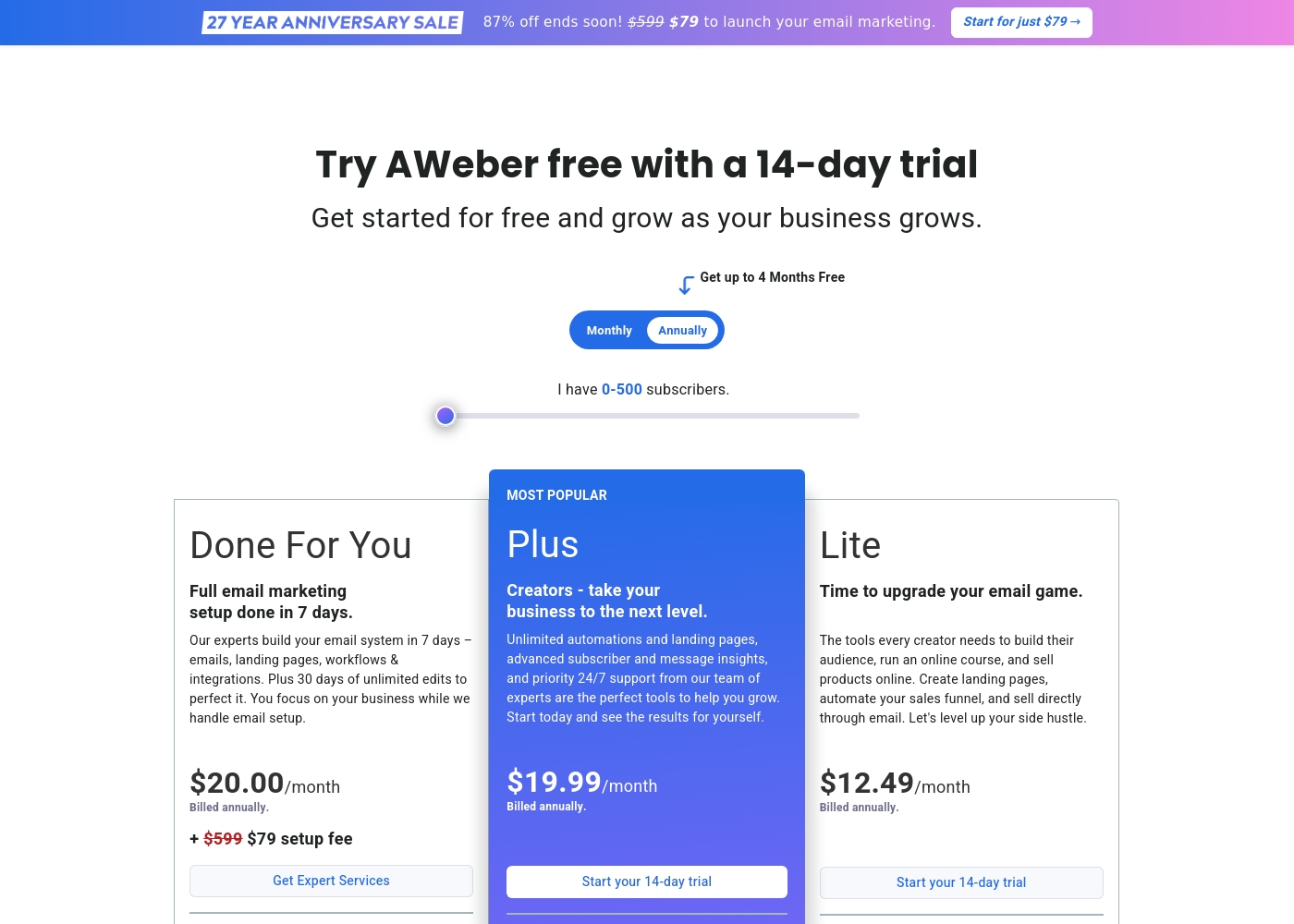
Aweber costs between $12.49/month and $20.00/month (billed annually) for 0-500 subscribers with three options: Lite at $12.49/month, Plus at $19.99/month, and Done For You at $20.00/month plus a $79 setup fee.
These pricing points reflect the annual billing option for the entry-level subscriber count. Your monthly cost will increase as your list grows beyond 500 subscribers.
Lite
Price: $12.49/month (Billed annually) Best For: Creators starting a side hustle or selling courses Other Features:
- Limited to 3 Landing pages and 3 Email automations
- 1.0% Ecommerce transaction fees
- Includes Web Push Notifications service
- Send to basic segments only
- Create landing pages, automate sales funnels, and sell directly through email
- Web Push Notifications (up to 50,000 subscribers/sends)
- Simple subscriber and message analytics
- AWeber Ecommerce (1.0% transaction fee)
- Unlimited automations and landing pages
- Advanced subscriber and message insights (analytics)
- Priority 24/7 Phone, Chat, and Email support
- Remove AWeber branding
- AWeber Ecommerce (0.6% transaction fee)
- Full email marketing setup done in 7 days by experts
- Includes emails, landing pages, workflows, and integrations built
- 30 days of unlimited edits to perfect the system
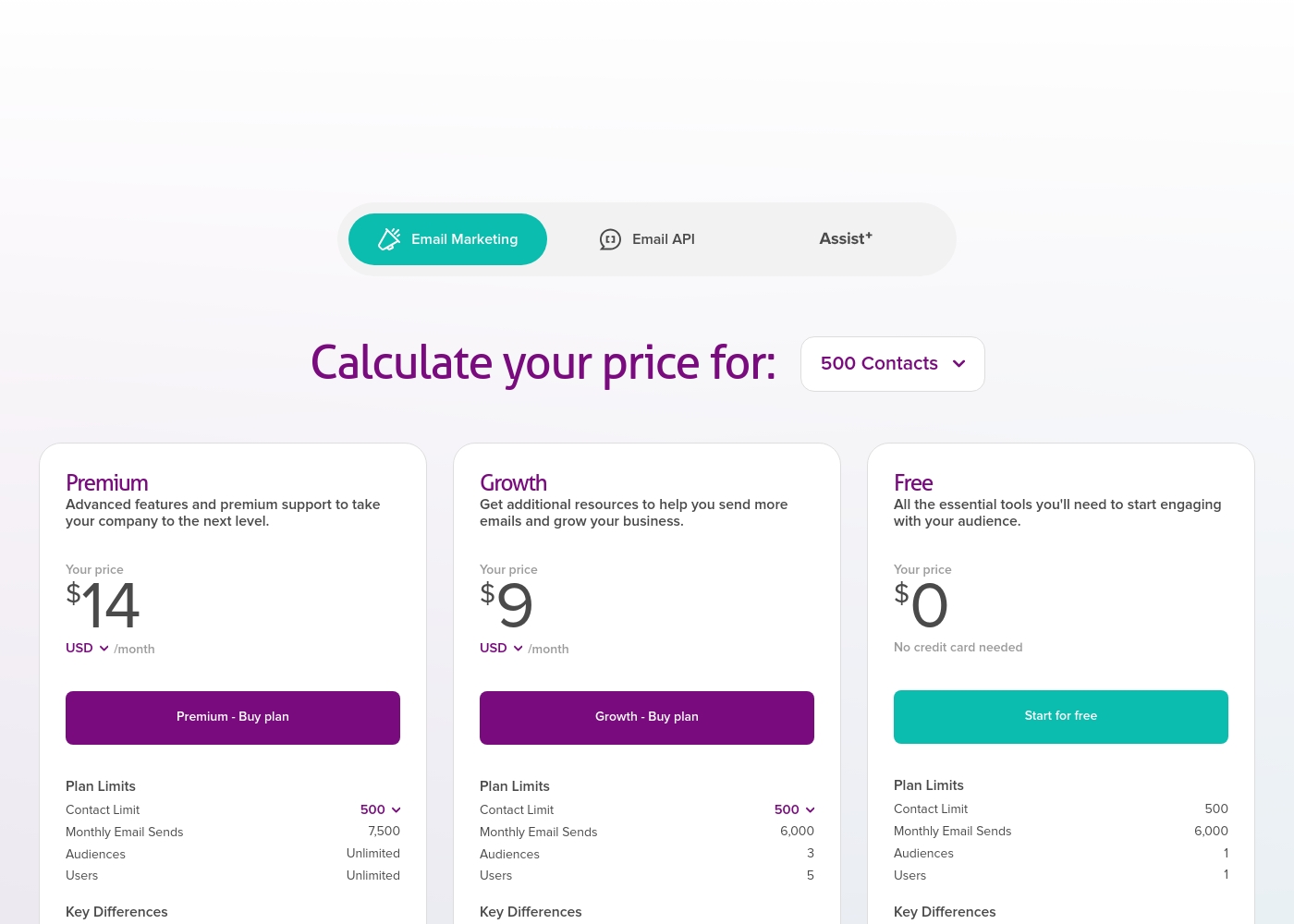
Cakemail costs between $0 and $14 per month for up to 500 contacts with three plans: Free at $0, Growth at $9, and Premium at $14.
The prices shown below are specifically for accounts managing up to 500 contacts. Prices will increase if you need higher contact limits or greater sending volumes.
Free
Price: $0 /month Best For: New businesses or teams just starting out with email marketing Other Features:
- No credit card required to sign up
- Allows 1 user and 1 audience
- 6,000 monthly email sends
- Advanced features and premium support
- Unlimited Audiences
- Unlimited Users
- Additional resources to grow your business
- 3 Audiences
- 5 Users
- Essential tools to start engaging with your audience
- 1 Audience
- 1 User
- No credit card needed
Pricing Notes
- Cakemail offers a permanent Free plan that never requires a credit card, allowing continuous testing.
- Aweber's pricing scales based on subscriber count, which can become expensive as your list grows large.
- Cakemail's Premium plan includes unlimited users and audiences, providing better team value for small mailing lists.
- Aweber facilitates E-commerce payments but charges a per-transaction fee on those sales.
- Both Aweber and Cakemail require moving to higher pricing tiers if you exceed their designated contact limits.
Pricing Head-to-Head
User Reviews
User feedback drawn from Trustpilot highlights significant issues, focusing primarily on billing transparency and account management practices. Users frequently cite instances of unexpected charges and "sneaky billing," such as being billed for unsubscribed contacts or experiencing price jumps after promotional periods ended.
Some customers reported that charges continued well after they attempted to cancel annual subscriptions. Customer support experiences are highly polarized; although AWeber advertises award-winning 24/7 service, several reviewers detail unhelpful interactions, arbitrary account suspensions (often related to list importing issues), and frustrating difficulty obtaining refunds even during specified trial periods, leading to claims of "unethical" practices.
I have been an AWeber client for a while and usually I'm quite happy with their offering. Their helpline is reliable and quick whenever I do need assistance with campaigns. This long-term relationship suggests consistent service quality has been provided.
We currently do not have specific user feedback snippets available for Cakemail from Trustpilot or Capterra to establish recurring themes regarding user experience. Based solely on the product description, Cakemail positions itself as a platform focused on embedded email solutions for products and services, featuring robust Email APIs and Zapier integrations.
Their pricing structure is usage-based, scaling with contacts, offering a permanent Free plan alongside Growth ($9/month) and Premium ($14/month) tiers (for 500 contacts). While the tool aims to offer smarter targeting and professional services, we cannot provide concrete details on user satisfaction regarding ease of use, support responsiveness, or system reliability.
Our Verdict
Choosing between Aweber and Cakemail is less about direct competition and more about focus. Aweber is the traditional marketing workhorse built for small business accessibility. Cakemail is a technical powerhouse designed to live inside another product. Aweber excels at providing a complete, ready-to-launch marketing toolkit easily. It gives small businesses templates, landing pages, and AI assistants to help them start fast. Best of all, Aweber backs this up with reassuring 24/7 in-house human support for immediate help. Cakemail’s strength lies in deep technical integration via its robust Email APIs and specialized embedded services. It offers fantastic value for small, collaborative teams with unlimited users on their Premium plan. Cakemail supports scaling needs that require customized API infrastructure. The deciding factor is simple: Do you need a complete front-end marketing stack, or do you need a powerful back-end API? If you need landing pages and AI tools for lead generation, choose Aweber immediately. Stick with Aweber if you are a solo creator seeking dependable support and rapid campaign deployment. Opt for Cakemail if your core product needs specialized, resilient email integration and you prioritize low-cost, unlimited user access.
Frequently Asked Questions
Which is better for small team collaboration: Aweber or Cakemail?
Cakemail offers better collaboration features for small teams. Its Premium plan includes unlimited user seats for a low monthly price. Aweber plans typically impose limits on the number of active users per account.
Does Cakemail support landing page creation like Aweber?
Aweber includes a dedicated drag-and-drop builder for creating both emails and landing pages. Cakemail focuses on API-driven email delivery. It does not advertise built-in landing page functionality.
Which platform offers better customer support, Aweber or Cakemail?
Aweber provides superior support, offering 24/7 in-house assistance via phone and live chat. Cakemail offers standard support, with premium options only available on its highest paid tiers.
Is Cakemail better for developers than Aweber?
Yes, Cakemail is explicitly designed for developers and product integration. It provides robust Email APIs and embedded email solutions, which is not Aweber’s primary focus.
How do the pricing models of Aweber and Cakemail compare for growing lists?
Both Aweber and Cakemail increase pricing based on your contact list size. Cakemail is very affordable for lists under 500 contacts. Aweber’s costs may increase more significantly as list numbers climb.
Can I use Aweber to handle payments and E-commerce?
Yes, Aweber includes E-commerce features that allow stripe integration for payment processing. Aweber does apply a per-transaction fee to these sales. Cakemail does not offer direct payment handling.
Ready to Choose?
Both tools have their strengths. Choose based on your specific needs.