ATLAS.ti vs NVivo
These two QDA heavyweights constantly battle for qualitative research dominance among serious academics. ATLAS.ti emphasizes AI acceleration and flexible user licensing for large teams. NVivo prioritizes academic rigor, deep comparative analysis, and structured, explicit pricing.
Best for: Institutions prioritizing maximum license efficiency across hundreds of users, Research teams requiring 24/5 specialist data expert support access
Best for: PhD candidates requiring the most cited QDA tool for maximum rigor and defensibility, Researchers performing robust comparative analysis using structured Cases and Attributes
AI-Powered QDA with Advanced Collaborative Tools
We recognize ATLAS.ti as a powerful QDA platform, offering cutting-edge AI coding tools and impressive license flexibility ideal for large teams. However, user reports detailing poor customer support and misleading free trial limitations raise critical concerns about the overall user experience. Overall, we recommend this software for institutions prioritizing advanced features and cross-platform compatibility, provided they are prepared for high-cost, non-transparent pricing and potential support challenges.
Pros
- Intentional AI Coding can reduce data analysis time by over 90%.
- Flexible 'My ATLAS.ti' licensing supports unlimited users without seat restrictions.
- Full project compatibility across Windows, Mac, and Web platforms.
- Access to 24/5 Free Live Support from specialized qualitative data experts.
Cons
- Subscription and license pricing are not publicly transparent (requires a quote).
- Customer support quality is widely reported by users as being dreadful and unhelpful.
- Misleading advertising regarding the “no functional limitations” free trial.
- Reported reliability issues with the premium AI transcription service (data loss).
Powerful QDA, Challenging User Experience
We find NVivo highly sophisticated for handling complex qualitative data at scale, which makes it an industry-leading tool favored by professional researchers and students. Overall, while the core analytical power is unmatched, we observed serious flaws in user support and initial accessibility that users must carefully consider before subscribing.
Pros
- Recognized as the leading and most cited QDA software for rigorous research.
- Integrated AI Assistant accelerates thematic coding and summary generation.
- Collaboration Cloud supports real-time teamwork across both Mac and Windows systems.
- Transcription services are automated in 43 languages, saving research time.
Cons
- Customer and IT support responsiveness is frequently reported as poor or useless.
- Onboarding and accessing the free trial process are complex and frustrating for new users.
- Specific bugs reported, including critical issues like being unable to export codes from Mac.
- Lacks necessary tooling or support for seamless corporate IT management.
AboutATLAS.ti
ATLAS.ti is a leading QDA software built for researchers demanding both flexibility and power. It provides an impressive all-in-one platform experience right out of the box.
This single package grants full access to desktop apps for Windows and Mac, plus a powerful Web version. Your projects are fully compatible regardless of the platform you use. Furthermore, you benefit from Free Live Support available 24/5 from qualitative data specialists, ensuring your analysis stays on track. ✅
AboutNVivo
NVivo is recognized as the leading and most cited qualitative data analysis software in research publications. For over 30 years, researchers have trusted it to handle complex textual and audiovisual data. We make it simple to import, organize, and explore data from many sources, including surveys, social media, and transcripts.
Whether you are a student, an individual researcher, or a large organization, there is an NVivo option tailored to your needs. It provides a secure, user-friendly interface that integrates smoothly into your entire research workflow. 💡
Highlights
Feature Comparison
Features Overview
We highlight the main differences and pick a winner for each feature.
AI Coding Efficiency
ATLAS.ti aggressively focuses on speed; NVivo focuses on structured AI results.
ATLAS.ti leverages Intentional AI Coding promising to reduce analysis time by over 90%. This uses OpenAI technology for reliable automatic data coding relief. ATLAS.ti users gain maximum control and incredible speed for heavy lifting. NVivo includes the Lumivero AI Assistant, sold as an annual add-on ($250). The AI Assistant quickly summarizes documents and suggests flexible child codes efficiently. It accelerates thematic coding and preliminary sentiment analysis for faster insight generation. While both use advanced AI, ATLAS.ti leads with the bold 90% time-saving claim. NVivo’s AI integrates more structured analysis features like sentiment categorization. For researchers prioritizing analysis throughput, ATLAS.ti delivers the faster potential solution. If you have massive interview transcripts, ATLAS.ti's AI provides the quickest path to themes.
License Flexibility
ATLAS.ti offers floating licenses; NVivo uses fixed, per-seat agreements.
ATLAS.ti uses flexible floating licenses managed through 'My ATLAS.ti' efficiency. You can share multi-user licenses widely without restrictions on specific machines. The user seat instantly re-opens for the next team member upon logoff. NVivo operates on a standard per-seat annual subscription model for individual users. For enterprise groups requiring ten or more seats, you must contact their dedicated sales team. Add-ons like Collaboration Cloud are also strictly billed per seat annually. The ATLAS.ti floating seat system vastly improves license efficiency for large institutions. NVivo’s fixed seat structure is easier to budget but less flexible for rotating research teams. ATLAS.ti maximizes license utility if you need 24/7 access spread across many rotating users. For universities, ATLAS.ti handles peak demand better because seats aren't permanently locked to specific individuals.
Academic Rigor
NVivo is the most cited tool; ATLAS.ti focuses on collaborative features.
NVivo is widely recognized as the leading and most cited QDA software in academia today. NVivo features robust data organization tools like Cases linked to Attributes. This structure enables powerful queries for highly rigorous comparative analysis of groups. ATLAS.ti supports solid research methodologies but is often touted for its speed and AI acceleration features. ATLAS.ti focuses on providing seamless cross-platform functionality for project continuity. The focus is less technical structuring and more ease of use. For PhD researchers who need to publish in high-impact journals, NVivo's proven methodology carries significant weight. The Cases and Attributes feature in NVivo directly supports defensible conclusions and statistical comparison. ATLAS.ti might be favored by applied researchers over highly rigorous academics. If your primary concern is methodological defense in a dissertation, NVivo provides a more established framework.
Pricing Transparency
NVivo lists prices openly; ATLAS.ti requires a custom quote for every license.
ATLAS.ti’s pricing is quote-based and non-transparent across all student, educational, and commercial tiers. You must request a written quote that is valid for 60 days to determine your exact cost. This opacity applies even to student licenses. NVivo offers explicit public pricing, with the base subscription starting between $130.00 and $1,005.00 depending on the license type. Its major add-ons (AI Assistant, Collaboration Cloud) are fixed annual costs. This makes budgeting much simpler. The lack of public pricing for ATLAS.ti makes initial comparisons and budgeting difficult for individuals and small teams. NVivo users know exactly how much they will pay annually for core features and add-ons. Price opaqueness could signal high institutional costs for ATLAS.ti. If you need immediate cost clarity without contacting sales, NVivo is the only practical option.
Cross-Platform Access
ATLAS.ti includes a full Web App; NVivo uses a supplemental Collaboration Cloud.
ATLAS.ti provides full compatibility across Windows, Mac, and a robust Web version included with the subscription. Projects are fully interchangeable, offering seamless movement across all platforms. This gives maximum flexibility for working away from your main machine. NVivo supports cross-platform team projects using the Collaboration Cloud add-on ($99/year per seat). This allows teams using both Windows and Mac to work on the same file. However, the core experience is desktop-focused. Since ATLAS.ti includes the Web version at no extra cost, it wins for overall platform flexibility and accessibility. NVivo requires an extra annual fee to enable centralized cloud collaboration. ATLAS.ti removes access friction for users constantly switching devices. ATLAS.ti is ideal for individuals who alternate between their home computer and a tablet or public computer.
Customer Support
Both tools offer specialized support but are widely criticized for poor responsiveness.
ATLAS.ti promotes Free Live Support 24/5 delivered by specialized qualitative data experts. Despite this promise, users widely report customer support quality as dreadful and unhelpful. One user reported support treating them like an inconvenience after data loss. NVivo includes premium support with its subscription but faces similar extreme user dissatisfaction. Users report support responsiveness is frequently useless and that tickets are closed without resolution. This problem is common for both IT managers and individual researchers. This is a clear area of failure for both leading QDA software providers, according to recent user reviews. Potential users should budget for self-reliance and rely heavily on community forums, not official support channels. Neither ATLAS.ti nor NVivo appears able to resolve this core pain point currently. Serious analytical projects risk major delays when critical issues arise, regardless of whether you choose ATLAS.ti or NVivo.
Automated Transcription
NVivo specifies higher accuracy and language support; ATLAS.ti is usage-based.
NVivo Transcription services promise up to 90% accuracy from quality audio or video formats. This feature supports automated transcription in 43 different languages, supporting broader international research. It includes a synchronized editor for easy corrections. ATLAS.ti offers AI Auto Transcription as a usage-based add-on package measured in minutes. While it is fast and accurate, it does not specify the accuracy percentage or the exact number of supported languages. Sixty free minutes are included with a full license purchase. NVivo wins due to its clear specification of 90% accuracy and wide 43-language support, indicating a more mature feature. ATLAS.ti users also report reliability issues with transcription data loss. Researchers recording international interviews will find NVivo’s specified 43 language support invaluable for workflow consistency.
ATLAS.ti pricing is structured according to your user type (Student, Educator, Commercial, or Government) and generally requires requesting a price quote to determine the final cost and license validity.
While exact dollar amounts aren't listed publicly, the following plans describe the intended audience for each license type. You can request a written quote valid for 60 days directly from their shopping cart.
Student Licenses
Best For: Undergraduate, graduate, and doctoral students Other Features:
- Specially priced license
- Full program version access
- License linked to degree studies
- Specially priced license
- Use of the full program version
- For undergraduate, graduate and doctoral students
- Unlimited number of members have access
- Single annual license fee based on institution size
- Upgrades included during the lease period
- For educators and researchers at degree-granting institutions
- For registered non-profit organizations, NGOs, government institutions, and supra-national organizations
- Purchase orders accepted
- For all types of commercial use
- Covers training, non-academic research, consulting, and administration
- Purchase orders accepted from businesses (excluding resellers)

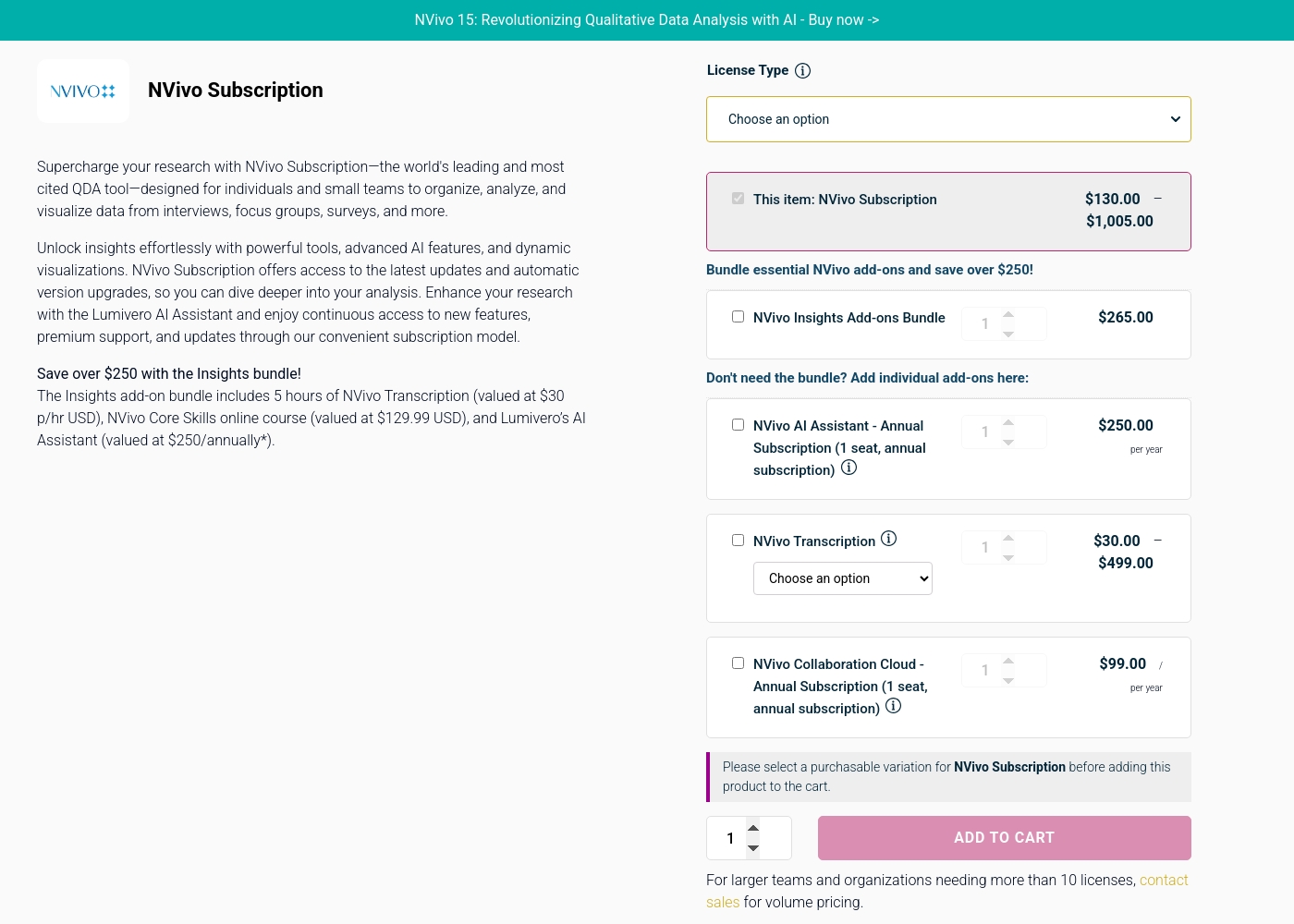
NVivo costs between $130.00 and $1,005.00 per license for the base subscription, with the main plan structure based on individual needs and optional add-ons.
NVivo focuses on flexible licensing for individuals and small teams, offering several powerful add-ons that enhance your qualitative data analysis experience. For organizations needing ten or more licenses, contact the sales team directly for volume pricing options.
NVivo Subscription
Price: $130.00, $1,005.00 Best For: Individuals and small teams Other Features:
- Access to the latest updates and automatic version upgrades.
- Designed to organize, analyze, and visualize data from interviews, surveys, and focus groups.
- Includes premium support and continuous access to new features.
- Access to latest updates and automatic version upgrades
- Continuous access to new features
- Premium support
- Includes the world's leading QDA tool
- Saves over $250
- 5 hours of NVivo Transcription
- NVivo Core Skills online course
- Lumivero's AI Assistant subscription
- Annual Subscription
- 1 seat included
- Annual Subscription
- 1 seat included
Pricing Notes
- ATLAS.ti utilizes non-transparent, quote-based pricing for all its license tiers (Student, Institution, Commercial).
- NVivo offers public pricing and its base subscription ranges from $130.00 to $1,005.00 annually.
- Core collaborative and AI features in NVivo require extra, separately-priced annual add-ons like AI Assistant ($250) and Collaboration Cloud ($99).
- ATLAS.ti’s core features include the Web version; NVivo charges extra for its cloud collaboration features.
- Both ATLAS.ti and NVivo charge usage-based fees for transcription services.
Pricing Head-to-Head
User Reviews
User feedback, although currently based on a very small sample of Trustpilot reviews, suggests strong dissatisfaction with specific aspects of the service and functionality. The core application seems functional, but severe logistical frustrations are reported, particularly surrounding support responsiveness and transcription reliability.
One reviewer noted that the app appeared to work well but later lost a transcript. This required the user to repurchase expensive usage credits to re-transcribe the data.
The app seems to work well, but it lost a transcript, forcing me to repurchase expensive credit time. Customer support was dreadful about refunding the charge. The representative spoke like I was an inconvenience and didn't know what I was talking about. I suggest using a more reliable program.
User sentiment across external platforms, based on limited recent feedback, highlights a critical gap between NVivo's powerful functionality and overall user experience. While the software is acknowledged as a leading QDA tool, users widely criticize support responsiveness, frequently calling it 'useless' and reporting that support tickets are closed without resolution or communication.
The initial onboarding process is also cited as 'very user unfriendly' and frustratingly difficult, often requiring extensive troubleshooting just to access the free trial. Reliability concerns are present, specifically noting critical functional constraints, such as the reported inability to export codes from the Mac version.
Lumivero customer support is absolutely useless. In the span of a year, they addressed only one issue. They closed my other tickets without any communication or explanation, which is unacceptable.
Our Verdict
Choosing between ATLAS.ti and NVivo depends largely on whether you value speed over established rigor. NVivo is the established academic leader, trusted globally for highly structured analysis. ATLAS.ti is aggressively disrupting the market with powerful AI acceleration and pricing flexibility for institutions. ATLAS.ti's superpower is its groundbreaking licensing and speed efficiencies. The floating 'My ATLAS.ti' seats scale instantly and perfectly for large universities or rotating teams. ATLAS.ti also claims that Intentional AI Coding reduces analysis time by over 90%. NVivo, however, excels in research structure and defensibility, crucial for publication. NVivo provides robust tools like Cases and Attributes for deep comparative analysis of your data. NVivo remains the most consistently cited QDA tool in academic literature. The critical decision factor often hinges on price transparency and the user experience. NVivo provides fixed, public pricing, although necessary add-ons raise the final bill. ATLAS.ti requires a quote for nearly every license, creating immediate budgeting uncertainty. If you manage licenses and need maximum flexibility across many users, choose ATLAS.ti immediately. For traditional, rigorous PhD research requiring structured comparison and established credibility, NVivo is likely the more reliable, albeit currently challenging, option.
Frequently Asked Questions
Which is better for large institutions: ATLAS.ti or NVivo?
ATLAS.ti is typically better for large institutions due to its 'My ATLAS.ti' floating license system. These pooled seats maximize license efficiency across unlimited users. NVivo uses a less flexible per-seat annual subscription model.
Which tool has better AI coding features: ATLAS.ti or NVivo?
ATLAS.ti claims Intentional AI Coding can reduce analysis time by over 90%. NVivo’s Lumivero AI Assistant provides structured features like faster summarization and AI-suggested child codes. Both offer advanced capabilities, but ATLAS.ti emphasizes speed.
Is NVivo worth the high cost compared to ATLAS.ti?
NVivo’s cost is transparent and reflects its status as the most cited QDA tool. It is worth the cost if your research needs rigorous, defensible comparative structuring (Cases/Attributes). ATLAS.ti is only worth it if you can negotiate a massive institutional discount.
Which software is more cross-platform friendly for researchers?
ATLAS.ti offers superior cross-platform access, including a full Web application with Windows and Mac desktop versions. NVivo requires purchasing the Collaboration Cloud add-on for centralized cross-platform project sharing.
Does ATLAS.ti integrate with other research platforms like NVivo does?
NVivo explicitly integrates with key tools like Citavi reference management. ATLAS.ti focuses more on seamless internal platform compatibility (Desktop/Web) than external third-party research integrations.
Which software has better customer support: ATLAS.ti or NVivo?
User reviews indicate that both ATLAS.ti and NVivo suffer from significantly criticized and poor customer support responsiveness. Neither software currently holds a clear advantage in this crucial area.
Ready to Choose?
Both tools have their strengths. Choose based on your specific needs.