ATLAS.ti vs Dovetail
This is a showdown between traditional qualitative depth and modern AI velocity. ATLAS.ti is the academic QDA standard, offering incredible methodological power. Dovetail is built for scaling continuous customer intelligence rapidly. The choice depends entirely on your team's core goals and size.
Best for: Academic researchers requiring deep, mixed-method Qualitative Data Analysis (QDA)., Institutions needing highly flexible, floating multi-user licenses for shared access.
Best for: Product teams transitioning to scalable, continuous customer intelligence across many teams., Organizations needing to centralize all customer feedback (Voice of Customer data) into one hub.
AI-Powered QDA with Advanced Collaborative Tools
We recognize ATLAS.ti as a powerful QDA platform, offering cutting-edge AI coding tools and impressive license flexibility ideal for large teams. However, user reports detailing poor customer support and misleading free trial limitations raise critical concerns about the overall user experience. Overall, we recommend this software for institutions prioritizing advanced features and cross-platform compatibility, provided they are prepared for high-cost, non-transparent pricing and potential support challenges.
Pros
- Intentional AI Coding can reduce data analysis time by over 90%.
- Flexible 'My ATLAS.ti' licensing supports unlimited users without seat restrictions.
- Full project compatibility across Windows, Mac, and Web platforms.
- Access to 24/5 Free Live Support from specialized qualitative data experts.
Cons
- Subscription and license pricing are not publicly transparent (requires a quote).
- Customer support quality is widely reported by users as being dreadful and unhelpful.
- Misleading advertising regarding the “no functional limitations” free trial.
- Reported reliability issues with the premium AI transcription service (data loss).
AI-powered hub for continuous customer intelligence.
We assess Dovetail as an essential tool for organizations scaling their research output and impact. It leverages advanced AI features to automate the analysis of vast amounts of customer feedback, acting as a single, accessible source of truth across product teams. Overall, we recommend Dovetail for companies prioritizing continuous, data-driven improvement by tapping into their voice-of-customer data.
Pros
- AI-native platform significantly automates analysis and report generation.
- Acts as the definitive central hub for all customer insights.
- A perpetual Free plan supports individual researchers getting started.
- Guarantees that future work builds on established knowledge, stopping redundant research.
Cons
- Unlimited 'Channels' are structured as a separate paid add-on.
- The Professional plan requires an annual commitment for the lowest advertised price.
- Pricing for the Enterprise tier is not transparent (Contact Sales).
AboutATLAS.ti
ATLAS.ti is a leading QDA software built for researchers demanding both flexibility and power. It provides an impressive all-in-one platform experience right out of the box.
This single package grants full access to desktop apps for Windows and Mac, plus a powerful Web version. Your projects are fully compatible regardless of the platform you use. Furthermore, you benefit from Free Live Support available 24/5 from qualitative data specialists, ensuring your analysis stays on track. ✅
AboutDovetail
Dovetail is your comprehensive Customer Insights Hub. This scalable and secure solution helps foster a truly customer-centric culture across every team, from researchers to product managers. Dovetail organizes messy data—including sales calls, support tickets, and usability tests—into a highly accessible single source of truth. It simplifies complicated research, making intelligence readily available for everyone who needs it. 💡
Highlights
Feature Comparison
Features Overview
We highlight the main differences and pick a winner for each feature.
AI & Automation
Dovetail is AI-native and automates analysis for velocity. ATLAS.ti uses AI coding to reduce manual analysis time dramatically.
ATLAS.ti uses Intentional AI Coding to accelerate deep qualitative work. They claim this can reduce the overall analysis time by 90%. ATLAS.ti offers an AI transcription service as a usage-based add-on. Dovetail is fundamentally an AI-native platform for continuous intelligence. AI automatically transforms massive amounts of raw data into actionable reports. You can ask 'Ask Dovetail' to get instant, cited answers from your data. The core difference is the focus on depth versus breadth and speed. ATLAS.ti accelerates traditional methodological tasks. Dovetail focuses on end-to-end automation and quick insights delivery. If project velocity for commercial insights matters most, Dovetail is the faster choice. For in-depth, complex coding, ATLAS.ti provides the accelerated methodological framework.
Pricing Model
Dovetail offers a clear Free plan and transparent pricing starting at $15/user. ATLAS.ti uses non-transparent, quote-based pricing.
ATLAS.ti's pricing requires requesting a quote based on your user status. Specific dollar amounts are not publicly listed for commercial or educational licenses. This hidden cost structure can complicate organizational budgeting. Dovetail has a perpetual Free plan for individual users and one project limit. The Professional plan starts at a transparent $15 per user/month when billed annually. The key difference is accessibility and transparency for smaller teams. Dovetail allows starting for free instantly. ATLAS.ti requires upfront engagement just to get a cost estimate. This pricing makes Dovetail significantly easier to adopt for small teams or individual users. ATLAS.ti caters better to large institutions used to quote-based procurement cycles.
Platform Access
ATLAS.ti provides full, interchangeable compatibility across desktop and web versions. Dovetail is a modern, pure web-first platform.
ATLAS.ti grants full access to desktop apps for Windows and Mac users. All projects are fully compatible and interchangeable across desktop and web platforms. Researchers can work offline with the dedicated apps seamlessly. Dovetail is designed as a web-accessed Customer Insights Hub. It is intended for always-online collaboration and centralization. It does not offer dedicated desktop applications for heavy processing or offline work. If you need the flexibility of dedicated desktop apps, ATLAS.ti is the clear winner here. Dovetail requires a reliable internet connection for research activities. ATLAS.ti supports researchers balancing fieldwork, lab work, and office writing environments because of its multi-platform availability and synchronization.
Team Collaboration
Dovetail distributes insights across the organization via Slack/Teams. ATLAS.ti collaboration is contained within the research project environment.
Real-time global collaboration in ATLAS.ti happens within the specialized Web platform. Teams can efficiently code and analyze shared projects together. This works well for dedicated QDA research groups. Dovetail excels at pushing intelligence beyond the research team itself. Features like unlimited free viewers and AI chat in Slack/Teams share insights widely. This democratizes the voice of the customer instantly. Dovetail focuses on organizational scale and intelligence distribution to stakeholders. ATLAS.ti focuses on maximizing research team efficiency within the project. If democratizing customer insights is your priority, Dovetail’s integrations are essential. If concurrent coding among a few researchers is the need, ATLAS.ti suffices.
Licensing Flexibility
ATLAS.ti offers floating licenses optimized for institutions. Dovetail offers standard per-user seats with unlimited viewer access.
ATLAS.ti manages multi-user licenses through its 'My ATLAS.ti' system. Seats are floating; a seat instantly opens when one user logs off. This system maximizes resource utilization for institutions with many simultaneous users. Dovetail uses standard per-user licensing for professionals who actively analyze data. The Enterprise plan does include unlimited free viewers. Free viewers can consume insights but not actively code or analyze. ATLAS.ti's floating license model is superior for managing large pools of academic users. Dovetail's model better suits scaling insight consumption by product teams. ATLAS.ti ensures that a large organization maximizes its seat investment without restricting concurrent user counts.
Support Quality
ATLAS.ti promises 24/5 expert support, but user reports describe it as 'dreadful.' Dovetail offers enhanced, priority support only for Enterprise teams.
ATLAS.ti promises 24/5 Free Live Support from specialized QDA experts. This commitment to expert availability is impressive for complex software. However, internal reviews cite terrible customer experience and unhelpful representatives. Dovetail provides standard Help Center support for all users. Enterprise customers receive dedicated assistance, including priority support and a Customer Success Manager. The basic support quality is not explicitly detailed. While ATLAS.ti offers high availability, the reported quality issues are a major red flag (3.4 rating). Dovetail reserves high-touch support for paying Enterprise clients. If immediate, reliable assistance for a critical project is needed, proceed with caution using ATLAS.ti despite the 24/5 claim.
Data Centralization
Dovetail is a single source of truth for all customer intelligence. ATLAS.ti organizes data on a project-by-project basis.
ATLAS.ti projects are highly detailed containers for in-depth QDA. Data is imported and analyzed within the project framework. Centralized management across many separate research studies is less emphasized. Dovetail is designed as a Customer Insights Hub for the entire organization. It centralizes all conversations, support tickets, and research into one repository. This ensures future work builds on established knowledge. This is a critical architectural difference between the tools. Dovetail focuses on eliminating research redundancy organization-wide. ATLAS.ti emphasizes maximizing the analytic power of individual studies. Use Dovetail if you hate starting research from scratch because past data is stuck in silos organizationally.
QDA Depth
ATLAS.ti is built for complex QDA methodology and research depth. Dovetail optimizes for high-volume analysis speed and rapid ROI.
ATLAS.ti is a feature-rich platform developed specifically for deep methodological analysis. It supports complex coding, querying, and sophisticated data visualization necessary for academia. Its core strength is methodological rigor. Dovetail provides advanced analysis features like charts, layouts, and semantic search. These features are tailored for product insights and quickly uncovering trends across large datasets. The primary metric is intelligence velocity. ATLAS.ti is the traditional choice if your project requires advanced methodological control. Dovetail is better for quickly synthesizing customer data for urgent product decisions. Academic and heavy non-commercial researchers will find the depth of ATLAS.ti more appropriate for their complex needs.
ATLAS.ti pricing is structured according to your user type (Student, Educator, Commercial, or Government) and generally requires requesting a price quote to determine the final cost and license validity.
While exact dollar amounts aren't listed publicly, the following plans describe the intended audience for each license type. You can request a written quote valid for 60 days directly from their shopping cart.
Student Licenses
Best For: Undergraduate, graduate, and doctoral students Other Features:
- Specially priced license
- Full program version access
- License linked to degree studies
- Specially priced license
- Use of the full program version
- For undergraduate, graduate and doctoral students
- Unlimited number of members have access
- Single annual license fee based on institution size
- Upgrades included during the lease period
- For educators and researchers at degree-granting institutions
- For registered non-profit organizations, NGOs, government institutions, and supra-national organizations
- Purchase orders accepted
- For all types of commercial use
- Covers training, non-academic research, consulting, and administration
- Purchase orders accepted from businesses (excluding resellers)

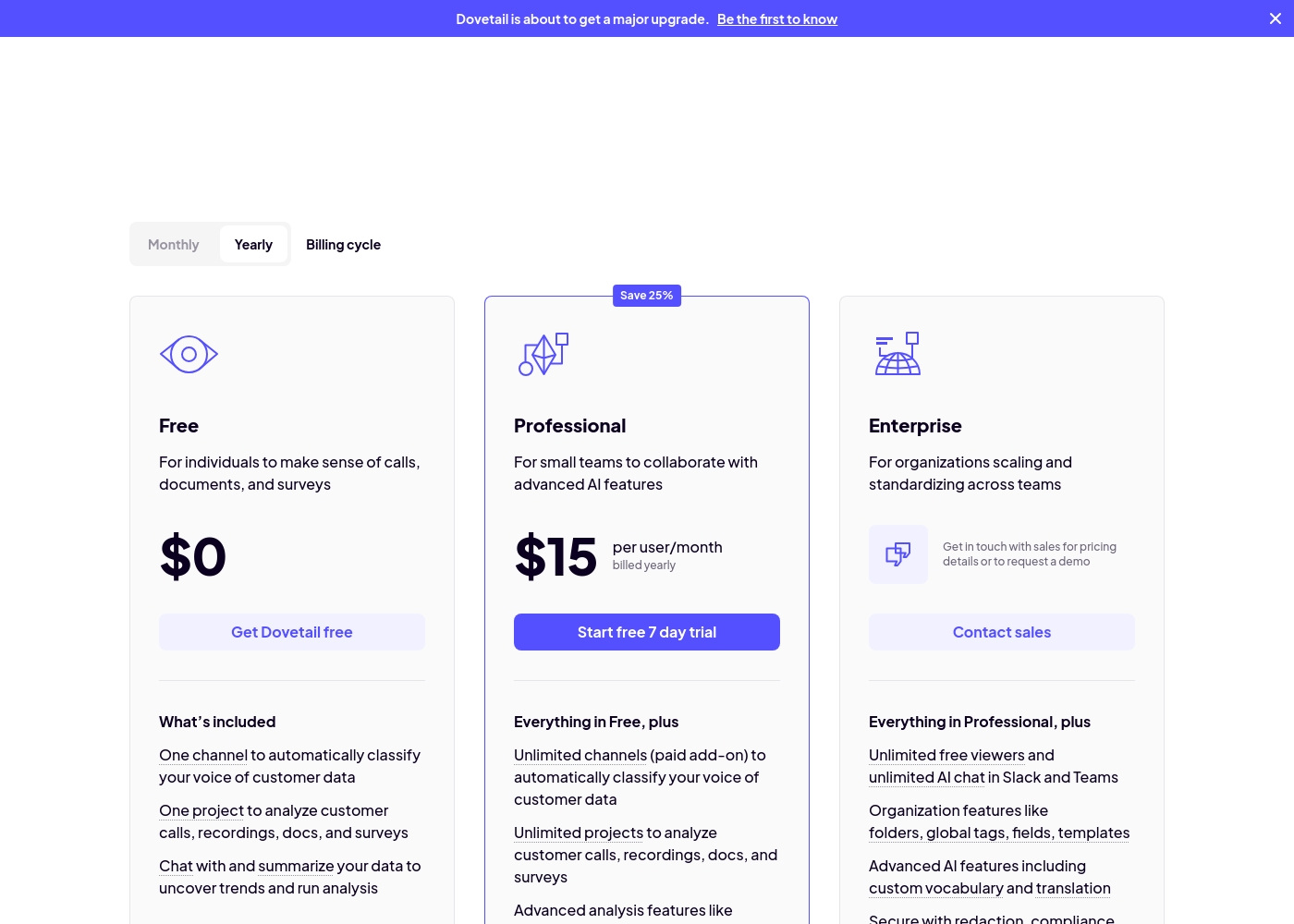
Dovetail costs between $0 and Contact Sales per user/year with 3 plans: Free at $0, Professional at $15 per user/month billed yearly, and Enterprise which requires contacting sales.
Here’s a detailed look at what each subscription level offers and who it is designed for.
Free
Price: $0 Best For: Individuals to make sense of calls, documents, and surveys Other Features:
- One channel to automatically classify customer data
- One project for analyzing customer calls, recordings, and surveys
- Chat with and summarize your data using AI
- One channel to automatically classify your voice of customer data
- One project to analyze customer calls, recordings, docs, and surveys
- Chat with and summarize your data to uncover trends and run analysis
- Everything in Free, plus...
- Unlimited projects to analyze customer calls, recordings, docs, and surveys
- Advanced analysis features like charts, layouts, views, filters
- Advanced AI features like specific summaries and semantic search
- Everything in Professional, plus...
- Unlimited free viewers and unlimited AI chat in Slack and Teams
- Organization features like folders, global tags, fields, templates
- Advanced AI features including custom vocabulary and translation
- Secure with redaction, compliance, access control, and data retention
Pricing Notes
- ATLAS.ti uses specialized license models (Student, Commercial, Educational). Pricing is hidden and requires requesting a quote.
- Dovetail offers a perpetual Free plan and Professional plan pricing at $15/user/month when billed annually.
- The Professional plan requires an annual commitment for the lowest advertised Dovetail price.
- Both ATLAS.ti and Dovetail use usage-based pricing for specific add-ons (transcription for ATLAS.ti, Channels/Recruit for Dovetail).
- The ATLAS.ti free trial is reported by users as being heavily restricted (e.g., documents must be under 500 words).
Pricing Head-to-Head
User Reviews
User feedback, although currently based on a very small sample of Trustpilot reviews, suggests strong dissatisfaction with specific aspects of the service and functionality. The core application seems functional, but severe logistical frustrations are reported, particularly surrounding support responsiveness and transcription reliability.
One reviewer noted that the app appeared to work well but later lost a transcript. This required the user to repurchase expensive usage credits to re-transcribe the data.
The app seems to work well, but it lost a transcript, forcing me to repurchase expensive credit time. Customer support was dreadful about refunding the charge. The representative spoke like I was an inconvenience and didn't know what I was talking about. I suggest using a more reliable program.
Our analysis of external user sentiment is strictly constrained by the available input data. The Trustpilot link provided is for "Dovetails Vintage," a retailer of chalk paint and furniture, not the Dovetail Customer Insights Hub software.
⚠️ Reviews for the retailer are overwhelmingly positive, highlighting superb customer service, amazingly quick delivery, and thoughtful personalization, often including hand-written notes and personalized stencils. Many users noted this superior, personal touch makes all the difference in today's world, leading to a high 4.7-star rating for the retail business.
Our Verdict
Choosing between ATLAS.ti and Dovetail means prioritizing complexity versus velocity. Dovetail is the clear winner for most modern, agile product teams. ATLAS.ti retains its position as the dedicated QDA powerhouse. ATLAS.ti's superpower is its methodological depth and cross-platform flexibility. If your work demands complex QDA on dedicated Windows or Mac applications, choose ATLAS.ti. Its floating institutional licenses also maximize value for large academic or government user pools. Dovetail's strength lies in AI-native speed and organizational scaling of insights. Dovetail automatically synthesizes massive customer data and makes it searchable via 'Ask Dovetail.' Its transparent pricing, starting at $0, means low friction adoption for any team size. The deciding factor is output: If your output is a methodology-heavy publication, use ATLAS.ti. If your output is rapid, cited intelligence for dozens of product decisions, Dovetail is superior. Go with Dovetail if you are a commercial team seeking centralized, continuous intelligence and transparency. Pick ATLAS.ti if you are a researcher who requires ultimate depth and desktop app compatibility.
Frequently Asked Questions
Which is better for small teams: ATLAS.ti or Dovetail?
Dovetail is better for small teams due to its transparent pricing structure. It offers a powerful, perpetual Free plan and an accessible $15/user/month Professional plan. ATLAS.ti requires requesting a quote, suggesting higher entry costs.
Does ATLAS.ti have a true free version like Dovetail's $0 plan?
No, ATLAS.ti only offers a free trial that is reported to be heavily restricted. Dovetail provides a full, perpetual Free plan for individuals actively working on one project.
Is Dovetail's methodological analysis as deep as ATLAS.ti's QDA approach?
ATLAS.ti is purpose-built for deep, complex QDA and methodological rigor. Dovetail emphasizes speed, AI-automation, and centralizing insights across many commercial projects. ATLAS.ti offers superior analytical depth.
Can I use ATLAS.ti and Dovetail when I’m offline?
Yes, ATLAS.ti provides dedicated desktop applications for Windows and Mac that work offline. Dovetail is a web-first application and generally requires an internet connection to function.
Which tool is better for integrating insights into organizational tools like Slack?
Dovetail is vastly superior for insights distribution. Its Enterprise plan includes unlimited AI chat built into Slack and Microsoft Teams. ATLAS.ti does not offer similar external communication integrations.
How does multi-user licensing differ between ATLAS.ti and Dovetail?
ATLAS.ti uses a flexible floating license system for institutions, maximizing seat use. Dovetail licenses are per-user seats but include unlimited free viewers in Enterprise plans. ATLAS.ti is better for heavy, concurrent researcher teams.
Ready to Choose?
Both tools have their strengths. Choose based on your specific needs.