Asana vs Process Street
Asana and Process Street manage work, but they solve entirely different organizational problems. Asana excels at flexible project tracking and team collaboration across multiple projects. Process Street focuses intensely on turning policies into auditable, repeatable workflows. This decision boils down to whether you track tasks or strictly enforce compliance standards.
Best for: Remote teams of 10-50 needing flexible project views (List, Board, Timeline), Marketing agencies running high volumes of creative ad campaigns and production
Best for: Regulated businesses (finance, healthcare) requiring auditable policy enforcement, Teams standardizing SOPs and complex compliance processes (SOC 2, ISO 9001)
Great features, poor customer support.
We find that Asana offers powerful project management features, excellent organizational scalability, and a generous free plan suitable for small teams. However, recurring external reports indicate severe problems with customer service responsiveness and billing transparency, heavily detracting from the product’s core strengths. Overall, we recommend caution for small businesses or any organization prioritizing reliable, direct customer support.
Pros
- Powerful free tier available for individuals and small teams (up to 10 users).
- Flexible design for managing tasks, projects, and team workflows efficiently.
- Supports excellent scalability, trusted by many Fortune 100 companies.
- Advanced features like Gantt charts and Timeline views are available starting on the Starter plan.
Cons
- Customer service is widely reported as non-existent, slow, or dependent on ineffective chatbots.
- Numerous complaints regarding deceptive auto-renewal practices and unauthorized charges.
- Refund requests are frequently denied, increasing costs for unintended subscriptions.
- Users often lose access or tasks when attempting to downgrade from a paid trial to the free plan.
AI-Powered Compliance and Operational Standardization
We find Process Street highly effective for organizations needing to enforce strict operational policies and ensure consistency across large, distributed teams. Overall, the powerful combination of AI automation and centralized document control makes this an essential tool for compliance-driven scaling.
Pros
- AI-enforced workflows guarantee policy compliance.
- Cora AI agent monitors regulations and flags risks 24/7.
- Centralizes policies into live, audit-ready workflows (DOCS).
- Drives consistency and accountability across global teams.
Cons
- Pricing is not publicly disclosed, requiring custom quotes.
- No transparent tiers or fixed subscription costs available.
- Specific features and user limits depend on individualized packages.
- May be overwhelming or costly for very small teams without complex compliance needs.
AboutAsana
Asana is an online platform built specifically to manage your team’s work, projects, and tasks. It supports powerful Human + AI collaboration.
This AI component understands your specific business context, helping to move your most important work forward efficiently. Because it's a centralized ecosystem, it easily brings all doers and stakeholders together in one place. 💡
AboutProcess Street
Process Street is the compliance operations platform. It helps your business automate consistency and ensure everything is documented correctly.
It's trusted by over a million users to standardize workflows and prove their execution. This tool uses AI to automate essential business processes and enforce policies rigidly.
It ensures you can always deliver audit-ready proof, consistently. The platform handles policy control (DOCS), workflow automation (OPS), and managing risk with its 24/7 AI compliance agent, CORA.
Highlights
Feature Comparison
Features Overview
We highlight the main differences and pick a winner for each feature.
Core Focus
Asana tracks dynamic team projects; Process Street enforces strict compliance controls.
Asana manages team tasks, projects, and high-level strategic alignment effectively. It provides flexible views like boards, lists, and required status approvals for tracking. Process Street is a platform for compliance operations and serious workflow automation solutions. It turns scattered policies into live, auditable, and repeatable processes. Governance is centralized for standards like SOC 2 and SOX. If you need dynamic project visibility, Asana is the pick. If you must prove process adherence for regulation, Process Street is essential. Asana helps you decide what's next, while Process Street ensures you did it correctly.
Workflow Enforcement
Process Street strictly enforces steps; Asana applies flexible automation rules to tasks.
Asana uses a Process Generator and unlimited automation rules to standardize work. These automations primarily focus on task routing and project flow updates. Asana gives users high flexibility in designing their specific workflows. Process Street uses AI-powered compliance agents to automate and enforce strict controls. It guarantees standardized steps are followed every single time to minimize errors quickly. This focus ensures actions are fully audit-ready upon completion. For regulated tasks, Process Street provides the required rigor. Asana optimizes for speed and task efficiency. For finance or legal teams, Process Street's built-in enforcement is invaluable for mitigating business risk.
Project Visualization
Asana offers robust Gantt and Timeline views, Process Street offers deep task visibility.
Asana offers robust visualization tools like List, Board, and Calendar views for tracking progress. Paid users gain powerful Timeline and Gantt Views for complex project dependencies. This allows for excellent "air traffic control" over large production pipelines. Process Street provides real-time visibility into required tasks and ongoing step-by-step workflows. It ensures clear accountability by showing exact ownership of the current step. It typically lacks dedicated, complex Gantt charts for long-term resource scheduling. If visual scheduling and resource mapping are critical, Asana provides superior native tools. Process Street focuses visibility on the detailed execution of compliance steps.
Audit & Governance
Process Street is intrinsically built for audits; Asana adds compliance features at top tiers.
Asana offers critical features like HIPAA and SIEM integration, but only on the highest Enterprise+ plan. Its design prioritizes project tracking first, with compliance being a premium add-on. Governance requires advanced security controls and API audit logs. Process Street’s core function is delivering audit-ready proof and centralized policies for major standards. Governance for SOC 2, SOX, and FDA is baked into every automated workflow effortlessly. The processes generate records that consistently support external audits. Process Street makes auditability easier and inherent at lower tiers. Asana's compliance seal demands top-tier pricing and complex setup.
AI Capabilities
Asana’s AI helps do tasks; Process Street’s AI monitors for compliance gaps.
Asana offers Asana AI Studio access to amplify team impact and handle routine work. The AI uses your business context to move essential projects forward faster. It helps teams accelerate goal achievement by reducing manual, context-switching tasks. Process Street employs Cora, an AI compliance agent, to monitor workflows proactively. Cora enforces controls and flags risks before they become non-compliant audit findings. It ensures that required manual and automated steps are followed correctly. Both tools use AI, but for fundamentally different functions within a company. Asana optimizes project speed; Process Street optimizes regulatory adherence.
Customer Support
Process Street advertises fast support; Asana users report extremely slow, poor support.
Asana has widespread user complaints about non-existent or painfully slow support responses. Users often contend with frustrating chatbots and struggle to reach a human agent quickly. Dedicated 24/7 support is reserved only for the expensive Enterprise plan. Process Street advertises a quick 5-minute average response time and a high 98% customer rating. Users frequently note the responsiveness and setup assistance they receive from their team. This is a clear, critical contrast in company priorities. Asana prioritizes large scale flexibility over accessible support. If reliable, immediate help during critical workflow setup is key, Process Street is the safer bet.
Free Tier Access
Asana offers a generous free plan, Process Street details must be confirmed with sales.
Asana provides an excellent, long-term Personal plan that is free for life. This free plan supports up to 10 users with unlimited essential tasks and storage. It is perfect for individuals or small teams just starting with project management. Process Street does not explicitly detail a public free plan or transparent pricing structure upfront. Most tier details require the user to contact a sales representative for current terms. For teams with zero budget or those initially testing system viability, Asana is immediately and easily accessible. Small teams needing basic task management should rely on Asana’s robust free offering.
Resource Management
Asana tracks personnel capacity readily; Process Street focuses on task allocation enforcement.
Asana utilizes resource management tools to visualize how teams are staffed across all projects. This helps leaders check available human resources across the entire business portfolio. This feature is available starting on the Advanced plan for complex objective alignment. Process Street ensures that the next necessary task in an SOP is assigned and completed correctly. While accountability is high, the platform is not designed for visualizing broad staffing capacity. It tracks compliance step execution rather than long-term team workload forecasting. If resource leveling and capacity planning are mandatory, Asana offers the native solution. Process Street will manage the specific tasks within a process expertly.
Asana costs between $US 0 and $24.99 per user per month (annual billing) with 5 plans: Personal at $US 0, Starter at $US 10.99, Advanced at $US 24.99, Enterprise at Contact Sales, and Enterprise+ at Contact Sales.
Here is a breakdown of what each plan offers your team.
Personal
Price: $US 0 (Free for life) Best For: Individuals and small teams wanting better task management Other Features:
- Work in teams (up to 10 people)
- Unlimited tasks, projects, and messages
- Unlimited storage (100 MB max. per file)
- List, Board, and Calendar views
- Basic search filters
- Work in teams (up to 10 people)
- Unlimited tasks, projects, and messages
- Unlimited storage (100 MB max. per file)
- List, Board, and Calendar views
- Basic search filters
- Unlimited user licenses
- Asana AI Studio access
- Timeline and Gantt Views
- Process Generator
- Advanced Search and Custom Fields
- Objectives and unlimited portfolios
- Resource Management
- Integrations to Salesforce, Tableau, and Power BI
- Form customization and approvals
- Native time tracking
- Bulk process actions
- SAML and SCIM for accelerated user configuration
- Service accounts
- 24/7 support
- Custom branding
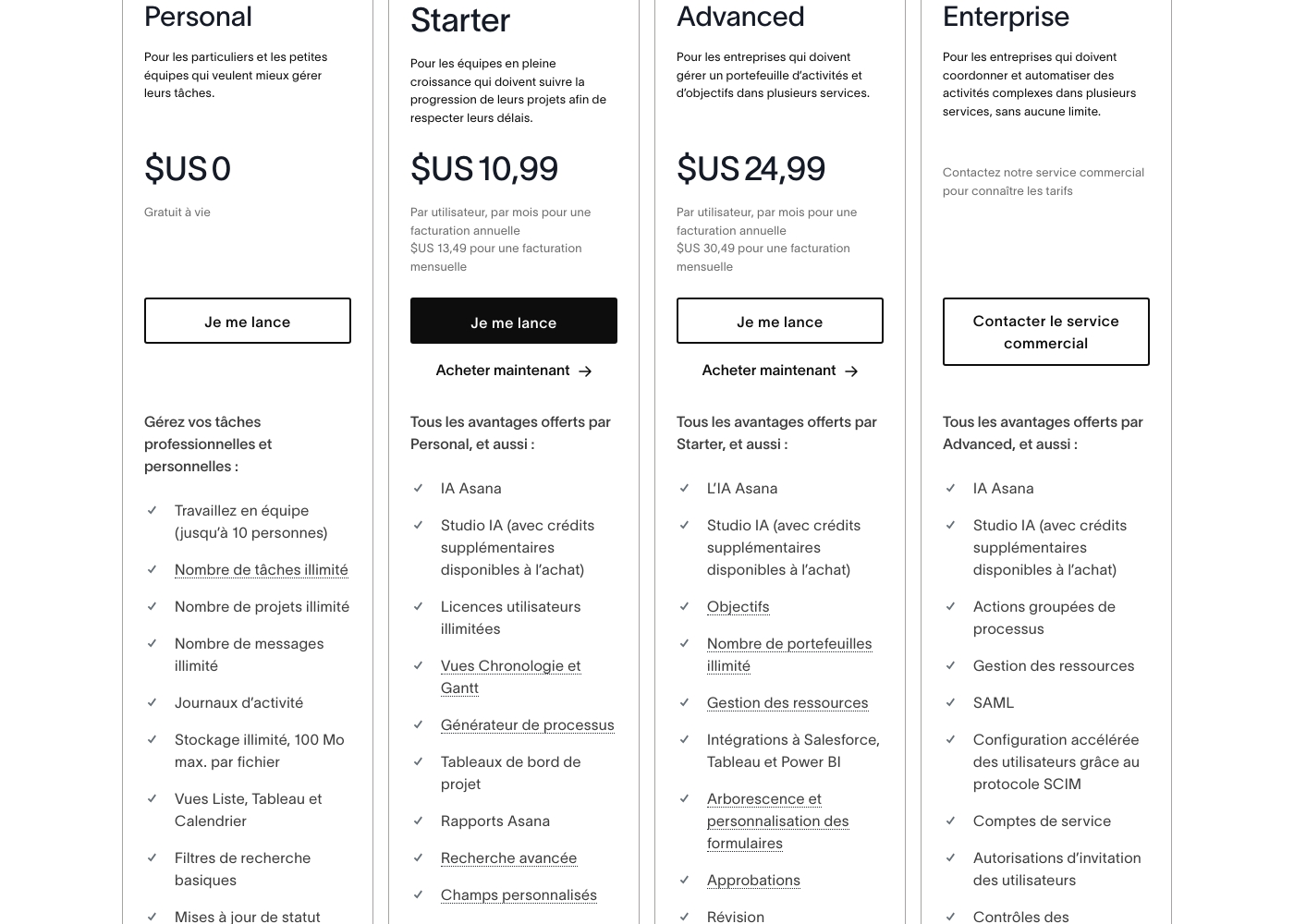
The specific tiers and features included in Process Street's subscription models are not publicly listed in this documentation. Interested users are directed to contact their team for specific pricing.
Pricing Details Available Upon Contact
Best For: Businesses requiring streamlined compliance, AI-powered automation, and strict operational standardization. Other Features:
- The Cora AI compliance agent monitors regulations and flags risks 24/7.
- Automated workflows (OPS) turn policies into repeatable, trackable tasks.
- Centralized document control (DOCS) manages policies for ISO 9001 (and others).
- Real-time visibility into task status and workflow tracking.
- AI-powered intelligence helps generate new workflows quickly.
If you're ready to explore how Process Street can transform your compliance posture and operations, reaching out to their experts is the next step. This customized approach ensures your organization receives the exact feature set and support levels needed for consistent auditing and standardization, especially in highly regulated industries.
- Cora AI compliance agent
- Automated workflows (OPS)
- Centralized policy control (DOCS)
- AI-enforced operational consistency
- Knowledge management

Pricing Notes
- Asana offers a permanent free plan for up to 10 users, providing excellent starting value.
- Asana pricing tiers (Starter, Advanced) are transparently listed ($10.99 - $24.99/user/month billed annually).
- Process Street’s specific pricing tiers and per-user costs are not publicly disclosed; information requires contacting sales.
- Asana requires purchasing licenses in specific increments, often forcing you to pay for unused seats.
- Asana explicitly states it does not offer refunds once a paid subscription has started.
Pricing Head-to-Head
User Reviews
External feedback, predominantly showcased through Trustpilot, reveals widespread dissatisfaction among users, giving the service a significantly low overall rating. Customers frequently criticize the subscription and billing practices, often citing unexpected auto-renewals or unauthorized charges occurring months after cancellation or trial expiration. The inability to secure refunds, even in cases of clear error, is a major pain point.
🚨 The most significant complaint centers on support responsiveness. Reviewers report slow service, sometimes waiting a week for an email reply, reliance on frustrating chatbots, and difficulties contacting a human representative. While some users acknowledge the base product is flexible and has good design features, the company's operational infrastructure and seeming focus on larger enterprises leaves smaller businesses feeling neglected, leading many to label the experience customer-hostile or deceptive.
The app itself is great, offering good design, projects, and flexible team spaces. However, the customer service experience is awful. The only way to talk to CS is often through slow, ineffective emails.
We aimed to synthesize external user sentiment for Process Street, balancing insights from both Trustpilot and Capterra. Although we located the Capterra listing URL, the provided materials did not contain specific textual snippets or testimonials from real users.
This severely limits our ability to report on recurring community themes regarding critical aspects like customer support responsiveness, the learning curve, or implementation success across various industries. Since Process Street employs a quote-based, non-public pricing model, external user feedback is crucial for assessing perceived value for money that customers experience after implementation.
Our Verdict
Choosing between Asana and Process Street isn't a race for the 'better' tool; it depends entirely on your purpose. Asana is your flexible project co-pilot, while Process Street is your regulatory compliance officer. They solve conflicting organizational needs daily. Asana’s superpower is providing unparalleled visibility and flexibility across complex projects. Asana gives you native Gantt charts, resource management, and unlimited portfolios to track everything. Its generous free plan for up to ten people makes Asana the ideal choice for early-stage teams. Process Street's superpower is structured governance and delivering audit-ready proof consistently. Process Street turns tedious, regulated policies into live, enforced, and auditable workflows. Cora AI constantly monitors execution, reducing audit risk and organizational errors significantly. The deciding factor should be risk versus flexibility in your environment. Choose Process Street if policy adherence, error reduction, and audit defense are your highest priorities. Choose Asana if you track many simultaneous, custom projects requiring versatile views and native resource allocation. Final Verdict: Use Asana for marketing or creative teams planning multi-month, dynamic campaigns. Implement Process Street if your key deliverable is consistent, audit-ready compliance across regulated departments.
Frequently Asked Questions
Which is better for small teams: Asana or Process Street?
Asana is better for small teams since it offers a powerful, permanent free plan. This plan supports up to 10 users with unlimited tasks and basic project views. Process Street is typically better suited for paid, structured adoption in regulated environments.
Which tool is specifically designed for achieving SOC 2 or ISO 9001 compliance?
Process Street is purpose-built for rigorous compliance operations and governance standards. It guarantees audit-ready proof for SOC 2, SOX, and ISO 9001 adherence. Asana only offers specialized compliance features like HIPAA at its most expensive Enterprise+ tier.
Does Asana have resource management features like Process Street?
Yes, Asana offers native resource management and staffing visualization starting on the Advanced plan. Process Street focuses on enforcing the specific steps within a workflow and tracking ownership, not on broad resource capacity planning.
Is Asana’s customer support reliable for urgent issues?
User reviews indicate Asana’s support is often slow, ineffective, or reliant on frustrating chatbots. Process Street explicitly advertises a 5-minute average response time and high user satisfaction. Process Street offers more reliable support.
What is the key difference in how Asana and Process Street use AI?
Asana uses AI Studio to automate the context of tasks, helping teams complete projects faster. Process Street uses Cora AI to monitor workflows, enforce controls, and proactively flag risks to maintain compliance adherence.
Which software offers better project visualization for tracking dependencies?
Asana offers better dedicated project visualization tools overall. Paid tiers include powerful Timeline and Gantt Views, ideal for mapping complex project dependencies. Process Street provides real-time visibility into required policy steps.
Ready to Choose?
Both tools have their strengths. Choose based on your specific needs.