AfterShip Tracking vs Seel
AfterShip Tracking and Seel are both post-purchase heroes, but they fight different battles. AfterShip Tracking focuses on package tracking and branding, while Seel automates returns and support. Let's see which one fits your e-commerce shop.
Best for: E-commerce stores needing detailed shipment analytics across 1,200+ carriers, Brands wanting to drive cross-sell revenue on custom tracking pages
Best for: Online retailers looking to automate returns and refunds, Support teams drowning in repetitive 'Where Is My Order?' tickets
Advanced features, severely hindered by execution.
AfterShip Tracking offers powerful functionality, connecting over 1,200 carriers and providing crucial AI-driven analytics and branded experiences. However, we note major user concerns regarding inconsistent tracking accuracy and widespread failures in both customer support and billing practices. Overall, operational reliability seems to severely undermine the tool's theoretical feature value.
Pros
- Extensive global carrier network (integrations with 1,239+ carriers).
- Robust AI capabilities, including Predictive Estimated Delivery Dates (EDD).
- Ability to create branded and customizable tracking pages.
- Volume-based pricing scales flexibly for e-commerce growth.
Cons
- Tracking data is frequently reported as inaccurate or severely delayed.
- Customer support is slow, unresponsive, and generally ineffective.
- Numerous complaints regarding confusing, unauthorized, or excessive charges.
- Lack of necessary onboarding or demo support for premium tiers.
Excellent post-purchase automation for e-commerce.
Seel effectively automates the post-purchase chaos, handling returns, tracking, and support with impressive AI. Overall, we find it's a robust, secure solution that delivers on its promise to reduce merchant workload and improve the customer experience, though it requires a custom consultation for pricing.
Pros
- Significantly reduces WISMO tickets with automated tracking updates.
- Provides 24/7 AI-powered live support for common shopper queries.
- Offers a branded, configurable resolution portal for returns/refunds.
- Integrates smoothly with platforms like Shopify.
Cons
- Pricing is not public; requires a custom demo and consultation.
- No free trial or free plan is explicitly offered.
- Initial onboarding and setup may require merchant effort.
- Services like 'One-click resale' are still in beta.
AboutAfterShip Tracking
AfterShip Tracking is robust shipment tracking software designed for retailers. It acts as an automated solution that rapidly fosters real customer loyalty after purchase. This system integrates seamlessly with 1,239 global carriers through a single connection. It gives you immediate, accurate, end-to-end visibility of every order in one central portal. You get the necessary data to monitor shipments and proactively handle any exceptions. ✅
AboutSeel
Seel is a post-purchase infrastructure platform for online merchants. It provides the tools to manage the entire customer experience after the "Buy" button is clicked. Think of it as a centralized system for handling returns, refunds, and support queries, powered by AI and trained on millions of interactions. ✅
Highlights
Feature Comparison
Features Overview
We highlight the main differences and pick a winner for each feature.
Tracking & Visibility
AfterShip Tracking offers deep, data-rich carrier tracking. Seel focuses on real-time status updates to deflect support tickets.
AfterShip Tracking provides unrestricted access to data from over 1,239 global carriers. It uses AI for carrier auto-detection and predictive, hour-level delivery dates. Seel provides global delivery tracking and real-time status updates. This proactive communication is designed to significantly reduce 'Where Is My Order?' tickets. The key difference is depth vs. simplicity. AfterShip Tracking is a detailed data platform, while Seel uses tracking as a tool for support automation. For a retailer needing to analyze carrier performance over three years, AfterShip Tracking is the choice. For one wanting to auto-notify customers to cut support load, Seel works well.
Post-Purchase Support
Seel is built for automated support with AI chat. AfterShip Tracking helps reduce tickets through proactive updates.
AfterShip Tracking reduces WISMO tickets by up to 65% through automated email and SMS notifications. It centralizes tracking data but doesn't offer direct shopper support. Seel's Agentic Workforce provides 24/7 AI-powered live chat. The AI is trained on your policies to handle address changes, product questions, and more. The trade-off is proactive updates vs. interactive support. AfterShip Tracking informs customers, while Seel engages and resolves their issues. If your team is swamped with repetitive questions, Seel's AI chat is a game-changer. If you mainly need to broadcast status updates, AfterShip Tracking suffices.
Returns & Refunds
Seel specializes in automated returns with flexible policies. AfterShip Tracking does not offer returns management.
AfterShip Tracking does not include features for managing returns, refunds, or exchanges. Its focus is purely on the shipment lifecycle. Seel offers a fully branded, configurable resolution portal. You can set rules for returns and offer refunds, exchanges, or store credit. This is a clear difference in product scope. Seel handles the entire post-purchase problem, while AfterShip Tracking handles the delivery part. For merchants wanting to offer 'return for any reason' programs to boost conversion, Seel is the necessary tool. AfterShip Tracking cannot fulfill this need.
Branding & Customization
AfterShip Tracking excels at custom tracking pages. Seel offers branded portals for returns and support.
AfterShip Tracking lets you create cohesive tracking pages with your brand's look. You can use a custom domain and remove branding on higher plans. Seel provides a branded resolution portal for returns and support. This portal is tailored to your store's identity and policies. Both tools offer branding, but for different touchpoints. AfterShip Tracking brands the delivery tracking experience, Seel brands the returns and support experience. Driving revenue with AI product recommendations on a tracking page is an AfterShip Tracking strength. Creating a seamless, on-brand returns process is Seel's specialty.
Integration & Setup
AfterShip Tracking integrates with 70+ platforms. Seel integrates smoothly but with fewer listed partners.
AfterShip Tracking offers native integrations with over 70 eCommerce platforms like Shopify, Magento, and NetSuite. Seel explicitly integrates with Shopify. Compatibility with other platforms requires a demo consultation. AfterShip Tracking has a broader documented integration ecosystem. Seel emphasizes a smooth, fast setup but with a narrower public list. For a store on a niche platform, AfterShip Tracking's extensive list is safer. For a Shopify-first store, both integrate well, though Seel's setup is noted as simple.
Security & Compliance
Both offer strong security. Seel adds insurance licensing, showing a focus on trust for financial transactions.
AfterShip Tracking maintains ISO 27001 and GDPR compliance with 99.9% uptime guarantee. Seel is SOC 2 Type II, GDPR, and CCPA compliant. It also holds a National Association of Insurance Commissioners license in all 50 US states. Seel's additional insurance licensing is significant. It operates as a licensed provider for its Worry-Free programs, adding a layer of trust. Both are secure, but Seel's compliance profile is more extensive, likely due to the financial nature of its refund and protection services.
Pricing Model
AfterShip Tracking has clear, public pricing tiers. Seel uses custom quotes, likely based on usage.
AfterShip Tracking offers four public plans from $11/month (Essentials) to custom (Enterprise). Pricing scales with shipment volume. Seel's pricing is not public. It is likely usage-based or integrated into a shopper fee, requiring a demo for a quote. The fundamental difference is transparency. AfterShip Tracking lets you self-serve and predict costs, while Seel requires a sales conversation. For a startup wanting to start small with clear costs, AfterShip Tracking's $11 plan is accessible. For an enterprise needing tailored solutions, Seel's custom model may be suitable.
User Reviews & Sentiment
AfterShip Tracking has poor reviews, citing tracking and support issues. Seel receives overwhelmingly positive feedback.
AfterShip Tracking holds a 2.2 rating on Trustpilot. Reviews cite inaccurate tracking, slow support, and billing problems. Seel holds a 4.6 rating. Users praise significant WISMO ticket reduction, easy setup, and helpful AI support. The sentiment gap is enormous. AfterShip Tracking users are frustrated with execution, while Seel users are delighted with the results. Real-world impact: Choosing AfterShip Tracking may lead to the support and accuracy issues users report. Choosing Seel aligns with stories of reduced workload and improved operations.
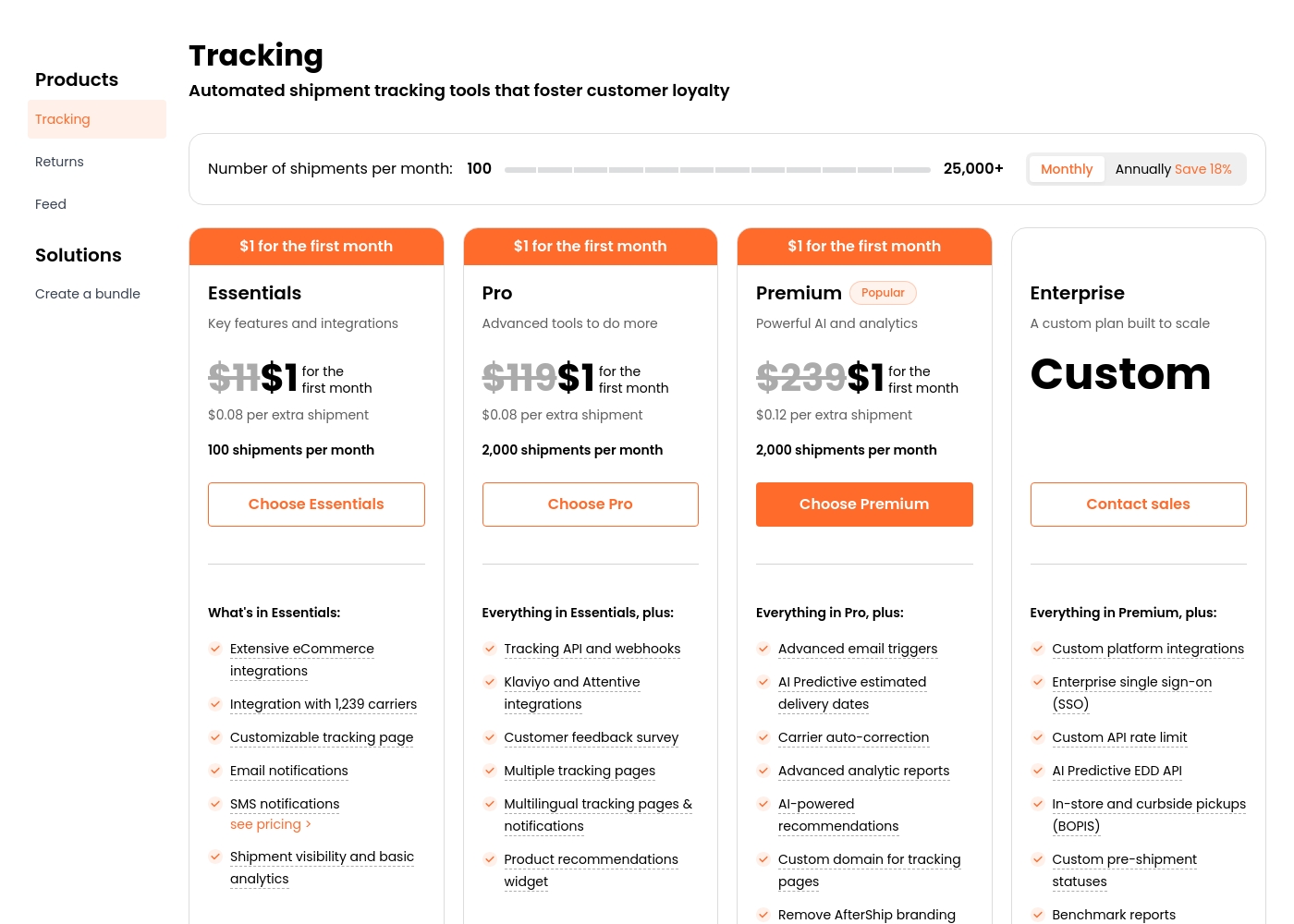
AfterShip Tracking costs between $11 and Custom per month with four plans: Essentials at $11, Pro at $119, Premium at $239, and Enterprise (Custom).
These plans scale directly depending on the number of shipments you process each month and offer different feature sets.
Essentials
Price: $11 per month ($1 for the first month) Best For: Key features and integrations Other Features: Extensive eCommerce integrations, Integration with 1,239 carriers, Customizable tracking page, Email notifications, SMS notifications.
- Extensive eCommerce integrations
- Integration with 1,239 carriers
- Customizable tracking page
- Email notifications
- SMS notifications
- Tracking API and webhooks
- Klaviyo and Attentive integrations
- Customer feedback survey
- Multiple tracking pages
- Multilingual tracking pages & notifications
- Advanced email triggers
- AI Predictive estimated delivery dates
- Carrier auto-correction
- Advanced analytic reports
- AI-powered recommendations
- Custom platform integrations
- Enterprise single sign-on (SSO)
- Custom API rate limit
- AI Predictive EDD API
- In-store and curbside pickups (BOPIS)
Here's a look at the services Seel offers to help manage your post-purchase experience.
Worry-Free Purchase®
Best For: Online retailers wanting to offer comprehensive refunds and returns for any reason. Other Features: - Automatic return/refund processing, - Resolution portal for shoppers, - One-click resale (beta) functionality, - Configurable resolution requirements.
This service is perfect if you want to give your shoppers total confidence during checkout. It lets customers return items for reasons ranging from product issues to simple second thoughts. 🛍️
- Comprehensive refunds and returns for any reason
- Configurable resolution rules
- One-click resale listing (beta)
- Integration with Shopify gift cards
- 24/7 live AI support chat
- Automated delivery tracking
- Real-time resolution status for shoppers
- Custom AI training on brand policies
Pricing Notes
- AfterShip Tracking offers a clear, transparent pricing structure with four public tiers.
- Seel requires a demo consultation for a custom quote, with no public pricing.
- AfterShip Tracking offers a $1 first-month trial for Essentials, Pro, and Premium plans.
- Seel does not explicitly offer a free trial or free plan.
- AfterShip Tracking's pricing is based on monthly shipment volume with overage fees.
- Seel's pricing is likely tied to service usage or a shopper fee model.
Pricing Head-to-Head
User Reviews
The external feedback from over 650 Trustpilot reviews paints a stark picture, suggesting a significant disparity between AfterShip's powerful feature set and its operational execution. Users frequently praise the potential of the tool but report debilitating issues focused primarily on tracking accuracy.
Many complain the system is unreliable, showing packages still “on the way” long after actual delivery, or displaying conflicting location details compared to carrier apps. Reliability seems to have degraded over time, becoming unpredictable.
A support ticket routinely takes a month or longer for a simple reply. Agents don't read the context and just provided irrelevant or copy-pasted answers. If you encounter an issue, it may never be resolved due to this level of service.
We found user sentiment for Seel on Trustpilot to be overwhelmingly positive, with many praising the platform's impact on their operations. A recurring theme is the significant reduction in 'Where Is My Order?' (WISMO) tickets and post-purchase support workload, thanks to the reliable tracking and AI chat.
Users frequently highlight the ease of use for both merchants and shoppers, noting that integration is straightforward and the branded resolution portal feels seamless. Several reviews mention the accuracy and helpfulness of the customer support when issues arise.
Seel has been a game-changer for our support team. The automated tracking updates cut our WISMO tickets by a huge margin. It's easy to set up and the branded portal looks great.
Our Verdict
For most e-commerce retailers, Seel is the more impactful choice. Its post-purchase automation delivers proven results in reducing support workload and boosting confidence. AfterShip Tracking's superpower is its massive carrier network and detailed data. It's a powerful tool for tracking shipments and building branded delivery pages. Seel's superpower is automating the entire post-purchase problem. It handles returns, refunds, and AI-powered support in one branded layer. The deciding factor is your biggest pain point. If you need deep shipment data and analytics, choose AfterShip Tracking. If you need to stop firefighting returns and tickets, choose Seel. Final verdict: Pick Seel if you want to automate support and returns. Pick AfterShip Tracking only if you need specialized shipment tracking and already have returns covered elsewhere.
Frequently Asked Questions
Which is better for reducing support tickets: AfterShip Tracking or Seel?
Seel is specifically designed for this with its AI-powered support chat and proactive tracking updates. AfterShip Tracking reduces tickets through notifications, but Seel's interactive automation is more comprehensive for post-purchase inquiries.
Does Seel integrate with my store like AfterShip Tracking does?
Seel integrates smoothly with Shopify. For other platforms, you must book a demo to discuss compatibility. AfterShip Tracking offers native integrations with over 70 eCommerce platforms.
Why can't I find Seel's pricing online like AfterShip Tracking's?
Seel provides custom quotes because its services are tailored to each merchant's products and policies. AfterShip Tracking publishes clear, tiered plans based on monthly shipment volume.
Is AfterShip Tracking's tracking more accurate than Seel's?
AfterShip Tracking provides deeper data from 1,239+ carriers with AI-powered predictive dates. Seel focuses on reliable real-time status updates to keep shoppers informed. The 'accuracy' differs in depth vs. support utility.
Can I use AfterShip Tracking for returns?
No. AfterShip Tracking focuses solely on shipment tracking and delivery updates. For managing returns, refunds, and exchanges, you would need a tool like Seel.
Which platform has better user reviews?
Seel has overwhelmingly positive reviews, with users praising its effectiveness. AfterShip Tracking has poor reviews, with many complaints about tracking accuracy and customer support responsiveness.
Ready to Choose?
Both tools have their strengths. Choose based on your specific needs.