AfterShip Shipping vs Sendcloud
Both AfterShip Shipping and Sendcloud simplify multi-carrier eCommerce logistics. AfterShip Shipping focuses on global API scalability and steep USPS discounts. Sendcloud is prioritized for comprehensive European automation and stellar customer experience. The difference in reliability is the key factor in this comparison.
Best for: High-volume U.S.-centric shippers leveraging deep USPS discounts, Teams needing robust API access for automated address validation
Best for: E-commerce businesses scaling within European markets, Shippers prioritizing an excellent, branded post-purchase customer experience
Robust multi-carrier portal, unreliable support.
We recognize AfterShip Shipping offers robust multi-carrier integration, enabling strong fulfillment automation and effective rate shopping across 132 services. However, we found reliable execution is undermined by severely inconsistent support response times and recurring critical billing errors reported by multiple users. Overall, we recommend caution due to significant operational risks posed by the lack of reliable customer service and data accuracy.
Pros
- Access to over 132 carriers through a single, quick integration.
- Powerful rate shopping compares rates across services in real-time.
- Platform supports a high rate of fulfillment automation (up to 80%).
- The application is generally easy for users to navigate and understand.
Cons
- Customer support is inconsistent and can take a month or more for simple replies.
- Frequent issues reported regarding inaccurate or inconsistent tracking and delivery status.
- Users report being charged after cancelling accounts or having difficulty unsubscribing.
- Support agents often fail to read contextual history within existing threads.
Comprehensive shipping automation for e-commerce.
Sendcloud provides a robust, highly-integrated shipping platform crucial for scaling e-commerce operations throughout Europe. We found the combination of extensive carrier access, high reliability, and instrumental specialist support delivers significant operational advantages. Overall, this is a top-tier choice for businesses ready to automate their fulfillment process and enhance the post-purchase experience.
Pros
- Smooth, highly intuitive user interface and streamlined workflow.
- Access to competitive rates from 160+ carriers on a single platform.
- Dedicated and instrumental onboarding support mentioned repeatedly by users.
- Saves hours via comprehensive batch label creation and automation.
Cons
- Some users report difficulty contacting general customer support staff.
- Recent shift to a subscription model disliked by long-term customers.
- Defaulting to certain expensive carriers (like DPD) can increase costs unexpectedly on certain accounts.
AboutAfterShip Shipping
AfterShip Shipping is a multi-carrier shipping management platform designed to simplify eCommerce fulfillment operations. It's built for brands expanding globally who need agile carrier integrations without draining IT resources.
This single portal unites access to over 132 carriers via one integration. You can easily plug it into your current tech stack for effective label printing and management.
By connecting your own carrier accounts, you start shipping in minutes, not hours, while enjoying your existing negotiated rates. It truly streamlines core needs and helps shorten fulfillment lead times.
AboutSendcloud
Sendcloud is Europe’s #1 shipping software, trusted by over 25,000 growing e-commerce businesses. It is designed specifically to simplify and streamline the entire parcel delivery process for you.
This platform uses an end-to-end strategy called “Connected Shipping.” It helps you manage needs from the product checkout right through to handling returns. You can easily connect your existing sales channels using over 100 integrations, including Shopify and WooCommerce.
It handles the boring, repetitive tasks so you can focus on strategy. You get quick access to 160+ carriers like DHL, UPS, and FedEx. This means you can ship smarter, faster, and more reliably without relying on extra staff or complex logistics. ✨
Highlights
Feature Comparison
Features Overview
We highlight the main differences and pick a winner for each feature.
Returns Management
Sendcloud offers a crucial automated returns portal. AfterShip Shipping focuses entirely on outbound logistics.
Effective returns management is vital for modern eCommerce success. AfterShip Shipping does not explicitly market a customer-facing returns portal feature. Its feature set heavily favors forward logistics and label creation. Sendcloud provides an automated, professional returns portal for customers. This significantly reduces manual backlog for your customer service team. Customers enjoy a friction-free experience when initiating a return request. The lack of this key functionality makes AfterShip Shipping less comprehensive. Sendcloud supports the full post-purchase lifecycle, not just outbound shipping. This returns capability helps Sendcloud build loyalty after the sale is complete. Providing a preferred returns method enhances the overall brand experience swiftly.
Integration Ecosystem
Sendcloud has more carriers and robust system integrations. AfterShip Shipping provides fewer connected carriers.
AfterShip Shipping connects you instantly to 129 global carriers via one integration point. It makes deploying new carrier services fast and straightforward. AfterShip Shipping links to about 70 total apps and integrations. Sendcloud boasts an extensive network of 160+ international and local carriers. It also integrates seamlessly with over 100 systems, including major shop platforms. This provides flexibility for complex tech stacks. Sendcloud wins on quantity of carriers and platform integrations needed for scale. This wider ecosystem reduces compatibility headaches immediately upon setup. For sellers doing business primarily in Europe, Sendcloud's depth with local carriers is essential. AfterShip Shipping is strong globally but less dense in specific regions.
Customer Support
Sendcloud offers superior support and great onboarding. AfterShip Shipping is plagued by reviews citing slow help.
AfterShip Shipping customers frequently report slow and unhelpful customer support interactions. Guaranteed responsive help requires purchasing expensive Silver or Gold support tiers. The Silver support tier has a minimum monthly charge of $200 per product. Sendcloud includes email and live chat support on all plans. Paid tiers add phone support (Growth+) and a dedicated Customer Success Manager (Pro). This ensures easier problem resolution. This distinction is stark: AfterShip Shipping requires huge costs for fast support. Sendcloud builds specialized support into its tiered subscription model naturally. Sendcloud's instrumental onboarding is often highlighted by users as a major benefit. AfterShip Shipping users complain about launch fees without adequate setup support.
API & Developer Tools
AfterShip Shipping offers deep, specialized APIs on its Pro tier. Sendcloud's API is primarily for custom systems.
AfterShip Shipping’s Pro plan is built with powerful APIs for engineers. This includes dedicated APIs for webhooks, labels, and shipping rates. Crucially, it has a U.S. address validation API, enhancing accuracy. Sendcloud offers API integration for custom systems that aren't natively supported. This specialized access is often reserved for Enterprise tier customization needs. They focus more on front-end automation. If your priority is integrating core shipping logic deep into a custom application, choose AfterShip Shipping. The dedicated validation and rate APIs are standardized and powerful. AfterShip Shipping is better suited for businesses that need to display exact rates during checkout validation. Sendcloud focuses more on simple order synchronization and label creation.
Branding & Tracking
Sendcloud turns tracking into a branded asset for customers. Unreliable tracking is a major flaw for AfterShip Shipping.
Sendcloud excels at the post-purchase experience with fully custom tracking pages. You communicate real-time updates using your logo and brand voice. This creates trust with every parcel delivery. AfterShip Shipping's tracking information is described by multiple users as inaccurate or significantly delayed. This unreliability leads to customer confusion. The platform focuses less on customer-facing branding. Sendcloud minimizes customer service inquiries about delivery location actively. AfterShip Shipping's reported tracking issues likely increase support traffic. If retaining customers through consistent, professional communication is important, Sendcloud offers crucial features. AfterShip Shipping's tracking uncertainty is a critical issue to consider.
Pricing Structure
AfterShip Shipping uses volume-only tiers. Sendcloud combines a base fee with a small fee per label.
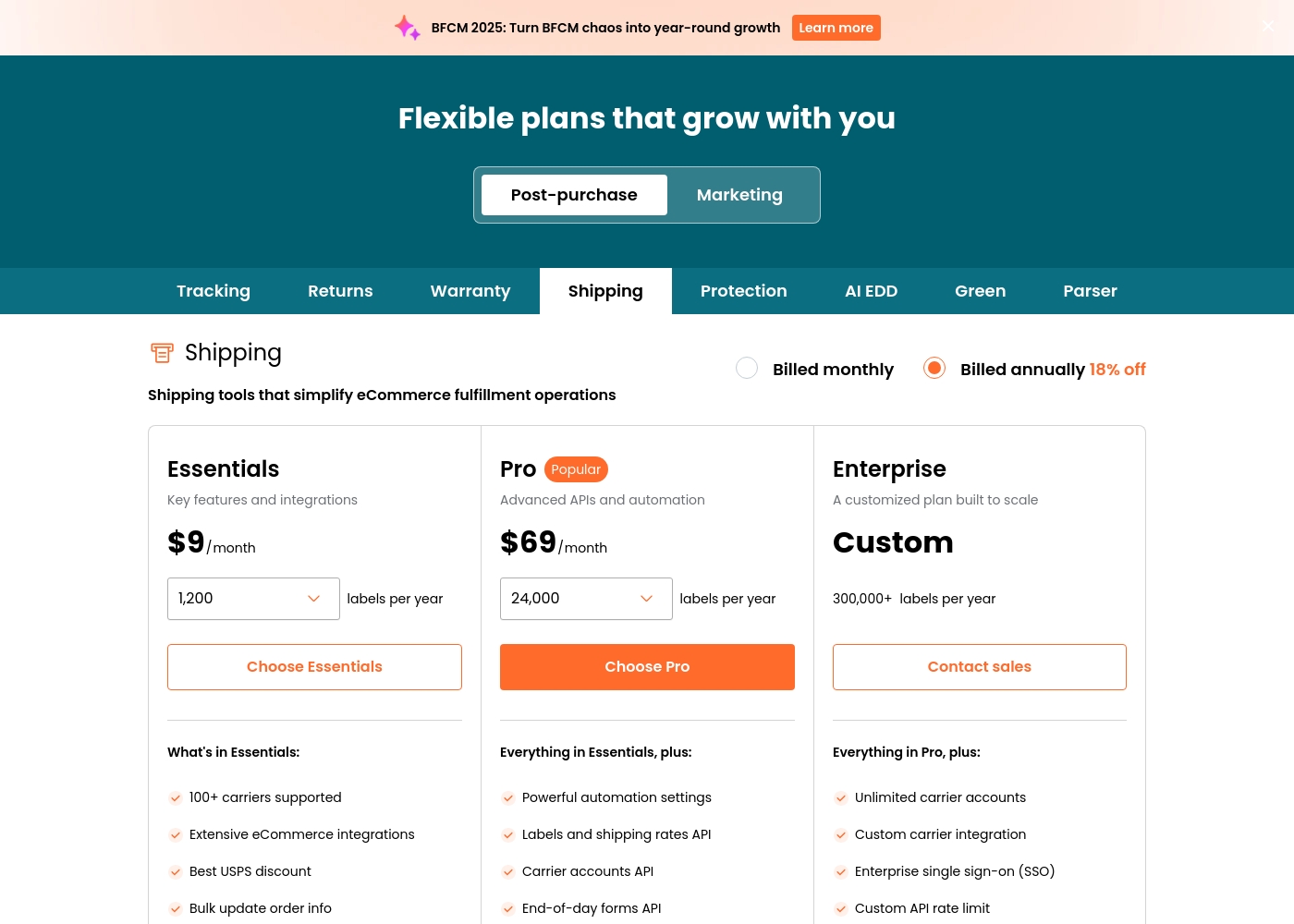
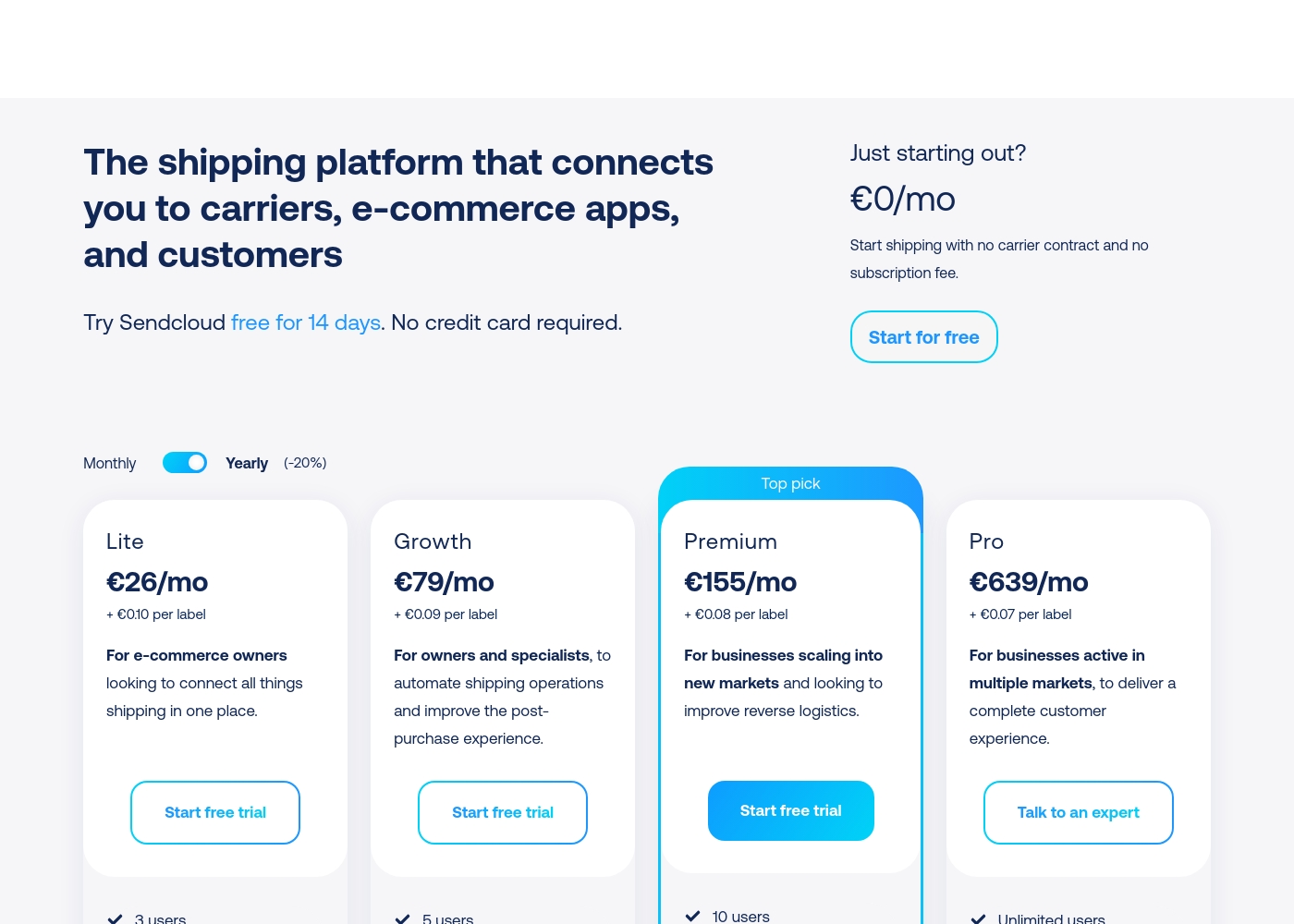
AfterShip Shipping uses a clean, predictable pricing model based on annual label volume. It costs between $0 and $69 per month for standard tiers. There is no additional per-label processing fee on top of the subscription. Sendcloud employs a hybrid model combining a subscription fee with a processing cost per label. For example, the Lite plan costs €26/month plus €0.10 per label. This setup is more complex to calculate. AfterShip Shipping offers substantial cost savings through its USPS partnership (up to 90% off). This is a massive advantage for high-volume U.S. shippers. While AfterShip Shipping is simpler, Sendcloud's tiered hybrid model rewards high-volume shippers. The per-label fee reduces significantly on the Pro plan (€0.07/label).
AfterShip Shipping costs between $0 and $69 per month with four primary plans: Free (basic features), Essentials at $9/month, Pro at $69/month, and Enterprise (Custom pricing).
Below you can review the specific limits and features for monthly billing. Remember that choosing annual billing can save you 18% on your subscription price.
Free
Price: $0 Best For: Businesses just starting out Other Features: You get all basic features and 10 free shipping labels to start.
- All basic features
- 10 free shipping labels
- 100+ carriers supported
- Extensive eCommerce integrations
- Best USPS discount
- Bulk update order info
- Bulk create shipping labels
- Everything in Essentials
- Powerful automation settings
- Labels and shipping rates API
- Carrier accounts API
- End-of-day forms API
- Everything in Pro
- Unlimited carrier accounts
- Custom carrier integration
- Enterprise single sign-on (SSO)
- Custom API rate limit
Sendcloud costs between €0 and €639 per month with 5 plans: Free at €0/mo, Lite at €26/mo, Growth at €79/mo, Premium at €155/mo, and Pro at €639/mo.
Sendcloud offers flexible plans designed to grow with your e-commerce business, starting completely free. Let's explore the individual tiers to see which features fit your shipping processes best.
Free
Price: €0/mo Websites Supported: Max. 2 integrations Best For: First steps in the e-commerce world. Other Features:
- No subscription fee.
- Includes 1 user.
- Must use Sendcloud’s discounted shipping rates.
- Provides discounted rates from major carriers.
Pricing Notes
- AfterShip Shipping pricing is solely based on annual label volume, offering a predictable cost structure.
- Sendcloud uses a hybrid model: a subscription fee plus a small per-label processing fee that decreases on higher tiers.
- AfterShip Shipping offers unique savings up to 90% through its integrated USPS partnership.
- Sendcloud offers a longer free trial (14 days) than AfterShip Shipping (7 days).
- AfterShip Shipping offers an 18% discount for annual commitment; Sendcloud offers 20% savings.
- Sendcloud Lite accounts start at €26/month plus €0.10 per label, complicating budgeting slightly.
Pricing Head-to-Head
User Reviews
AfterShip Shipping reviews reveal highly mixed feedback, reflected in its lower overall TrustScore. While the core product offers strong features like label printing and easy navigation, recurring user frustrations center on critical operational failures.
The most common complaint involves intensely slow and unhelpful customer support 👎. Many users report support tickets taking weeks or even a month for a simple reply, often finding agents unresponsive or copying irrelevant, canned text.
Debashish was super helpful! He answered all my questions quickly and even got on a Google Meet to walk me through the steps. This was truly excellent customer service.
Sendcloud maintains a strong reputation, reflected in its 4.1-star rating across thousands of reviews. Users consistently praise the platform's ability to simplify shipping operations, highlighting a clean, intuitive, and highly reliable interface that saves significant time, often automating tasks that previously took hours.
The greatest strengths noted are the excellent and fast integrations with over 160 carriers, effectively turning shipping management into "one-stop shopping." Onboarding receives phenomenal feedback, with numerous users specifically naming agents who provided excellent, specialized support. While many find the pricing competitive, especially the free plan, a few growing businesses expressed frustration about the recent introduction of paid monthly fees or finding carrier defaults (like DPD) too costly.
Onboarding was brilliant; I couldn't fault a single thing. Our specialist was excellent and knew everything about the platform. Without that guidance, we certainly would have struggled and gone elsewhere.
Our Verdict
Choosing between AfterShip Shipping and Sendcloud depends heavily on execution versus ambition. If you need a trustworthy, feature-complete platform, Sendcloud is the clear winner. AfterShip Shipping certainly promises powerful tools, but the user experience seems severely flawed. AfterShip Shipping’s superpower lies in its deep developer focus and cost savings. Its Pro plan unlocks critical APIs for rates and U.S. address validation for custom scaling. Plus, you can score massive savings, up to 90%, using the built-in USPS discount program. Sendcloud excels at the complete customer lifecycle and global reliability. It connects you to over 160 carriers and features a highly intuitive user interface. Crucially, Sendcloud includes an effective, branded returns portal and highly rated customer support. Sendcloud truly makes shipping feel like a brand asset. The deciding factor should be user reliability and post-purchase experience. Sendcloud delivers trusted, effective shipping operations validated by its high customer rating. AfterShip Shipping is only preferable if your engineering team absolutely requires those very specialized APIs and accepts the risk of buggy operation. If you prioritize customer satisfaction and smooth operations, choose Sendcloud today. AfterShip Shipping is better only for the few enterprises needing custom API endpoints for specialized, high-volume logistics.
Frequently Asked Questions
Which software offers better deals on shipping rates?
AfterShip Shipping offers massive savings up to 90% via its USPS partnership. Sendcloud allows users to leverage competitive discounted rates on 160+ carriers. You can also upload your existing contracts with both AfterShip Shipping and Sendcloud (paid plans).
Does AfterShip Shipping include phone support like Sendcloud?
No, guaranteed quick support with AfterShip Shipping requires purchasing an expensive support add-on. Sendcloud includes phone support starting at the Growth plan level. Sendcloud also assigns a dedicated Customer Success Manager on its high-tier Pro plan.
Which platform is better for managing customer returns?
Sendcloud is significantly better for returns management organization. It provides an automated, professional self-service returns portal for your customers. AfterShip Shipping has no dedicated feature designed for managing customer returns efficiently.
Which tool is better for businesses scaling internationally and in Europe?
Sendcloud is highly focused on European expansion, supporting shipping from 8 core EU nations. AfterShip Shipping offers worldwide carrier access but lacks the specific regional depth. Sendcloud also handles complex customs paperwork automatically.
Does AfterShip Shipping or Sendcloud have a higher user review rating?
Sendcloud benefits from high user satisfaction, evidenced by a strong 4.1-star rating. AfterShip Shipping is suffering from significant customer complaints, resulting in a low 2.8-star rating. Sendcloud is generally regarded as more reliable.
Which tool offers more options for deep system integration?
AfterShip Shipping offers powerful, specialized APIs for items like U.S. address validation on its Pro plan. Sendcloud focuses on out-of-the-box integrations with over 100 systems. Choose AfterShip Shipping if you need deep, custom engineering access.
Ready to Choose?
Both tools have their strengths. Choose based on your specific needs.