AfterShip Email vs Aweber
AfterShip Email and Aweber target slightly different marketers in the email world. AfterShip Email is deeply integrated with eCommerce for boosting revenue and recovery. Aweber focuses on providing easy, flexible email tools for small businesses and creators. Choosing the right one depends entirely on your primary marketing goals.
Best for: E-commerce businesses focused on maximizing sales recovery (4.2% rate), Stores heavily leveraging Shopify or WooCommerce data syncs
Best for: Small business owners and individual creators, Teams requiring reliable 24/7 phone and chat support
Feature-rich, but buyer beware of support.
The platform offers impressive specialized eCommerce automation features and supports robust AI-powered segmentation. However, we identified significant, widespread user complaints regarding poor operational reliability and extremely slow, unhelpful customer support organizationally. Overall, the powerful feature set is clearly offset by notable business practice and service risks.
Pros
- Specialized tools built for eCommerce (abandoned carts, unique coupon codes).
- Robust AI features available for predictive demographics and customer segmentation.
- Clear, flexible pricing tiers that include a helpful free plan.
- Intuitive drag-and-drop editor simplifies creating personalized email campaigns.
Cons
- Widespread user reports of extremely unresponsive and ineffective customer support.
- System reliability issues cited, particularly concerning data accuracy (tracking service).
- Recurring user complaints about unauthorized charges and difficulties canceling subscriptions.
Feature-rich, hampered by operational flaws.
We find AWeber provides a functional email marketing platform targeting small businesses with strong automation and AI tools. However, external feedback detailing unexpected billing practices and unannounced account suspensions raises significant concerns about user trust and service reliability. Overall, the reported operational and customer service drawbacks severely counteract the platform's solid feature set.
Pros
- Access to 24/7 support via phone, chat, and email (as advertised).
- Robust AI assistants available for drafting emails and refining subject lines.
- Flexible pricing tiers starting low for 500 contacts, available with a free trial.
- Unlimited features provided on the Plus plan, including automations and landing pages.
Cons
- Numerous reports of 'sneaky billing,' including charging for unsubscribed or inactive lists.
- Customer accounts or essential features often suspended without prior email notification.
- Users report significant difficulty securing refunds, even when canceling during the trial period.
- Arbitrary rejection of imported customer lists, leading to account suspension risks.
AboutAfterShip Email
AfterShip Email is an agile email automation tool built specifically for eCommerce needs. It helps you design and execute targeted campaigns that boost sales and improve customer engagement. This software works well with major platforms like Shopify, WooCommerce, and Klaviyo, ensuring you can leverage existing data easily. 💡
The platform provides well-designed templates for various scenarios, allowing you to create relevant content without excessive complications. By integrating seamlessly with other AfterShip systems, you can achieve full visibility and engagement throughout the customer lifecycle.
AboutAweber
AWeber is a dedicated email and automation solution created to support small businesses. Their goal is to provide powerful tools that help you grow at a fraction of the cost of other systems. The platform focuses on making it easy to grow your customer base and increase your total revenue. ✅
It offers ready-made, eye-catching landing pages and sign-up forms that you can effortlessly add to your website. If you're ready to sell directly, you can also set up your own online store in just minutes. This complete system is designed to take your business to the next level.
Highlights
Feature Comparison
Features Overview
We highlight the main differences and pick a winner for each feature.
Customer Support
Aweber offers consistent 24/7 staff support to all users. AfterShip Email requires costly upgrades for reliable, guaranteed response times.
AfterShip Email standard support is often cited by users as highly unresponsive and slow. The platform offers Silver support with guaranteed 10-minute chat fixes. However, this premium support requires users to purchase the highest tiers of AfterShip Email. Aweber provides 24/7 in-house support via phone, live chat, or email to all subscribers. Aweber users consistently praise their responsive support team. If reliable help is critical, Aweber is the safer choice over the standard service provided by AfterShip Email.
eCommerce Specialization
AfterShip Email contains purpose-built tools for sales recovery and revenue optimization. Aweber provides general tools for selling products.
AfterShip Email is optimized for direct transactional gains in high-volume stores. Their abandoned cart flows achieve a reported 4.2% recaptured rate. AfterShip Email helps prevent fraud by offering unique coupon codes for single use, driving a 48% revenue rise. The system specializes in post-purchase customer journeys. Aweber supports commerce by allowing Stripe payments and subscriptions but focuses on simple creator sales. It lacks the deep, specialized recovery mechanics of AfterShip Email. For serious e-commerce stores focusing on maximizing Average Order Value, AfterShip Email is clearly superior.
AI and Segmentation
AfterShip Email uses AI for deep targeting intelligence. Aweber uses AI to assist with content creation.
AfterShip Email leverages Predicted Demographics to forecast customer age and gender profiles. This strategic insight informs advanced automated segmentation and targeting. AfterShip Email also includes AI-powered product recommendations to increase cart value seamlessly. This AI functionality is focused on strategic optimization. Aweber includes an AI writing assistant to help users rapidly generate email copy and subject lines. This is a great tool for overcoming writer's block quickly. The choice is between AfterShip Email’s superior *targeting* or Aweber’s valuable *efficiency* aid.
Integrations & Ecosystem
Aweber offers 750+ integrations for broad connectivity. AfterShip Email concentrates primarily on deep retail platform syncs.
AfterShip Email delivers essential, deep data synchronization with Shopify, WooCommerce, and Klaviyo. This focus ensures data streams remain reliable and consistent. Aweber boasts over 750 integrations, offering connections to nearly any tool a small business might use. This massive breadth offers extreme flexibility for creators. If your entire stack is built around retail logistics, AfterShip Email works beautifully. If you need wide access to niche marketing or CRM tools, Aweber is better.
Setup and Lead Capture
Aweber provides ready-made landing pages and forms instantly. AfterShip Email requires external tools for popups and forms.
AfterShip Email requires integrating third-party tools like OptiMonk or Privy to generate popups and capture new leads. The platform focuses on the email flow builder once contacts are acquired. AfterShip Email’s core strength is designing complex automation sequences using conditional logic. Aweber includes ready-made landing pages and sign-up forms built into the platform. This makes launching lead capture strategies very fast and hassle-free. Aweber is simpler for solo entrepreneurs who want a one-stop-shop for capturing new subscribers.
Security and Compliance
AfterShip Email offers clear enterprise-level compliance certifications. Aweber does not specify major external security standards.
AfterShip Email is ISO 27001 certified, confirming rigorous internal security standards. They also publicly state their adherence to GDPR compliance protocols. These certifications are essential for larger, global enterprises. Aweber mentions data processing terms in policies but does not cite these crucial certifications in the provided data. This visibility gap may concern businesses with strict data governance requirements. For users prioritizing official security accreditation, AfterShip Email provides greater certainty and documentation.
Migration Services
Aweber provides guided, free migration services for all plans. AfterShip Email only includes dedicated migration support in its Enterprise tier.
Aweber offers free migration services staffed by their in-house team. Users get a 1:1 setup call and guidance to make switching easy. Aweber simplifies the onboarding process significantly with this inclusive service. AfterShip Email lists dedicated ESP migration as a key feature of its costly Enterprise plan. Non-Enterprise users rely on a one-time data sync, which requires more self-management. For small teams migrating a list, Aweber saves time and stress by handling the heavy lifting.
Pricing Structure
AfterShip Email has defined contact tiers and an optional $1 trial for new accounts. Aweber's pricing details beyond the free plan are less clear.
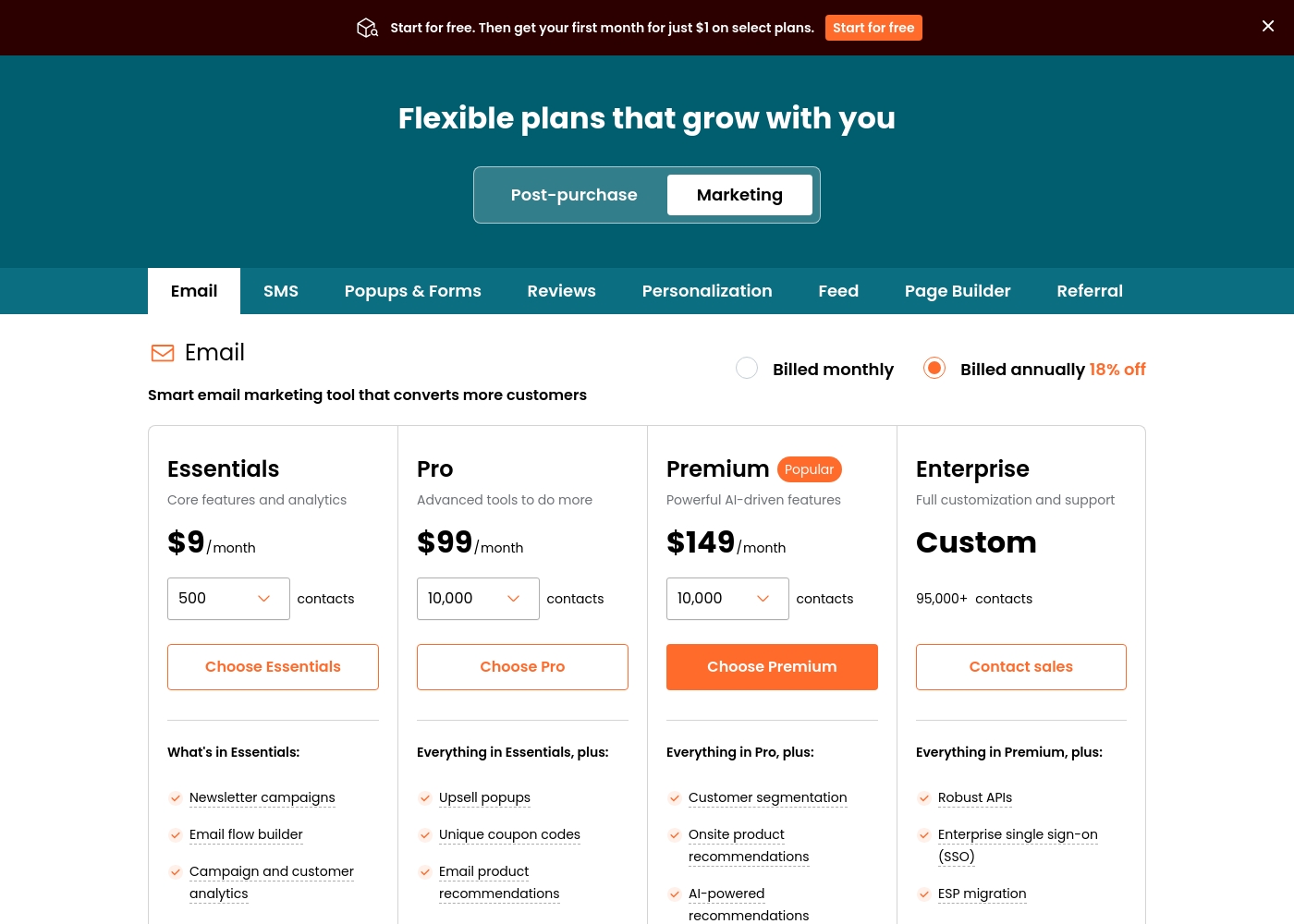
AfterShip Email clearly defines costs based on contact volume for Essentials ($9), Pro ($99), and Premium ($149). They offer a substantial 18% savings for annual billing commitments. AfterShip Email also has a separate, clear $12/user/month charge for dedicated team access. Aweber offers a free plan and a price range of “0–50” but lacks clear public details on contact scaling limitations. AfterShip Email offers more structured and transparent scaling options for contact limits and feature sets.
AfterShip Email costs between $9 and Custom per month with 4 main paid plans: Essentials at $9/month, Pro at $99/month, Premium at $149/month, and Enterprise at Custom pricing.
These flexible plans are designed to accommodate your growing business needs, with pricing based on your number of contacts. If you choose to be billed annually instead of monthly, you save 18%.
Essentials
Price: $9/month Best For: Core features and analytics Other Features:
- Newsletter campaigns
- Email flow builder
- Campaign and customer analytics
- Remove AfterShip branding
- Includes all basic features
- Newsletter campaigns
- Email flow builder
- Campaign and customer analytics
- eCommerce and ESP integrations
- Remove AfterShip branding
- Everything in Essentials, plus:
- Upsell popups
- Unique coupon codes
- Email product recommendations
- Countdown timers
- Everything in Pro, plus:
- Customer segmentation
- Onsite product recommendations
- AI-powered recommendations
- Advanced automated email flows
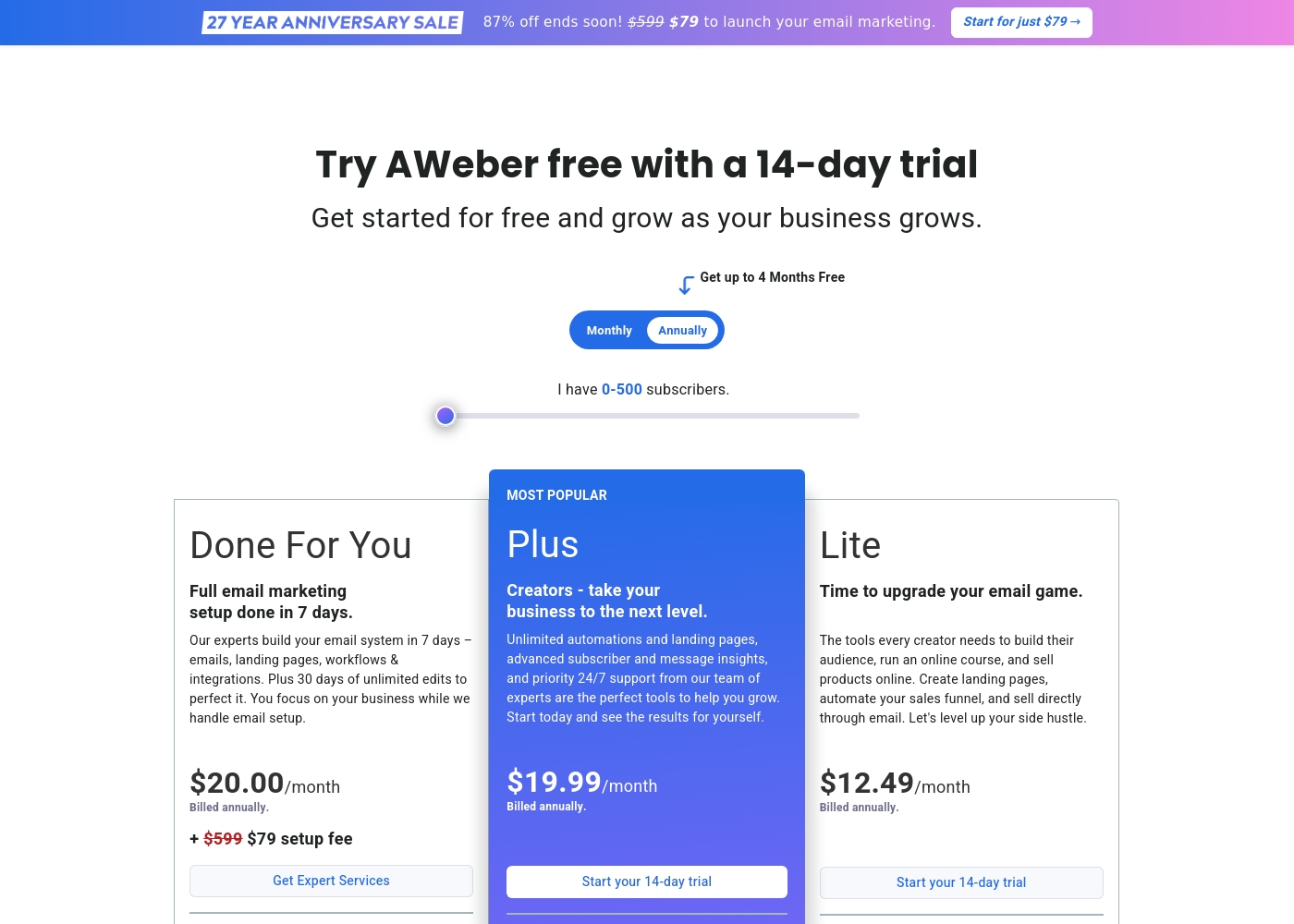
Aweber costs between $12.49/month and $20.00/month (billed annually) for 0-500 subscribers with three options: Lite at $12.49/month, Plus at $19.99/month, and Done For You at $20.00/month plus a $79 setup fee.
These pricing points reflect the annual billing option for the entry-level subscriber count. Your monthly cost will increase as your list grows beyond 500 subscribers.
Lite
Price: $12.49/month (Billed annually) Best For: Creators starting a side hustle or selling courses Other Features:
- Limited to 3 Landing pages and 3 Email automations
- 1.0% Ecommerce transaction fees
- Includes Web Push Notifications service
- Send to basic segments only
- Create landing pages, automate sales funnels, and sell directly through email
- Web Push Notifications (up to 50,000 subscribers/sends)
- Simple subscriber and message analytics
- AWeber Ecommerce (1.0% transaction fee)
- Unlimited automations and landing pages
- Advanced subscriber and message insights (analytics)
- Priority 24/7 Phone, Chat, and Email support
- Remove AWeber branding
- AWeber Ecommerce (0.6% transaction fee)
- Full email marketing setup done in 7 days by experts
- Includes emails, landing pages, workflows, and integrations built
- 30 days of unlimited edits to perfect the system
Pricing Notes
- AfterShip Email pricing is highly transparent, based on contact volume tiers (500 to 95,000+ contacts).
- AfterShip Email charges an extra $12 per member monthly for team access seats.
- Committing to annual billing saves AfterShip Email users a significant 18%.
- Aweber's specific per-contact pricing structure beyond the free tier remains ambiguous from the provided data.
Pricing Head-to-Head
User Reviews
The external feedback available mostly targets AfterShip’s core logistics and tracking product, not the dedicated Email marketing tool. However, the consistent negative sentiment raises significant concerns about the company's overall operational reliability and customer support structure.
Users frequently cite major issues with tracking accuracy, noting packages are often shown as "still on the way" even after delivery, or that logs are contradictory. More alarmingly, the review volume heavily criticizes the customer service experience.
This is some of the worst business support I’ve received. Agents refuse to read the context in the thread and just copy-paste answers that don't address the core question. Getting a simple reply often takes over a month to process.
User feedback drawn from Trustpilot highlights significant issues, focusing primarily on billing transparency and account management practices. Users frequently cite instances of unexpected charges and "sneaky billing," such as being billed for unsubscribed contacts or experiencing price jumps after promotional periods ended.
Some customers reported that charges continued well after they attempted to cancel annual subscriptions. Customer support experiences are highly polarized; although AWeber advertises award-winning 24/7 service, several reviewers detail unhelpful interactions, arbitrary account suspensions (often related to list importing issues), and frustrating difficulty obtaining refunds even during specified trial periods, leading to claims of "unethical" practices.
I have been an AWeber client for a while and usually I'm quite happy with their offering. Their helpline is reliable and quick whenever I do need assistance with campaigns. This long-term relationship suggests consistent service quality has been provided.
Our Verdict
Choosing between AfterShip Email and Aweber requires evaluating your business needs vs their infrastructure performance. If you are a high-volume e-commerce seller, AfterShip Email offers powerful, specialized tools. However, for most small businesses, Aweber offers reliable service and better support. AfterShip Email’s superpower is its deep revenue generation and recovery mechanics for online stores. It boasts a 4.2% recaptured rate using advanced abandoned cart flows. AfterShip Email successfully uses predictive AI and unique coupon codes to optimize every transaction for e-commerce. Aweber shines with its fantastic 24/7 in-house support team, which is accessible to everyone using the tool. Small businesses love Aweber because it offers a vast ecosystem of 750+ integrations for broad connectivity. Aweber makes getting started fast with built-in landing pages and free migration services. If reliable 24/7 customer support is your absolute priority, Aweber is the clear organizational winner. If you manage high-volume e-commerce sales and require deep, specialized recovery tools, AfterShip Email provides the crucial advanced features. Pick AfterShip Email if you need ISO 27001 security and deep Shopify optimization for revenue generation. Choose Aweber if you prioritize broad platform connectivity and consistent human guidance for your small business growth.
Frequently Asked Questions
Which tool is better for e-commerce abandoned cart recovery: AfterShip Email or Aweber?
AfterShip Email is superior for e-commerce recovery tools. The platform reports a significant 4.2% recaptured rate on abandoned cart sales. AfterShip Email focuses heavily on revenue optimization, including unique coupon codes.
Does AfterShip Email have AI writing tools like Aweber?
No, AfterShip Email does not include an AI writing assistant for content creation. Aweber offers a built-in AI writing and subject line assistant. AfterShip Email uses AI for demographic prediction and strategic segmentation instead.
Which platform offers better customer support and reliability?
Aweber is known for its highly reliable 24/7 in-house support team for all users. AfterShip Email users often complain about their extremely slow standard support. AfterShip Email requires expensive Silver or Gold plan upgrades for guaranteed response times.
Which tool offers more platform integrations?
Aweber offers far more breadth with over 750 listed integrations. AfterShip Email focuses on deeper integrations, specifically with major e-commerce platforms like Shopify and WooCommerce. Aweber is better for connecting niche tools and apps widely.
Is Aweber or AfterShip Email more focused on large enterprises?
AfterShip Email has an Enterprise plan offering dedicated managers and SSO/API access. AfterShip Email also holds important ISO 27001 security certification. Aweber is primarily focused on small businesses and individual creators.
Can I get help migrating my contact list to AfterShip Email or Aweber?
Aweber provides a free migration service guided by their dedicated team. AfterShip Email only includes this white-glove service in its custom-priced Enterprise plan. For easier transition, Aweber is the better choice.
Ready to Choose?
Both tools have their strengths. Choose based on your specific needs.