Drip vs Mailchimp
Drip and Mailchimp are both email marketing powerhouses, but they play different games. Drip specializes in deep e-commerce automation for B2C brands. Mailchimp is the all-in-one platform for broader marketing needs. Here's how they stack up.

Powerful for e-commerce, but check the support.
We find Drip to be a highly capable email automation platform built specifically for B2C e-commerce. Its visual builder and smart segmentation are standout features for creating personalized customer journeys. Overall, it's a strong choice for online brands, provided your team can manage the learning curve and verify support levels.
优点
- Excellent visual workflow builder for automation
- Deep e-commerce integrations (Shopify, WooCommerce)
- Powerful, behavior-based segmentation tools
- Free migration for large lists (17,500+)
缺点
- Pricing can become expensive as contacts scale
- Some users report slow or inconsistent customer support
- Requires integration with compatible platforms
- Advanced features may have a learning curve
行业领先的功能,不稳定的支持网络
我们认为 Mailchimp 提供了行业领先的电子邮件营销功能,并辅以强大的自动化和有价值的 AI 内容优化工具。总的来说,该平台是需要强大设计和测试功能的企业的一个绝佳选择,前提是他们能预见到客户服务和复杂计费结构可能带来的摩擦。
优点
- 直观的用户界面和拖放式构建器简化了营销活动设计。
- 强大的自动化功能可帮助营销人员节省大量时间。
- 有价值的报告工具提供深入见解和行业基准测试。
- 生成式 AI 功能有助于改进内容,包括主题行。
缺点
- 客户支持经常被提及不存在、无帮助或响应缓慢。
- 计费方式被报告为具有掠夺性,对轻微的超额使用也会产生意外收费。
- 用户经常遇到技术访问问题,尤其是在双因素身份验证方面。
- 用户界面有时被描述为笨拙或难以导航。
关于Drip
Drip is an email marketing automation platform built for B2C companies that sell online. Whether you're an e-commerce brand, a course creator, or a travel provider, it gives you the tools to move beyond generic newsletters. It's designed to be a powerful yet simple engine for driving revenue through personalization. 💡
关于Mailchimp
Mailchimp 被公认为专注于电子邮件营销和高级自动化的领先平台。它旨在通过掌握数字外联来帮助企业增加收入。凭借超过 1100 万全球用户和 22 年的经验,它是实现更多销售的可靠选择。
这个强大的平台非常适合寻求无缝转化工具的企业,包括集成的短信活动。您可以无风险地开始发送您的第一封电子邮件,甚至开始时都不需要信用卡。Standard 或 Premium 套餐的用户可以获得个性化的产品导览,以自信地开始使用他们的营销活动。💡
亮点
功能比较
功能概览
我们强调主要差异并为每个功能选择获胜者。
User Interface
Drip's builder is focused on e-commerce personalization. Mailchimp's is broader with more templates and AI help.
Drip provides a clean, visual email builder designed to pull in product data from your store. It feels tailored for creating dynamic, personalized e-commerce messages. Mailchimp offers a highly intuitive drag-and-drop builder with a massive library of expert templates. Its recent generative AI features help write subject lines and copy faster. The key difference is specialization vs. breadth. Drip's UI feels built for a single purpose. Mailchimp's feels like a full-service marketing studio.
Automation
Drip excels at deep, behavior-driven e-commerce workflows. Mailchimp offers powerful, more general-purpose automations.
Drip shines with pre-built workflows for cart abandonment, browse abandonment, and post-purchase sequences. It connects directly to store data for hyper-targeted actions. Mailchimp provides enhanced automations on its Standard plan, including customer journeys and conditional logic. It's great for welcome series, lead nurturing, and re-engagement campaigns across industries. Drip's automations are a scalpel for e-commerce revenue. Mailchimp's are a Swiss Army knife for general marketing tasks. Both are powerful, just for different goals.
Reporting & Analytics
Mailchimp offers deeper, industry-benchmarked reports. Drip focuses on e-commerce revenue metrics.
Mailchimp's analytics include funnel visualizations and unique industry benchmarking. You can compare your open rates directly to competitors in your sector. Drip's reports are laser-focused on revenue attribution. It tracks how much money your email campaigns and segments generate. It claims segmented users earn 5x more revenue. Mailchimp gives you a broader marketing view. Drip gives you a clear ROI view for e-commerce. For most, Mailchimp's insights are more comprehensive.
Integration Ecosystem
Mailchimp has a significantly larger library of integrations. Drip has deep, focused e-commerce connections.
Mailchimp connects to over 300 platforms, including Shopify, Google Analytics, Canva, and QuickBooks. It's designed to be the central hub of your marketing stack. Drip offers 50+ integrations, but they are heavily weighted toward e-commerce and booking platforms like Shopify, BigCommerce, and WooCommerce. The connections are deep and purpose-built. If you use many different tools, Mailchimp wins on sheer quantity. If you're in e-commerce, Drip's focused integrations might feel more relevant.
Pricing Model
Drip is pure usage-based. Mailchimp uses tiered plans with per-seat limits.
Drip's pricing is straightforward: you pay based on your number of active contacts and email volume. No per-user fees. All plans include unlimited sends. Mailchimp has four clear tiers (Free, Essentials, Standard, Premium). Each tier has a set number of user seats and email send limits (10x, 12x, or 15x contacts). Drip's model scales cleanly with your list. Mailchimp's model scales with both your list and team size. Drip can get expensive at high contact counts, while Mailchimp's Premium tier is for enterprises.
Customer Support
Both have mixed reviews. Drip offers live chat at higher tiers. Mailchimp has 24/7 chat on paid plans.
Drip provides email support for all paid users and live chat for those on $99+/month plans. Reviews mention fast chat responses but inconsistent email support. Mailchimp offers 24/7 email and chat support on Essentials and above. Premium adds phone support. Reviews are polarized, citing some excellent help and some frustrating, unhelpful experiences. Both platforms have support issues highlighted in user reviews. Mailchimp's 24/7 availability is a slight edge, but quality can vary for both.
Learning Curve
Drip is simpler for e-commerce users. Mailchimp offers more features, which can mean a steeper initial climb.
Drip is designed for e-commerce operators. If you sell online, its workflows and segmentation make intuitive sense from the start. The focus is narrow. Mailchimp is a full marketing platform with email, automations, forms, ads, and more. There's more to learn, but the interface is generally considered very user-friendly. For a specific e-commerce use case, Drip might be quicker to master. For general marketing needs, Mailchimp's breadth is more to explore but well-guided.
Mobile Experience
Both offer capable mobile apps for managing campaigns on the go.
Drip has a mobile app that lets you manage contacts, view reports, and perform basic tasks from your phone. It's functional for monitoring. Mailchimp's mobile app is well-regarded, allowing you to create campaigns, view reports, and manage contacts from anywhere. It's a robust companion to the desktop platform. Both provide solid mobile experiences. Mailchimp's app is often cited as slightly more feature-complete for campaign creation.
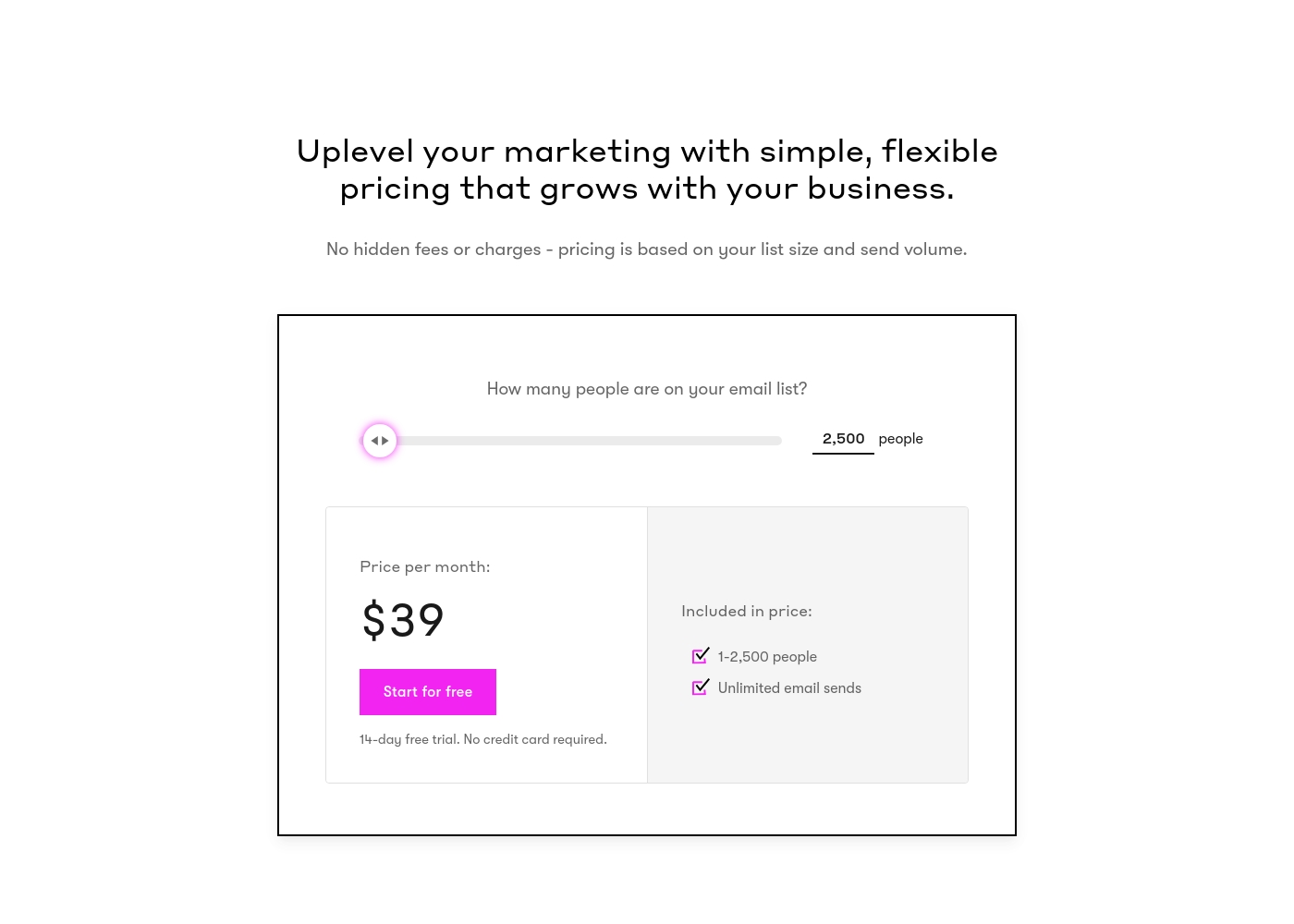
Drip pricing: Drip offers a flexible, usage-based subscription starting at $39/month for up to 2,500 people. Pricing scales based on your email list size and includes a 14-day free trial with no credit card required to start browsing its powerful automation tools tool and visual builder.
Your monthly cost increases as your audience grows, but you always get features like unlimited email sends and onsite campaigns. This ensures you only pay for what you actually use while accessing expert support and pre-built marketing playbooks right from the start.
You can cancel your subscription at any time within your billing settings if your business needs change. This model is specifically designed for e-commerce brands looking for deep segmentation and personalized customer journeys without enterprise-level complexity or hidden fees.
Mailchimp 每月的费用在 0 美元到 350 美元之间,有四种主要套餐:Free(0 美元/月),Essentials(13 美元/月起),Standard(20 美元/月起),以及 Premium(需要联系销售团队以获取高容量报价)。
以下是每个套餐所提供内容的详细信息。请注意,此处显示的价格通常是针对最低的 500 个联系人层级,或者如上所述,是针对更高联系人层级的折扣价格。
Free
价格:$0/月 支持的网站:未明确说明 最适合:轻松创建电子邮件营销活动和了解您的客户。 退款政策:未明确说明 其他功能:
- 每月最多 1,000 封电子邮件(每日 500 封限制)
- 1 个席位(用户)
- 1 个受众
- 前 30 天的电子邮件支持
- 轻松创建电子邮件营销活动
- 了解您的客户
- 前 30 天的电子邮件支持
- 在正确的时间发送正确的内容
- 测试和调度功能
- 24/7 电子邮件和聊天支持
- 最多 3 个用户
- 通过个性化销售更多产品
- 优化工具
- 增强的自动化
- 生成式 AI 功能
- 定制代码的电子邮件模板
- 通过专属入职培训快速扩展
- 无限联系人
- 优先支持;为团队打造
- 生成式 AI 功能
- 基于角色的访问权限(5 个角色)
Pricing Notes
- Drip's pricing starts at $39/month for up to 2,500 contacts. There's no free plan, but the 14-day trial requires no credit card.
- Mailchimp offers a free plan for up to 500 contacts. Paid plans start at $13/month (Essentials). A 14-day trial is available for paid tiers.
- Drip includes unlimited email sends on all paid plans. Mailchimp has monthly send limits (10x, 12x, or 15x your contact count) and overage fees.
- Drip has no per-user fees. Mailchimp's Essentials plan allows 3 users, Standard 5, and Premium unlimited.
- Both platforms increase cost as your contact list grows. Drip's model is more direct; Mailchimp's involves plan tiers and potential overages.
Pricing Head-to-Head
用户评论
We found a mixed bag of user sentiment from Trustpilot, as the Capterra link was inaccessible. Reviews praise Drip's powerful automation and segmentation for driving revenue, with many noting its ease of use for e-commerce.
💡 On the downside, several users report frustration with customer support responsiveness and occasional platform glitches. Pricing is frequently cited as a concern, with some feeling the cost can escalate quickly as contacts grow.
Drip's automation tools are top-notch. We set up abandoned cart sequences that really boosted our recovery rate. The visual builder makes it easy to see the customer journey.
Mailchimp 收到的外部反馈两极分化,突显了优秀的产品功能与令人沮丧的支持体验之间的差异。用户一致称赞该平台的直观界面和易用性,确认了拖放式构建器和广泛的自动化功能是成长型企业的显著时间节省工具。评论者通常欣赏现有模板的质量以及平台与 CRM 和网站系统的稳健集成。然而,围绕客户支持的重大担忧被广泛报道。许多用户表示难以联系到有帮助的代表,描述了响应缓慢、代理无助,甚至个性化入职培训失败等问题。此外,计费行为也经常受到批评,被认为是“掠夺性的”,有大量报告称因超过一个人的联系人限制而触发了意外收费和自动升级。😡 尽管有强大的报告工具等出色功能,但这些反复出现的对支持和复杂计费挑战的抱怨严重影响了整体用户体验。
用户界面易于导航,拖放式电子邮件构建功能设计得非常好且简单易用。我们为所有潜在客户和现有客户的营销使用 Mailchimp。它为我们节省了大量的制作时间。
我们的判断
It's not a clear knockout—this battle depends entirely on what you sell. Drip is the specialist, while Mailchimp is the generalist. Your choice should hinge on one question: are you an e-commerce brand or a broader business? Drip's superpower is its deep integration with e-commerce platforms. It connects directly to your Shopify or BigCommerce store. Its automations are built to recover carts and turn browsers into buyers. It's a revenue machine. Mailchimp's superpower is its breadth and accessibility. It offers a free plan, hundreds of integrations, and helpful AI tools. It's designed to be the central hub for all your marketing, not just email. It's a marketing Swiss Army knife. The deciding factor is your primary goal. If maximizing online store revenue is your #1 priority, Drip's specialized tools are likely worth the higher cost. If you need an affordable, all-in-one platform to manage your whole marketing stack, Mailchimp is the safer, more flexible bet. Choose Drip if you're an e-commerce brand ready to invest in powerful automation to boost sales. Choose Mailchimp if you're a startup, small business, or non-e-commerce brand that values simplicity, a free entry point, and broad functionality.
常见问题
Which is better for Shopify stores, Drip or Mailchimp?
Both integrate well with Shopify. Drip is built specifically for e-commerce and its automations are more deeply tailored for store data. Mailchimp also offers strong Shopify sync but is a broader marketing platform.
Does Drip have a free plan like Mailchimp?
No, Drip does not offer a free plan. Its pricing starts at $39/month. It does offer a 14-day free trial without requiring a credit card. Mailchimp provides a free plan for up to 500 contacts.
Which platform is easier to set up for beginners?
Mailchimp is generally considered easier for absolute beginners due to its intuitive interface and extensive template library. Drip is straightforward but its features are more specialized for e-commerce users.
Can I send unlimited emails with Drip or Mailchimp?
Drip includes unlimited email sends on all paid plans. Mailchimp has monthly send limits on all plans, calculated as a multiple (10x, 12x, or 15x) of your contact count. Exceeding these limits incurs overage fees.
Which tool is better for advanced automation and segmentation?
Both offer advanced capabilities. Drip's strength is behavior-driven e-commerce segmentation (e.g., based on cart value). Mailchimp's strength is its broader, rule-based automations and industry benchmarking reports.
Does Mailchimp offer SMS marketing that Drip does not?
Yes. Mailchimp offers SMS marketing as a paid add-on feature on select plans in certain countries. Drip does not appear to offer a native SMS marketing feature.
准备好选择了?
这两个工具都有各自的优点。根据您的具体需求进行选择。