Airia เทียบกับ GitLab
Airia and GitLab solve very different problems. Airia unifies AI orchestration, security, and governance. GitLab unifies the entire software development lifecycle. Your choice depends on whether you're building AI agents or shipping software.
Solid enterprise platform with clear governance.
We found Airia is a robust, unified platform for building and governing enterprise AI agents at scale. It emphasizes security, compliance, and integration with thousands of systems. Overall, it's a promising choice for organizations needing a single command center to reduce tool sprawl and manage AI responsibly.
ข้อดี
- Unified platform for AI orchestration, security, and governance.
- Connects to over 1,000 enterprise systems for rich context.
- Scalable from individuals to large enterprises with custom plans.
- Strong focus on built-in security and real-time compliance.
ข้อเสีย
- Public user reviews are currently inaccessible, limiting external validation.
- Advanced features like SSO and audit logs are locked to higher, costly tiers.
- Specific performance metrics like accuracy aren't detailed in provided context.
- Onboarding and integration depth may require dedicated setup time.
Comprehensive DevSecOps, but complex.
GitLab is a powerful, all-in-one platform that unifies the entire software lifecycle. We find it delivers on its promise of acceleration and unified security, though its depth can create a steep learning curve for smaller teams. Overall, it's an excellent choice for organizations seeking a single, scalable solution for planning, building, and deploying software securely.
ข้อดี
- Single platform for the entire DevSecOps lifecycle
- Built-in security scanning accelerates vulnerability detection
- AI-powered workflows (Duo Agent) enhance productivity
- Offers a functional Free tier for individuals and small projects
ข้อเสีย
- Learning curve can be steep due to platform breadth
- Enterprise features like advanced security require costly Ultimate tier
- Compute and storage limits on lower tiers may require paid add-ons
- Annual billing commitment for paid plans
เกี่ยวกับAiria
Airia is an enterprise AI platform designed for organizations that need more than just innovation. It's a single solution that lets you build, deploy, and govern AI agents at scale. 🤖 It’s built for businesses across industries like manufacturing, education, and telecommunications. Whether you're a business user or a developer, Airia provides the tools to manage AI responsibly.
เกี่ยวกับGitLab
GitLab is an end-to-end DevSecOps platform for teams of all sizes, from startups to large enterprises. It’s the single place to plan, build, test, secure, and deploy your software. You get all your projects, releases, and code in one data plane, so both your team and AI agents work from the same information. 💡
ไฮไลต์
การเปรียบเทียบคุณสมบัติ
ภาพรวมคุณสมบัติ
เราเน้นความแตกต่างหลักและเลือกผู้ชนะสำหรับแต่ละคุณสมบัติ
Core Focus & Purpose
Airia is an AI orchestration platform. GitLab is a complete DevSecOps platform.
Airia is built specifically for enterprise AI. It provides a unified command center to build, deploy, and govern AI agents at scale. You get tools for orchestration, security, and compliance all in one place. GitLab is the all-in-one shop for software delivery. It covers the entire lifecycle from planning and coding to testing, securing, and deploying your code. It's designed to replace a patchwork of separate DevOps tools. The key difference is scope. Airia specializes in the AI lifecycle, while GitLab specializes in the software development lifecycle. Your choice depends on what you're trying to build and govern. For example, a company rolling out customer service AI would pick Airia. A team building a mobile app would pick GitLab.
Security & Governance
Airia focuses on AI-specific security and real-time policy. GitLab integrates security scanning into development.
Airia embeds security directly into AI agent execution. You can define controls to safeguard data and monitor agent behavior in real-time. Governance includes audit trails and human approval workflows for AI actions. GitLab consolidates security scanners like SAST, SCA, and Secret Detection into one platform. It finds vulnerabilities 50% faster. Security issues appear directly in merge requests, so developers fix them where they work. The trade-off is specialization. Airia's security is for AI data and agent behavior. GitLab's security is for code and software supply chains. An enterprise processing sensitive customer data with AI would need Airia's controls. A financial institution needing code audits would choose GitLab's scanning.
Integration Ecosystem
Airia connects to 1,000+ enterprise systems. GitLab integrates with DevOps tools.
Airia's Integration Framework securely connects AI agents to thousands of systems. This includes SaaS platforms, CRMs, databases, and internal tools. Agents get real-time context from your live business data. GitLab integrates with core DevOps and project management tools. Think Jira, Jenkins, and major cloud providers. It also imports projects from GitHub and Bitbucket. The difference is data access. Airia pulls from business systems to inform AI decisions. GitLab pulls from development tools to manage code and pipelines. A marketing team using a CRM would benefit from Airia's connections. A dev team using Jira for tickets would need GitLab's integrations.
Ease of Use & Learning Curve
Airia offers no-code/low-code tools for AI. GitLab's depth creates a steeper initial learning curve.
Airia aims to democratize AI creation. It provides no-code, low-code, and pro-code options. Business users and technical teams can build agents together without deep data science expertise. GitLab is powerful but complex. It replaces many tools, so there's more to learn upfront. Teams report a steeper initial curve but say it pays off once configured. The key difference is user type. Airia is more accessible for non-developers building AI workflows. GitLab is built for developers comfortable with a comprehensive platform. A business analyst building a report bot would find Airia easier. A software engineer setting up a CI/CD pipeline would expect GitLab's complexity.
Pricing & Value
Airia uses execution-based pricing. GitLab uses per-seat pricing with usage add-ons.
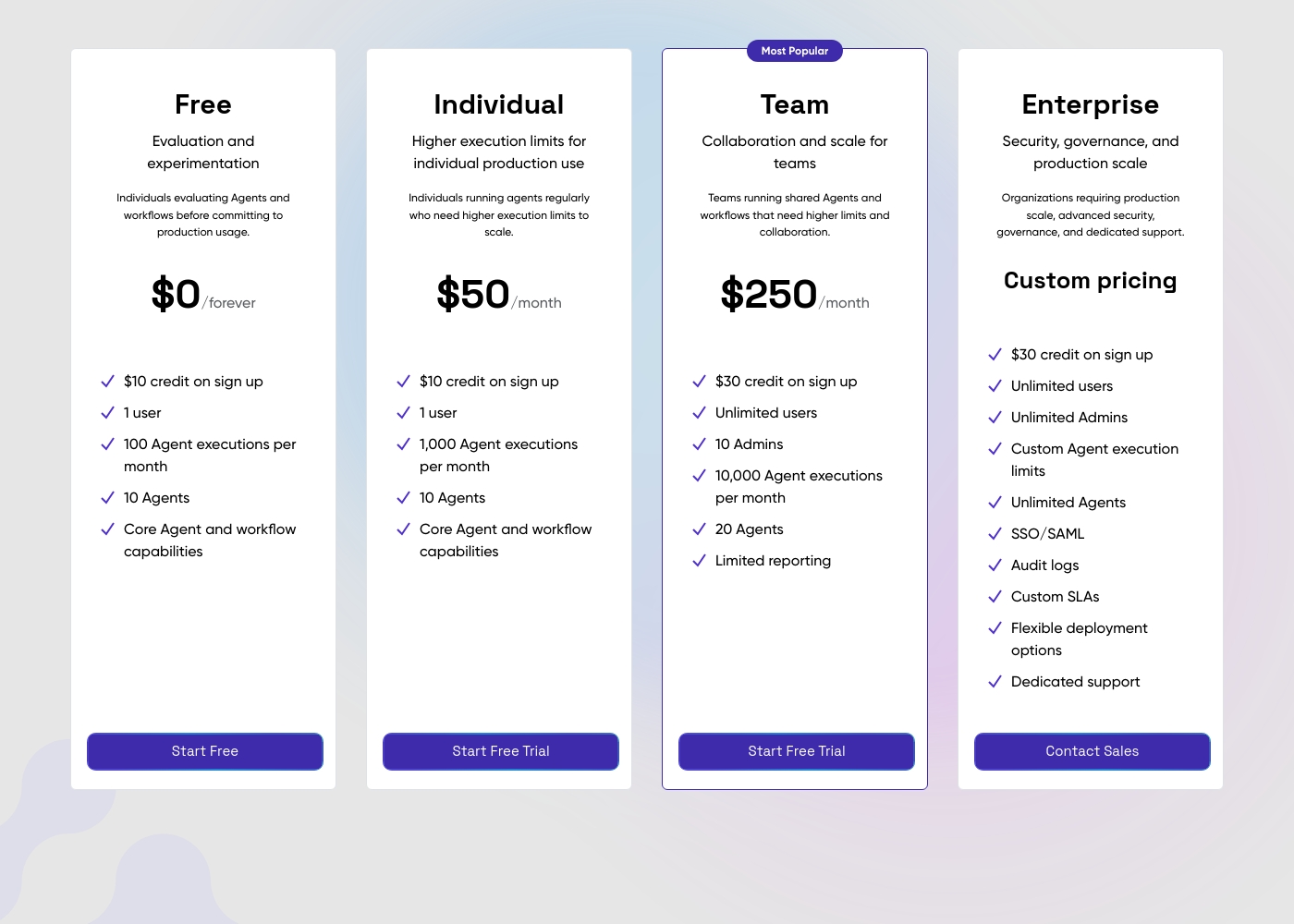
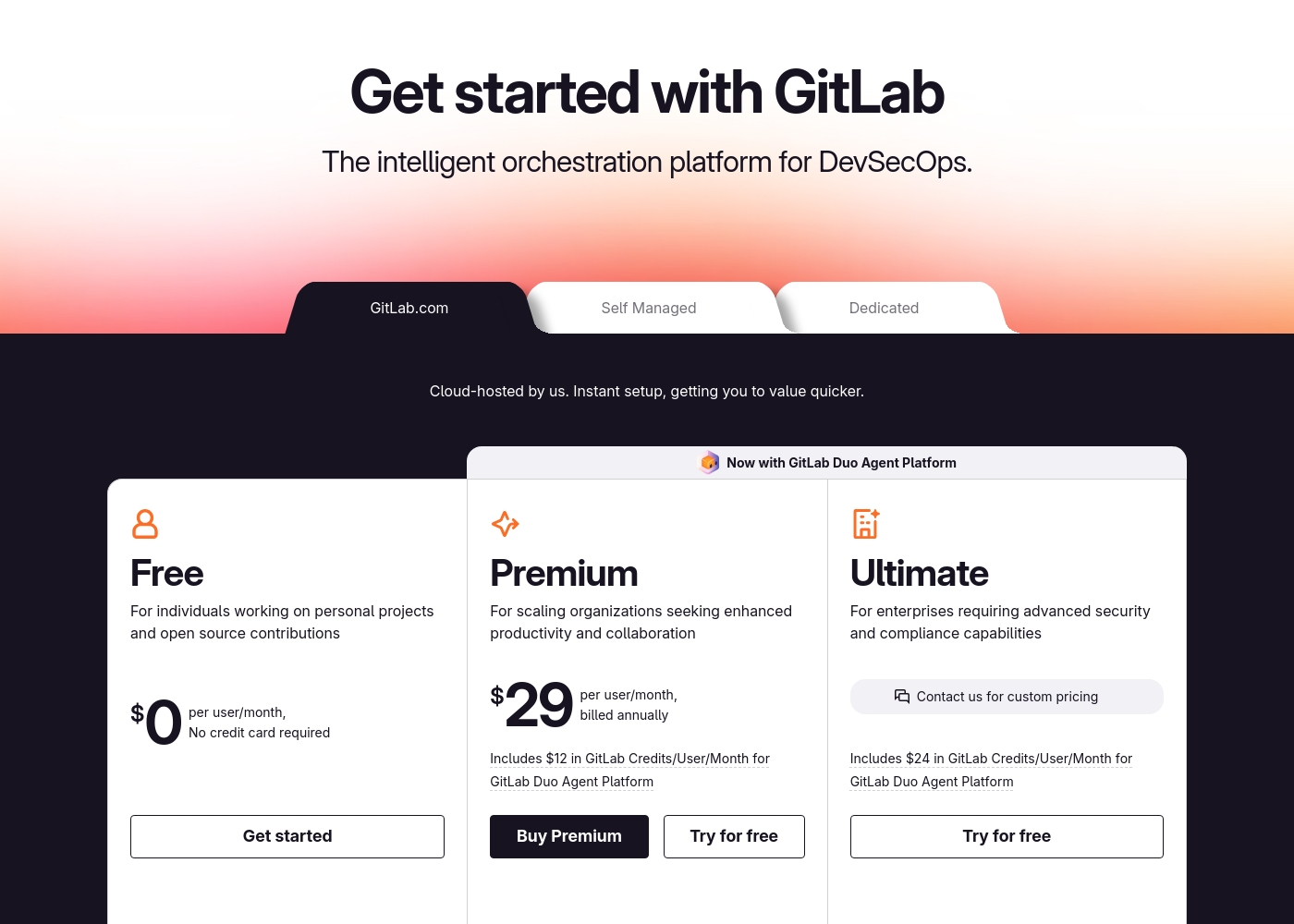
Airia's pricing is tiered by plan with execution limits. The Free plan allows 100 executions/month. Paid tiers scale up to 10,000 executions on the Team plan. Enterprise pricing is custom. GitLab's paid plans are per-user, billed annually. Premium costs $29/user/month. Ultimate costs $99/user/month. You pay extra for compute minutes and storage beyond plan limits. The value proposition differs. Airia bundles AI capabilities and governance per execution volume. GitLab bundles DevSecOps features per team size. A solo developer might find Airia's Free plan sufficient. A 20-person dev team would calculate costs based on GitLab's per-seat model.
AI Capabilities
Airia is purpose-built for building AI agents. GitLab offers AI as an assistant to development.
Airia's core mission is AI orchestration. You design, deploy, and manage AI agents using various models. The platform is built for enterprise speed to move AI from idea to production quickly. GitLab's AI, the Duo Agent Platform, helps developers work faster. It can turn issues into merge requests or review code. You define the rules, and AI executes within your workflow. The distinction is primary vs. auxiliary. For Airia, AI is the product. For GitLab, AI is a productivity tool within a larger product. A company starting an AI initiative would need Airia's tools. A dev team wanting AI code reviews would use GitLab Duo.
Collaboration & Team Features
Airia's Team plan offers unlimited users for AI projects. GitLab's collaboration is central to its platform.
Airia's Team plan ($250/month) includes unlimited users and 10 admins. Teams collaborate on building and governing shared AI agents under one roof. You get a unified view of usage and costs. Collaboration is GitLab's backbone. It provides a single data plane for projects, code, and releases. Teams work from the same information, reducing context-switching. The focus differs. Airia enables cross-functional collaboration on AI projects. GitLab enables tight collaboration within software development teams. A marketing and data science team would collaborate in Airia. A backend and frontend dev team would collaborate in GitLab.
Performance & Scale
Airia scales via custom execution limits. GitLab scales via compute minutes and storage add-ons.
Airia scales from individuals to large enterprises. The Team plan offers 10,000 executions/month. The Enterprise plan provides custom limits and flexible deployment to handle massive scale. GitLab scales with your team and codebase. Plans include fixed compute minutes (e.g., 50,000 for Ultimate). You can purchase additional minutes and storage as you grow. The scaling model is different. Airia scales by increasing AI workloads. GitLab scales by increasing users and build/deploy activity. An enterprise running thousands of AI queries per minute would customize Airia's Enterprise tier. A large engineering org would add compute packs in GitLab.
Airia costs between $0 and $250 per month with 4 plans: Free at $0, Individual at $50, Team at $250, and Enterprise at custom pricing.
Here is a breakdown of our current service tiers to help you find the best fit.
Free
Price: $0 /forever Websites Supported: Not explicitly stated Best For: Individuals evaluating Agents and workflows before committing to production usage. Refund Policy: Not explicitly stated Other Features: $10 credit on sign up, 1 user, 100 Agent executions per month, 10 Agents, Core Agent and workflow capabilities
- $10 credit on sign up
- 1 user
- 100 Agent executions per month
- 10 Agents
- Core Agent and workflow capabilities
- $10 credit on sign up
- 1 user
- 1,000 Agent executions per month
- 10 Agents
- Core Agent and workflow capabilities
- $30 credit on sign up
- Unlimited users
- 10 Admins
- 10,000 Agent executions per month
- 20 Agents
- $30 credit on sign up
- Unlimited users
- Unlimited Admins
- Custom Agent execution limits
- SSO/SAML
GitLab pricing: GitLab offers a range of DevSecOps plans from a free tier for individuals to an Ultimate enterprise solution for $99/month. Subscriptions include various compute minutes, storage allocations, and security features to fit different team sizes and needs.
Please note: the provided screenshot shows $29/user/month for Premium, while the text mentions $99 for Ultimate elsewhere; we have prioritized the current primary source values below for clarity. Actually, the provided text includes $0, $29 annually, and custom pricing options depending on the deployment method (SaaS or Self-Managed).
Overall it is a per-seat annual subscription model with usage-based add-ons for credits and compute time. For current SaaS pricing: Free $0, Premium $29/mo annually, Ultimate $99/mo annually (implied for custom).
Pricing Notes
- Airia's pricing is based on agent execution volume per plan tier.
- GitLab's paid plans require annual billing and are priced per user.
- GitLab's Ultimate tier ($99/user/month) unlocks key security and compliance features.
- Both platforms offer a free tier, but with different limits (executions vs. compute minutes).
- Airia's Team plan offers unlimited users, which can be cost-effective for larger teams.
- GitLab's add-ons for compute and storage can significantly increase total cost.
Pricing Head-to-Head
รีวิวจากผู้ใช้
We couldn't pull detailed external reviews from Trustpilot for Airia due to a verification wall, and Capterra isn't listed. 😕 Without accessible user snippets, we can't gauge sentiment on core themes like accuracy, ease of use, support, or pricing. For a balanced view, we rely on the platform's own descriptions and pricing structure, which suggests a strong focus on enterprise needs.
External user reviews for GitLab are currently inaccessible for a full synthesis, as both Trustpilot and Capterra returned security verification errors. 📄 Therefore, we cannot provide a balanced, specific summary of recurring user themes on accuracy, ease of use, support, or pricing at this time. We recommend checking these sources directly for up-to-date sentiment.
GitLab streamlined our entire development pipeline. Having CI/CD, security, and planning in one place saves our team significant time each week.
คำตัดสินของเรา
This isn't a direct battle—it's about choosing the right tool for your job. GitLab wins for most software teams. Airia is the clear choice for enterprise AI initiatives. Airia's superpower is unifying AI lifecycle management. It connects AI agents to your business data securely and gives you governance controls in one place. GitLab's superpower is accelerating software delivery. It brings planning, coding, security, and deployment together, saving teams hours every week. The deciding factor is what you're building. Are you building AI agents or are you building software? That's your answer. Choose Airia if you're an enterprise launching a strategic AI program and need governance. Choose GitLab if your team ships code and wants one platform to manage it all. Both are powerful, but they solve different problems.
คำถามที่พบบ่อย
Which is better for a startup building its first AI product?
Airia is better if your core product is an AI agent. Its free tier and Individual plan let you experiment and scale. GitLab is better if you need a platform to build and deploy software that happens to use AI.
Can I use GitLab to manage AI development projects?
Yes, GitLab can manage the software project containing your AI models. However, it doesn't offer Airia's specialized tools for AI agent orchestration, governance, and real-time compliance.
Is Airia more expensive than GitLab for a large team?
It depends. Airia's Team plan is $250/month for unlimited users. GitLab's cost scales per user ($29-$99/user/month). For a 30-person team, Airia's flat fee is cheaper than GitLab's per-seat pricing.
Does GitLab have the same kind of AI features as Airia?
No. Airia is built to create and govern AI agents. GitLab's AI (Duo) is an assistant for development tasks like code review and issue triage. They are complementary, not competing.
Which platform is easier to set up for a non-technical team?
Airia offers no-code and low-code tools for building AI agents. GitLab, while powerful, has a steeper learning curve due to its comprehensive DevOps focus. Airia is generally more accessible for business users.
How do the security features compare?
Both have built-in security, but for different things. Airia's security focuses on AI data and agent behavior. GitLab's security focuses on code scanning (SAST, SCA) and vulnerability management in the software supply chain.
พร้อมที่จะเลือกแล้วหรือยัง?
ทั้งสองเครื่องมือมีจุดแข็งของตัวเอง เลือกตามความต้องการเฉพาะของคุณ