Vapi

Vapi review

The API-native voice AI platform for developers building voice products and running phone operations at scale.

Vapi costs from $29/mo · 2 plans · prices checked Oct 12, 2026

By Ciroapp Editorial Team · Updated Sep 16, 2026

Commission may apply at no extra cost

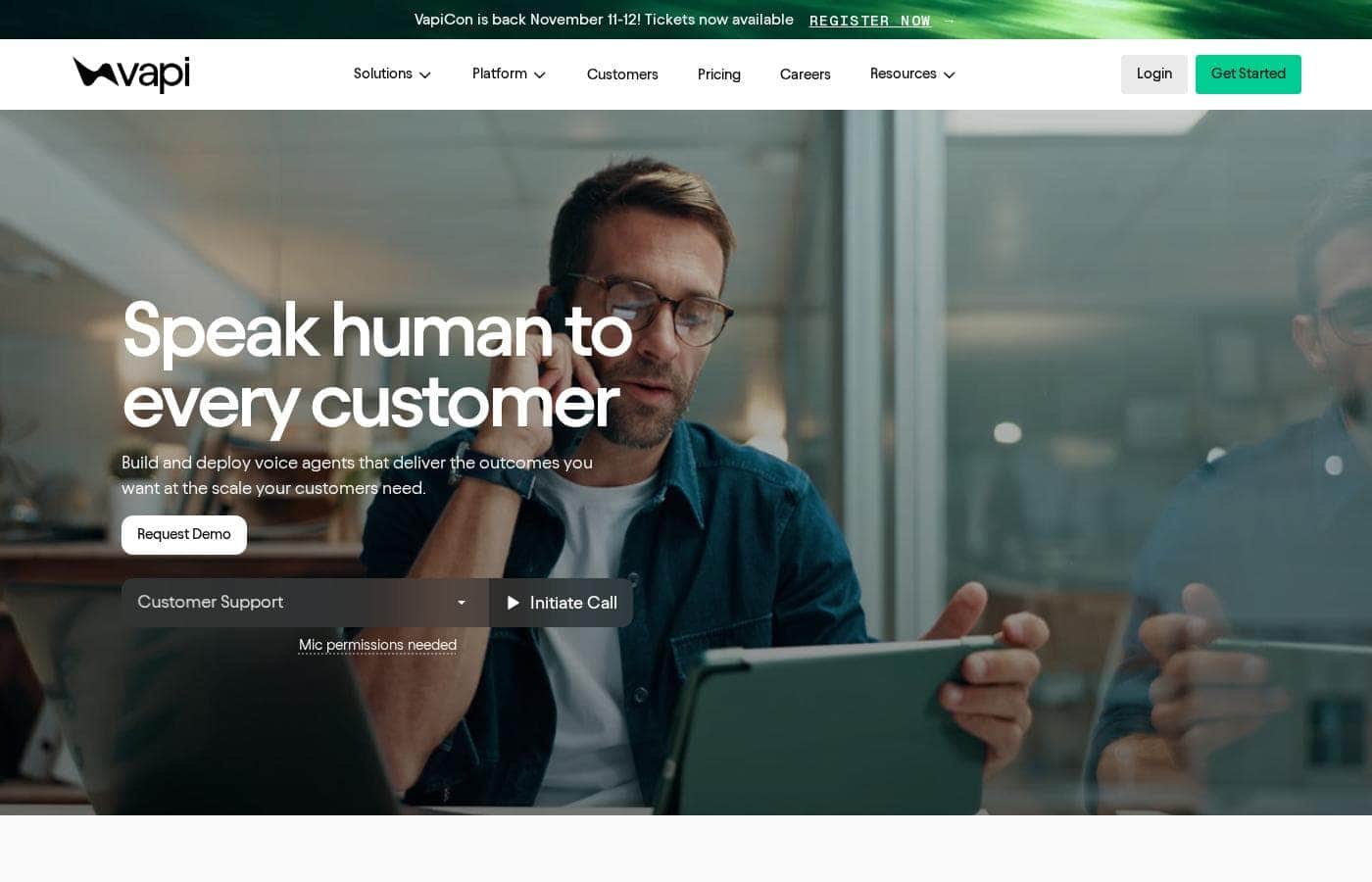
Vapi homepage screenshot

At a glance

Quick overview for Vapi: rating, pricing summary, key features, and highlights.
Pricing verified Oct 12, 2026

Ciroapp score

4.1/ 5

Vapi gives developers a single API for building voice agents that listen, understand, and respond in live calls. It's powerful and battle-tested at scale, but there's no real no-code path, and usage-based billing can be hard to predict. Overall, it's a strong pick for engineering teams that want full control.

Pros

  • Pros:Entire platform is API-native, so voice agents can be built, versioned, and managed in code like any other service in your stack
  • Pros:Offers thousands of configurations and integrations, letting teams tune agent behavior and swap components instead of accepting a fixed stack
  • Pros:Proven under production load, with voice agent deployments ranging from early-stage startups to Fortune 500 companies

Cons

  • Cons:API-native by design, so there is no meaningful no-code path; teams without developers will struggle to extract value from it
  • Cons:Usage-based billing layered on monthly plans means costs scale with call volume and can be hard to predict, with plans reaching $2,024/month
  • Cons:Achieving high-quality call outcomes depends on choosing and tuning the right configurations, which takes experimentation and engineering time
Best for
  • Engineering teams building voice AI products that need phone or voice capabilities embedded via API
  • Startups automating inbound and outbound phone operations without building the voice stack from scratch
  • Enterprises running large-scale voice agent deployments that require deep configuration control
This section is a summary. Detailed sections about features, use cases, pricing, and reviews follow below.

What is Vapi?

Vapi is an API-native platform built for developers who need serious voice AI capabilities. Instead of a point-and-click bot builder, it exposes voice agents as programmable infrastructure, with thousands of configurations and integrations available to shape behavior. Teams from early-stage startups to Fortune 500 companies use it to ship voice products and run phone operations at scale.

Vapi is a developer platform for building and running voice agents. A production voice agent has to capture speech, understand it, and respond naturally within a live conversation, and Vapi provides that pipeline through a single API so developers don't have to assemble the pieces themselves. Its API-native design makes it best understood as infrastructure: you configure agent behavior, connect your own tools, and manage calls in code.

That makes it suitable both for embedding voice into products and for operating phone systems under real load.

Should you choose Vapi?

Quick buyer guidance before you compare plans or click through.

Choose it if

  • Engineering teams building voice AI products that need phone or voice capabilities embedded via API
  • Startups automating inbound and outbound phone operations without building the voice stack from scratch
  • Enterprises running large-scale voice agent deployments that require deep configuration control
  • Developers who want control over the components and settings that shape their agents' behavior

Skip it if

  • Non-technical founders or operators who want a no-code, plug-and-play voice bot
  • Teams that need a fully managed call center product with fixed monthly costs rather than usage-based billing
  • Low-volume use cases where managing API integrations and configurations outweighs the benefit

Next steps before buying

  1. 1Visit vapi.ai/pricing and create an account on the free $0/month tier to explore the platform
  2. 2Work through the developer documentation and build a first voice agent against the API in a test environment
  3. 3Configure your integrations and agent settings, then run a small pilot to measure call quality and per-call costs
  4. 4Scale gradually while monitoring usage-based charges as your call volume grows

Vapi Key Features

✨ API-First Voice AI Infrastructure

Vapi is built API-native, which means everything the platform does is accessible programmatically. Developers can create voice agents, configure their behavior, and manage live calls through code, treating voice the same way they treat any other service in their stack. This approach suits teams that want voice capabilities embedded directly in their own product rather than a standalone dashboard tool.

✨ Thousands of Configurations and Integrations

Rather than locking you into a single stack, Vapi exposes thousands of configurations and integrations. Teams can adjust how their agents behave, connect tools they already use, and refine setups as requirements change. This depth of configurability is what makes it possible to build genuinely sophisticated voice products instead of generic phone bots.

✨ Built for Large-Scale Phone Operations

Vapi is not just for prototypes; it is designed to manage phone operations at scale. The platform is used by everyone from trail-blazing startups to Fortune 500 companies to deploy voice agents that handle real call volume. For teams whose voice product depends on reliability under load, that production pedigree matters.

✨ Consolidated Voice Agent Pipeline

A production voice agent has to listen, understand, and respond within a single live conversation. Vapi provides the pipeline that connects those pieces, so developers configure one agent instead of stitching together separate speech and language services. That consolidation is a major reason teams choose a platform like this over building from scratch.

Use Cases

💡 Customer Support Phone Automation

Support teams can deploy voice agents that answer calls, resolve common requests, and escalate when needed. Because Vapi is configurable across thousands of settings, support organizations can shape agent behavior to match their own scripts, policies, and escalation rules rather than accepting a one-size-fits-all bot.

💡 Voice-Enabled Product Features

Developers building apps that need a voice interface, whether an assistant, an interactive service, or a calling feature, can use Vapi's API to add it without constructing the underlying voice infrastructure. This is the platform's core audience: teams shipping sophisticated voice products of their own.

💡 Inbound and Outbound Phone Operations at Scale

Operations that involve many simultaneous calls, such as inbound routing, notifications, and follow-ups, can be run programmatically through Vapi. The platform's explicit design for large-scale phone operations, and its adoption by Fortune 500 companies, reflect that it is built to sustain meaningful call volume.

💡 Rapid Prototyping of Voice Agents

With plans starting at $0/month, developers can prototype a voice agent before spending anything. The same API used in production also serves experimentation, so a working prototype can evolve into a deployed agent rather than being rebuilt from scratch.

Vapi pricing

From$29/mo

  • From the vendor's pricing page, checked Oct 12, 2026
  • 2 plans

Prices checked on Oct 12, 2026 from Vapi's pricing page

Vapi pricing page screenshotView pricing page screenshot
PlanBilled monthlyBilled annuallyIncludes
Core
$29/mo
—
Pro
$999/mo
—

Price history

Tracking prices since Oct 1, 2026. No price change detected yet.

Pricing types: Monthly subscription, Usage-based pricing

Pricing notes

Vapi pricing: Billing options: Monthly subscription, Usage-based pricing

Cost calculator

Estimate what Vapi costs for your team.

Billing
Per month
$29
Per year
$348

Core states no user limit: shown as one price for the whole account. Check the price for 5 users with the vendor. Estimate based on published list prices, before taxes, add-ons and discounts.

Email me when Vapi changes price

One email when we detect a price change on the vendor's pricing page. No newsletter, no deals. Unsubscribe in one click.

User Reviews

No reviews yet.

Write a Review

Write a Review for Vapi
0/100 characters
0/2000 characters

Why use Vapi?

Building a reliable voice agent from scratch means solving telephony, speech recognition, response latency, and model orchestration independently, which amounts to months of specialized engineering. Vapi compresses that work into an API, so teams can focus on agent behavior and business logic instead.

Its thousands of configurations and integrations also mean you can tune or swap components rather than being locked into one fixed stack. That balance of speed and control is why organizations from startups to the Fortune 500 run their voice operations on it.

Vapi alternatives

Other tools in the AI voice generator category

View all AI voice generator tools
Insighto

Insighto

AI voice generator3.5/5

Insighto is an AI-powered Phone Agent Platform that automates customer conversations through AI-powered phone calls and chat, reducing wait times and improving business communications 🤖. It’s for businesses that want seamless, around-the-clock support across calls, SMS, email, WhatsApp, and live chat. It also offers fully white-labeled branding and easy CRM integrations with HubSpot, Zoho, Salesforce.

Inworld AI

Inworld AI

AI voice generator4.1/5

Inworld is a research lab and inference provider focused on realtime AI for consumer-facing applications. We build first-party speech models, serve the LLMs developers choose, and operate the inference behind modular APIs, so developers of high-volume consumer applications can meet the quality, latency, reliability, and cost bar their users require. Perfect for building Tutors, Companions, Voice agents, Fitness coaches, NPCs, Customer Experience, and more realtime conversational use cases.

Murf AI

Murf AI

AI voice generator3.8/5

Murf AI is an advanced platform focused entirely on streamlined AI voice technology. It provides a comprehensive AI Voice Studio for professionals who need to generate realistic voiceovers directly from text. You can choose from over 200 realistic voices and 10 different speaking styles. 💡 For developers, Murf also offers a suite of State-of-the-Art (SOTA) voice APIs. These APIs enable powerful capabilities like text-to-speech, voice cloning, and translation for integration into new products. Whether you are generating voices for corporate videos or designing conversational agents, Murf gives you fine-tuned control over output details like pitch, speed, tone, and specific pronunciations.

Vapi FAQ

How much does Vapi cost?

Vapi's cheapest paid plan, Core, costs $29 per month. Paid plans range from $29 to $999 per month. Prices checked on Oct 12, 2026 from the vendor's pricing page.

Does Vapi have a free plan?

No. Vapi lists no free plan; the cheapest paid plan starts at $29 per month.

Has Vapi's price changed recently?

No. We have not detected a price change since we started tracking on Oct 1, 2026.

What is Vapi?

Vapi is an API-native platform built for developers who need voice AI capabilities. It is used to create sophisticated voice products and manage large-scale phone operations, offering thousands of configurations and integrations. Teams from trail-blazing startups to Fortune 500 companies deploy their voice agents on it.

Do I need to be a developer to use Vapi?

Effectively, yes. Vapi is built API-first for engineering teams, so expect to write code and manage configurations. Non-technical teams looking for a drag-and-drop voice tool will likely find it too low-level for their needs.

Can Vapi handle high call volumes?

The platform is explicitly designed for managing large-scale phone operations, and it is used by Fortune 500 companies as well as startups. That said, you should validate performance and per-call costs against your own call volume before committing to a paid plan.

Ready to try Vapi? Check out the official site or pricing.

Are you Vapi? Claim this listing · Get the badge