Tenable

Tenable review

One platform for exposure management across IT, cloud, OT, identity, and AI attack surfaces.

Tenable costs from $308.33/mo · 4 plans · prices checked Oct 12, 2026

By Ciroapp Editorial Team · Updated Sep 16, 2026

Commission may apply at no extra cost

Tenable homepage screenshot

At a glance

Quick overview for Tenable: rating, pricing summary, key features, and highlights.
Pricing verified Oct 12, 2026

Ciroapp score

3.8/ 5

Tenable One pulls IT, cloud, OT, identity, and AI exposure checks into one prioritized risk view, built on the well-established Nessus scanner. It's a genuine consolidation play for complex estates, but pricing is quote-only and setup takes real effort. Overall, it's a solid shortlist pick for mid-size and enterprise security teams.

Pros

  • Pros:Covers the full modern attack surface — IT, cloud, OT, identity, and AI — from one platform, reducing the need to stitch together separate tools.
  • Pros:Built on the Nessus scanning heritage, one of the most widely deployed vulnerability assessment technologies in the industry.
  • Pros:Correlates findings across domains so teams prioritize genuine, combined exposures instead of reacting to raw vulnerability counts.

Cons

  • Cons:Pricing is handled through Tenable's buy page rather than a transparent published price list, which makes budget planning harder before talking to sales.
  • Cons:The breadth of the platform can be overkill for small teams or individuals who only need straightforward vulnerability scanning — standalone Nessus Pro may fit better.
  • Cons:Unifying multiple security domains means real implementation and tuning effort is required before the unified risk view becomes trustworthy.
Best for
  • CISOs and security directors at mid-size to enterprise organizations who need one consolidated risk view across IT, cloud, OT, and identity estates
  • Security teams consolidating several point tools (scanners, cloud assessors, identity checks) into a single exposure management platform
  • Industrial and critical-infrastructure organizations where OT exposure must be monitored alongside traditional IT
This section is a summary. Detailed sections about features, use cases, pricing, and reviews follow below.

What is Tenable?

Tenable One is an exposure management platform that consolidates visibility across an organization's entire attack surface. It brings together findings from IT infrastructure, cloud environments, operational technology, identity systems, and emerging AI assets into a single view of risk. The goal is to replace fragmented security tooling and siloed reporting with a prioritized picture of where the organization is most exposed.

For teams juggling disconnected scanner outputs, that consolidation is the core value proposition.

Tenable is the company behind Tenable One, a platform in the exposure management category, and its product line includes Nessus, one of the most widely deployed vulnerability scanners. Tenable One extends vulnerability management into broader exposure management by covering IT, cloud, OT, identity, and AI attack surfaces in a single platform. Rather than treating each environment as a separate security problem, it correlates findings across domains so teams can see how individual weaknesses combine into real exposure.
Should you choose Tenable?

Quick buyer guidance before you compare plans or click through.

Choose it if

  • CISOs and security directors at mid-size to enterprise organizations who need one consolidated risk view across IT, cloud, OT, and identity estates
  • Security teams consolidating several point tools (scanners, cloud assessors, identity checks) into a single exposure management platform
  • Industrial and critical-infrastructure organizations where OT exposure must be monitored alongside traditional IT
  • Teams beginning to account for AI services as part of their attack surface

Skip it if

  • Small businesses or individuals that only need a straightforward vulnerability scanner — standalone Nessus Pro is likely a better fit than the full platform
  • Buyers who require transparent, self-serve pricing without engaging a sales process
  • Teams without the resources to integrate and tune a multi-domain platform before the unified risk view delivers value

Next steps before buying

  1. 1Visit tenable.com and use the buy page to identify the right entry point — Nessus Pro for scanning-only needs or Tenable One for full exposure management
  2. 2Request a demo or quote so licensing can be scoped to your number of assets, cloud accounts, and OT sites
  3. 3Onboard your highest-risk domain first (usually IT vulnerability scanning), then add cloud, OT, identity, and AI coverage incrementally
  4. 4Define how the prioritized exposure list maps to remediation owners and workflows so findings translate into fixes rather than another dashboard

Tenable Key Features

✨ Full-attack-surface coverage

Tenable One extends visibility beyond traditional IT assets to cloud environments, operational technology (OT), identity systems, and emerging AI attack surfaces. For organizations whose critical systems sit outside the classic data center, this breadth is the platform's defining trait — one scope of coverage instead of separate products for each domain.

✨ Unified exposure and risk prioritization

Instead of presenting raw scanner output, the platform correlates findings across domains into a single view of risk. That lets security teams rank which combinations of weaknesses actually matter — for example, an identity misconfiguration that exposes a cloud workload — and direct remediation at the exposures most likely to be exploited.

✨ Vulnerability assessment built on the Nessus engine

Tenable's assessment heritage comes from Nessus, one of the most widely deployed vulnerability scanners. Within Tenable One, that capability serves as the foundational scanning layer, while Nessus Pro remains available as a standalone option for teams that only need vulnerability scanning.

✨ Exposure management instead of siloed tooling

The vendor positions Tenable One as a way to move past security silos. In practice, that means one data model and one reporting surface for weaknesses that would otherwise live in separate consoles, reducing the manual effort of reconciling different tool reports before every leadership briefing or audit.

Use Cases

💡 Enterprise-wide risk reporting

Security leaders who must answer "where are we most exposed?" in a board, audit, or insurance context can use the unified view to report on IT, cloud, OT, identity, and AI exposure in consistent terms instead of reconciling five different tool dashboards.

💡 Cloud and hybrid infrastructure assessment

Teams running workloads across on-premises systems and multiple cloud providers can assess both from the same platform, correlating cloud misconfigurations with vulnerabilities on the connected infrastructure that supports them.

💡 OT and industrial environment monitoring

Organizations with operational technology — manufacturing lines, utilities, building systems — can include those assets in the same exposure picture as IT. That matters wherever a weakness on the corporate network could reach production or safety-critical systems.

💡 Identity and AI attack surface checks

Because identity systems and AI services are now common entry points, the platform extends exposure assessment to identity configurations and emerging AI assets — useful for teams whose attack surface has grown faster than their tooling.

Tenable pricing

From$308.33/mo

  • From the vendor's pricing page, checked Oct 12, 2026
  • 4 plans

Prices checked on Oct 12, 2026 from Tenable's pricing page

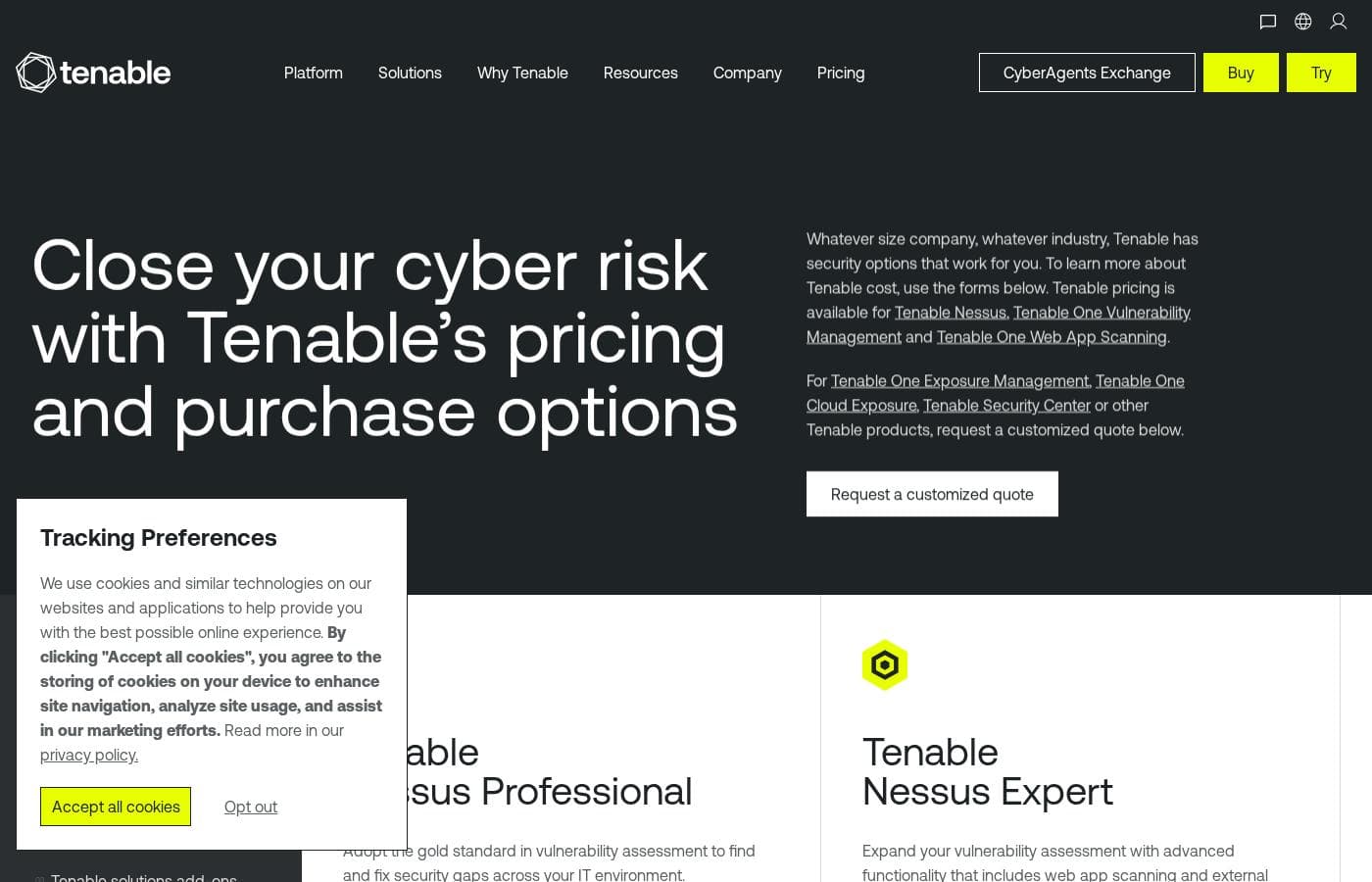
Tenable pricing page screenshotView pricing page screenshot
PlanBilled monthlyBilled annuallyIncludes
Nessus Professional (1-Year)
—
$399.17/mo
$4,790 per year
Nessus Expert (1-Year)
—
$565.83/mo
$6,790 per year
Tenable One Vulnerability Management (1-Year, up to 250 assets)
—
$308.33/mo
$3,700 per year
Tenable One Web App Scanning (1-Year, 5 FQDNs base)
—
$565.83/mo
$6,790 per year

Price history

Tracking prices since Oct 1, 2026. No price change detected yet.

Cost calculator

Estimate what Tenable costs for your team.

Billing

Nessus Professional (1-Year) has no published price for this billing cycle.

Nessus Professional (1-Year) has a flat price: the number of seats does not change the total. Estimate based on published list prices, before taxes, add-ons and discounts.

Email me when Tenable changes price

One email when we detect a price change on the vendor's pricing page. No newsletter, no deals. Unsubscribe in one click.

User Reviews

No reviews yet.

Write a Review

Write a Review for Tenable
0/100 characters
0/2000 characters

Why use Tenable?

Modern attack surfaces span on-premises servers, multi-cloud accounts, industrial systems, identity providers, and AI services, and each is often monitored by a different tool. Tenable One addresses this by unifying those signals into a single risk picture, which makes it easier to decide what to fix first.

Organizations that need one clear view of risk across disparate systems, rather than another point solution, are exactly who this platform is built for.

Tenable alternatives

Other tools in the Exposure Management category

View all Exposure Management tools

Tenable FAQ

How much does Tenable cost?

Tenable's cheapest paid plan, Tenable One Vulnerability Management (1-Year, up to 250 assets), costs $308.33 per month. Paid plans range from $308.33 to $565.83 per month. Prices checked on Oct 12, 2026 from the vendor's pricing page.

Does Tenable have a free plan?

No. Tenable lists no free plan; the cheapest paid plan starts at $308.33 per month.

Has Tenable's price changed recently?

No. We have not detected a price change since we started tracking on Oct 1, 2026.

What is the difference between Tenable One and Nessus?

Nessus is Tenable's vulnerability scanner, and Nessus Pro remains available as a standalone product for teams that primarily need scanning. Tenable One is the broader exposure management platform: it incorporates that assessment capability but extends coverage to cloud environments, operational technology (OT), identity systems, and emerging AI attack surfaces, correlating everything into one risk view.

Which environments does Tenable One cover?

According to the vendor, the platform covers the entire attack surface: IT infrastructure, cloud environments, operational technology (OT), identity systems, and the emerging AI attack surface. That breadth is the main differentiator versus a traditional vulnerability scanner that only sees a slice of the estate.

Who is Tenable One best suited for?

Organizations with complex, mixed environments — IT plus cloud, OT, identity, and AI assets — that want a single prioritized view of exposure. Teams that only need basic vulnerability scanning can likely get by with Nessus Pro or a lighter alternative instead of the full platform.

Ready to try Tenable? Check out the official site or pricing.

Are you Tenable? Claim this listing · Get the badge