LifeSight

LifeSight review

Agentic unified marketing measurement that shows what every channel truly drives.

By Ciroapp Editorial Team · Updated Sep 16, 2026

Commission may apply at no extra cost

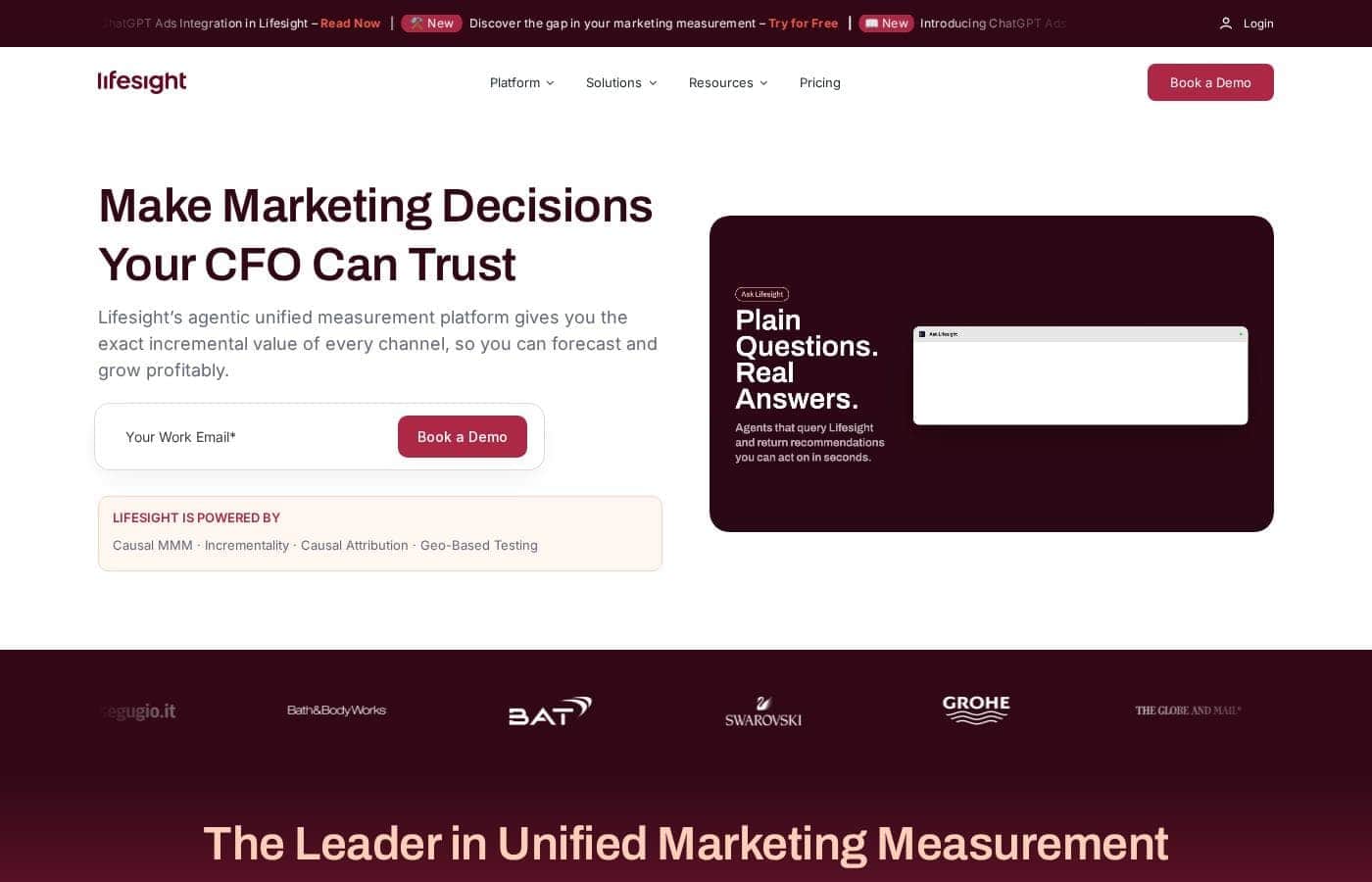
LifeSight homepage screenshot

At a glance

Quick overview for LifeSight: rating, pricing summary, key features, and highlights.

Ciroapp score

3.9/ 5

LifeSight triangulates MMM, incrementality testing, and causal attribution in one platform, answering plain-English questions with confidence intervals and enforcing your budget rules automatically. The trade-offs: no public pricing, a days-to-weeks onboarding ramp, and no independent reviews to verify the vendor's claims. Overall, it's a strong bet for multi-channel teams ready to invest in a sales-led evaluation.

Pros

  • Pros:Triangulates causal MMM, incrementality testing, and causal attribution in one platform, cross-checking platform self-reporting so metrics like the example where only 38% of Meta-reported conversions were incremental get exposed
  • Pros:Answers plain-English questions like "What's Meta actually driving?" with numbers and attached confidence intervals, so no data science background is needed to read the causal model
  • Pros:Designs geo-lift tests calibrated to its own model — such as a 3-week test across 5 DMAs — letting you validate a budget-shift projection before moving real spend

Cons

  • Cons:No public pricing whatsoever — the website lists no plans, rates, or billing terms, and there's no software trial, refund policy, or cancellation terms mentioned, so everything depends on a sales conversation
  • Cons:Insights aren't instant — the company says actionable results arrive only days to weeks after you integrate all marketing and conversion data sources, so plan for an onboarding ramp
  • Cons:The full connector list isn't published, so you must confirm each of your specific data sources — especially offline ones — with their team before committing
Best for
  • Marketing teams that want "what's working?" answered with causal proof, not another dashboard
  • Performance marketers reallocating budgets based on true incrementality
  • Finance leaders who need revenue, payback, and profit contribution in P&L language
This section is a summary. Detailed sections about features, use cases, pricing, and reviews follow below.

What is LifeSight?

Platform dashboards love to claim credit for sales that would've happened anyway. That's the core problem Lifesight tackles. It unifies MMM, incrementality testing, and causal attribution in one place, so you can see each channel's true incremental impact and move budget with proof your finance team will accept.

Lifesight is an agentic unified marketing measurement platform. It combines causal MMM, incrementality testing, causal attribution, and geo-based testing in a single system. AI agents clean your data, answer questions in plain English, and can execute approved changes on ad platforms.

It's built for marketing teams, performance marketers, finance leaders, and agencies who want decisions backed by causal evidence rather than platform-reported numbers.

Should you choose LifeSight?

Quick buyer guidance before you compare plans or click through.

Choose it if

  • Teams frustrated by inflated platform-reported conversions who want MMM, experiments, and attribution triangulated together
  • Organizations that want plain-English Q&A with confidence intervals attached to every recommendation
  • Brands that need automated budget rules and saturation analysis to prevent overspending
  • Businesses with strict security needs, given listed SOC 2 Type II, ISO 27001, GDPR/CCPA, and HIPAA compliance
  • Teams without data scientists, since the site says no technical expertise is required

Skip it if

  • Buyers who need transparent pricing upfront; no prices are published on the site, so you'll have to contact sales
  • Teams expecting instant insights; the site says it takes days to weeks after integrating marketing and conversion data
  • Very small advertisers with minimal spend or only one or two channels, who may not need this depth of measurement
  • Anyone uncomfortable with agents acting on ad accounts, even within guardrails; you should plan to review what gets automated
  • Buyers who just want a simple last-click attribution dashboard; this platform is far more involved than that

Next steps before buying

  1. 1Request the free Measurement Gap Report first to see where your current measurement has blind spots before committing to anything
  2. 2Contact sales for a quote, since pricing isn't listed publicly, and ask directly about contract, trial, or refund terms
  3. 3List every data source you'd need connected, including offline sales, and confirm Lifesight supports each integration
  4. 4Write down your governance rules, like budget caps or iROAS thresholds, so you can ask how the agents would enforce them
  5. 5Compare this causal approach against simpler attribution tools or other MMM vendors to confirm the fit before you buy

Ease of use

Lifesight is positioned as no-code and marketer-friendly. You ask questions in plain English, and agents handle the modeling and data cleaning. The real effort sits upfront: integrating your marketing and conversion data sources. The company says most teams generate actionable insights within days to weeks after that, and no data science background is needed.

LifeSight Key Features

✨ One honest view of every channel

Lifesight unifies causal MMM, incrementality testing, and causal attribution in one platform. That triangulation corrects the bias in platform-reported metrics, so you see each channel's true incremental impact — online and offline. Use it when dashboards disagree and budget meetings stall.

The outcome: numbers your finance team will accept.

✨ Ask questions in plain English

Type "What's Meta actually driving?" and AI agents read the causal model, answer with numbers, and attach confidence intervals. No data science skills required. In one site example, just 38% of Meta-reported conversions were actually incremental.

You get answers in minutes, not months.

🛡️ Budget rules the agents enforce

You set the rules; agents check them automatically before any recommendation goes out.

  • Spend caps, like a 20% quarterly increase limit unless iROAS beats 2.8x
  • Saturation curves that flag diminishing returns, like Meta at 74%
  • One-click execution on ad platforms, within your guardrails

✨ Validate before you commit budget

Before moving real money, Lifesight designs geo-lift tests to prove a projection first. The site shows a 3-week test across 5 DMAs built for exactly that. Every test also calibrates the model, so your next decision is sharper than the last.

It's measurement that improves with each cycle.

Use Cases

💬 Settle the "What's Working?" Debate

Budget meetings stall when every platform claims credit. Type your question in plain English — "What's Meta actually driving?" — and agents read the causal model, then answer with numbers and confidence intervals. No dashboards to decode.

Expected outcome: one honest view of every channel, online and offline. > Tip: Start with the free Measurement Gap Report to spot your blind spots first.

📊 Move Budget Where It Works Hardest

Saturation curves show when a channel maxes out. In the site's example, Meta prospecting sat at 74% saturation while YouTube had room — so shifting $40K projected +$125K incremental revenue. A geo-lift test then validates it before you commit.

Expected outcome: reallocations backed by causal evidence, not platform estimates.

🛡️ Enforce Your Budget Rules Automatically

Set guardrails once — say, a 20% quarterly budget cap unless iROAS beats 2.8x. LifeSight checks every recommendation against your rules before anything goes live, and agents can push approved changes to ad platforms in one click. Expected outcome: faster decisions your governance policy already covers.

📈 Report in Language Finance Trusts

Finance leaders get incremental revenue, payback periods, and profit contribution in P&L language — auto-generated and auditable. Agencies run one standardized methodology across every client, proving value with causal evidence instead of platform reports. Expected outcome: board-ready numbers that hold up in the room.

LifeSight pricing

Prices not verified yet — see the vendor page.

LifeSight's pricing page

LifeSight pricing page screenshotView pricing page screenshot

Pricing range: Custom quote (no public pricing)

Pricing notes

LifeSight doesn't publish its pricing online — no plans or rates appear on the website. You'll need to contact their team for a quote, though the site does offer a free Measurement Gap Report to help you spot blind spots in your ad spend.

LifeSight doesn't list public prices — there are no plans, rates, or billing terms on its website, so you'll need to contact their team for exact numbers.

Here's everything we could confirm from what's publicly available.

What You'd Be Buying

LifeSight is a unified marketing measurement platform. It combines MMM, incrementality testing, and causal attribution in one place, so you can see which channels truly drive sales — not just what ad platforms claim. AI agents handle data cleanup, answer plain-English questions, and can even push budget changes to your ad accounts.

The site reports the platform has measured over $27B in ad spend for more than 300 companies, with an average sales lift of 9.8%.

What's Actually Free

There's one free item: a personalized Measurement Gap Report. You fill in a few details, and it flags blind spots in your ad spend plus what to test next. It's a useful starting point, but it's a report — not access to the platform itself.

No software trial, refund policy, or cancellation terms appear on the site. So before you sign anything, ask their team about contract length, license limits, and exactly what's included at your price.

Who It's Built For

LifeSight speaks to four main audiences:

  • Marketing teams that want causal proof behind budget decisions
  • E-commerce brands looking for one-click optimization and anomaly detection
  • Finance leaders who need payback periods and auditable, P&L-style reporting
  • Agencies running standardized measurement across multiple clients

Setup is described as fast and no-code, and most teams get actionable insights within days to weeks of connecting their data. You don't need data scientists on staff.

Our Suggestion

Since numbers aren't public, book a demo and request a written quote. Bring your annual ad spend and channel mix so the conversation is concrete. It's also worth asking about security and compliance upfront — the site lists SOC 2 Type II, GDPR/CCPA, HIPAA, and ISO 27001, which matters if you operate in regulated markets.

Email me when LifeSight changes price

One email when we detect a price change on the vendor's pricing page. No newsletter, no deals. Unsubscribe in one click.

User Reviews

No reviews yet.

Write a Review

Write a Review for LifeSight
0/100 characters
0/2000 characters

Why use LifeSight?

If budget meetings keep turning into arguments over whose attribution numbers are right, Lifesight offers a way out. It replaces platform self-reporting with causal proof, then helps you act on it fast. Here's what stands out from the company's own materials:

  • Triangulated measurement, not one biased model. Lifesight combines MMM, incrementality experiments, and causal attribution. That cross-check is designed to correct the bias baked into platform-reported metrics.
  • Ask questions in plain English. Type "What's Meta actually driving?" and agents read the causal model, answer with numbers, and attach confidence intervals. One example on the site: just 38% of Meta-reported conversions were incremental.
  • The full decision loop runs in one place. Observe, orient, decide, act, learn. Agents unify and clean data, recommend moves, and can push changes to ad platforms in one click, within guardrails you define.
  • Budget governance happens automatically. Your rules, like a 20% quarterly cap unless iROAS beats 2.8x, get checked before any recommendation goes out.
  • Saturation curves reveal where the next dollar works hardest. The site illustrates how shifting $40K from Meta to YouTube projected +$125K incremental revenue at 88% confidence.
  • Validate before you commit budget. Lifesight designs geo-lift tests, like a 3-week test across 5 DMAs, so you can prove a projection before moving real money.

Scale is part of the pitch too: the company reports $27B+ in ad spend measured across 300+ companies, with a claimed 9.8% average sales lift.

LifeSight alternatives

Other tools in the Customer Data Platform (CDP) category

View all Customer Data Platform (CDP) tools

LifeSight FAQ

Which data sources does LifeSight connect with?

LifeSight unifies all your marketing and conversion data, online and offline, into one view. It doesn't publish a full connector list, so share your stack with their team and confirm each source before you buy.

How does LifeSight keep your data secure?

Lifesight encrypts your data in transit and at rest. The platform also lists SOC 2 Type II, ISO 27001, GDPR/CCPA, and HIPAA compliance, which helps if you handle regulated customer data.

How much control do you have over LifeSight's AI agents?

You set the guardrails. Agents can push changes to ad platforms in one click, or act on your behalf — and your rules, like budget caps or iROAS thresholds, are checked before any recommendation goes out.

Can you test a budget recommendation before committing spend?

Yes. Lifesight designs geo-lift tests calibrated to its causal model — for example, a 3-week test across 5 DMAs — so you can validate a projection before moving real budget.

Ready to try LifeSight? Check out the official site or pricing.

Are you LifeSight? Claim this listing · Get the badge