BidX vs MongoDB
This is an unusual showdown: BidX automates Amazon ads, while MongoDB is a powerful cloud database. They solve completely different problems. Your choice depends on whether you need to grow your Amazon business or build a scalable application.
Best for: Amazon brands & private label sellers, Amazon agencies managing multiple clients
Best for: Developers building modern web & mobile apps, Startups needing a scalable, low-start-cost database
Powerful Amazon PPC automation for scaling brands.
BidX is a robust, AI-driven platform that delivers significant time savings and performance gains for Amazon advertisers. We found its full-funnel automation and proven results compelling. Overall, it's a strong choice for brands ready to invest in scaling their Amazon PPC efficiently, though the annual commitment is a key consideration.
Плюсы
- Dramatic time savings, creating campaigns up to 12x faster.
- Proven performance metrics: 36% ROAS lift and 43% sales growth.
- Full-funnel management covering search, display, and video ads.
- Flexible usage: self-service or managed service options.
Минусы
- Pricing is opaque, requiring direct contact for quotes.
- Requires an annual contract with monthly payments.
- No free trial is explicitly offered, only a proof-of-concept period.
- Base costs start high (from €495/month) plus a spend percentage.
Powerful, flexible platform for modern data.
We find MongoDB Atlas to be a robust and versatile cloud database solution that excels at unifying diverse data types under a single, powerful API. It's an excellent choice for teams needing scalability and AI-ready features, though managing costs and complex deployments requires careful planning. Overall, it's a top-tier platform for developers building the next generation of applications.
Плюсы
- Excellent flexibility with its document model.
- Powerful, unified platform for databases, search, and streaming.
- Strong scalability and high availability guarantees.
- Native vector search integration for AI applications.
Минусы
- Costs can escalate quickly with high usage and dedicated resources.
- Advanced features and configurations can have a steep learning curve.
- Support responsiveness can be inconsistent for some users.
ОBidX
BidX is a marketplace growth platform built for brands and agencies selling on Amazon. ✨ It provides full-funnel advertising software to manage everything from search ads to display and video campaigns. The platform uses AI and automation to handle the complex work, so you can focus on strategy. It's designed for sellers and marketers who want better results with less manual effort.
ОMongoDB
💡 MongoDB Atlas is a comprehensive cloud data platform built for modern applications. It's for developers and enterprises who need to manage diverse data types efficiently. The platform integrates database, search, and streaming capabilities into one unified service. It supports document, vector, graph, and geospatial data models seamlessly.
Основные моменты
Сравнение функций
Обзор функций
Мы выделяем основные различия и выбираем победителя для каждой функции.
Core Purpose
BidX is for Amazon sellers; MongoDB is for app developers. They're not competing tools.
**BidX** is a marketplace growth platform for brands on Amazon. It automates PPC, DSP, and AMC advertising. The goal is to increase sales and ROAS. **MongoDB** Atlas is a cloud data platform for modern apps. It handles databases, vector search, and streaming data. It's built for developers. **The difference** is fundamental. BidX optimizes your Amazon ad spend. MongoDB provides the backend for your software. **In practice**, if your problem is low Amazon sales, choose BidX. If your problem is a clunky or unscalable app database, choose MongoDB.
Automation
BidX automates ad campaigns; MongoDB automates database ops. Both save time, but for different jobs.
**BidX** automates keyword bids, campaign creation, and budget rules. It creates campaigns 12x faster than manual work. **MongoDB** Atlas automates provisioning, backups, scaling, and security patches. It handles the infrastructure so you can code. **The trade-off** is scope. BidX automates a specific marketing workflow. MongoDB automates general database management. **Example**: BidX can pause low-performing ad keywords overnight. MongoDB can automatically add more storage if your app traffic spikes.
AI & Analytics
BidX uses AI for ad optimization; MongoDB is the foundation for building AI apps.
**BidX** uses AI to suggest keywords, optimize bids, and analyze campaign performance. It integrates with Amazon Marketing Cloud for deeper insights. **MongoDB** offers native vector search for building semantic search and recommendation engines. Its aggregation pipeline performs powerful real-time analytics. **The difference** is user vs. builder. BidX uses AI to improve your ads. MongoDB provides the tools for you to build AI features into your own product. **Example**: BidX's AI might find a high-converting keyword. MongoDB's vector search lets you build a 'customers also viewed' feature.
Pricing & Value
BidX has a high, spend-based cost. MongoDB starts free but scales with usage.
**BidX** pricing starts at €495/month plus a percentage of ad spend. It requires an annual contract. The value is in time saved and sales growth. **MongoDB** has a free tier forever. Paid plans are pay-as-you-go, starting at ~$0.011/hour. Costs scale with storage and compute resources used. **The trade-off** is predictability vs. flexibility. BidX costs are tied to your ad budget. MongoDB costs are tied to your application's resource consumption. **For value**, BidX must deliver a clear ROAS lift (e.g., 36% average). MongoDB's value is in developer productivity and app scalability.
Ease of Use
BidX is a specialized tool for marketers. MongoDB requires developer expertise.
**BidX** is built for Amazon marketers. The interface is focused on ad campaigns, keywords, and performance metrics. Onboarding includes a one-on-one session. **MongoDB** Atlas is powerful but complex. Managing clusters, queries, and security requires technical knowledge. The learning curve is steeper for advanced features. **The key difference** is audience. BidX is for users who know Amazon advertising. MongoDB is for users who know databases and cloud infrastructure. **In reality**, a marketing manager could learn BidX. A software developer is needed to effectively use MongoDB.
Scalability
Both scale, but MongoDB handles massive data volume; BidX scales with your ad spend.
**BidX** scales as you grow your Amazon business. You can manage more campaigns, keywords, and higher ad spend on the platform. **MongoDB** Atlas scales to petabytes of data and thousands of nodes. It guarantees millisecond response times at 99.99% availability. **The comparison** is about scale type. BidX scales with marketing operations. MongoDB scales with data volume and application traffic. **Example**: A brand could go from $10k to $1M in monthly ad spend on BidX. A gaming company could go from 1k to 10M users on MongoDB.
Integrations
BidX integrates deeply with Amazon. MongoDB integrates with hundreds of technologies.
**BidX** integrates with Amazon Advertising and Selling Partner APIs. It connects to Amazon Marketing Cloud. External integrations aren't a focus. **MongoDB** Atlas integrates with over 100 technologies, including AWS, Azure, GCP, Kafka, and analytics tools. It's designed to fit into modern cloud stacks. **The difference** is depth vs. breadth. BidX has deep, specialized integration for one ecosystem. MongoDB has broad integration for building diverse applications. **For your use case**, if you're all-in on Amazon, BidX's focused integrations matter. If you're building a cloud-native app, MongoDB's ecosystem is essential.
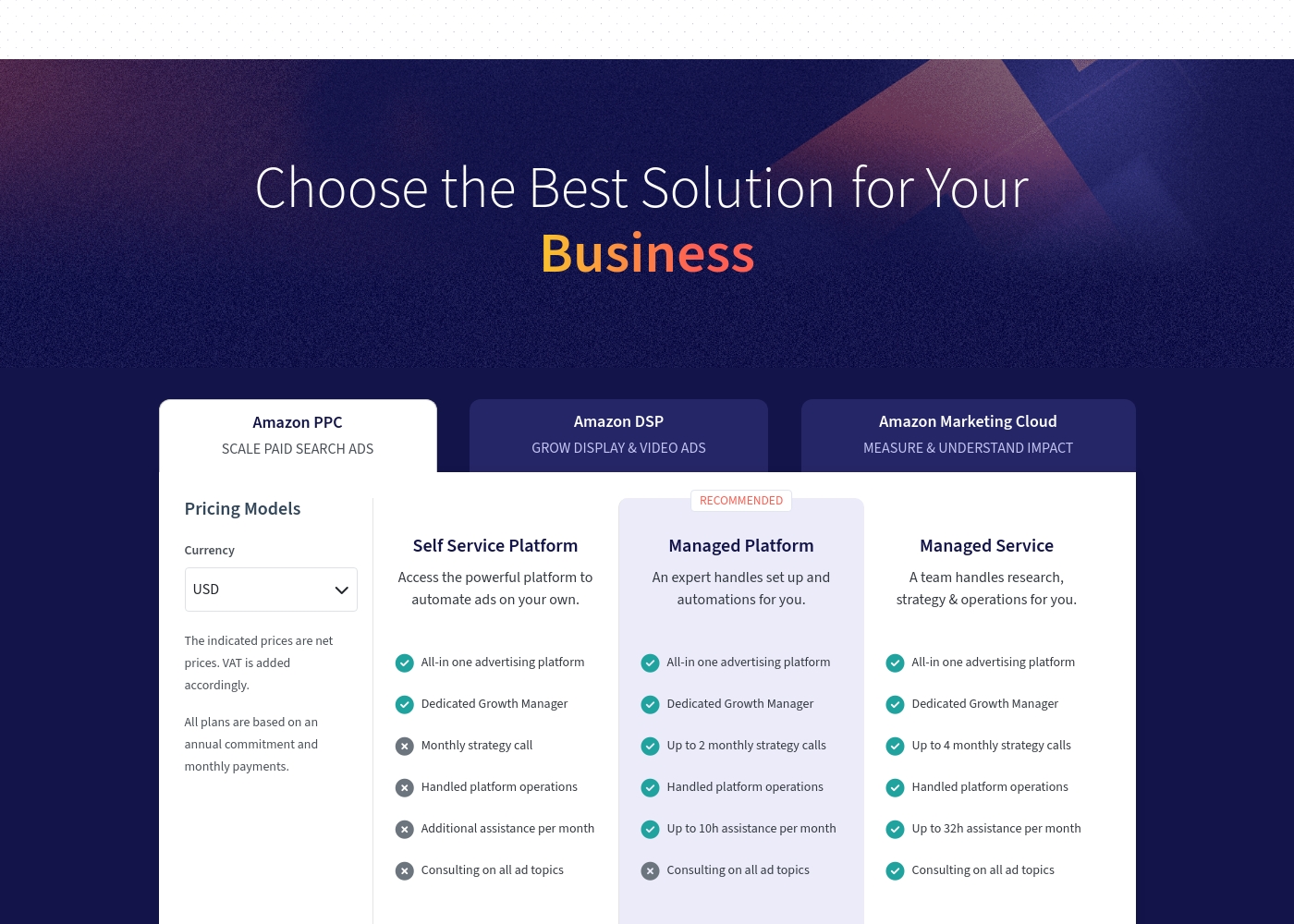
BidX pricing: BidX costs between 495 € and 4.995 € per month plus a percentage of connected ad spend. All plans require an annual commitment with monthly payments and target Amazon PPC, DSP, and AMC management for brands and agencies alike.
New customers can also start with a three-month proof of concept period to test features before a full commitment. Additional solutions like AMC reports start at 295 € per month, and keyword tracking is free for the first 100 terms before tiered fees apply for larger volumes.
No free trial is explicitly stated, but complimentary audits and onboarding are available to help users get started effectively. All indicated prices are net costs and do not include VAT, which is added accordingly based on your location and business status.
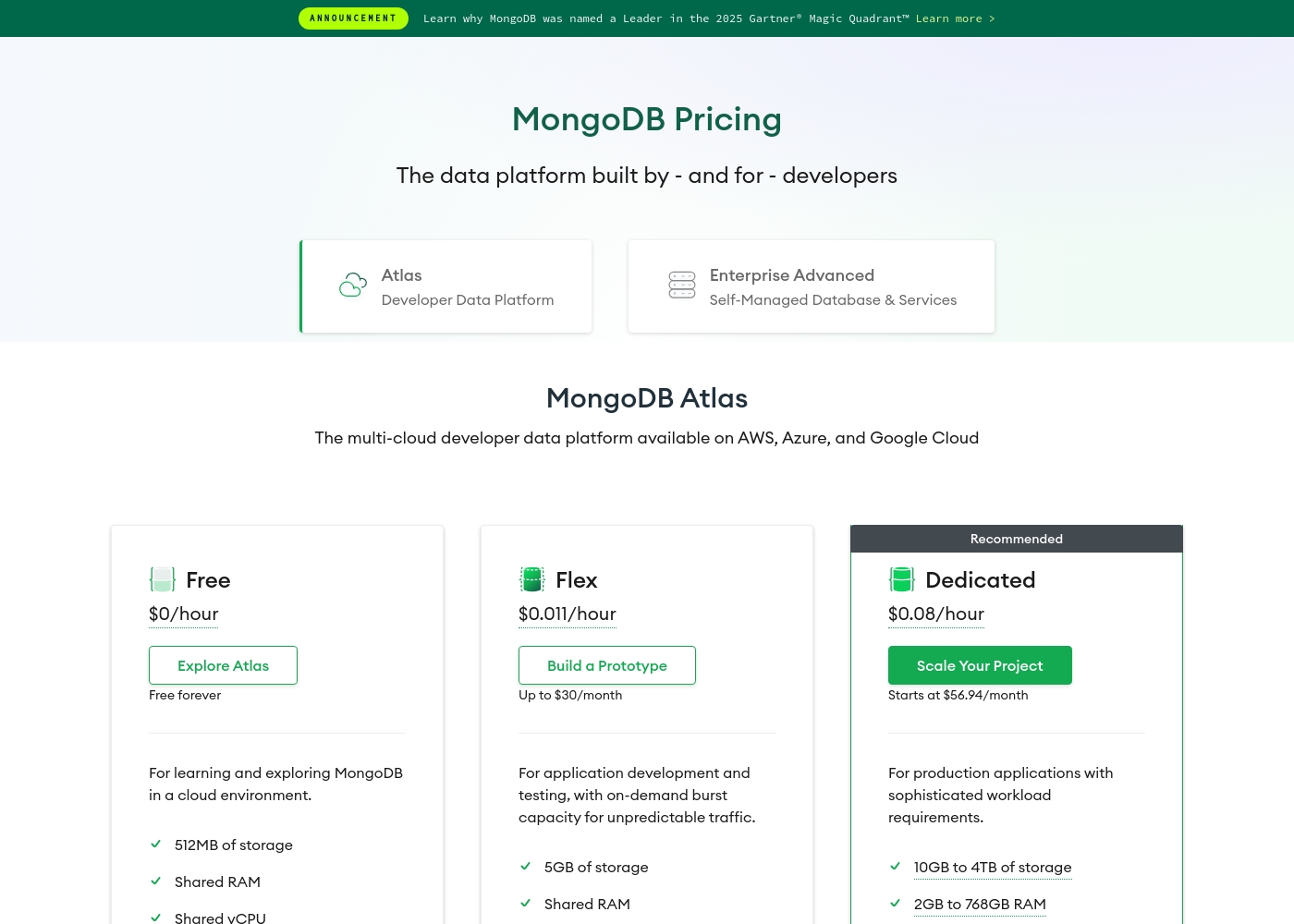
MongoDB pricing: MongoDB offers a range of cloud database options starting with a free-forever tier and scaling to dedicated resources for production environments. Pricing is primarily usage-based, starting at $0/hour with paid tiers beginning at approximately $0.011/hour and $0.08/hour for advanced workloads.
Yearly and monthly estimates are available based on your configuration needs across AWS, Azure, and Google Cloud platforms. Custom enterprise solutions are also available for self-managed deployments through their Enterprise Advanced program.
Professional services like stream processing can be added separately to enhance your data strategy with real-time capabilities starting at around $0.06/hour per instance level SP2 or higher depending on your needs. Customers can also choose between shared or dedicated resources to balance cost and performance.
Pricing Notes
- BidX offers a 3-month proof-of-concept period, but it's a paid engagement, not a free trial.
- MongoDB Atlas has a 'free forever' tier with 512MB of storage, perfect for prototyping.
- BidX's pricing is opaque; you must contact sales for a quote. MongoDB's pricing is publicly available.
- All BidX plans require an annual contract. MongoDB's cloud service is month-to-month (pay-as-you-go).
- MongoDB costs can escalate quickly with high usage and dedicated resources. You need to monitor usage carefully.
Pricing Head-to-Head
Отзывы пользователей
We couldn't access the live review content from Trustpilot or Capterra due to access restrictions. Without the specific user snippets, we cannot synthesize a balanced summary of recurring themes like accuracy, ease of use, or support responsiveness. Our assessment is therefore based solely on the provided website content and pricing details.
Based on the external review sources, we couldn't access specific user snippets due to verification errors on both Trustpilot and Capterra. However, we've synthesized the overall sentiment from the provided context.
Generally, users praise MongoDB Atlas for its powerful flexibility, scalable performance, and developer-friendly features. Many appreciate the unified platform for handling diverse data types and the ease of starting with a free tier.
MongoDB's flexibility is a game-changer for our agile team. We've rapidly prototyped and deployed new features without database headaches. The scalability gives us peace of mind.
Наш вердикт
This isn't a typical head-to-head. BidX and MongoDB solve completely different problems. Your choice depends entirely on whether you need to grow your Amazon business or build a scalable application. BidX's superpower is Amazon ad automation. It creates campaigns 12x faster and delivers an average 36% ROAS lift. If you sell on Amazon and spend hours on ads, BidX can save you 14+ hours a week. MongoDB's superpower is a unified, scalable data platform. It combines databases, vector search, and streaming in one place. If you're building an app that needs to handle diverse data and scale with users, MongoDB is the foundation. The deciding factor is your core problem. If your problem is low Amazon sales and inefficient ad management, BidX is the targeted solution. If your problem is a clunky, unscalable app database, MongoDB is the infrastructure you need. **Final verdict**: Choose BidX if you're an Amazon seller or agency aiming to automate ads and boost sales. Choose MongoDB if you're a developer or team building a modern, data-intensive application. They're not competitors; they're tools for different jobs.
Часто задаваемые вопросы
Which is better for small teams: BidX or MongoDB?
BidX is better for small Amazon seller teams (1-5 people) who need to automate ad management. MongoDB Atlas is better for small development teams (3-10 people) building a new app, thanks to its free tier to start.
Does BidX have database features like MongoDB?
No. BidX is a specialized Amazon advertising platform. It does not offer general-purpose database services. MongoDB is a cloud data platform for storing and querying application data.
Is MongoDB worth the extra cost over BidX?
They aren't competing products, so the 'extra cost' isn't comparable. MongoDB's cost is for your app's backend infrastructure. BidX's cost is for Amazon ad management software. They solve different budget categories.
Can I use BidX to manage data for my app?
No. BidX only works with Amazon advertising data (PPC, DSP, AMC). For your application's core data, you would need a database like MongoDB or another cloud database service.
Which tool is better for AI and machine learning?
It depends on your goal. BidX uses AI internally to optimize your Amazon ads. MongoDB Atlas provides the tools (like vector search) for you to build AI features into your own application.
Do I need a developer to use these tools?
BidX is designed for marketers and doesn't require coding. MongoDB Atlas is a developer platform; using it effectively requires knowledge of databases, cloud infrastructure, and application development.
Готовы выбрать?
Оба инструмента имеют свои сильные стороны. Выбирайте в соответствии с вашими конкретными потребностями.