Salesforce vs Shape
Salesforce brings massive enterprise power and deep industry focus. Shape is built for efficient sales teams needing maximum lead engagement and robust communication tools. They offer very different levels of scale and specialization.
Enterprise Power, Support Needs Fixing
We recognize Salesforce as a globally powerful, feature-rich platform offering expansive, industry-specific tools. However, feedback related to customer support, proprietary billing, and usability is substantially negative and concerning. Overall, the foundational product is essential for large enterprises, but the necessary customer service and contractual practices appear fundamentally broken for many users.
Prós
- Extensive, feature-rich platform capable of handling complex enterprise needs.
- Offers specialized products and industry-specific Cloud solutions.
- Strong ecosystem, community, and AppExchange support.
- Effective for complex data pulling and building detailed reports.
Contras
- Customer service and support are widely reported as nonexistent or abysmal.
- Billing practices are often described as predatory, inflexible, and costly.
- The software is cumbersome, time-consuming, and requires excessive clicks for daily tasks.
- Sales teams pressure long-term contracts (3+ years) and high annual price increases.
Envolvimento automatizado encontra ferramentas de vendas abrangentes.
Avaliámos o Shape com base no seu compromisso com o envolvimento de leads automatizado e ferramentas de vendas integradas. A plataforma oferece pontuação de IA sofisticada, um sistema de comunicação premiado e integração dedicada em todos os planos. No geral, o Shape proporciona uma solução robusta tudo-em-um para gerir e fechar leads de forma eficiente, mas a transparência dos preços é um obstáculo significativo para os potenciais compradores.
Prós
- Plataforma abrangente de CRM e integração de marketing.
- Automação poderosa para seguimento de leads consistente.
- Sistema de comunicação premiado (telefone, texto, MMS).
- Entrega de e-mail segura e fiável usando servidores SMTP conformes.
Contras
- Estrutura de preços opaca, baseada em cotação, que requer contacto com vendas.
- Ausência de um teste gratuito ou garantia de devolução do dinheiro publicamente declarados.
SobreSalesforce
Salesforce is a leading global software company recognized for providing integrated technology solutions. It helps businesses across many sectors, offering specific tools for Financial Services, Retail, Healthcare, and more.
This platform focuses on connecting proactively with customers, automating workflows, and unifying data. Importantly, Salesforce incorporates powerful AI agents like Agentforce to improve support, boost productivity, and drive business outcomes.
The system aims to give you a single, unified value chain approach. You can also leverage a strong ecosystem through the AppExchange for additional tools and partners.
SobreShape
O Shape é uma plataforma abrangente que combina um poderoso CRM de Vendas com um robusto conjunto de marketing. Este sistema ajuda-o a automatizar eficientemente as suas atividades de vendas e marketing.
Inclui ferramentas de comunicação sofisticadas concebidas para maximizar a produtividade. Obtém um sistema telefónico premiado que gere chamadas, mensagens de texto e MMS de forma contínua.
A plataforma também inclui CRMs integrados para mensagens de texto e e-mail. Esta configuração permite uma comunicação bidirecional poderosa, garantindo que a sua entrega é segura e fiável.
Destaques
Comparação de recursos
Visão Geral de Recursos
Destacamos as principais diferenças e escolhemos um vencedor para cada recurso.
Scope & Scale
Salesforce handles massive enterprise demands; Shape focuses on comprehensive sales efficiency and momentum.
Salesforce is the choice for enterprise organizations requiring unified data and specialized products. It is designed for massive complexity and global reach. Shape provides an integrated Sales CRM and robust marketing suite in a unified package. Shape is excellent for high-volume sales teams needing communication tools and fast engagement. The key difference is depth of industry specificity versus integrated sales speed. Salesforce offers specialized clouds for highly complex needs. Shape focuses on maximizing lead conversion quickly with automation. If your business operates in specialized fields like Healthcare, Salesforce offers purpose-built tools; otherwise, Shape is likely more nimble.
Onboarding & Setup
Shape includes vendor-handled onboarding; Salesforce setup often requires extensive time and consulting.
Shape includes an Expert Onboarding Plan in every single tier offered. The Shape vendor team handles data imports and full system implementation for you. This allows your team to launch faster. Salesforce setup often requires significant internal resources or costly external partners for complex integrations. Time-to-value can be delayed substantially with Salesforce. Shape eliminates implementation friction by providing hands-on support immediately. Salesforce expects users to manage much of the setup process. Shape gets new sales staff selling immediately, avoiding the long learning curve and setup delays common with Salesforce deployments.
Communication Tools
Shape features an award-winning integrated suite; Salesforce relies heavily on AppExchange integrations.
Shape provides an integrated phone system, local presence dialing, and a texting CRM. This included suite handles calls, texts, and MMS smoothly and efficiently. Salesforce requires integrating necessary voice, SMS, or advanced communication features through costly add-ons or the AppExchange. This adds complexity and cost. Shape’s built-in bi-directional texting CRM supports real-time, conversational engagement. Salesforce’s communication features are often less unified without customization. For sales teams doing high-volume calling and texting, Shape provides a much smoother, all-in-one experience.
AI Capabilities
Salesforce uses AI for support and productivity (Agentforce); Shape uses AI primarily for lead prioritization (Engage).
Salesforce leverages Agentforce AI to provide 24/7 customer and employee support answers. Its AI focuses on automating internal knowledge and boosting overall organizational productivity. Shape offers powerful AI lead scoring in its Engage plan to identify top-converting prospects. This intelligence allows sales teams to maximize daily efficiency. Both platforms utilize AI, but their application is completely different. Salesforce uses AI for broad operational support. Shape uses its AI to dramatically sharpen the focus of the sales team, ensuring only the hottest leads are pursued immediately.
Customer Support
Shape promises professional support from day one; Salesforce users widely report abysmal, nonexistent support.
Shape includes an Expert Onboarding plan and Professional Support in every tier offered. They help with system implementation and data migration. Salesforce users report severe frustration trying to reach human support staff or account managers. Many users describe support as 'abysmal.' Shape provides dedicated hands-on support included in the contract price. Salesforce users often feel abandoned after signing the lengthy contract. If reliable customer assistance is crucial for your operation, prior official user reviews strongly favor the promises made by Shape.
Pricing Model
Both platforms require quotes, offering low transparency; Salesforce demands annual prepayment, Shape uses per-seat pricing.
Salesforce generally requires annual contracts and upfront annual payment for most of its specific Cloud products. Specific pricing is not publicly stated. Shape operates on a per-seat pricing model across its three quote-based tiers. They do not list public prices either. Neither Salesforce nor Shape offers transparent public pricing on their websites—you must contact sales. Shape is clearer on how they charge (per seat), while Salesforce pricing depends entirely on the unique bundle of products purchased.
Automation & Follow-up
Shape excels at continuous, automated lead follow-up; Salesforce focuses on broad, complex data workflow automation.
Shape uses powerful pre-built workflows and texting/email CRMs for consistent lead engagement. This automation is designed specifically to convert leads rapidly. Salesforce automation focuses on streamlining internal organizational process flows and managing vast data landscapes. It's more about enterprise coordination. The clear goal of Shape’s automation is to accelerate sales cycles. Salesforce focuses on operational excellence. Shape makes sure no prospect ever falls through the cracks, generating better ROI from marketing spend through disciplined engagement.
Integration Ecosystem
Salesforce dominates with the AppExchange; Shape focuses on its integrated, all-in-one suite.
Salesforce offers access to the massive AppExchange ecosystem of partners, apps, and integrations. This allows for nearly limitless customization and extending capabilities. Shape focuses on its comprehensive, built-in communication and marketing suite. This reduces the need for external integrations. Salesforce is superior if you need to connect dozens of external, specialized tools. Shape is better if you prefer a single, unified system. An integrated system like Shape generally leads to fewer maintenance headaches than managing numerous Salesforce AppExchange connections.
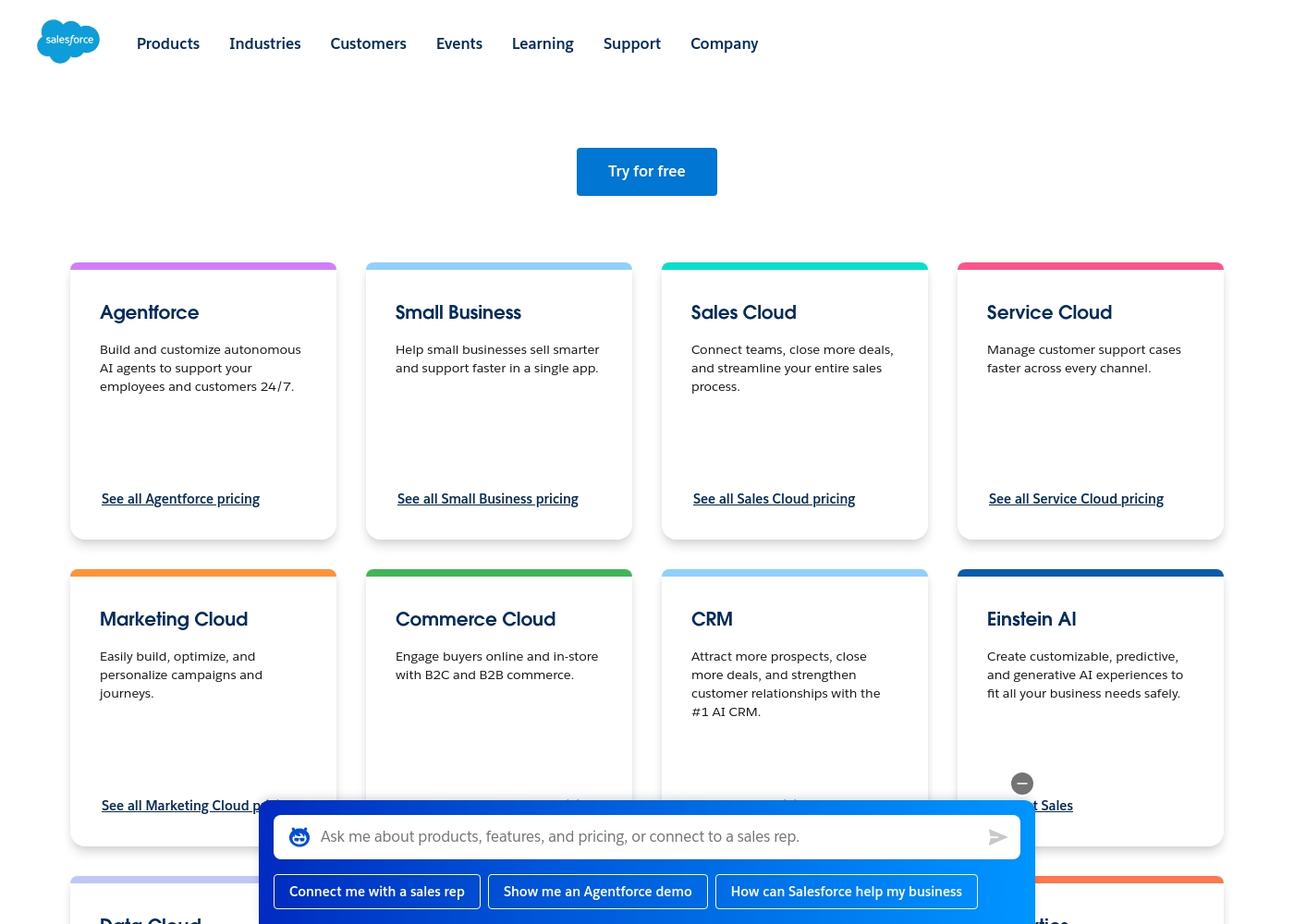
Salesforce pricing is determined on a quote-by-quote basis depending on the specific Cloud products chosen, such as Agentforce, Sales Cloud, and Marketing Cloud. Exact subscription costs are not explicitly stated, as they vary drastically by client needs.
- Build and customize autonomous AI agents
- Support employees and customers 24/7
- Help small businesses sell smarter
- Faster support in a single app
- Connect sales teams and close more deals
- Streamline the entire sales process
- Manage customer support cases faster
- Manage support across every channel
O Shape utiliza um modelo de preços baseado em cotação com três planos principais: Professional, Engage e Enterprise, nenhum dos quais tem custos listados explicitamente.
Para ver os detalhes de preços atuais, tem de contactar a equipa de vendas ou clicar em 'Get Started' para uma cotação personalizada.
Shape Professional
Preço: Não explicitamente indicado Websites Suportados: Não explicitamente indicado Ideal Para: Startups, equipas pequenas e novos negócios Política de Reembolso: Não explicitamente indicada Outras Funcionalidades: CRM com IA + Gestão de Leads, Gestão de Leads + CRM, Automação e Fluxos de Trabalho Pré-definidos, Plano de Integração com Especialistas, Suporte Profissional
- CRM com IA + Gestão de Leads
- Gestão de Leads + CRM
- Automação e Fluxos de Trabalho Pré-definidos
- Plano de Integração com Especialistas
- Suporte Profissional
- Pontuação de leads com IA e chamadas ilimitadas para aumentar o envolvimento e a eficiência
- CRM com IA + Gestão de Leads
- Gestão de Leads + CRM
- Automação e Fluxos de Trabalho Pré-definidos
- Plano de Integração com Especialistas
- Funcionalidades avançadas e serviços para empresas de grande escala
- CRM com IA + Gestão de Leads
- Gestão de Leads + CRM
- Automação e Fluxos de Trabalho Pré-definidos
- Plano de Integração com Especialistas
Pricing Notes
- Both Salesforce and Shape use an opaque, quote-based pricing model requiring direct contact with sales.
- Salesforce generally requires annual contracts and upfront annual payment for most Cloud products.
- Shape uses a per-seat pricing model, scaling costs based on the number of users required.
- Salesforce offers a specific free trial; Shape does not list a public free trial or money-back guarantee.
- Beware: Salesforce users report predatory billing practices and mandated annual price increases.
Pricing Head-to-Head
Avaliações de usuários
User feedback on Salesforce is deeply polarized, leading to a very poor overall Trustpilot rating. While some users acknowledge the platform is a powerful tool with extensive features, the overwhelming sentiment focuses on severe issues with customer service and support responsiveness.
Users frequently describe support as "nonexistent" or "abysmal," reporting long waits, unhelpful automated systems, and difficulty reaching essential account managers. A significant pain point is the perceived lack of accountability and predatory billing practices; customers routinely mention inflexible contracts, mandatory annual price increases, and financial stress, especially for smaller businesses.
I strongly regret ever signing up with Salesforce. Their billing practices are predatory and completely inflexible, causing huge frustration and financial stress. I wish I had taken the time to read these reviews first.
As amostras de clientes fornecidas são únicas, pois discutem exclusivamente a 'Shape Republic', uma marca de suplementos nutricionais que vende batidos de proteína e produtos para perda de peso, e não a plataforma de CRM 'Shape'. Os utilizadores elogiaram frequentemente a ótima qualidade e eficácia dos produtos físicos, notando especificamente o quanto gostam do sabor dos Slim Shakes e dos batidos de proteína (usando sabores como Vanilla Cafe Frappe e Blueberry Muffin).
No entanto, em paralelo com o feedback positivo sobre o produto, os utilizadores relataram experiências muito negativas com o apoio ao cliente e a logística. Os revisores mencionaram respostas de suporte que não respondiam, longos tempos de processamento (até três semanas), dificuldades com códigos promocionais que não funcionavam e problemas com encomendas perdidas ou incompletas.
À parte de um processo de compra muito longo, a qualidade e eficácia das produções são A+++. Entregam ótimos produtos.
Nosso veredicto
Choosing between Salesforce and Shape is like picking a battleship or a fighter jet. Salesforce is the massive enterprise infrastructure, built for complex organizational data needs. Shape is the nimble, specialized tool designed to engage and convert leads immediately. The decision boils down to whether you prioritize raw scale and specialization or aggressive sales automation. Salesforce’s superpower lies in its industry depth and sheer scale. It offers specialized Clouds for Healthcare, Retail, and Financial Services. Salesforce unifies data across your entire organization, giving you a comprehensive view of the business. If you need powerful, detailed reporting and robust enterprise security, Salesforce handles it all. Shape focuses relentlessly on sales efficiency and communication. Shape includes an award-winning integrated phone, text, and email system right out of the box. Its powerful automation ensures leads receive consistent follow-up across all channels instantly. Shape even includes expert onboarding, meaning the Shape team handles complex data migration for you. The deciding factor is complexity versus operational friction. Salesforce is powerful, but users widely report it is cumbersome and its support is abysmal and nonexistent. Shape offers a quicker launch and integrated tools, lowering friction for front-line sales teams. If reliable customer service and quick setup are priorities, Shape wins out over Salesforce easily. Choose Salesforce only if you are a massive enterprise requiring industry-specific vertical solutions. For high-volume sales teams prioritizing reliable communication, instant lead engagement, and hands-on setup, Shape is the clearer choice. Shape wins for integrated efficiency, while Salesforce wins for sheer organizational complexity.
Perguntas Frequentes
Which is better for high-volume sales teams: Salesforce or Shape?
Shape focuses on immediate lead engagement and automated follow-up across integrated communication channels. Salesforce is more focused on broader managerial and data organization tasks. Shape's integrated communication suite makes it superior for aggressive, high-volume sales efforts.
Does Shape have industry-specific tools like Salesforce?
No, Shape provides a generalized, powerful Sales CRM and marketing suite for various industries. Salesforce famously offers deep, specialized Cloud solutions like Financial Services Cloud and Healthcare Cloud. Salesforce is the obvious choice if industry-specific processes are mandatory.
Which platform offers better customer support and onboarding?
Shape is the clear winner here, as it includes expert onboarding and professional support in all tiers. Salesforce users widely report support is often nonexistent and intensely frustrating. Shape handles data migration for you, ensuring a fast team launch.
Can I expect transparent pricing from Salesforce or Shape?
Neither Salesforce nor Shape offers transparent public pricing. Both require you to contact their sales teams for a personalized quote. Salesforce generally requires annual commitment, while Shape charges based on a per-seat model.
Is the communication suite better in Salesforce or Shape?
Shape has an award-winning, integrated communication system, including a phone system and bi-directional texting CRM. Salesforce requires you to integrate most communication tools via the AppExchange, adding cost and complexity. Shape excels because communication tools are native and unified.
Which is better for organizations with over 1,000 employees: Salesforce or Shape?
For massive organizational scale and complex, multi-department data management, Salesforce is the established choice. Salesforce is built to unify entire enterprise value chains. Shape's Enterprise plan accommodates large teams, but Salesforce has deeper global infrastructure.
Pronto para escolher?
Ambas as ferramentas têm seus pontos fortes. Escolha com base nas suas necessidades específicas.