Netlify vs Splunk
Netlify and Splunk serve completely different worlds. Netlify is a lightning-fast web deployment platform for developers. Splunk is a powerful data platform for security and observability. Choosing between them depends entirely on what you're building.
Plataforma de implementação poderosa e amigável para programadores.
Descobrimos que o Netlify se destaca na simplificação das implementações web com a sua robusta integração Git e rede de distribuição global. É uma excelente escolha para programadores e equipas que priorizam velocidade e automação do fluxo de trabalho. No geral, ele oferece uma plataforma moderna e fiável que elimina os problemas de infraestrutura para a maioria dos projetos.
Prós
- Implementação baseada em Git e ambientes de pré-visualização sem falhas.
- Nível gratuito generoso, ideal para projetos pessoais.
- HTTPS automatizado e CDN global para maior velocidade.
- Painel intuitivo e integração simplificada.
Contras
- O suporte ao cliente pode ser lento ou difícil de contactar.
- O preço dos planos pagos pode aumentar com maior utilização.
- Relatos ocasionais de instabilidade da plataforma ou erros de compilação.
- Funcionalidades avançadas podem exigir uma curva de aprendizagem.
Powerful but complex data platform.
We find Splunk offers a robust, unified platform for security and observability with extensive integrations and scalability. However, its pricing structure is opaque and usage-based, which can make cost planning challenging. Overall, it's a strong choice for enterprises needing deep data analysis, but smaller teams may find it complex and expensive.
Prós
- Unified platform for security and observability.
- Over 2,000 integrations with various data sources.
- AI and automation for threat response.
- Handles massive data volumes at scale.
Contras
- Opaque pricing requires consultation with sales.
- Can be complex to set up and learn.
- Usage-based models may lead to unpredictable costs.
- External review access was blocked, limiting user sentiment data.
SobreNetlify
💡 O Netlify é uma plataforma de desenvolvimento web que gere todo o ciclo de vida do seu site ou aplicação. É concebida para programadores, equipas e empresas que querem criar e lançar projetos web rapidamente. Quer comece a partir do código, de um prompt ou de uma pasta arrastada e largada, fornece as ferramentas e a infraestrutura para colocar o seu trabalho no ar para utilizadores em todo o lado.
SobreSplunk
Splunk is a unified platform for security and observability. It's designed for teams that need to search, analyze, and act on data from any source. Whether you're a security analyst hunting threats or an engineer troubleshooting app performance, it brings everything together in one place. ✨
Destaques
Comparação de recursos
Visão Geral de Recursos
Destacamos as principais diferenças e escolhemos um vencedor para cada recurso.
Core Purpose
Netlify deploys websites. Splunk analyzes machine data. They solve entirely different problems.
Netlify takes your code or AI prompt and makes a live website in seconds. It handles hosting, scaling, and security on a global network. You focus on the frontend and product experience. Splunk ingests logs, metrics, and traces from across your entire IT environment. It helps you search, visualize, and act on that data for security and performance. It's the command center for your operations team. The key difference is creation vs. analysis. Netlify is for building and shipping digital products. Splunk is for monitoring and securing the systems that run them.
Pricing & Value
Netlify offers transparent, usage-based plans. Splunk requires a sales call for custom pricing.
Netlify's pricing is clear and starts with a free plan. Paid tiers are $9/month (Personal) or $20/month (Pro), with costs based on credits for bandwidth and builds. You control spend by keeping auto-recharge off. Splunk's pricing is opaque and usage-based. Costs depend on data volume (Ingest) or activity metrics (Activity-based). You must contact sales for a quote, making budgeting unpredictable without consultation. Netlify provides immediate, predictable value for web projects. Splunk's value is enterprise-scale data insights, but at a significantly higher and less transparent cost.
Ease of Use
Netlify is built for quick starts. Splunk requires significant setup and expertise.
Netlify lets you deploy by connecting a Git repo, using the CLI, or dragging a folder. Automatic HTTPS, forms, and image optimization work with zero config. A developer can have a site live in minutes. Splunk requires configuring data inputs, building searches, and creating dashboards. Ingesting data from multiple sources and setting up alerts is a complex process. It's designed for trained professionals, not casual users. The trade-off is power versus simplicity. Netlify removes infrastructure friction. Splunk provides deep analytical power at the cost of a steep learning curve.
Integration Ecosystem
Netlify integrates with your development workflow. Splunk integrates with your entire data ecosystem.
Netlify connects seamlessly with Git providers (GitHub, GitLab), CI/CD tools, and frontend frameworks. Its focus is on streamlining the web development lifecycle from commit to deployment. Splunk boasts over 2,000 integrations for ingesting data from virtually any source: cloud services, databases, network devices, and business applications. It's built to be a central hub for all machine data. Netlify's ecosystem is deep for its niche. Splunk's ecosystem is incredibly broad, reflecting its role as an enterprise data aggregator.
Scalability
Both scale massively, but for different things. Netlify scales traffic. Splunk scales data ingestion.
Netlify's global edge network serves millions of sites with 99.99% uptime. It automatically scales to handle traffic spikes from any geographic location without configuration. Splunk is built to ingest and analyze petabytes of data per day. It scales to monitor complex, hybrid IT environments across global enterprises. The deciding factor is your bottleneck. If your challenge is web traffic and global delivery, Netlify is built for it. If your challenge is making sense of enormous data volumes, Splunk is the specialist.
Security Features
Netlify secures your website. Splunk helps you secure your entire organization.
Netlify provides security for your web application: free HTTPS, DDoS protection, a web application firewall, and SOC 2 compliance. It protects your site from common web attacks. Splunk provides security information and event management (SIEM) capabilities. It uses AI to detect threats, automate responses, and help you investigate breaches across your whole IT stack. Netlify is a protective layer for your deployed site. Splunk is an active security operations platform for threat hunting and incident response.
Preços do Netlify: O Netlify oferece um nível gratuito para projetos pessoais e hobbies, com opções de escalonamento para equipas profissionais e empresariais. Os detalhes dos preços para planos pagos estão disponíveis contactando o departamento de vendas ou visitando o painel de controlo para necessidades específicas da conta.
Os preços do Netlify não estão explicitamente indicados no texto fornecido. Vamos analisar os níveis e funcionalidades disponíveis.
Plano Gratuito
Preço: $0/mês Sites Suportados: Não especificado explicitamente Ideal para: Projetos pessoais, experiências ou sites de hobby Política de Reembolso: Não especificado explicitamente Outras Funcionalidades: Implementação a partir do Git, CLI ou arrastar e largar, rede de distribuição global, HTTPS automatizado e suporte da comunidade.
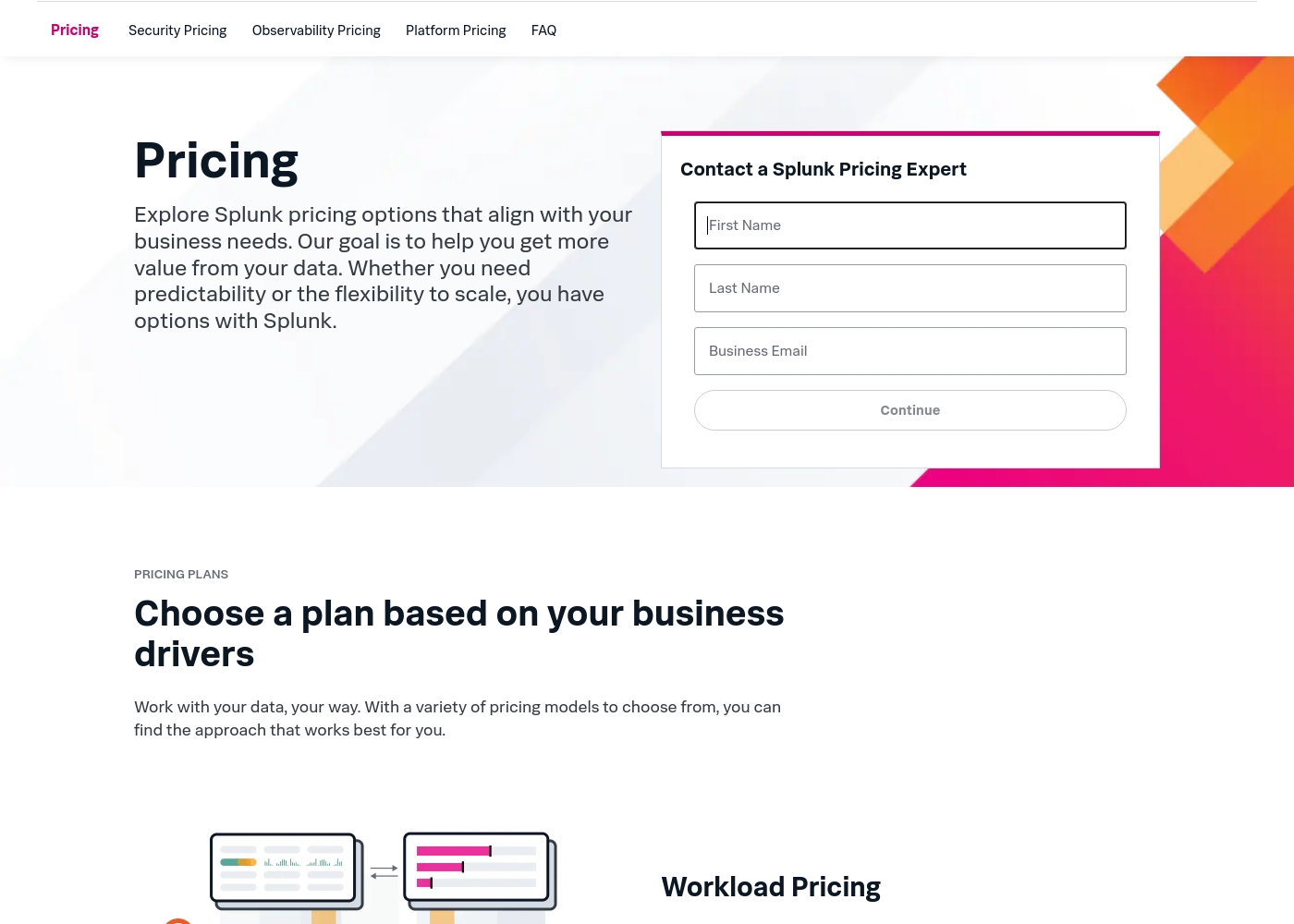
Splunk costs are Not explicitly stated per year with 2 plans: Ingest Pricing at Not explicitly stated, Activity-based Pricing at Not explicitly stated.
Take a look at the different ways you can manage your data costs below.
Ingest Pricing
Price: Not explicitly stated Websites Supported: Not explicitly stated Best For: Teams needing predictable costs for high-volume data ingestion Refund Policy: Not explicitly stated Other Features: Simple predictable approach, Economical search scaling, Broad data ingestion
- Search and analyze machine data
- Expanded use cases on ingested data
- Standard data ingestion
- Metric time series (MTS)
- Traces analyzed per minute
- Sessions monitoring
- Uptime requests
Pricing Notes
- Netlify's pricing is transparent and self-serve. You can start for free and upgrade as needed.
- Splunk requires a sales consultation for a custom quote, which can make cost planning challenging.
- Netlify's costs are based on usage credits for bandwidth, builds, and AI inference.
- Splunk's costs are based either on data volume ingested or the count of observability activities processed.
- Netlify's free plan is a robust forever-free tier, not a limited-time trial.
- Splunk offers a free trial to explore the UI, but production use requires a paid plan.
Pricing Head-to-Head
Avaliações de usuários
De acordo com o Trustpilot e o Capterra, os utilizadores elogiam consistentemente o Netlify pela sua facilidade de utilização e pelas suas funcionalidades poderosas de implementação, especialmente para sites estáticos e projetos JAMstack. Muitos destacam a integração perfeita com o Git e a conveniência das implementações de pré-visualização para colaboração em equipa.
No entanto, as preocupações recorrentes apontam para a resposta do suporte ao cliente e problemas ocasionais com erros de compilação ou estabilidade da plataforma. O preço é frequentemente mencionado, com alguns utilizadores a considerar o nível gratuito generoso para projetos pessoais, mas os planos pagos podem parecer caros para equipas maiores.
O Netlify tornou a implementação dos meus projetos JAMstack incrivelmente fácil. As implementações de pré-visualização mudam o jogo para o trabalho com clientes. Recomendo-o a qualquer programador à procura de simplicidade.
Based on the provided external sources, we couldn't retrieve detailed user reviews for Splunk due to access restrictions. Trustpilot and Capterra both returned verification or security pages, preventing us from gathering specific sentiment on accuracy, ease of use, support, or pricing.
This means our review is based solely on the official product information and pricing details provided. We recommend checking these review sites directly for the latest user feedback before making a decision.
Nosso veredicto
For most people building websites or web apps, **Netlify is the clear choice**. It's built to get your code live fast with minimal fuss. **Netlify's superpower** is its unified, fast workflow. Push a change and see it live in under 30 seconds. Every branch gets a unique preview URL for safe team review. It turns deployment from a chore into a competitive advantage. **Splunk's superpower** is making sense of chaos. It ingests data from anywhere and lets you search, analyze, and act. It's indispensable for security teams hunting threats or engineers troubleshooting performance across massive systems. **The deciding factor** is your goal. If you're creating digital experiences—sites, apps, tools—you want Netlify. If you're analyzing machine data to secure or optimize your infrastructure, you need Splunk. **Final verdict:** Choose **Netlify** if you're a developer or team focused on shipping web projects quickly and reliably. Choose **Splunk** if you're an IT or security professional tasked with understanding and protecting a complex data environment. They're not really competing tools; they're solutions for completely different jobs.
Perguntas Frequentes
Can Netlify do what Splunk does for data analysis?
No. Netlify is a web deployment platform, not a data analytics tool. It hosts your site and handles traffic. Splunk is designed to search, analyze, and visualize massive volumes of machine data for security and operations. They serve fundamentally different purposes.
Is Splunk worth the high cost compared to Netlify?
It's an apples-to-oranges comparison. Splunk's cost is for enterprise-scale data analysis and security. Netlify's cost is for hosting and deploying websites. Splunk is worth it if you need deep visibility into your entire IT stack. Netlify is the right choice for building and shipping web applications.
Which is easier to get started with, Netlify or Splunk?
Netlify is dramatically easier. You can deploy a site by dragging a folder or connecting a Git repo in minutes. Splunk requires complex configuration, data input setup, and learning its query language. Expect a significant learning curve with Splunk.
Do I need both Netlify and Splunk?
It's possible, but for different roles. A company might use Netlify to host its marketing website and Splunk to monitor the security and performance of its internal applications and infrastructure. They don't overlap in function.
Which has better integrations for my tools?
Depends on your tools. Netlify integrates perfectly with Git providers, frontend frameworks, and CI/CD pipelines. Splunk has over 2,000 integrations for ingesting data from databases, cloud services, network devices, and business applications. Splunk's integration ecosystem is broader, but Netlify's is deeper for its niche.
Is there a free version of Splunk like Netlify's free plan?
Splunk offers a free trial to explore its UI, but it's not a permanent free tier. Netlify has a robust, forever-free plan that includes core features, 300 monthly credits, and unlimited deploy previews. Netlify's free offering is much more generous for ongoing use.
Pronto para escolher?
Ambas as ferramentas têm seus pontos fortes. Escolha com base nas suas necessidades específicas.