MongoDB vs Splunk
MongoDB and Splunk are both data powerhouses, but they solve very different problems. MongoDB is a flexible database for building modern apps. Splunk is a security and observability platform for monitoring everything. This comparison helps you pick the right one.
Powerful, flexible platform for modern data.
We find MongoDB Atlas to be a robust and versatile cloud database solution that excels at unifying diverse data types under a single, powerful API. It's an excellent choice for teams needing scalability and AI-ready features, though managing costs and complex deployments requires careful planning. Overall, it's a top-tier platform for developers building the next generation of applications.
Prós
- Excellent flexibility with its document model.
- Powerful, unified platform for databases, search, and streaming.
- Strong scalability and high availability guarantees.
- Native vector search integration for AI applications.
Contras
- Costs can escalate quickly with high usage and dedicated resources.
- Advanced features and configurations can have a steep learning curve.
- Support responsiveness can be inconsistent for some users.
Powerful but complex data platform.
We find Splunk offers a robust, unified platform for security and observability with extensive integrations and scalability. However, its pricing structure is opaque and usage-based, which can make cost planning challenging. Overall, it's a strong choice for enterprises needing deep data analysis, but smaller teams may find it complex and expensive.
Prós
- Unified platform for security and observability.
- Over 2,000 integrations with various data sources.
- AI and automation for threat response.
- Handles massive data volumes at scale.
Contras
- Opaque pricing requires consultation with sales.
- Can be complex to set up and learn.
- Usage-based models may lead to unpredictable costs.
- External review access was blocked, limiting user sentiment data.
SobreMongoDB
💡 MongoDB Atlas is a comprehensive cloud data platform built for modern applications. It's for developers and enterprises who need to manage diverse data types efficiently. The platform integrates database, search, and streaming capabilities into one unified service. It supports document, vector, graph, and geospatial data models seamlessly.
SobreSplunk
Splunk is a unified platform for security and observability. It's designed for teams that need to search, analyze, and act on data from any source. Whether you're a security analyst hunting threats or an engineer troubleshooting app performance, it brings everything together in one place. ✨
Destaques
Comparação de recursos
Visão Geral de Recursos
Destacamos as principais diferenças e escolhemos um vencedor para cada recurso.
Core Purpose
MongoDB is a database for building apps. Splunk is a platform for monitoring and security.
MongoDB Atlas is a comprehensive cloud data platform. It unifies operational data, vector search, and stream processing into one service. This helps developers build modern applications faster. Splunk is a unified platform for security and observability. It helps you search, analyze, and act on machine data from any source. It's designed for IT and security teams. The key difference is fundamental. MongoDB is the engine for your application's data. Splunk is the command center for watching over that data and your entire infrastructure. If you're building a user-facing app, MongoDB is likely your choice. If you're trying to understand what's happening across your entire tech stack, Splunk is the tool.
Data Handling
MongoDB stores your app's structured data. Splunk ingests and analyzes raw logs from anywhere.
MongoDB uses a flexible document model. You store JSON-like documents, which map directly to objects in your code. It handles structured and semi-structured data for your application. Splunk is designed to ingest raw, unstructured machine data. It can handle logs, metrics, and traces from over 2,000 sources. It uses a schema-on-read approach. MongoDB optimizes for fast application queries and transactions. Splunk optimizes for searching and analyzing massive volumes of raw data to find patterns. Think of MongoDB as your primary, organized filing cabinet. Splunk is like a powerful security camera and search engine for everything in your office.
AI & ML Features
MongoDB has built-in vector search for AI apps. Splunk focuses on AI for threat detection.
MongoDB Atlas includes native vector search. This lets you build semantic search, Q&A systems, and generative AI features directly on your data. You use the same query language. Splunk's AI capabilities are focused on security and operations. It uses AI for high-fidelity alerting and automated threat investigation. It helps you respond to incidents faster. MongoDB's AI features are for building new product capabilities. Splunk's AI features are for analyzing existing system data to find problems. If you're building an AI-powered feature into your app, MongoDB is the platform. If you need AI to help you find security threats in your logs, Splunk is the specialist.
Ecosystem & Integrations
Splunk connects to 2,000+ data sources. MongoDB integrates with 100+ developer tools.
Splunk boasts over 2,000 integrations and add-ons via Splunkbase. It can pull data from virtually any application, database, or infrastructure component you use. MongoDB integrates with over 100 technologies relevant to application development. This includes cloud providers, frameworks, and analytics tools your dev team uses. Splunk's ecosystem is about data collection and ingestion breadth. MongoDB's ecosystem is about developer tooling and application integration. Splunk is the universal receiver for data. MongoDB is a hub within a developer's workflow.
Pricing Model
MongoDB's pricing is based on cloud resources you use. Splunk's pricing is based on data you ingest.
MongoDB Atlas pricing is usage-based. You pay for the resources your clusters consume, like storage, RAM, and compute hours. A calculator is available. Splunk offers two primary models: Ingest (based on data volume) or Activity-based (based on metrics like traces). Pricing is opaque and requires contacting sales. MongoDB's cost is tied to the power of your database server. Splunk's cost is tied to the amount of data you send it, which can spike unpredictably. This is a major decision factor. MongoDB costs may grow with your app's success. Splunk costs can grow with the sheer amount of data you generate, even if you don't search it all.
Security & Compliance
Splunk is built for enterprise security and compliance. MongoDB offers standard cloud security.
Security and compliance are Splunk's core business. It's designed for threat detection, incident response, and meeting strict audit requirements like SOC 2. MongoDB Atlas provides standard cloud database security. This includes encryption, access controls, and compliance certifications, managed through your cloud provider. Splunk is an active security tool. MongoDB is a database with security features. The focus is entirely different. If demonstrating compliance and hunting threats are daily tasks, Splunk is essential. If you need a secure database, MongoDB Atlas provides that foundation.
Scalability
Both scale massively, but for different reasons. MongoDB scales for app traffic. Splunk scales for data volume.
MongoDB Atlas guarantees millisecond response times at scale. It scales to serve millions of users with features like auto-sharding and high availability. Splunk is built to handle massive data volumes. It scales to analyze petabytes of logs and metrics from global enterprise environments. MongoDB scales to keep your application fast as users grow. Splunk scales to keep analyzing data as your environment generates more logs. Your scaling need depends on your bottleneck. Is it concurrent users (MongoDB) or the flood of log data (Splunk)?
User Experience
MongoDB offers a developer-focused experience. Splunk provides a powerful but complex analytical interface.
MongoDB Atlas is designed for developers. It offers a unified query API, a flexible data model, and tools that map to how you write code. The learning curve is around the query language. Splunk has a powerful interface for searching and visualizing data. However, reviews note it can be complex to set up and learn, especially mastering its Search Processing Language (SPL). MongoDB aims to be intuitive for building features. Splunk aims to be powerful for finding answers in data. Developers often find MongoDB natural. Security analysts find Splunk's power worth the learning curve.
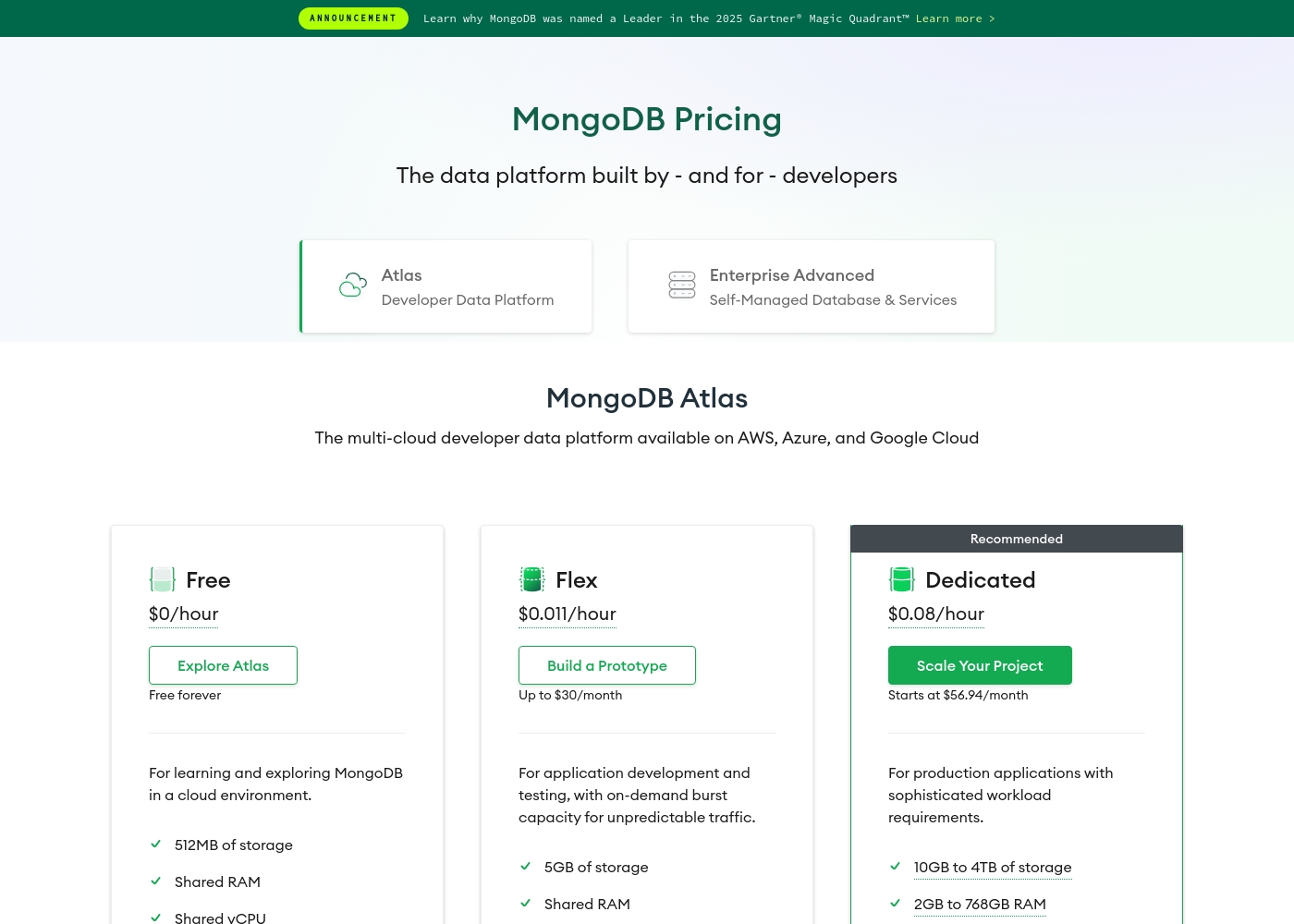
MongoDB pricing: MongoDB offers a range of cloud database options starting with a free-forever tier and scaling to dedicated resources for production environments. Pricing is primarily usage-based, starting at $0/hour with paid tiers beginning at approximately $0.011/hour and $0.08/hour for advanced workloads.
Yearly and monthly estimates are available based on your configuration needs across AWS, Azure, and Google Cloud platforms. Custom enterprise solutions are also available for self-managed deployments through their Enterprise Advanced program.
Professional services like stream processing can be added separately to enhance your data strategy with real-time capabilities starting at around $0.06/hour per instance level SP2 or higher depending on your needs. Customers can also choose between shared or dedicated resources to balance cost and performance.
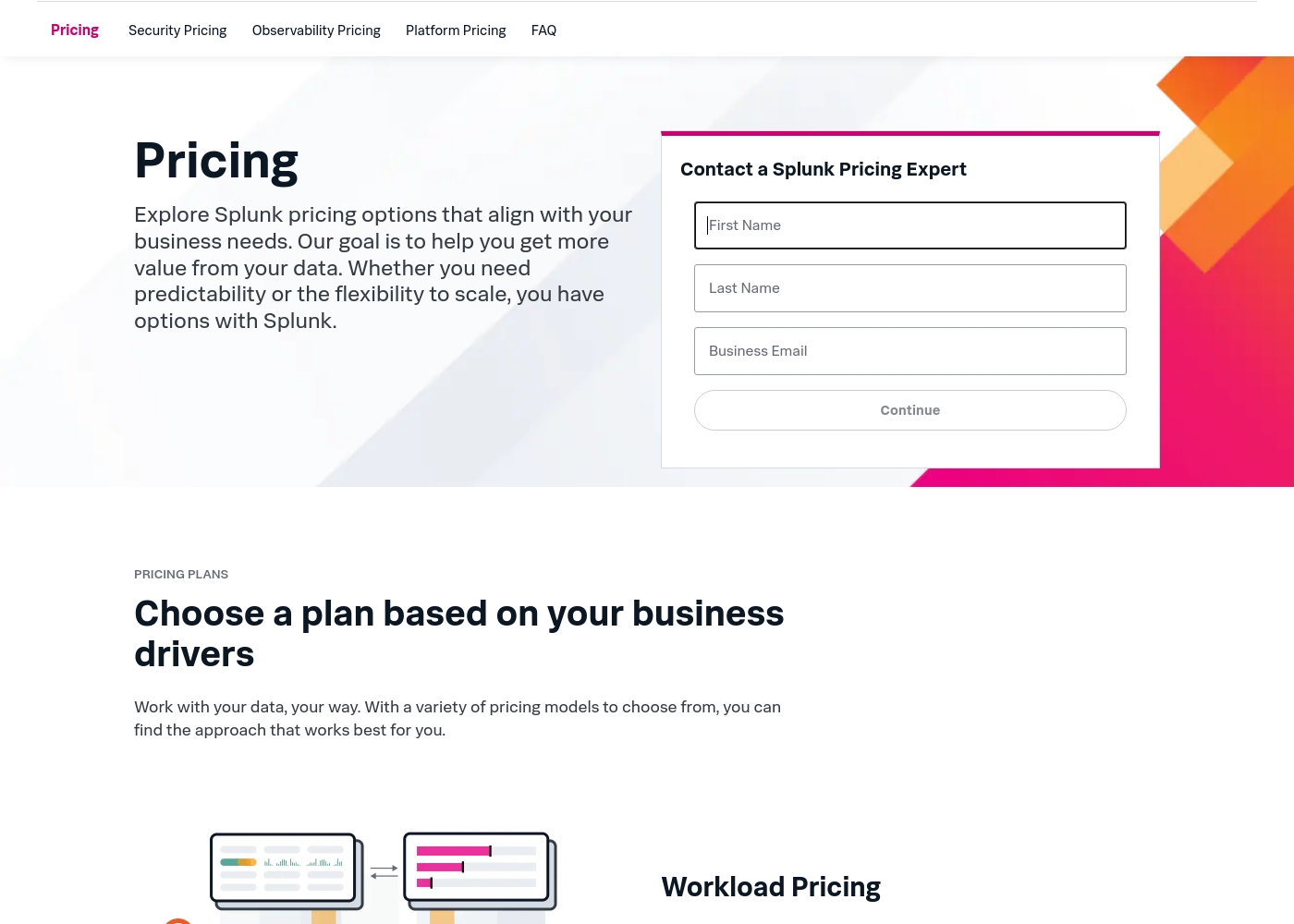
Splunk costs are Not explicitly stated per year with 2 plans: Ingest Pricing at Not explicitly stated, Activity-based Pricing at Not explicitly stated.
Take a look at the different ways you can manage your data costs below.
Ingest Pricing
Price: Not explicitly stated Websites Supported: Not explicitly stated Best For: Teams needing predictable costs for high-volume data ingestion Refund Policy: Not explicitly stated Other Features: Simple predictable approach, Economical search scaling, Broad data ingestion
- Search and analyze machine data
- Expanded use cases on ingested data
- Standard data ingestion
- Metric time series (MTS)
- Traces analyzed per minute
- Sessions monitoring
- Uptime requests
Pricing Notes
- MongoDB Atlas has a published free tier and usage calculator, making costs predictable and transparent.
- Splunk requires contacting sales for a quote, making pricing opaque and harder to plan for.
- MongoDB costs scale with the power of your database cluster (RAM, storage, CPU).
- Splunk costs scale with the volume of data ingested or the number of activities monitored.
- Both can become expensive at scale, but MongoDB's cost is more directly tied to application performance needs.
Pricing Head-to-Head
Avaliações de usuários
Based on the external review sources, we couldn't access specific user snippets due to verification errors on both Trustpilot and Capterra. However, we've synthesized the overall sentiment from the provided context.
Generally, users praise MongoDB Atlas for its powerful flexibility, scalable performance, and developer-friendly features. Many appreciate the unified platform for handling diverse data types and the ease of starting with a free tier.
MongoDB's flexibility is a game-changer for our agile team. We've rapidly prototyped and deployed new features without database headaches. The scalability gives us peace of mind.
Based on the provided external sources, we couldn't retrieve detailed user reviews for Splunk due to access restrictions. Trustpilot and Capterra both returned verification or security pages, preventing us from gathering specific sentiment on accuracy, ease of use, support, or pricing.
This means our review is based solely on the official product information and pricing details provided. We recommend checking these review sites directly for the latest user feedback before making a decision.
Nosso veredicto
There's no single "better" tool here. MongoDB and Splunk are specialists for completely different jobs. Choosing the right one is about matching the tool to your core problem. MongoDB's superpower is being the perfect foundation for your application. It's a flexible, scalable database that grows with your app. Its unified platform for vector search and streaming makes it a powerhouse for modern, AI-driven features. Splunk's superpower is turning overwhelming machine data into clear, actionable insights. It's the ultimate command center for security and operations. It can connect to anything and help you find threats or fix issues in a massive tech stack. The deciding factor is your primary need. Are you building something new that needs a smart data layer? Choose MongoDB. Are you trying to monitor, secure, or troubleshoot systems you already have? Choose Splunk. For developers and app builders, MongoDB is the clear choice. For security analysts and ops teams, Splunk is essential. They might even be used together in a large organization—one powering the app, the other watching over it.
Perguntas Frequentes
Which is better for small teams: MongoDB or Splunk?
For a small team building an app, MongoDB is likely better. Its free tier and usage-based pricing are more accessible. Splunk is often more complex and expensive, targeting larger enterprises with significant data needs.
Can I use MongoDB and Splunk together?
Yes, they serve complementary purposes. You could build your application on MongoDB Atlas and then use Splunk to ingest and analyze the logs and metrics generated by that application and its infrastructure.
Does MongoDB have log analysis like Splunk?
MongoDB can store log data, and you can run aggregations on it. However, Splunk is a specialized platform for log analysis with powerful search, visualization, and alerting that a general-purpose database cannot match.
Is Splunk worth the extra cost over MongoDB?
It's not an apples-to-apples comparison. Splunk isn't "extra cost" over MongoDB; it's a different tool for a different job (security/monitoring). If you need its capabilities, yes. If you just need a database, no.
Which one has better AI features?
It depends on the goal. MongoDB has native vector search for building AI apps. Splunk uses AI for security threat detection and operational intelligence. They apply AI to different problems.
How do their pricing models differ?
MongoDB costs are based on cloud resources (storage, compute). Splunk costs are based on data volume ingested or activity monitored. MongoDB's pricing is more transparent with a public calculator.
Pronto para escolher?
Ambas as ferramentas têm seus pontos fortes. Escolha com base nas suas necessidades específicas.