MongoDB vs Pinecone
This is a classic battle: a full-stack data platform versus a specialized vector database. MongoDB aims to be your one-stop shop for all data needs. Pinecone is laser-focused on making AI retrieval fast and simple.
Best for: Developers building full-stack applications that need a single database for everything., Teams needing real-time stream processing alongside their operational data.
Best for: AI developers focused purely on building semantic search or RAG pipelines., Teams needing fast, accurate vector retrieval without managing infrastructure.
Powerful, flexible platform for modern data.
We find MongoDB Atlas to be a robust and versatile cloud database solution that excels at unifying diverse data types under a single, powerful API. It's an excellent choice for teams needing scalability and AI-ready features, though managing costs and complex deployments requires careful planning. Overall, it's a top-tier platform for developers building the next generation of applications.
Pro
- Excellent flexibility with its document model.
- Powerful, unified platform for databases, search, and streaming.
- Strong scalability and high availability guarantees.
- Native vector search integration for AI applications.
Contro
- Costs can escalate quickly with high usage and dedicated resources.
- Advanced features and configurations can have a steep learning curve.
- Support responsiveness can be inconsistent for some users.
Powerful, simple vector search for AI.
We found Pinecone excels as a fully managed vector database, making complex AI retrieval accessible. It significantly reduces operational overhead, allowing developers to focus on application logic rather than infrastructure. Overall, we recommend it for teams needing fast, reliable, and scalable vector search without the management burden.
Pro
- Extremely easy setup and integration.
- Fast and accurate vector search performance.
- Fully managed service eliminates infrastructure hassles.
- Scalable to billions of vectors automatically.
Contro
- Pricing can escalate with high usage volumes.
- Advanced filtering may have a learning curve.
- Limited to vector-specific use cases.
Informazioni suMongoDB
💡 MongoDB Atlas is a comprehensive cloud data platform built for modern applications. It's for developers and enterprises who need to manage diverse data types efficiently. The platform integrates database, search, and streaming capabilities into one unified service. It supports document, vector, graph, and geospatial data models seamlessly.
Informazioni suPinecone
Pinecone is a fully managed vector database built specifically for AI applications. 🧠 It handles the heavy lifting of storage, indexing, and retrieval for your data. This means you can build smarter agents, powerful RAG pipelines, semantic search, and recommendation systems without managing complex infrastructure. It's designed for developers and teams who need their AI to understand context at any scale.
Punti salienti
Confronto delle funzionalità
Panoramica funzionalità
Evidenziamo le principali differenze e scegliamo un vincitore per ogni funzionalità.
Core Purpose
MongoDB is a multi-model data platform. Pinecone is a dedicated vector database.
MongoDB Atlas unifies operational data, vector search, and streaming in one system. You can run your main app database and your AI features from the same platform. Pinecone does one thing: store and query vector embeddings for AI. It's built specifically for fast semantic search and retrieval. The key difference is scope. MongoDB handles your entire data stack, while Pinecone is a specialist tool within it.
Vector Search
Both offer vector search. MongoDB integrates it; Pinecone is built for it.
MongoDB Atlas includes vector search natively. You store your operational data and embeddings together. This simplifies building apps like recommendation engines. Pinecone is a vector-first database. Its entire architecture is optimized for fast, accurate vector search and filtering at any scale. For pure vector search performance and simplicity, Pinecone has the edge. MongoDB wins if you need vectors alongside your main application data.
Data Models
MongoDB uses flexible documents. Pinecone uses fixed vector schemas.
MongoDB's document model maps to your code objects. You can store complex, nested data. It also supports graph and geospatial data natively. Pinecone stores vectors with optional metadata. The schema is simpler and focused on retrieval. You define vectors and their associated metadata fields. MongoDB offers more flexibility for diverse data. Pinecone's simpler model is easier to get started with for AI projects.
Scalability
Both scale automatically. Pinecone is simpler at massive vector counts.
MongoDB scales by choosing larger cluster tiers (RAM, vCPUs). It guarantees performance with dedicated resources. Pinecone handles billions of vectors automatically. It manages sharding and scaling without you tuning anything. Query speed stays consistent. Pinecone is easier to scale for huge vector workloads. MongoDB offers more control over scaling for mixed workloads.
Pricing Structure
MongoDB starts cheaper for general use. Pinecone's paid plans have higher minimums.
MongoDB has a generous free tier (512MB). Paid tiers start at ~$0.011/hour for small, shared clusters. Pinecone's free tier is 2GB. The next tier, Builder, is a flat $20/month. The Standard plan has a $50 monthly minimum. For small projects, MongoDB can be more affordable. Pinecone's pricing is clearer but with higher entry points for paid features.
Ease of Setup
Pinecone is faster for starting a pure vector project. MongoDB has a steeper initial learning curve.
Pinecone is designed for quick setup. You can create an index and start adding vectors in minutes. The API is focused and simple. MongoDB Atlas requires choosing a cluster tier and region. While managed, its broader feature set means more to learn upfront. If your goal is just vector search, Pinecone gets you running faster. MongoDB requires more initial configuration.
Enterprise Security
Both offer robust security. Pinecone has more certifications out-of-the-box.
MongoDB Atlas provides security features. Check their docs for specific compliance like SOC 2 or HIPAA availability on your tier. Pinecone comes with SOC 2, GDPR, ISO 27001, and HIPAA (on Standard/Enterprise). It includes encryption, SSO, and RBAC on all paid plans. Pinecone offers a more comprehensive, pre-built security and compliance package.
Operational Overhead
Pinecone is truly zero-ops. MongoDB manages more complexity for you.
Pinecone is a black box of simplicity. It handles indexing, scaling, and performance tuning completely. You focus on your code. MongoDB Atlas manages your database, but you still choose configurations. You might monitor storage and query performance more actively. Pinecone eliminates almost all database operations. MongoDB manages the heavy lifting but still requires some oversight.
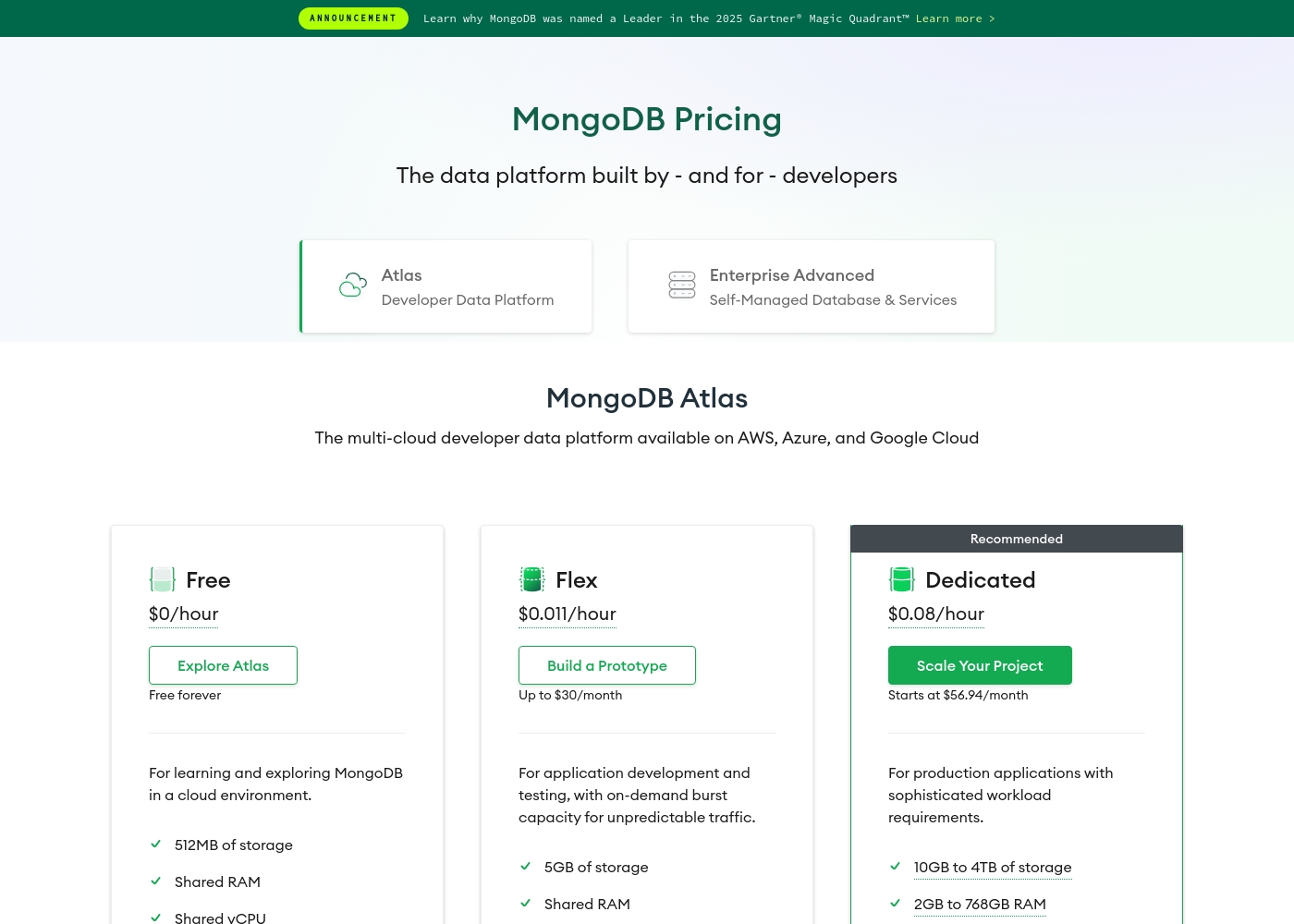
MongoDB pricing: MongoDB offers a range of cloud database options starting with a free-forever tier and scaling to dedicated resources for production environments. Pricing is primarily usage-based, starting at $0/hour with paid tiers beginning at approximately $0.011/hour and $0.08/hour for advanced workloads.
Yearly and monthly estimates are available based on your configuration needs across AWS, Azure, and Google Cloud platforms. Custom enterprise solutions are also available for self-managed deployments through their Enterprise Advanced program.
Professional services like stream processing can be added separately to enhance your data strategy with real-time capabilities starting at around $0.06/hour per instance level SP2 or higher depending on your needs. Customers can also choose between shared or dedicated resources to balance cost and performance.
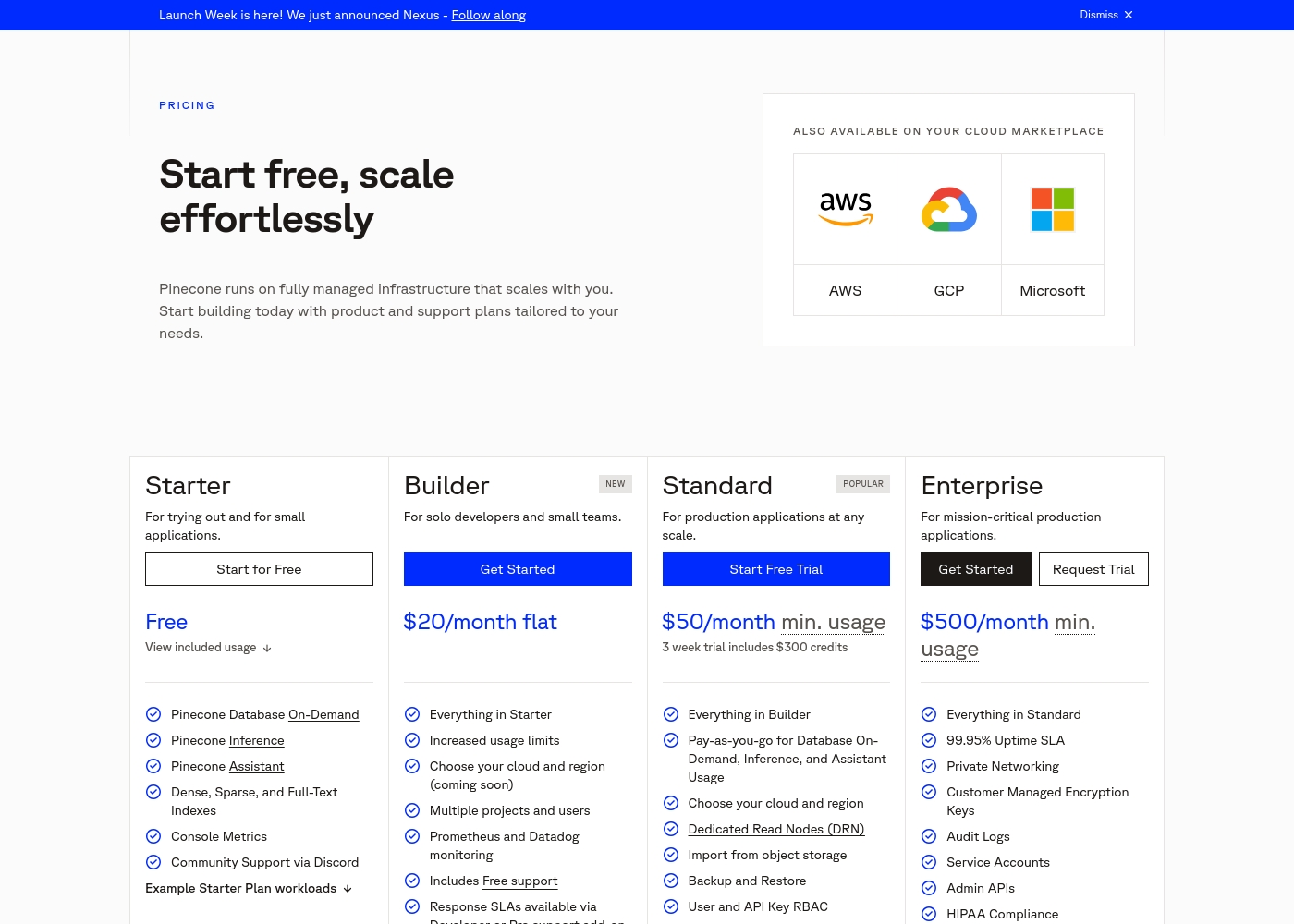
Pinecone pricing: Pinecone offers flexible vector database plans ranging from a free Starter tier to usage-based Enterprise solutions starting at $500/month. Pricing scales with your data needs, including options for flat-rate developer plans and pay-as-you-go production environments..........................................................................................................................................................................................................................................................................................................................................................................................................................................................................................................................................................................................................................................................................................................................................................................................................................................................................................
Pricing Notes
- MongoDB's free tier is generous but limited to 512MB of storage.
- Pinecone's free Starter plan is also generous, offering 2GB of storage.
- MongoDB's paid costs start lower (~$0.011/hour) for small, shared clusters.
- Pinecone's paid plans (Builder, Standard) have fixed monthly minimums of $20 and $50.
- Both can scale to high costs with heavy usage. Monitor your consumption carefully.
- MongoDB offers a 3-week free trial with $300 in credits on its Standard plan.
Pricing Head-to-Head
Recensioni degli utenti
Based on the external review sources, we couldn't access specific user snippets due to verification errors on both Trustpilot and Capterra. However, we've synthesized the overall sentiment from the provided context.
Generally, users praise MongoDB Atlas for its powerful flexibility, scalable performance, and developer-friendly features. Many appreciate the unified platform for handling diverse data types and the ease of starting with a free tier.
MongoDB's flexibility is a game-changer for our agile team. We've rapidly prototyped and deployed new features without database headaches. The scalability gives us peace of mind.
We reviewed user feedback on Trustpilot for Pinecone. The sentiment is overwhelmingly positive, with users frequently praising the platform's ease of use and speed.
Many reviewers highlight how simple it is to set up and integrate, calling it a "game-changer" for AI projects. ⚡ Accuracy and performance are recurring themes, with users noting fast query times and reliable results.
Pinecone is incredibly easy to set up and use. We integrated it into our RAG pipeline in minutes, and the search performance is fantastic. It's become a core part of our AI stack.
Il nostro verdetto
The right choice depends entirely on your project's core need. MongoDB is the versatile all-rounder, while Pinecone is the specialist champion for vector search. MongoDB's superpower is unification. It combines your main database, search, and streaming in one platform. You can build AI features right alongside your core app data without separate systems. Pinecone's superpower is focused simplicity. It makes adding instant, accurate vector search incredibly easy. You avoid infrastructure headaches and scale to billions of vectors automatically. The deciding factor is your project's scope. If you need a general-purpose database with AI capabilities, MongoDB wins. If your project is purely about fast AI retrieval, Pinecone is the clearer choice. Choose MongoDB if you're building a complex application and want one data platform. Choose Pinecone if your primary goal is adding lightning-fast, scalable vector search to your AI project.
Domande frequenti
Can I use Pinecone as my main application database?
No. Pinecone is a vector database for AI retrieval, not a general-purpose database. Use MongoDB for your core application data and add Pinecone alongside it if needed for vector search.
Is MongoDB's vector search as fast as Pinecone's?
For specialized vector search at massive scale, Pinecone is generally faster and simpler. MongoDB's vector search is great for integrated use cases, but Pinecone's entire architecture is optimized for retrieval speed.
Which is cheaper for a small AI project?
It depends on your data type. MongoDB's free tier is 512MB. Pinecone's is 2GB. For paid use, MongoDB can start cheaper with shared clusters. Pinecone's Builder plan is a flat $20/month.
Do I need to know MongoDB to use Pinecone?
No. They are completely separate products with different APIs. Pinecone has its own simple API focused on vector operations. You don't need MongoDB knowledge to use it.
Which one is easier to get started with for AI?
For a pure AI vector search project, Pinecone is easier. Its setup is faster and the API is simpler. MongoDB has a broader learning curve but offers more if you need multiple data features.
Can I migrate data from MongoDB to Pinecone?
Yes, but it's a different data model. You would extract your vector embeddings (and metadata) from MongoDB and load them into a Pinecone index. It's not a direct migration.
Pronto a scegliere?
Entrambi gli strumenti hanno i loro punti di forza. Scegli in base alle tue esigenze specifiche.