Google Cloud vs MongoDB
Choosing between Google Cloud and MongoDB can be tough. One is a massive cloud infrastructure provider, while the other is a specialized data platform. Here's how to decide which one fits your project.
Infrastruttura Potente, Fatturazione e Supporto Rischiosi.
Riconosciamo che Google Cloud offre infrastrutture leader, offrendo una solida integrazione AI e una significativa scalabilità per i carichi di lavoro aziendali. Tuttavia, l'elevato volume di segnalazioni riguardanti il supporto clienti inaccessibile e la fatturazione confusa e non trasparente è profondamente preoccupante. Nel complesso, consideriamo questa piattaforma ad alto rischio per gli utenti che danno priorità all'assistenza reattiva o a un controllo granulare dei costi.
Pro
- Accesso a strumenti AI generativi di prim'ordine come Gemini e Vertex AI.
- Supporta strategie di sviluppo open source, multicloud e ibride.
- I nuovi utenti ricevono 300 $ di crediti gratuiti al momento dell'iscrizione.
- Offre potenziali risparmi fino al 57% tramite sconti per uso impegnativo.
Contro
- Il supporto clienti è spesso inaccessibile e nascosto.
- Gli utenti segnalano fatturazione non trasparente e addebiti imprevisti nonostante abbiano crediti.
- Costi estremamente elevati per gli abbonamenti di supporto tecnico (fino a 12.500 $/mese).
- La mancanza di limiti di spesa rigidi per i servizi pay-as-you-go è un punto dolente comune.
Powerful, flexible platform for modern data.
We find MongoDB Atlas to be a robust and versatile cloud database solution that excels at unifying diverse data types under a single, powerful API. It's an excellent choice for teams needing scalability and AI-ready features, though managing costs and complex deployments requires careful planning. Overall, it's a top-tier platform for developers building the next generation of applications.
Pro
- Excellent flexibility with its document model.
- Powerful, unified platform for databases, search, and streaming.
- Strong scalability and high availability guarantees.
- Native vector search integration for AI applications.
Contro
- Costs can escalate quickly with high usage and dedicated resources.
- Advanced features and configurations can have a steep learning curve.
- Support responsiveness can be inconsistent for some users.
Informazioni suGoogle Cloud
Google Cloud è una piattaforma cloud completa che offre più di 150 prodotti e capacità. Aiuta le aziende a modernizzare l'infrastruttura esistente o a creare applicazioni basate sull'AI interamente nuove da zero. Il servizio è pensato per sviluppatori, leader aziendali e startup pronti a crescere e trasformarsi digitalmente.
I nuovi clienti possono provare Google Cloud con l'uso gratuito di oltre 20 prodotti. Inoltre, riceverai 300 $ di crediti gratuiti al momento dell'iscrizione per aiutarti a esplorare. 💡
Informazioni suMongoDB
💡 MongoDB Atlas is a comprehensive cloud data platform built for modern applications. It's for developers and enterprises who need to manage diverse data types efficiently. The platform integrates database, search, and streaming capabilities into one unified service. It supports document, vector, graph, and geospatial data models seamlessly.
Punti salienti
Confronto delle funzionalità
Panoramica funzionalità
Evidenziamo le principali differenze e scegliamo un vincitore per ogni funzionalità.
Core Purpose
Google Cloud is a vast cloud infrastructure platform. MongoDB is a specialized data platform.
Google Cloud offers over 150 products. You can run everything from VMs to AI models. It's like renting a supercomputer. MongoDB Atlas focuses on your data layer. It manages your database, search, and streams. It's like having a dedicated, expert DBA. The difference is scope vs. specialization. Google Cloud provides the entire toolbox. MongoDB excels at one critical tool. For a startup building a full app, Google Cloud provides the foundation. For a team optimizing a data-heavy feature, MongoDB is targeted.
AI & Data Analytics
Google Cloud has massive AI/ML and analytics suites. MongoDB has native vector search for AI apps.
Google Cloud's Vertex AI and BigQuery are industry leaders. You can build models with 200+ foundation models. BigQuery runs petabyte-scale analytics. MongoDB's strength is unifying data and vectors. You can store operational data and embeddings together. This simplifies building AI features like semantic search. Google Cloud offers a broader, more complex AI platform. MongoDB makes specific AI workflows simpler. One is a comprehensive lab, the other a focused workbench. Choose Google Cloud for custom model training. Choose MongoDB for integrating AI into your existing app's data flow.
Database Flexibility
Google Cloud offers multiple managed databases. MongoDB offers one highly flexible document database.
Google Cloud provides Cloud SQL, Spanner, Firestore, and more. You pick the right tool for each job. This can mean managing multiple systems. MongoDB uses a single document model for all data. The same API handles operational, graph, and geospatial data. This reduces context switching. Google Cloud gives you specialized databases. MongoDB gives you one versatile database. It's the difference between a Swiss Army knife and a full workshop. For apps with diverse data types in one service, MongoDB is seamless. For needing different database engines, Google Cloud has options.
Real-time Processing
Google Cloud uses multiple services for streams. MongoDB has integrated stream processing.
Google Cloud handles streams with Dataflow, Pub/Sub, and others. It's powerful but requires configuring separate services. This adds architectural complexity. MongoDB Atlas Stream Processing is built in. You use the same query language for streams and batches. This creates a unified developer experience. Google Cloud offers more scalable, global streaming. MongoDB offers simplicity and integration. One is built for massive scale, the other for developer velocity. For processing Kafka streams alongside your app data, MongoDB is simpler. For global, high-throughput event processing, Google Cloud has dedicated tools.
Ease of Getting Started
Both have generous free tiers. Google Cloud has a steeper initial learning curve.
Google Cloud gives $300 in credits and 20+ free products. However, its console can feel slow and complex. New users report difficulty with simple tasks. MongoDB offers a free-forever tier with 512 MB. The Atlas interface is focused and generally intuitive. Many developers find its document model natural. Google Cloud's scale means more to learn upfront. MongoDB's focus makes its core product more approachable. One is a sprawling city, the other a well-organized campus. Your choice depends on your role. A cloud architect might embrace Google Cloud's scope. An app developer might prefer MongoDB's streamlined data focus.
Cost Management
Google Cloud offers committed discounts but billing can be unclear. MongoDB costs scale with resource usage.
Google Cloud's pricing is usage-based with potential for 57% savings. Users complain about non-transparent billing and unexpected charges. Support for cost limits is a pain point. MongoDB's costs scale with storage and compute hours. Users note costs can escalate quickly with high usage. Monitoring your usage is crucial in both cases. Google Cloud has more discount levers but more billing complexity. MongoDB's model is simpler but can surprise you. Both require vigilant monitoring. For predictable, committed workloads, Google Cloud's discounts help. For variable workloads, MongoDB's pay-as-you-go is straightforward.
Customer Support
Google Cloud support is expensive and hard to reach. MongoDB support is included in paid tiers.
Google Cloud's technical support can cost up to $12,500/month. Free users report support is hidden and nearly impossible to contact. This is a major frustration. MongoDB's Dedicated tiers include enhanced support. Users report mixed experiences but availability is better. SLAs are tied to your pricing tier. Google Cloud's paid support is enterprise-grade but costly. MongoDB's included support is more accessible for mid-market. The difference in accessibility is stark. If you're a large enterprise, Google Cloud's support might be justified. For smaller teams, MongoDB's included support is a significant advantage.
Vendor Lock-in Risk
Google Cloud promotes multicloud. MongoDB is an open-source based platform.
Google Cloud actively supports hybrid and multicloud strategies. They offer tools to manage apps across clouds. This reduces lock-in to their specific infrastructure. MongoDB's core is open source. You can run it on-premise or other clouds. Atlas is a managed service on AWS, Azure, and GCP. Google Cloud sells infrastructure flexibility. MongoDB sells data portability. Both address lock-in from different angles. If you fear infrastructure lock-in, Google Cloud's stance is reassuring. If you fear data lock-in, MongoDB's open-source core is a plus.
I costi di Google Cloud variano ampiamente poiché utilizza una struttura di pagamento basata sull'utilizzo, offrendo ai nuovi clienti 300 $ di crediti gratuiti e l'accesso a oltre 20 prodotti gratuiti.
Non troverai piani mensili fissi qui, ma invece tre modi flessibili per utilizzare le risorse computazionali della piattaforma.
Pay-as-you-go (Prezzi Standard)
Prezzo: Non esplicitamente indicato (Basato sull'utilizzo) Siti Web Supportati: Non esplicitamente indicato Ideale per: Organizzazioni di tutte le dimensioni che necessitano di scalabilità flessibile Politica di Rimborso: Non esplicitamente indicato Altre Funzionalità:
- Paghi solo per i servizi che utilizzi.
- Nessun costo iniziale o penale di chiusura.
- Risparmi potenziali fino al 57% con sconti per uso impegnativo.
- Supporto gratuito per la fatturazione 24/7.
- Paghi solo per i servizi che utilizzi
- Nessun costo iniziale o penale di chiusura
- Risparmia fino al 57% con sconti per uso impegnativo
- Supporto gratuito per la fatturazione 24/7
- 300 $ di crediti gratuiti
- Accesso gratuito a oltre 20 prodotti
- Esegui, testa e distribuisci carichi di lavoro
- Fino a 350.000 $ di crediti Cloud
- Supporto e soluzioni personalizzati
- Supporto alla scalabilità per aziende innovative
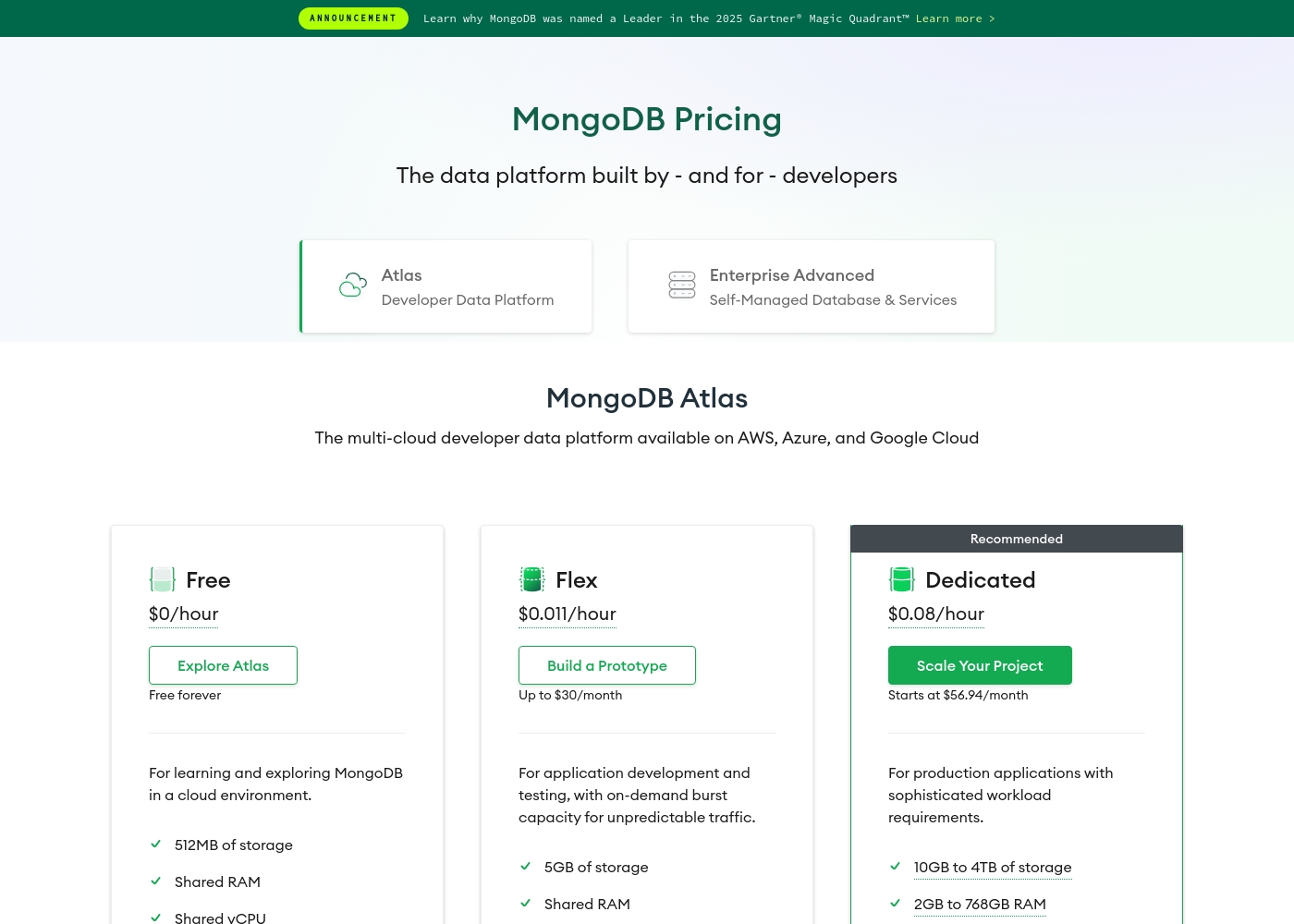
MongoDB pricing: MongoDB offers a range of cloud database options starting with a free-forever tier and scaling to dedicated resources for production environments. Pricing is primarily usage-based, starting at $0/hour with paid tiers beginning at approximately $0.011/hour and $0.08/hour for advanced workloads.
Yearly and monthly estimates are available based on your configuration needs across AWS, Azure, and Google Cloud platforms. Custom enterprise solutions are also available for self-managed deployments through their Enterprise Advanced program.
Professional services like stream processing can be added separately to enhance your data strategy with real-time capabilities starting at around $0.06/hour per instance level SP2 or higher depending on your needs. Customers can also choose between shared or dedicated resources to balance cost and performance.
Pricing Notes
- Google Cloud offers $300 in free credits for new customers, while MongoDB has a free-forever tier.
- Google Cloud's technical support is extremely expensive, costing up to $12,500 per month.
- MongoDB's costs scale with cluster resources (storage, RAM, vCPUs), which can escalate quickly.
- Both platforms use usage-based pricing, making it hard to predict costs without careful monitoring.
- Google Cloud provides committed use discounts up to 57% for predictable workloads.
Pricing Head-to-Head
Recensioni degli utenti
Il sentimento esterno, catturato principalmente da Trustpilot, è in modo schiacciante negativo, risultando in una pessima valutazione media di 1,5 stelle. I problemi citati più di frequente ruotano attorno alla fatturazione non trasparente e al supporto clienti assolutamente disfunzionale ⚠️. Gli utenti segnalano addebiti imprevisti, a volte totali di centinaia di dollari, anche quando possiedono crediti gratuiti consistenti. Molti percepiscono questa mancanza di trasparenza come una "trappola deliberata" pensata per i nuovi utenti. Inoltre, ottenere aiuto è quasi impossibile; gli utenti descrivono il supporto come intenzionalmente nascosto e irraggiungibile, che li invia in loop frustranti e infiniti. Coloro che necessitano di aiuto tecnico affrontano costi esorbitanti, con il supporto tecnico specializzato che costa migliaia di dollari al mese.
Oltre alla gestione dei costi, gli utenti criticano la scarsa facilità d'uso. Le lamentele includono la console "inutilmente lenta" e il processo per attività semplici, come recuperare una chiave API, che richiede clic eccessivi. Gli utenti incontrano difficoltà anche in funzioni importanti di gestione dell'account, come l'eliminazione di progetti attivi che continuano a generare spese o l'aggiornamento delle informazioni di fatturazione. Ciò indica fortemente che, sebbene la piattaforma sia tecnologicamente potente, l'esperienza utente, l'amministrazione e il controllo finanziario circostanti sono gravemente difettosi.
Il mio account ha accumulato 327 € di costi API, anche se avevo 264 € di crediti gratuiti disponibili che non sono stati utilizzati. Il supporto è completamente nascosto e impossibile da raggiungere, facendolo sembrare una trappola deliberata. Questa piattaforma ha una struttura di prezzi estremamente poco trasparente.
Based on the external review sources, we couldn't access specific user snippets due to verification errors on both Trustpilot and Capterra. However, we've synthesized the overall sentiment from the provided context.
Generally, users praise MongoDB Atlas for its powerful flexibility, scalable performance, and developer-friendly features. Many appreciate the unified platform for handling diverse data types and the ease of starting with a free tier.
MongoDB's flexibility is a game-changer for our agile team. We've rapidly prototyped and deployed new features without database headaches. The scalability gives us peace of mind.
Il nostro verdetto
This isn't a simple apples-to-apples comparison. Google Cloud is the full cloud platform. MongoDB is the specialized data platform. Google Cloud's superpower is its sheer scale. It offers everything from world-class AI with Vertex AI to massive analytics with BigQuery. It's your partner for the entire infrastructure stack. MongoDB's superpower is data unification. It seamlessly blends operational data, vector search, and streaming into one system. This simplifies building complex, data-rich applications dramatically. The deciding factor is your core need. If you need a comprehensive cloud foundation, Google Cloud is the answer. If your biggest challenge is managing and querying diverse application data, MongoDB is your tool. For a startup building from scratch, Google Cloud provides the full toolkit. For a team trying to make their app's data layer smarter and faster, MongoDB delivers targeted power.
Domande frequenti
Which is better for small teams: Google Cloud or MongoDB?
MongoDB often wins for small teams focused on their app's database. Its free-forever tier and focused interface are easier to start with. Google Cloud's $300 credit is generous, but its platform can feel overwhelming.
Does Google Cloud have a database like MongoDB?
Yes, Google Cloud offers Firestore and Cloud Datastore as document databases. They serve similar use cases to MongoDB. However, MongoDB's core platform is built entirely around this document model and its associated features.
Is MongoDB worth the extra cost over Google Cloud?
It's not about extra cost, but about value for your specific need. MongoDB's cost is for a specialized data platform. Google Cloud's costs are for a broad infrastructure suite. If you only need a powerful database, MongoDB's pricing can be more predictable.
Can I use Google Cloud and MongoDB together?
Yes, absolutely. You can run MongoDB Atlas as a managed service on Google Cloud infrastructure. This is a common pattern, combining Google's infrastructure with MongoDB's specialized database.
Which is easier to learn for a developer?
Many developers find MongoDB's document model and query API more intuitive initially. Google Cloud requires learning a vast array of services and concepts. The learning curves serve different goals: app development vs. infrastructure management.
Which platform is better for AI applications?
It depends on the AI task. For training custom models at scale, Google Cloud's Vertex AI is more powerful. For adding semantic search or AI features to an app using your existing data, MongoDB's native vector search is simpler.
Pronto a scegliere?
Entrambi gli strumenti hanno i loro punti di forza. Scegli in base alle tue esigenze specifiche.