Splunk vs Vanta
Splunk and Vanta both tackle security, but they're built for totally different jobs. Splunk is a data powerhouse for searching and analyzing logs. Vanta automates compliance frameworks like SOC 2. This comparison breaks down which one your team actually needs.
Best for: Security Operations (SOC) teams needing real-time threat hunting, DevOps and SRE teams troubleshooting application performance
Best for: Startups needing to get SOC 2 certified quickly, Growing SaaS companies managing multiple compliance frameworks
Powerful but complex data platform.
We find Splunk offers a robust, unified platform for security and observability with extensive integrations and scalability. However, its pricing structure is opaque and usage-based, which can make cost planning challenging. Overall, it's a strong choice for enterprises needing deep data analysis, but smaller teams may find it complex and expensive.
Avantages
- Unified platform for security and observability.
- Over 2,000 integrations with various data sources.
- AI and automation for threat response.
- Handles massive data volumes at scale.
Inconvénients
- Opaque pricing requires consultation with sales.
- Can be complex to set up and learn.
- Usage-based models may lead to unpredictable costs.
- External review access was blocked, limiting user sentiment data.
Powerful compliance automation for growing teams.
We found Vanta excels at automating compliance workflows and reducing manual effort, which aligns with its promise to save time and accelerate deals. Its tiered pricing offers flexibility, but the lack of transparent costs and a free trial means committing to a demo before understanding the full investment.
Avantages
- Automates evidence collection and monitoring for frameworks like SOC 2.
- AI-powered questionnaire automation speeds up vendor assessments.
- Unified platform for compliance, risk management, and audit prep.
- Trust Center helps showcase security posture to customers.
Inconvénients
- Pricing requires a custom quote, with no public tiers or free trial.
- Add-ons for key features like Third-Party Risk Management increase costs.
- Initial setup and policy onboarding may have a learning curve.
- Some users report integration challenges with specific tools.
À propos deSplunk
Splunk is a unified platform for security and observability. It's designed for teams that need to search, analyze, and act on data from any source. Whether you're a security analyst hunting threats or an engineer troubleshooting app performance, it brings everything together in one place. ✨
À propos deVanta
Vanta is an Agentic Trust Platform designed for startups, mid-market, and enterprise companies. It automates the entire process of getting and staying compliant with frameworks like SOC 2, ISO 27001, and HIPAA. The platform combines compliance, risk management, and audit preparation into one place. It's built for security leaders who want to scale their programs without adding headcount. 💡
Points forts
Comparaison des fonctionnalités
Aperçu des fonctionnalités
Nous mettons en évidence les principales différences et désignons un gagnant pour chaque fonctionnalité.
Core Purpose
Splunk is for deep data analysis. Vanta is for automated compliance workflows.
Splunk ingests and searches machine data from any source. It's built for security analysts and engineers needing real-time insights from logs, metrics, and traces. Vanta automates the process of getting and staying compliant. It continuously monitors controls against frameworks like SOC 2 and handles audit evidence collection. The key difference is scope. Splunk answers 'what is happening?' across your stack. Vanta answers 'are we compliant?' and fixes it. Choose Splunk if your core problem is visibility into complex systems. Choose Vanta if your core problem is manual compliance work blocking deals.
Automation
Vanta automates compliance tasks. Splunk automates security responses.
Vanta's AI Agent automates policy generation, evidence collection, and questionnaire responses. It's designed to save thousands of manual hours per year. Splunk's automation focuses on security operations. It uses automated workflows to investigate and respond to threats based on high-fidelity alerts. Vanta automates 'paperwork' tasks for compliance. Splunk automates 'action' tasks for security operations. A startup getting SOC 2 would use Vanta's automation. A SOC team hunting threats would use Splunk's automation.
Integrations
Splunk connects to thousands of data sources. Vanta connects to business tools.
Splunk boasts 2,000+ integrations for ingesting data from virtually any log, metric, or trace source. This includes cloud providers, databases, and custom apps. Vanta integrates with cloud providers, code repositories, HR systems, and identity providers. It focuses on tools needed for evidence collection and monitoring. Splunk's integration depth is for data collection. Vanta's integration depth is for compliance automation. Splunk needs to see your firewall logs. Vanta needs to see your employee list and cloud configuration.
Reporting
Splunk offers deep data analysis. Vanta offers compliance dashboards.
Splunk provides powerful search and reporting on raw data. You can create custom dashboards to visualize trends, threats, and performance metrics. Vanta provides compliance status reports, audit readiness dashboards, and customizable reports for frameworks like SOC 2. Splunk reports on technical data. Vanta reports on compliance posture. An engineer would use Splunk to report on application errors. A CISO would use Vanta to report on audit progress to the board.
Ease of Use
Vanta is purpose-built for compliance workflows. Splunk is a complex data platform.
Vanta is designed for security and compliance teams. Its workflows guide users through policy creation and evidence collection step-by-step. Splunk is a powerful but complex data platform. It has a steep learning curve, especially for writing queries and building dashboards. Vanta simplifies a specific process. Splunk provides a toolkit to solve many problems. Vanta is easier for your compliance officer. Splunk is more powerful for your data engineer.
Customer Support
Both offer specialized support, but details are behind sales calls.
Splunk's support details and SLAs are not public. You contact sales for specifics on response times and support plans. Vanta offers access to expert partners for compliance services. Detailed support SLAs are also not listed publicly. Neither tool provides transparent support information upfront. You'll need to engage with their sales teams. This makes it hard to compare without getting quotes from both.
Scalability
Splunk handles massive data volumes. Vanta scales compliance programs.
Splunk is built to handle enormous data volumes from enterprise environments. Its usage-based pricing scales with your data needs. Vanta scales from startups to enterprises by adding compliance frameworks and advanced features in higher tiers. Splunk's scalability is about data ingestion capacity. Vanta's scalability is about program complexity. A global bank uses Splunk's scale for petabytes of logs. A growing SaaS company uses Vanta's scale to add ISO 27001.
Mobile Experience
Not a primary focus for either tool based on provided data.
Neither Splunk's nor Vanta's documentation highlights mobile apps or experiences as a key feature. Their primary interfaces are web-based. This suggests both tools are designed for desktop use by specialized roles, not for on-the-go mobile management. The lack of mobile focus is understandable given their technical and compliance-oriented nature. You'll likely use both tools at your desk, not on your phone.
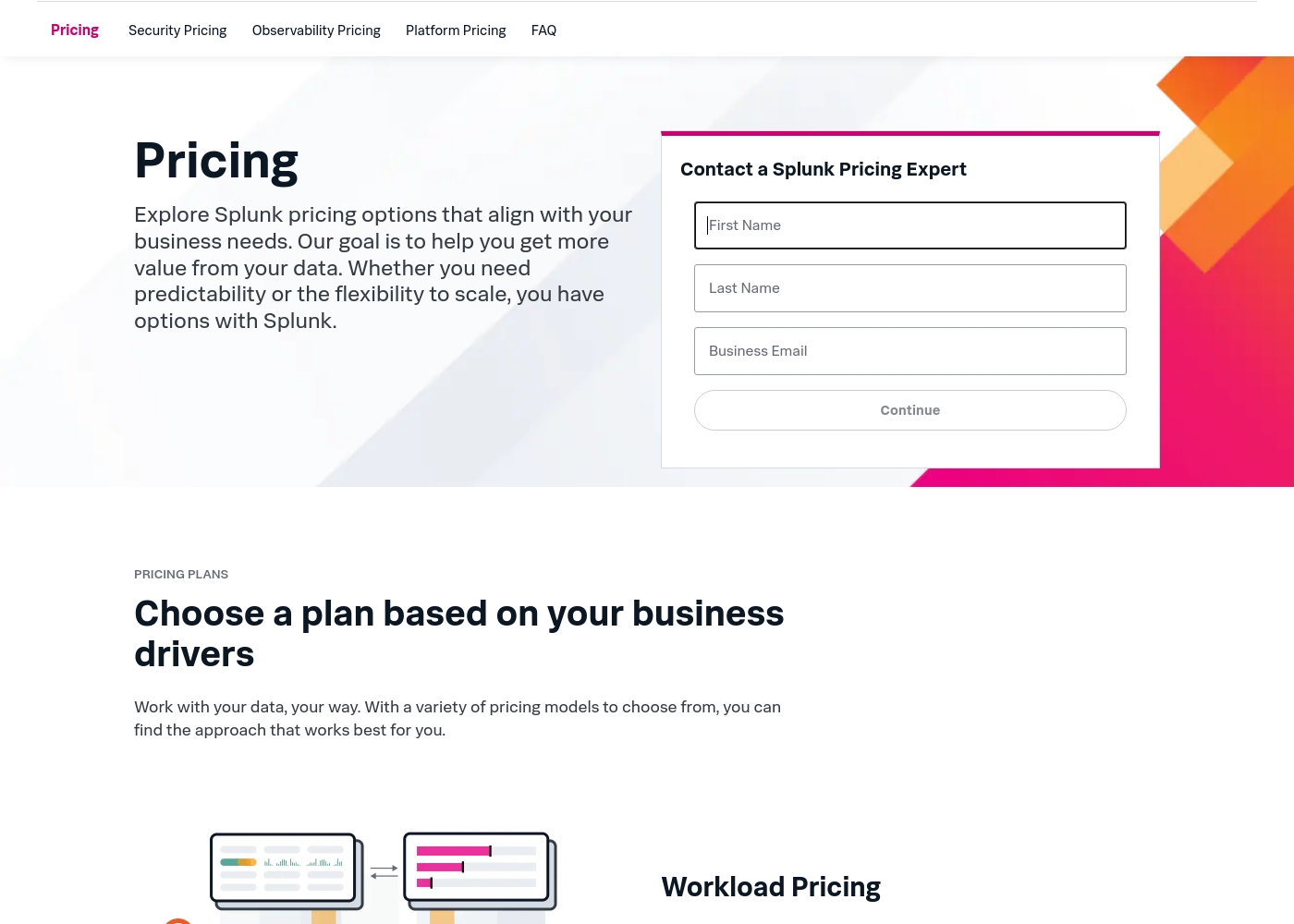
Take a look at the different ways you can manage your data costs below.
Ingest Pricing
Best For: Teams needing predictable costs for high-volume data ingestion Other Features: Simple predictable approach, Economical search scaling, Broad data ingestion
This plan is a great fit if you want a straightforward bill based on the amount of data you bring into the platform. It makes it easy to run extra searches without worrying about hidden fees. It's built for consistency and long-term planning.
- Search and analyze machine data
- Expanded use cases on ingested data
- Standard data ingestion
- Metric time series (MTS)
- Traces analyzed per minute
- Sessions monitoring
- Uptime requests
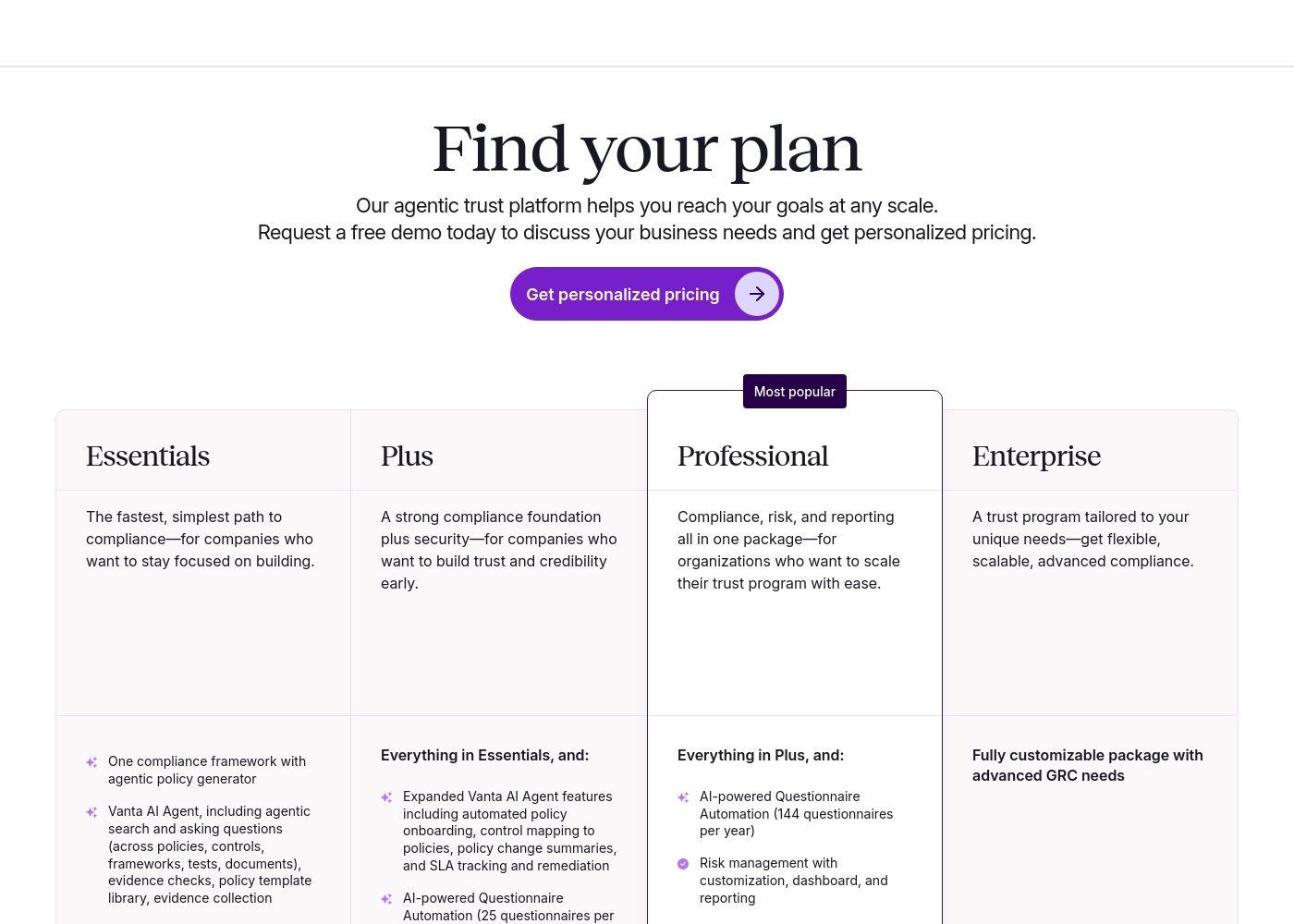
Take a look at the details for each tier below to see which fits your company's current stage.
Essentials
Best For: Companies who want to stay focused on building while reaching compliance. Other Features: One compliance framework, Vanta AI Agent, Automated evidence collection, Basic reporting and audit workflows, Auditor API access.
This plan is the fastest way for startups to build a compliance foundation. It's a great fit if you're laser-focused on one framework and need evidence collection that just works.
- One compliance framework with agentic policy generator
- Vanta AI Agent (search, evidence checks, policy templates)
- Automated evidence collection for audit readiness
- Basic reporting and audit workflows
- Auditor API and Trust Center access
- Automated policy onboarding
- Control mapping and SLA tracking
- AI-powered Questionnaire Automation (25 per year)
- Access Management
- AI-powered Questionnaire Automation (144 per year)
- Risk management with customization and reporting
- Advanced Trust Center
- Custom monitoring tests and automation
- Advanced reporting (six customizable reports)
- Fully customizable package
- Advanced GRC needs
- Workspaces and SCIM
- Advanced control management
Pricing Notes
- Splunk's pricing is completely opaque and requires a sales consultation. Costs are based on data volume or activity metrics.
- Vanta's pricing is customized across four tiers. Costs depend on your company size, number of frameworks, and feature needs.
- Splunk offers a free trial to explore the UI. Vanta does not offer a free trial; you must request a demo.
- Neither tool provides public pricing, making direct cost comparison impossible without contacting sales.
- Splunk's usage-based model can lead to variable costs. Vanta's tiered model may offer more predictability after quoting.
Pricing Head-to-Head
Avis des utilisateurs
Based on the provided external sources, we couldn't retrieve detailed user reviews for Splunk due to access restrictions. Trustpilot and Capterra both returned verification or security pages, preventing us from gathering specific sentiment on accuracy, ease of use, support, or pricing.
This means our review is based solely on the official product information and pricing details provided. We recommend checking these review sites directly for the latest user feedback before making a decision.
We couldn't access specific review snippets from Trustpilot or Capterra due to security blocks, but we know these platforms host user feedback on Vanta. Based on common themes in the compliance software space, users typically praise ease of use, automated evidence collection, and strong customer support that helps during audits.
However, recurring concerns often include custom pricing that can feel expensive for smaller teams, occasional integration hiccups with certain tools, and a learning curve during initial onboarding. The platform's reliability for continuous monitoring is frequently highlighted, though some note the AI questionnaire automation needs refinement.
Vanta automated our SOC 2 evidence collection, saving our team dozens of hours monthly. The platform is intuitive, and support was responsive when we had audit questions.
Notre verdict
There's no single winner here. Splunk and Vanta solve fundamentally different problems. Your choice depends entirely on whether your biggest pain is data visibility or compliance work. Splunk's superpower is making sense of chaos. It ingests data from 2,000+ sources and lets you search for threats or performance issues in real time. If you're drowning in logs from multiple systems, Splunk is your life raft. Vanta's superpower is eliminating manual work. It automates evidence collection and questionnaire responses, saving teams over 2,000 hours annually. If spreadsheets and audit prep are killing your productivity, Vanta is the answer. The deciding factor is your core need. Choose Splunk if you need to search, analyze, and act on machine data for security or operations. Choose Vanta if you need to automate compliance to get audit-ready faster and unblock sales deals. For most teams, this isn't an 'either/or' decision. A large enterprise might use Splunk for security operations and Vanta for compliance. A fast-growing startup should pick Vanta to handle SOC 2 first, then add Splunk when data complexity grows.
Questions fréquemment posées
Which is better for small teams: Splunk or Vanta?
For a small startup needing SOC 2 quickly, Vanta is often the better first choice. Its Essentials plan focuses on one compliance framework with automation. Splunk's complexity and usage-based pricing can be overkill and unpredictable for a small team's initial needs.
Does Splunk have compliance features like Vanta?
No, Splunk is not a compliance platform. It's a data platform for security and observability. While you could use its search capabilities to analyze logs for compliance, it doesn't automate evidence collection or workflow like Vanta does.
Can I use Vanta for security monitoring instead of Splunk?
No, Vanta is not designed for real-time security event monitoring or threat hunting. It monitors compliance controls and posture. For active security monitoring and incident response, you need a tool like Splunk.
Is Vanta worth the cost over doing compliance manually?
Based on user testimonials, Vanta often saves teams 2,000+ hours annually. For a team where compliance blocks sales or requires significant headcount, that time savings usually justifies the investment. It depends on your current manual workload and deal velocity.
How do their pricing models compare?
Splunk uses usage-based pricing (data volume or activity). Costs can fluctuate with your usage. Vanta uses tiered subscription pricing based on company size and framework needs. Both require contacting sales for a quote, so direct comparison is difficult.
Which tool has better customer support?
Neither tool provides public support details or SLAs. Both require engaging with sales teams to discuss support options and responsiveness. You'll need to ask each vendor directly during the sales process.
Prêt à choisir ?
Chaque outil a ses forces. Choisissez selon vos besoins.