Albato vs Splunk
Albato and Splunk are both powerful platforms, but they solve completely different problems. Albato connects your apps and automates workflows. Splunk analyzes machine data for security and performance.
Automatisation Sans Code Fiable avec un Support Exceptionnel.
Nous trouvons qu'Albato est une solution iPaaS sans code très efficace, excellant notamment par son support client et sa facilité d'utilisation par rapport à ses principaux concurrents. Dans l'ensemble, cette plateforme offre une synchronisation et une automatisation de flux de travail fiables et flexibles à un prix compétitif pour les entreprises de toutes tailles.
Avantages
- Support client humain exceptionnel, très réactif (un atout majeur).
- Efficacité économique nettement améliorée par rapport aux alternatives du marché.
- Interface et constructeur par glisser-déposer intuitifs, épurés et faciles à utiliser.
- Gère sans effort les webhooks complexes et les automatisations multi-étapes.
Inconvénients
- Le forfait Free limite sévèrement les automatisations à seulement deux étapes.
- Certains outils de niche ou spécifiques peuvent parfois manquer initialement.
- Aucune garantie de remboursement explicite n'est annoncée.
Powerful but complex data platform.
We find Splunk offers a robust, unified platform for security and observability with extensive integrations and scalability. However, its pricing structure is opaque and usage-based, which can make cost planning challenging. Overall, it's a strong choice for enterprises needing deep data analysis, but smaller teams may find it complex and expensive.
Avantages
- Unified platform for security and observability.
- Over 2,000 integrations with various data sources.
- AI and automation for threat response.
- Handles massive data volumes at scale.
Inconvénients
- Opaque pricing requires consultation with sales.
- Can be complex to set up and learn.
- Usage-based models may lead to unpredictable costs.
- External review access was blocked, limiting user sentiment data.
À propos deAlbato
Albato est une plateforme d'intégration en tant que service (iPaaS) pilotée par l'IA. Cette plateforme est conçue pour faire fonctionner ensemble vos outils existants plus rapidement, plus facilement et plus intelligemment. Elle se concentre entièrement sur l'automatisation sans code, ce qui signifie que des compétences techniques ne sont pas nécessaires pour construire des configurations complexes. Albato se connecte déjà à plus de 1 000 applications populaires, ce qui en fait une solution robuste pour les entreprises de toutes tailles. Elle est actuellement utilisée par plus de 200 000 utilisateurs à la recherche de capacités d'intégration puissantes. 💡
À propos deSplunk
Splunk is a unified platform for security and observability. It's designed for teams that need to search, analyze, and act on data from any source. Whether you're a security analyst hunting threats or an engineer troubleshooting app performance, it brings everything together in one place. ✨
Points forts
Comparaison des fonctionnalités
Aperçu des fonctionnalités
Nous mettons en évidence les principales différences et désignons un gagnant pour chaque fonctionnalité.
User Interface
Albato is clean and intuitive. Splunk is powerful but complex.
Albato's interface is a clean, drag-and-drop builder. Users can create multi-step automations without writing code. The learning curve is minimal for basic workflows. Splunk's interface is a command-line and dashboard-based system. It's designed for deep data analysis, not quick automations. Mastering it requires significant training and technical skill. The key difference is accessibility. Albato empowers non-technical users immediately. Splunk demands specialized expertise to unlock its full potential.
Core Purpose
Albato connects apps. Splunk analyzes machine data.
Albato is an Integration Platform as a Service (iPaaS). Its goal is to move data between apps like a smart middleman. It excels at tasks like syncing leads from Facebook to a CRM. Splunk is a unified platform for security and observability. It ingests and searches logs, metrics, and traces from any source. Its purpose is to find threats and troubleshoot performance. You don't choose between them—you use them for different jobs. Albato automates actions; Splunk provides insights.
Integration Ecosystem
Both connect to many sources, but in different ways.
Albato offers one-click integrations with over 1,000 popular business apps. It also works with any standard API for custom connections. The focus is on app-to-app data transfer. Splunk integrates with over 2,000 data sources, including logs, metrics, and traces. It supports OpenTelemetry and various SDKs. The focus is on ingesting all machine data for analysis. Albato's ecosystem is for operational automation. Splunk's ecosystem is for deep technical monitoring and security.
Automation vs. Analysis
Albato triggers actions. Splunk searches for answers.
Albato automates workflows based on triggers and actions. You can set it to send a Slack message when a new lead arrives. It performs repetitive tasks automatically. Splunk analyzes data to answer complex questions. A security analyst can search all firewall logs to find an attack pattern. It provides the intelligence, not the automated action. This is the core trade-off. Albato does the work. Splunk tells you what work needs doing.
Data Handling
Albato moves data between apps. Splunk stores and queries it.
Albato acts as a data pipe, transferring information from Point A to Point B in near real-time. It can transform data with built-in tools like filters and JSON parsing during the transfer. Splunk is a massive data repository designed to store and index petabytes of machine data. It lets you run complex queries against historical data for forensic analysis. Albato is transient and action-oriented. Splunk is permanent and analytical.
AI Capabilities
Both use AI, but for opposite tasks.
Albato AI focuses on content generation and summarization within workflows. It can rewrite product descriptions or summarize customer feedback automatically. Splunk AI focuses on security operations. It provides high-fidelity threat alerts and automates incident response playbooks to defend against attacks. Albato AI helps you create and communicate. Splunk AI helps you protect and diagnose.
Target Audience
Albato for business ops. Splunk for IT & security.
Albato is built for marketers, operations teams, and small businesses. It's ideal for anyone who needs to connect tools without a developer. The pricing is accessible for SMBs. Splunk targets security analysts, DevOps engineers, and IT operations in mid-to-large enterprises. Its complexity and usage-based pricing suit organizations with dedicated technical teams. The user personas rarely overlap. One is for business growth, the other for business resilience.
Pricing Transparency
Albato is upfront. Splunk requires a sales call.
Albato lists clear monthly prices: Free, $13, $37, $91, and $141. You know what you'll pay based on transaction volume before you sign up. Splunk's pricing is not published. You must contact sales for a quote based on your specific data volume or activity metrics. This makes cost planning difficult upfront. For predictable budgets, Albato wins. Splunk's cost is tailored but opaque.
Albato coûte entre 0 $ et 141 $ par mois avec six options de planification disponibles : Gratuit à 0 $, Basic à 13 $, Standard à 37 $, Pro à 91 $ et Enterprise à 141 $.
Explorons les détails de chaque niveau pour vous aider à trouver ce qui convient le mieux à vos besoins d'intégration.
Free (Gratuit)
Prix : 0 $/mois Sites Web pris en charge : Non spécifié explicitement Idéal pour : Idéal pour les automatisations API simples en deux étapes Politique de remboursement : Non spécifiée explicitement Autres fonctionnalités :
- 100 transactions
- 5 automatisations actives
- 2 étapes par automatisation
- 100 transactions
- 5 automatisations actives
- 2 étapes par automatisation
- Temps de mise à jour de l'automatisation de 15 min
- 1 000 transactions
- 20 automatisations actives
- Étapes illimitées par automatisation
- Accès aux applications premium
- 5 000 transactions
- Étapes illimitées par automatisation
- Temps de mise à jour de l'automatisation de 5 min
- Possibilité d'acheter des transactions supplémentaires (0,02 $/tâche)
- 15 000 transactions
- Étapes illimitées par automatisation
- Temps de mise à jour de l'automatisation de 5 min
- Possibilité d'acheter des transactions supplémentaires (0,02 $/tâche)
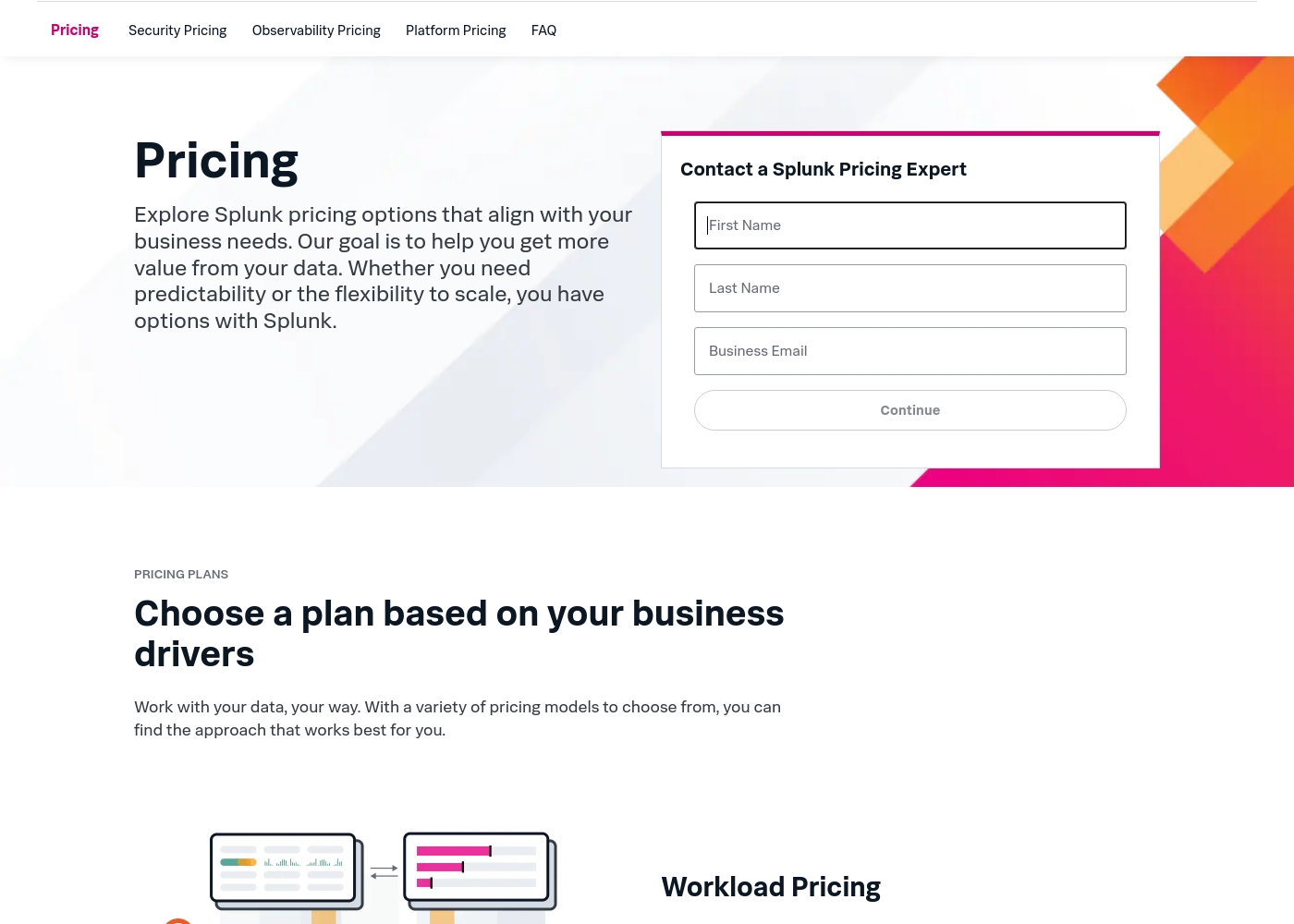
Splunk costs are Not explicitly stated per year with 2 plans: Ingest Pricing at Not explicitly stated, Activity-based Pricing at Not explicitly stated.
Take a look at the different ways you can manage your data costs below.
Ingest Pricing
Price: Not explicitly stated Websites Supported: Not explicitly stated Best For: Teams needing predictable costs for high-volume data ingestion Refund Policy: Not explicitly stated Other Features: Simple predictable approach, Economical search scaling, Broad data ingestion
- Search and analyze machine data
- Expanded use cases on ingested data
- Standard data ingestion
- Metric time series (MTS)
- Traces analyzed per minute
- Sessions monitoring
- Uptime requests
Pricing Notes
- Albato offers a clear free plan and transparent monthly pricing from $0 to $141.
- Splunk's pricing is usage-based and not public; you must contact sales for a custom quote.
- Albato's model is predictable: cost scales with transaction volume on fixed tiers.
- Splunk's model can be unpredictable: costs spike with data ingestion or activity levels.
- Albato provides a 7-day free trial with 500 transactions to test the platform.
- Splunk offers a free trial to explore the UI, but duration and limits are not specified.
Pricing Head-to-Head
Avis des utilisateurs
Les utilisateurs louent constamment Albato comme une alternative très efficace et économique aux plateformes comme Zapier et Make, notant que sa tarification transparente offre une bien meilleure valeur. La plateforme excelle en expérience utilisateur, présentant une interface intuitive avec un constructeur par glisser-déposer épuré qui rend les automatisations complexes et multi-étapes accessibles, même aux utilisateurs non techniques.
L'aspect le plus fréquemment célébré est cependant le support client vraiment exceptionnel d'Albato. De nombreux évaluateurs soulignent des agents spécifiques comme Pedro et Alex pour leur patience, leurs compétences techniques, leur rapidité et pour être allés « au-delà » pour résoudre des flux de travail complexes ; ce niveau de support élevé confirme souvent la décision de s'abonner.
Je trouve qu'Albato est le meilleur en matière d'automatisation. La conception UX pour implémenter des webhooks et mapper des données rend le processus simple et intuitif. Cela garantit que l'analyse des bogues potentiels est un jeu d'enfant, fonctionnant de manière fiable à chaque fois.
Based on the provided external sources, we couldn't retrieve detailed user reviews for Splunk due to access restrictions. Trustpilot and Capterra both returned verification or security pages, preventing us from gathering specific sentiment on accuracy, ease of use, support, or pricing.
This means our review is based solely on the official product information and pricing details provided. We recommend checking these review sites directly for the latest user feedback before making a decision.
Notre verdict
Albato and Splunk aren't competitors—they're tools for entirely different jobs. Albato is your go-to for automating workflows between apps. Splunk is your command center for security and data analysis. Albato's superpower is making complex integrations simple. It connects over 1,000 apps in minutes, saving teams hours of manual work. Its transparent pricing and exceptional support make it a favorite for SMBs. Splunk's superpower is making sense of chaos. It ingests and analyzes massive volumes of machine data. It helps security teams find threats and engineers solve performance problems at enterprise scale. The deciding factor is your core need. Pick Albato if you need to sync data and automate tasks between business tools. Pick Splunk if you need to monitor, search, and analyze logs, metrics, and traces. For most small businesses and non-technical teams, Albato is the practical choice. For enterprises with complex IT and security challenges, Splunk is the essential platform.
Questions fréquemment posées
Which is easier to use, Albato or Splunk?
Albato is significantly easier. Its no-code interface is intuitive for non-technical users. Splunk has a steep learning curve and is designed for technical analysts and engineers.
Can Albato do what Splunk does for security?
No, they serve different purposes. Albato automates workflows between apps. Splunk is a dedicated platform for security analytics, threat detection, and observability.
Which is more expensive, Albato or Splunk?
Albato is generally more affordable with clear monthly plans up to $141. Splunk's usage-based pricing can become very expensive for organizations with high data volumes.
Do I need a developer to use Albato?
No, Albato is built for non-technical users. You can create automations with a visual drag-and-drop builder. Custom API integrations may require some technical knowledge.
Is Splunk good for small businesses?
Splunk is best for mid-to-large enterprises due to its complexity and usage-based pricing. Small businesses typically find Albato's simpler automation tools more suitable and affordable.
Can I connect the same apps with both tools?
Technically yes, but for different reasons. Albato would connect them to automate data flow. Splunk might ingest their logs for analysis. The use case is completely different.
Prêt à choisir ?
Chaque outil a ses forces. Choisissez selon vos besoins.