DataHawk vs Thinkific
DataHawk and Thinkific solve totally different problems. DataHawk unifies your Amazon and Walmart data. Thinkific helps you sell online courses. They aren't direct competitors, but you might wonder about the best tool for your business growth.
Best for: Brands selling on multiple marketplaces like Amazon and Walmart, Ecommerce agencies managing analytics for several clients
Best for: Entrepreneurs turning personal expertise into a course business, Coaches and consultants building a branded online academy
Powerful Analytics, But Opaque Pricing
We see DataHawk as a strong contender for businesses needing a unified, AI-powered view of their ecommerce data. The platform promises to simplify complex analytics. Overall, it appears capable, but the custom pricing model and lack of public reviews are key considerations for potential buyers.
Vorteile
- Unifies data from multiple marketplaces into one dashboard.
- Includes AI-guided insights to uncover performance opportunities.
- Designed for ease of use, reducing manual data work.
- Scalable platform with features like daily alerts.
Nachteile
- Pricing is entirely custom and not publicly disclosed.
- Requires booking a demo for any cost information.
- No standard or transparent monthly/annual rates listed.
- Limited public user reviews make independent validation difficult.
Vorteile
Nachteile
ÜberDataHawk
DataHawk is a unified analytics platform for ecommerce. 🎯 It combines data from different sources into one place. The system uses artificial intelligence to help you understand your performance better. It’s designed for ecommerce businesses that want clearer, smarter insights.
ÜberThinkific
Highlights
Funktionsvergleich
Funktionsübersicht
Wir heben die Hauptunterschiede hervor und wählen einen Gewinner für jede Funktion.
Core Platform
DataHawk is a data analytics tool. Thinkific is a content creation and sales engine.
DataHawk is built to solve one problem: unifying ecommerce data. It pulls sales, ad, and review data from Amazon and Walmart into one dashboard. It uses AI to help you understand performance trends. Thinkific is an all-in-one platform for selling knowledge. You use its drag-and-drop builder to create courses. It also handles communities, memberships, payments, and marketing. The difference is fundamental. DataHawk helps you analyze a business you already run. Thinkific helps you build and sell a new type of product.
User Interface
DataHawk focuses on clear data visualization. Thinkific focuses on intuitive content building.
DataHawk's interface is designed for clarity. It aims to turn complex marketplace data into simple, executive-ready dashboards. The goal is to make analytics accessible for non-technical users. Thinkific's interface is built for creators. Its drag-and-drop course builder is praised for being simple to use. Some users note that certain admin areas can feel slightly dated. You'll use DataHawk to read charts. You'll use Thinkific to build and arrange content. They serve very different tasks.
Automation
DataHawk automates data collection. Thinkific automates sales and marketing workflows.
DataHawk automates the painful process of gathering data. It pulls information from marketplaces automatically. You can set up daily performance alerts to stay informed. Thinkific automates the sales funnel. It offers tools for abandoned cart emails, failed payment recovery, and scheduled marketing reports. Its TCommerce processor reportedly helps increase sales. DataHawk saves you hours of manual reporting. Thinkific helps you capture more revenue from your existing audience.
Reporting & Analytics
DataHawk provides deep ecommerce analytics. Thinkific provides learner and revenue analytics.
DataHawk's strength is deep marketplace analytics. It unifies data from different sources for a single source of truth. Its AI helps uncover insights you might miss manually. Thinkific's analytics track your learning business. You can monitor learner progress, marketing performance, and revenue growth. Advanced dashboards are available on higher plans. DataHawk answers: 'How is my Amazon business performing?' Thinkific answers: 'How is my course selling?'
Customer Support
DataHawk relies on consultative sales support. Thinkific offers multi-channel support tiers.
DataHawk's process starts with a demo. Support details are negotiated in your custom plan. The emphasis is on guided setup and data mapping during onboarding. Thinkific provides standard support via email and chat. Grow and Expand plans add phone support. The Plus plan includes a dedicated success team. They won a G2 award for service. Thinkific offers more structured, scalable support options. DataHawk's support is likely more hands-on but less publicly defined.
Pricing Model
DataHawk uses opaque custom pricing. Thinkific uses transparent tiered subscriptions.
DataHawk pricing is entirely custom. You must book a demo to get a quote. Costs are based on your analytics needs and marketplace scale. There are no public plans. Thinkific offers clear, tiered plans. Prices start at $0/month for a free plan and go up to $8,217/month for enterprise. You can see most features and limits before you buy. Thinkific's pricing is easy to understand. DataHawk's requires a sales conversation.
Customization
DataHawk customizes analytics for your data. Thinkific customizes the learner experience and branding.
DataHawk customizes the dashboard to your key metrics. It connects to your specific marketplaces. The analytics depth is tailored to your business needs. Thinkific lets you customize your course site, landing pages, and domain. You control the look, feel, and structure of your learning products. Some advanced layout changes may require more steps. DataHawk is customizable in what data it shows you. Thinkific is customizable in how your content looks and sells.
Scalability
DataHawk scales with your data volume. Thinkific scales with your student count.
DataHawk is built to handle growing ecommerce data. It's designed to be scalable for businesses of different sizes. Limits are tailored in your custom plan. Thinkific explicitly offers unlimited courses, bandwidth, and students (within plan-based 'active' limits). It's built to scale from your first learner to a global academy. Both tools are built to grow with you, just in completely different dimensions.
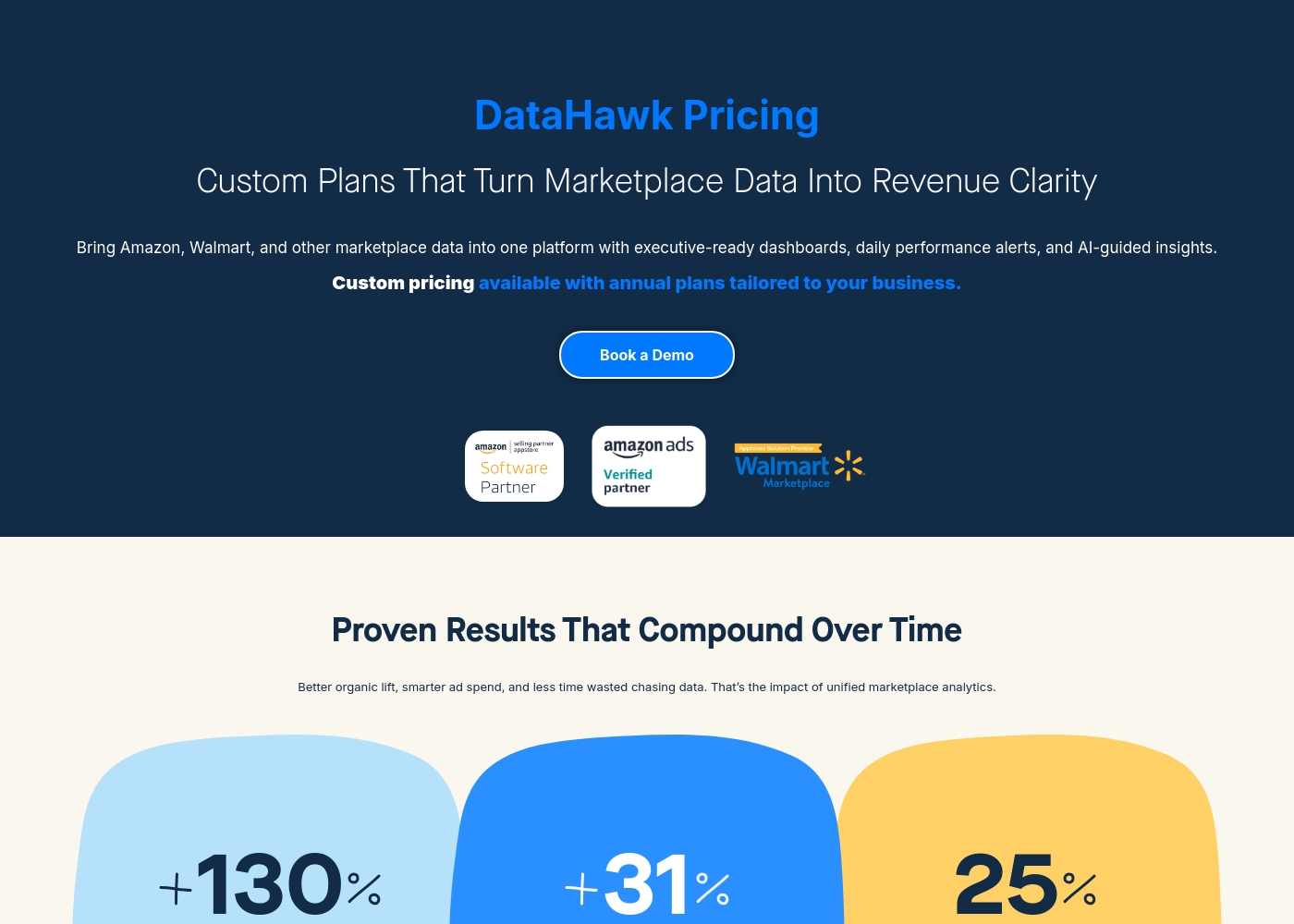
DataHawk pricing: DataHawk offers custom pricing models tailored specifically to your business needs and marketplace scale. Instead of flat fees, they provide annual plans based on the depth of analytics and connectivity required for your eCommerce operations Explorer dashboards and AI insights included everywhere. 🚀
Custom
Websites Supported: Amazon, Walmart, and other marketplaces Best For: Brands and agencies needing unified marketplace analytics and automated reporting Other Features: Executive-ready dashboards, Daily performance alerts, AI-guided insights, Amazon Ads partner verification, Walmart Marketplace integration
This plan is perfect for growing businesses that have outgrown manual spreadsheets. It brings multiple marketplace data sources into one clean view so you can focus on strategy rather than data cleaning. You get professional-grade tools regardless of your technical background.
Pricing Notes
- DataHawk uses completely custom pricing. You must book a demo for any quote.
- Thinkific offers a transparent free tier and 30-day free trial on paid plans.
- DataHawk's model is opaque, while Thinkific's is publicly listed.
- Thinkific's pricing scales with active student count and feature access.
- DataHawk's cost is tailored to your analytics depth and marketplace scale.
Pricing Head-to-Head
Nutzerbewertungen
We found that user sentiment on Trustpilot and Capterra is currently inaccessible due to technical blocks (CAPTERRA returns a 403 error, and Trustpilot requires browser verification). This means we cannot synthesize specific recurring themes like accuracy, ease of use, support, pricing, or onboarding from live reviews at this time. We advise checking the review platforms directly for the latest user feedback.
Unser Fazit
This is a trick comparison. DataHawk and Thinkific don't actually compete. They solve completely different problems for different businesses. DataHawk's superpower is unifying your Amazon and Walmart data. It kills spreadsheet chaos. It uses AI to find insights in your sales and ad performance. Thinkific's superpower is letting you build and sell online courses. It's an all-in-one school. You get a course builder, payments, and community tools in one place. The deciding factor isn't features, but your core need. Do you need to analyze existing ecommerce sales? Or do you need to create and sell digital education products? Choose DataHawk if you're a brand or agency drowning in marketplace data. Choose Thinkific if you're an expert packaging knowledge into a sellable course. They're both great at what they do, but they do very different things.
Häufig gestellte Fragen
Can I use DataHawk to create online courses like with Thinkific?
No. DataHawk is purely an analytics platform for ecommerce marketplaces. It doesn't have course building tools. Thinkific is designed specifically for creating and selling courses.
Which tool is better for selling on Amazon and Walmart?
DataHawk is better for analyzing your performance on those marketplaces. Thinkific is not designed for marketplace selling; it's for selling your own courses directly to customers.
Is Thinkific worth the price if I only want to sell a few courses?
Yes, Thinkific has a free plan and low-cost tiers. It's a good value even for small course catalogs, as you get the builder, hosting, and basic selling tools included.
Does DataHawk offer a free trial so I can test it?
No, DataHawk does not publicly offer a free trial. You need to book a demo and get a custom quote to start using the platform.
Can I host my course on my own website with Thinkific?
Yes, Thinkific supports custom domains. You can build your school on a subdomain or connect a domain you own for a fully branded experience.
How does DataHawk help with Walmart Marketplace specifically?
DataHawk connects to Walmart Marketplace. It pulls your sales and performance data there. This data is unified with your Amazon data in a single dashboard for comparison.
Bereit zu wählen?
Beide Tools haben Stärken. Wähle passend zu deinem Bedarf.