AfterShip Email vs Drip
AfterShip Email and Drip both automate e-commerce emails, but they serve different needs. AfterShip Email focuses on shipping-related flows and simple segmentation, while Drip offers deeper behavior-based automation and personalization. The right pick depends on your tech stack and how complex you want your campaigns.
Feature-rich, but buyer beware of support.
The platform offers impressive specialized eCommerce automation features and supports robust AI-powered segmentation. However, we identified significant, widespread user complaints regarding poor operational reliability and extremely slow, unhelpful customer support organizationally. Overall, the powerful feature set is clearly offset by notable business practice and service risks.
Vorteile
- Specialized tools built for eCommerce (abandoned carts, unique coupon codes).
- Robust AI features available for predictive demographics and customer segmentation.
- Clear, flexible pricing tiers that include a helpful free plan.
- Intuitive drag-and-drop editor simplifies creating personalized email campaigns.
Nachteile
- Widespread user reports of extremely unresponsive and ineffective customer support.
- System reliability issues cited, particularly concerning data accuracy (tracking service).
- Recurring user complaints about unauthorized charges and difficulties canceling subscriptions.

Powerful for e-commerce, but check the support.
We find Drip to be a highly capable email automation platform built specifically for B2C e-commerce. Its visual builder and smart segmentation are standout features for creating personalized customer journeys. Overall, it's a strong choice for online brands, provided your team can manage the learning curve and verify support levels.
Vorteile
- Excellent visual workflow builder for automation
- Deep e-commerce integrations (Shopify, WooCommerce)
- Powerful, behavior-based segmentation tools
- Free migration for large lists (17,500+)
Nachteile
- Pricing can become expensive as contacts scale
- Some users report slow or inconsistent customer support
- Requires integration with compatible platforms
- Advanced features may have a learning curve
ÜberAfterShip Email
AfterShip Email is an agile email automation tool built specifically for eCommerce needs. It helps you design and execute targeted campaigns that boost sales and improve customer engagement. This software works well with major platforms like Shopify, WooCommerce, and Klaviyo, ensuring you can leverage existing data easily. 💡
The platform provides well-designed templates for various scenarios, allowing you to create relevant content without excessive complications. By integrating seamlessly with other AfterShip systems, you can achieve full visibility and engagement throughout the customer lifecycle.
ÜberDrip
Drip is an email marketing automation platform built for B2C companies that sell online. Whether you're an e-commerce brand, a course creator, or a travel provider, it gives you the tools to move beyond generic newsletters. It's designed to be a powerful yet simple engine for driving revenue through personalization. 💡
Highlights
Funktionsvergleich
Funktionsübersicht
Wir heben die Hauptunterschiede hervor und wählen einen Gewinner für jede Funktion.
Automation & Flows
AfterShip Email excels at e-commerce transactional flows. Drip shines with complex, behavior-driven visual workflows.
AfterShip Email provides automated flows for abandoned carts, browse abandonment, and shipping updates. Its strength is in triggered emails tied to shopping and logistics events. It reports a 4.2% recapture rate for abandoned carts. Drip allows building sophisticated, multi-step automations using a visual workflow builder. You can create sequences based on browsing behavior, purchase history, and lifecycle stages. It's designed for nurturing long-term customer relationships. The key difference is scope. AfterShip Email is best for specific, high-impact e-commerce triggers. Drip is for building entire, personalized customer journeys from scratch. If you need to quickly recover abandoned carts, AfterShip Email is effective. For a full lifecycle marketing strategy, Drip offers more flexibility.
Segmentation
Drip's dynamic, behavior-based segmentation is a core strength. AfterShip Email offers more basic segmentation.
AfterShip Email includes customer segmentation based on attributes or past campaign behavior. You can create targeted campaigns, but it's less dynamic than some alternatives. Drip's segments update themselves automatically based on real-time behavior and lifecycle stages. The platform states that customers using segments earn 5x more revenue. This is a major focus for the tool. Drip's approach is more advanced and revenue-focused. AfterShip Email's segmentation is functional but simpler. For sending highly targeted messages based on granular customer actions, Drip is the clear winner here.
User Interface & Ease of Use
Drip emphasizes a simple setup with visual tools. AfterShip Email is straightforward for its core e-commerce functions.
AfterShip Email is described as simple yet powerful. It offers a zero-coding drag-and-drop editor and pre-built templates for quick setup. It integrates easily with major platforms. Drip is designed for simplicity and ease. It involves connecting your store, importing a list, and using pre-built templates and workflows. The visual builder is a key ease-of-use feature. Both aim for accessibility. Drip's visual builder for complex workflows might require a slight learning curve. AfterShip Email focuses on specific, ready-made e-commerce scenarios. Users wanting to build custom journeys may find Drip's interface more intuitive for that purpose.
Pricing & Value
AfterShip Email offers a free plan and clear tiers. Drip's usage-based pricing can get expensive with large lists.
AfterShip Email has a free plan and tiers starting at $9/month for 500 contacts. The Pro and Premium plans both support 10,000 contacts but unlock more features like AI and A/B testing. Annual billing saves 18%. Drip's pricing starts at $39/month for up to 2,500 people and scales with list size and email volume. It includes unlimited sends but has a cap of 50 workflows. Free migration is available for large lists. AfterShip Email provides more cost-effective entry points, especially for smaller stores. Drip's model is straightforward but costs rise as your contact list grows. For value on a tight budget, AfterShip Email is more attractive. Drip offers more advanced features that justify the cost for growing brands.
Customer Support
Drip reports high satisfaction scores and fast live chat. AfterShip Email has widespread complaints about poor support.
AfterShip Email's reviews highlight major issues with customer support. Users report extreme delays, copy-pasted answers, and unresponsive agents. This is a significant concern in external reviews. Drip claims a 97.3% customer satisfaction score. Live chat responses are under 2 minutes, and email replies in less than 1.6 hours for eligible plans. The difference is stark. AfterShip Email's support reputation is poor based on external feedback. Drip presents a much more positive support experience. If reliable support is critical, Drip appears to be the safer choice based on available data.
Integration Ecosystem
Drip offers 50+ integrations. AfterShip Email connects well with core e-commerce platforms and Klaviyo.
AfterShip Email integrates seamlessly with Shopify, Shopify Plus, WooCommerce, and Klaviyo. It also connects with popup tools and supports ESP migration from Mailchimp/Omnisend. Drip integrates with over 50 platforms, including major e-commerce (Shopify, BigCommerce, WooCommerce), booking systems, and LMS. It's designed to be a central hub for B2C data. Drip has a broader integration ecosystem across different business types. AfterShip Email's integrations are tightly focused on e-commerce and shipping. If you use a variety of marketing tools or a non-e-commerce platform like an LMS, Drip is more versatile. For a pure e-commerce stack, AfterShip Email covers the essentials well.
AI & Personalization
AfterShip Email leverages AI for demographics and recommendations. Drip focuses on data-driven personalization via its builder.
AfterShip Email offers AI-powered Predicted Demographics to forecast customer gender and age. It also provides AI product recommendations and unique coupon codes to personalize offers. Drip's personalization comes from connecting your store to drop real customer data into every message. It emphasizes using behavior data for relevance rather than specific AI features. AfterShip Email provides dedicated AI tools. Drip's personalization is more about leveraging your existing data within its powerful visual builder. For built-in AI features to augment your data, AfterShip Email has the edge. For hands-on, data-driven personalization, Drip gives you the tools to build it yourself.
Reporting & Analytics
AfterShip Email provides analytics on campaign performance and revenue. Drip's reporting details are less clear from the provided data.
AfterShip Email includes an analytics portal to monitor open rate, CTR, conversion, and total revenue. It focuses on measuring campaign effectiveness and ROI. Drip's JSON mentions building powerful workflows but doesn't detail its reporting dashboard's capabilities. A user review notes they wish the dashboard was more intuitive. AfterShip Email explicitly offers core metrics. Drip's analytics depth isn't fully outlined in this comparison data. Based on the available information, AfterShip Email provides clearer reporting on key e-commerce metrics.
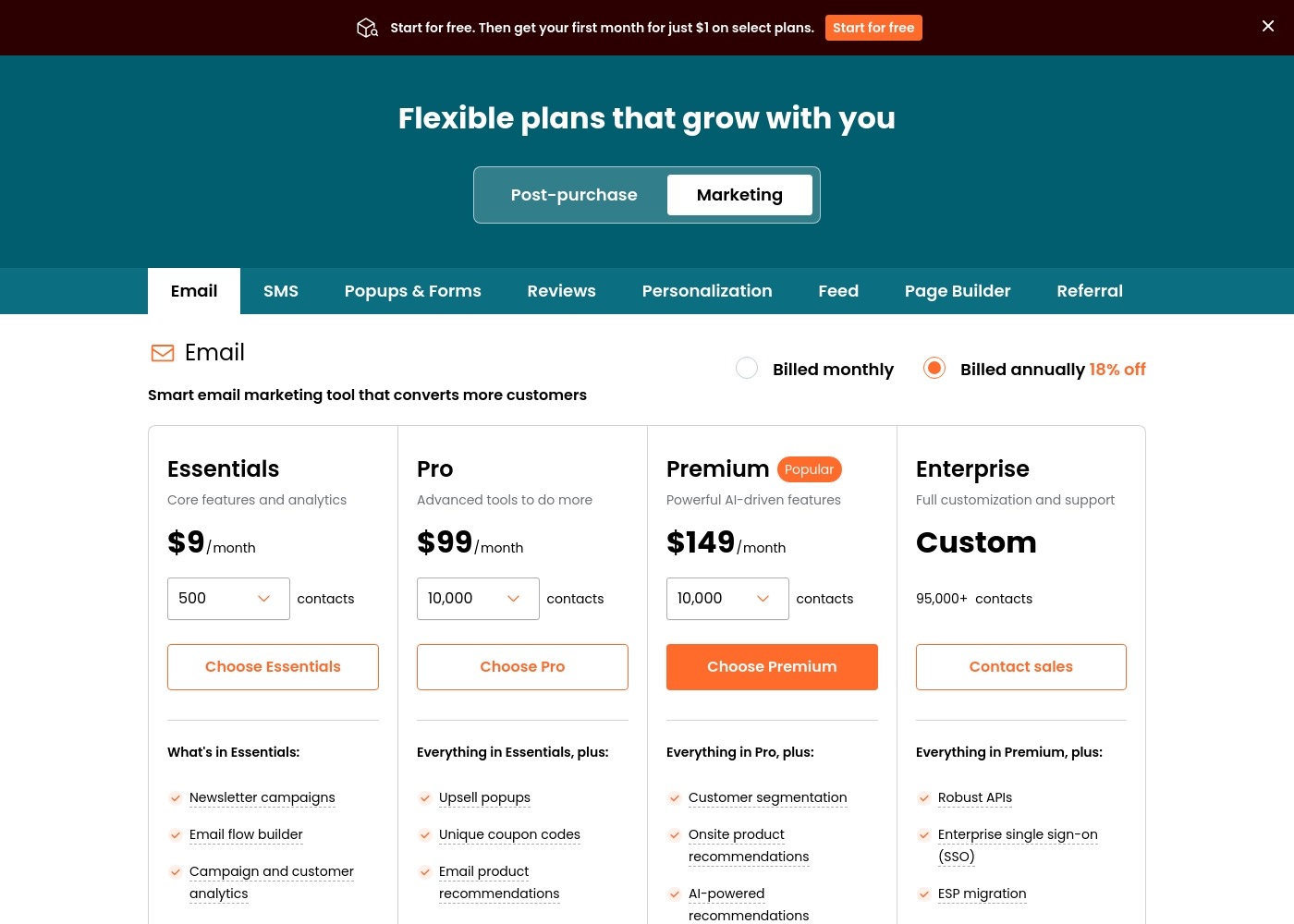
AfterShip Email costs between $9 and Custom per month with 4 main paid plans: Essentials at $9/month, Pro at $99/month, Premium at $149/month, and Enterprise at Custom pricing.
These flexible plans are designed to accommodate your growing business needs, with pricing based on your number of contacts. If you choose to be billed annually instead of monthly, you save 18%.
Essentials
Price: $9/month Websites Supported: Not explicitly stated Best For: Core features and analytics Refund Policy: Not explicitly stated Other Features:
- Newsletter campaigns
- Email flow builder
- Campaign and customer analytics
- Remove AfterShip branding
- Includes all basic features
- Newsletter campaigns
- Email flow builder
- Campaign and customer analytics
- eCommerce and ESP integrations
- Remove AfterShip branding
- Everything in Essentials, plus:
- Upsell popups
- Unique coupon codes
- Email product recommendations
- Countdown timers
- Everything in Pro, plus:
- Customer segmentation
- Onsite product recommendations
- AI-powered recommendations
- Advanced automated email flows
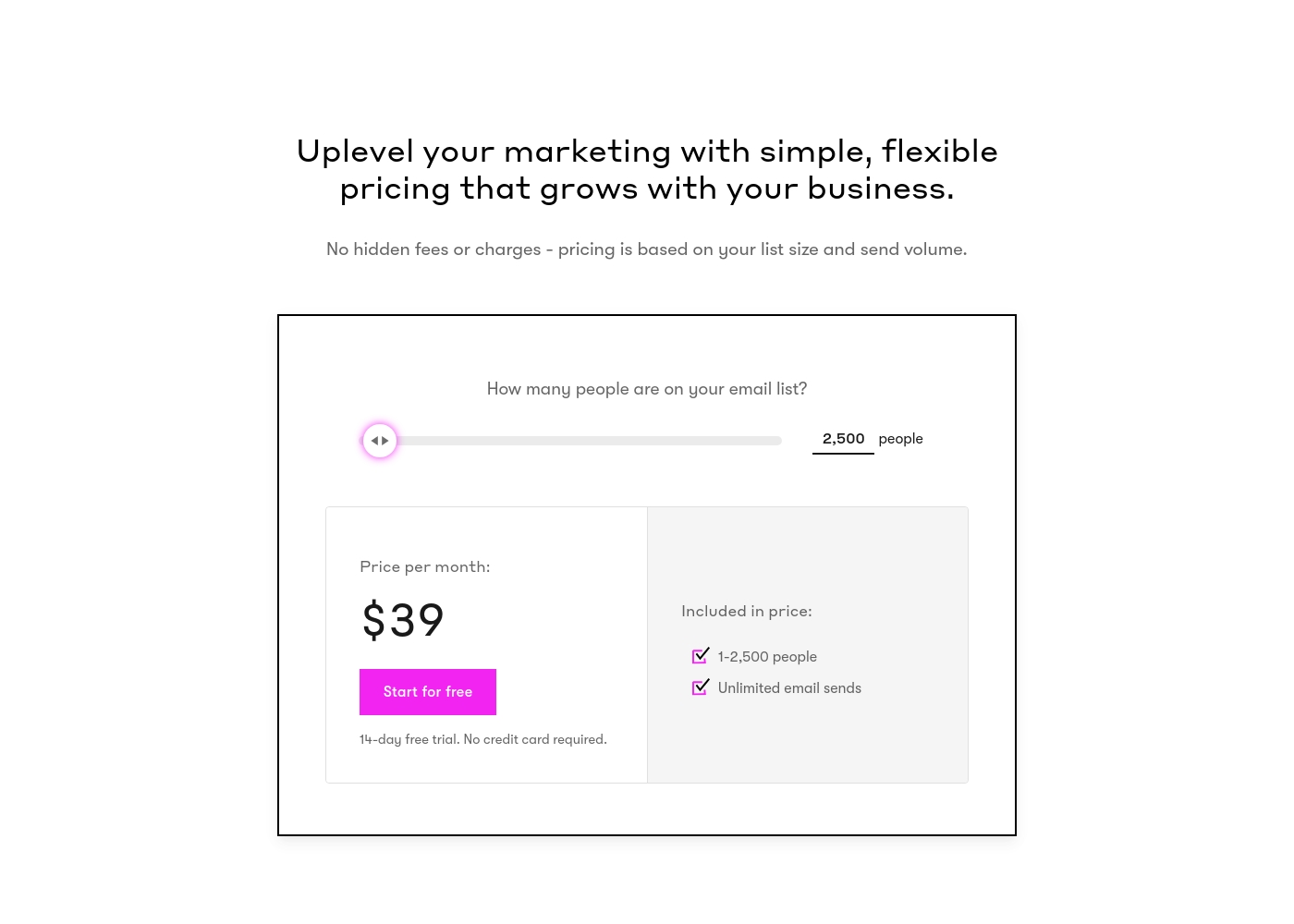
Drip pricing: Drip offers a flexible, usage-based subscription starting at $39/month for up to 2,500 people. Pricing scales based on your email list size and includes a 14-day free trial with no credit card required to start browsing its powerful automation tools tool and visual builder.
Your monthly cost increases as your audience grows, but you always get features like unlimited email sends and onsite campaigns. This ensures you only pay for what you actually use while accessing expert support and pre-built marketing playbooks right from the start.
You can cancel your subscription at any time within your billing settings if your business needs change. This model is specifically designed for e-commerce brands looking for deep segmentation and personalized customer journeys without enterprise-level complexity or hidden fees.
Pricing Notes
- AfterShip Email's Free plan is a significant differentiator for getting started at no cost.
- Drip's pricing starts at $39/month for 2,500 contacts, which can be higher than AfterShip Email's paid entry point ($9 for 500 contacts).
- AfterShip Email charges $12/user/month for team member access, an additional cost not mentioned for Drip.
- Drip includes unlimited email sends on all paid plans, which simplifies forecasting costs.
- AfterShip Email offers an 18% discount for annual billing, while Drip does not mention annual discounts.
- Both offer free trials, but AfterShip Email also has a $1 first-month promotion on select plans.
Pricing Head-to-Head
Nutzerbewertungen
The external feedback available mostly targets AfterShip’s core logistics and tracking product, not the dedicated Email marketing tool. However, the consistent negative sentiment raises significant concerns about the company's overall operational reliability and customer support structure.
Users frequently cite major issues with tracking accuracy, noting packages are often shown as "still on the way" even after delivery, or that logs are contradictory. More alarmingly, the review volume heavily criticizes the customer service experience.
This is some of the worst business support I’ve received. Agents refuse to read the context in the thread and just copy-paste answers that don't address the core question. Getting a simple reply often takes over a month to process.
We found a mixed bag of user sentiment from Trustpilot, as the Capterra link was inaccessible. Reviews praise Drip's powerful automation and segmentation for driving revenue, with many noting its ease of use for e-commerce.
💡 On the downside, several users report frustration with customer support responsiveness and occasional platform glitches. Pricing is frequently cited as a concern, with some feeling the cost can escalate quickly as contacts grow.
Drip's automation tools are top-notch. We set up abandoned cart sequences that really boosted our recovery rate. The visual builder makes it easy to see the customer journey.
Unser Fazit
For most e-commerce brands, Drip is the more powerful and reliable choice. Its behavior-driven automation and segmentation are built to drive revenue growth. AfterShip Email is a solid, budget-friendly option for specific transactional needs. AfterShip Email's superpower is its focus on e-commerce essentials. It excels at abandoned cart recovery (4.2% recapture rate), shipping notifications, and using AI for simple personalization like demographic predictions. It gets the job done for core flows. Drip's superpower is deep, visual automation. It lets you build sophisticated customer journeys based on every click and purchase. The platform claims users of its segments earn 5x more revenue. It's a complete marketing engine. The deciding factor is your marketing ambition. Choose AfterShip Email if you need reliable, set-it-and-forget-it transactional emails and are on a tight budget. Choose Drip if you want to craft detailed, personalized campaigns that nurture customers over time. In short, AfterShip Email is a great tool for specific e-commerce tasks. Drip is a comprehensive platform for brands serious about leveraging email for full-funnel growth and have the budget to match.
Häufig gestellte Fragen
Which is better for small teams: AfterShip Email or Drip?
For small teams with basic needs and tight budgets, AfterShip Email is often better due to its free plan and lower-cost tiers. Drip is powerful but its pricing starts higher, which might be overkill for very simple needs.
Does AfterShip Email have advanced automation like Drip?
No. AfterShip Email's automation focuses on e-commerce triggers like abandoned carts and shipping events. Drip offers a visual builder for creating complex, multi-step workflows based on customer behavior and lifecycle stages.
Is Drip worth the extra cost over AfterShip Email?
If you need advanced segmentation and behavior-based automation to drive significant revenue growth, Drip can be worth it. AfterShip Email is better for core transactional emails at a lower price point.
Can I migrate from AfterShip Email to Drip easily?
Drip offers free migration and personalized onboarding for lists over 17,500 contacts. For smaller lists, you would likely use standard import/export tools. AfterShip Email supports migration from platforms like Mailchimp.
Which tool has better customer support?
Based on external reviews, Drip has significantly better support. Users praise its fast live chat and helpful agents. AfterShip Email receives consistent complaints about unresponsive and unhelpful support.
Do both tools integrate with Shopify?
Yes, both integrate seamlessly with Shopify. AfterShip Email also deeply integrates with Shopify Plus. Drip integrates with over 50 platforms, including BigCommerce and WooCommerce.
Bereit zu wählen?
Beide Tools haben Stärken. Wähle passend zu deinem Bedarf.