Typewise vs Vanta
Typewise and Vanta both use AI to automate work, but for very different jobs. Typewise is built for customer support teams to resolve tickets faster. Vanta is for security teams to get and stay compliant. It's a choice between front-office speed and back-office risk management.
Best for: Customer support teams automating ticket resolution, Sales teams needing AI-assisted quoting or renewals
Best for: Startups needing fast SOC 2 certification, Companies managing multiple compliance frameworks (ISO 27001, HIPAA)
Powerful AI for customer conversations.
We find Typewise offers a compelling AI orchestration layer that promises to automate support and sales workflows across your entire tech stack. Its strength lies in rapid deployment and outcome-based pricing, though teams should be prepared for an initial learning curve to maximize its potential.
Pros
- Promises fast 15-minute initial launch.
- Pricing model is outcome-based, starting at $1 per resolution.
- Integrates deeply with 200+ platforms like Salesforce and Zendesk.
- Allows workflow creation with natural language instructions.
Cons
- External feedback notes a potential steep learning curve.
- Success-based pricing may be costly for very high-volume teams.
- Some users report occasional reliability issues with complex tasks.
- Full value may require significant integration and setup effort.
Powerful compliance automation for growing teams.
We found Vanta excels at automating compliance workflows and reducing manual effort, which aligns with its promise to save time and accelerate deals. Its tiered pricing offers flexibility, but the lack of transparent costs and a free trial means committing to a demo before understanding the full investment.
Pros
- Automates evidence collection and monitoring for frameworks like SOC 2.
- AI-powered questionnaire automation speeds up vendor assessments.
- Unified platform for compliance, risk management, and audit prep.
- Trust Center helps showcase security posture to customers.
Cons
- Pricing requires a custom quote, with no public tiers or free trial.
- Add-ons for key features like Third-Party Risk Management increase costs.
- Initial setup and policy onboarding may have a learning curve.
- Some users report integration challenges with specific tools.
AboutTypewise
✨ Typewise is an AI orchestration platform for customer-facing teams. It's designed for support, sales, and commerce departments that want to use AI across their whole operation. The platform acts as an intelligent supervisor, working across your CRM, billing, knowledge base, and more to handle complex workflows.
AboutVanta
Vanta is an Agentic Trust Platform designed for startups, mid-market, and enterprise companies. It automates the entire process of getting and staying compliant with frameworks like SOC 2, ISO 27001, and HIPAA. The platform combines compliance, risk management, and audit preparation into one place. It's built for security leaders who want to scale their programs without adding headcount. 💡
Highlights
Feature Comparison
Features Overview
We highlight the main differences and pick a winner for each feature.
Core Automation
Typewise automates customer interactions. Vanta automates security compliance.
Typewise acts as an AI supervisor for support, sales, and billing. It reads across your CRM, ERP, and knowledge base to handle complex workflows. Vanta automates evidence collection and monitoring for frameworks like SOC 2 and ISO 27001. Its Vanta Agent drafts policies and answers questionnaires. The key difference is focus. Typewise optimizes customer-facing speed and resolution. Vanta optimizes back-office security and audit readiness. Choose based on your primary bottleneck: slow ticket handling or slow compliance.
Pricing & Value
Typewise has transparent, outcome-based pricing. Vanta uses custom, tiered quotes.
Typewise charges $1 per successful resolution. You pay only when the AI works, aligning cost directly with value. Vanta's pricing is not public. You must request a demo for a quote based on your company size and needed frameworks. Typewise's model offers clear predictability for support costs. Vanta's model bundles compliance value but requires a sales conversation. For budget clarity, Typewise wins. For bundled compliance packages, Vanta may offer perceived value at scale.
Speed to Value
Typewise promises a live agent in minutes. Vanta takes weeks to fully deploy.
Typewise claims you can launch your first AI agent in about 15 minutes. You connect tools and set a goal in plain English. Vanta's onboarding for compliance frameworks typically takes weeks. It involves policy setup, integration mapping, and audit preparation. This reflects their different scopes. Typewise aims for immediate workflow impact. Vanta aims for thorough, sustained compliance. If you need a quick win for support tickets, choose Typewise. If you need a long-term compliance foundation, choose Vanta.
Integration Ecosystem
Both connect widely, but for different systems.
Typewise boasts 200+ deep, native integrations with core business tools like Salesforce, Zendesk, and ERPs. It's built to act within that stack. Vanta integrates across cloud providers, code repositories, HR systems, and identity providers. It connects to where your compliance evidence lives. Typewise's integrations are for taking action. Vanta's integrations are for collecting evidence. Your choice depends on whether your priority is acting on customer data or monitoring security controls.
User Interface & Control
Typewise uses natural language for control. Vanta uses dashboards and policies.
Typewise lets you create workflows with plain English instructions. Business teams can adapt automations without coding. Vanta provides dashboards for compliance status, risk registers, and audit workflows. It uses policies and rules for control. Typewise feels more like talking to your system. Vanta feels like managing a program. The 'best' interface depends on whether you want to direct action or oversee status.
Reporting & Analytics
Typewise tracks customer outcomes. Vanta tracks compliance posture.
Typewise's Insights Hub focuses on resolution rates, CSAT, and conversation quality. It measures support performance. Vanta provides compliance dashboards, risk reports, and audit progress tracking. It measures security program health. The reports serve entirely different masters: the customer versus the auditor. Your need for either type of reporting should be a major deciding factor.
Customer Support & Onboarding
Typewise offers fast, self-directed setup. Vanta provides guided, expert-led implementation.
Typewise promotes a fast, self-service start with a 15-minute first agent. Deeper support details aren't public. Vanta includes access to expert partners for compliance services and onboarding. It's a more hands-on process. Typewise favors teams comfortable with a quick start. Vanta favors teams needing guided compliance expertise. Choose based on your team's appetite for self-service versus white-glove service.
Scalability
Typewise scales with ticket volume. Vanta scales with compliance complexity.
Typewise's costs scale linearly with resolutions. It handles growing ticket volume without adding seats. Vanta scales through tiers from Essentials (one framework) to Enterprise (custom GRC). It handles more frameworks and users. Typewise scales with your support operation's activity. Vanta scales with your organization's regulatory burden. Pick based on whether your growth is measured in customers or in compliance requirements.
Typewise costs from $1 per resolution with 1 plan: Success-Based Pricing at $1 per resolution.
Here's a breakdown of how our pricing works for your team.
Success-Based Pricing
Price: Starting from $1 per resolution Best For: Customer support and sales teams looking to automate resolutions responsibly. Other Features: Multi-Agent Orchestration, Knowledge & Actions Hub, Hybrid Intelligence, Automated Evaluations, Outcome performance tracking
- Multi-Agent Orchestration
- Natural Language Instructions
- Hybrid Intelligence & Approvals
- Knowledge & Actions Hub
- Outcome performance tracking
Take a look at the details for each tier below to see which fits your company's current stage.
Essentials
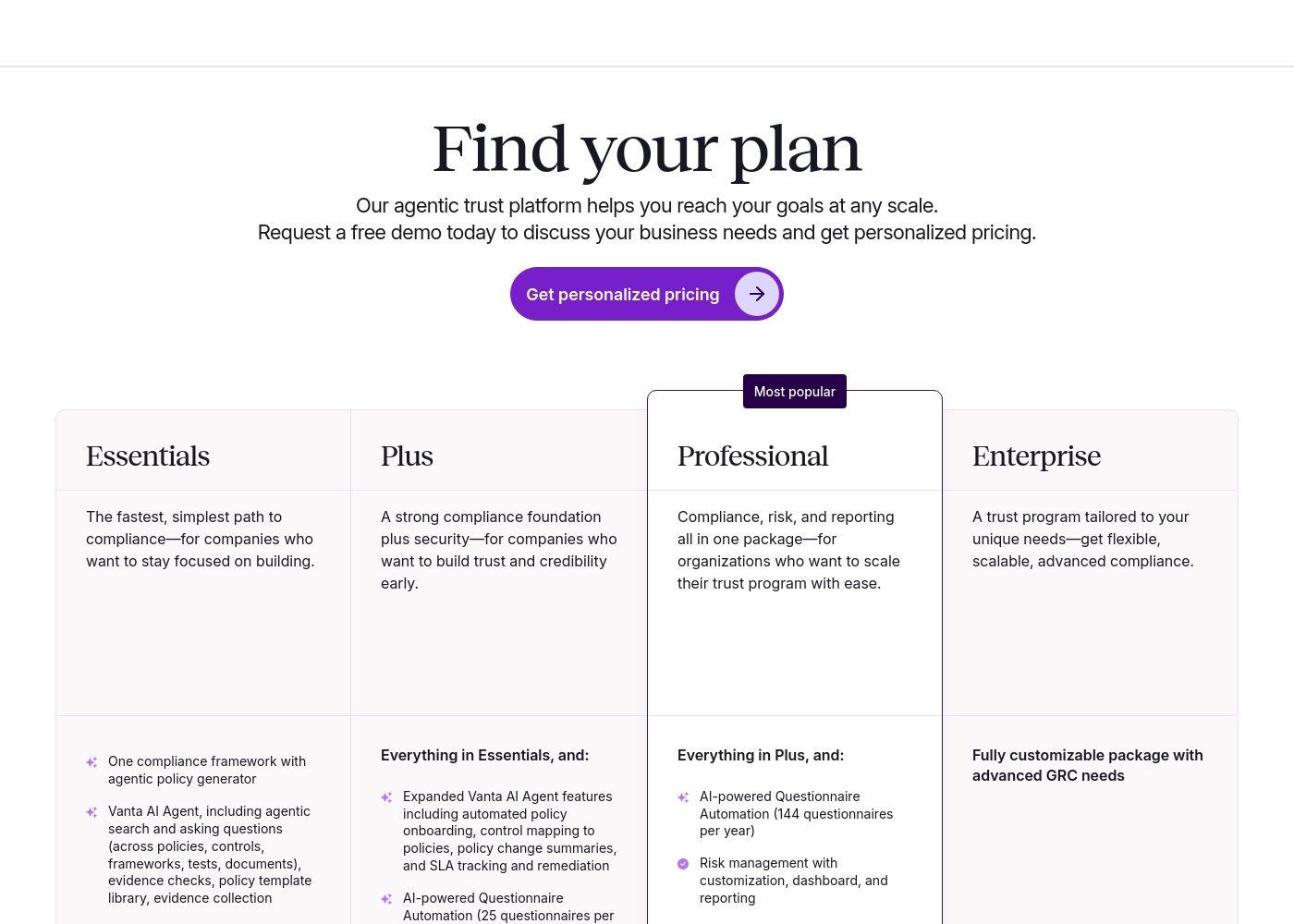
Best For: Companies who want to stay focused on building while reaching compliance. Other Features: One compliance framework, Vanta AI Agent, Automated evidence collection, Basic reporting and audit workflows, Auditor API access.
This plan is the fastest way for startups to build a compliance foundation. It's a great fit if you're laser-focused on one framework and need evidence collection that just works.
- One compliance framework with agentic policy generator
- Vanta AI Agent (search, evidence checks, policy templates)
- Automated evidence collection for audit readiness
- Basic reporting and audit workflows
- Auditor API and Trust Center access
- Automated policy onboarding
- Control mapping and SLA tracking
- AI-powered Questionnaire Automation (25 per year)
- Access Management
- AI-powered Questionnaire Automation (144 per year)
- Risk management with customization and reporting
- Advanced Trust Center
- Custom monitoring tests and automation
- Advanced reporting (six customizable reports)
- Fully customizable package
- Advanced GRC needs
- Workspaces and SCIM
- Advanced control management
Pricing Notes
- Typewise's pricing is transparent and outcome-based. You pay for results.
- Vanta's pricing requires a sales demo and is based on company size and framework needs.
- Typewise offers a free trial. Vanta does not.
- Vanta's tiers (Essentials to Enterprise) bundle more compliance features and higher questionnaire limits.
Pricing Head-to-Head
User Reviews
The limited external sentiment from Trustpilot suggests a generally positive view of Typewise, focusing on its powerful AI for email and chat. Users appreciate the significant accuracy improvements and time savings it brings to daily communication.
However, some note that the learning curve can be steep initially and the pricing model might feel expensive for smaller teams or occasional users. We see recurring mentions of strong support responsiveness when needed, but also feedback on occasional reliability hiccups with very complex requests.
Typewise has transformed how we handle customer emails. The AI suggestions are incredibly accurate and save us hours every day. It feels like having a super-smart assistant in our inbox.
We couldn't access specific review snippets from Trustpilot or Capterra due to security blocks, but we know these platforms host user feedback on Vanta. Based on common themes in the compliance software space, users typically praise ease of use, automated evidence collection, and strong customer support that helps during audits.
However, recurring concerns often include custom pricing that can feel expensive for smaller teams, occasional integration hiccups with certain tools, and a learning curve during initial onboarding. The platform's reliability for continuous monitoring is frequently highlighted, though some note the AI questionnaire automation needs refinement.
Vanta automated our SOC 2 evidence collection, saving our team dozens of hours monthly. The platform is intuitive, and support was responsive when we had audit questions.
Our Verdict
Typewise and Vanta are both powerful AI tools, but they answer completely different questions. Typewise asks, "How can we resolve customer issues faster?" Vanta asks, "How can we prove we're secure and compliant?" Typewise's superpower is instant workflow automation. It can connect your entire tech stack and launch a smart agent in 15 minutes. It's built for front-line teams to handle customer conversations at scale. Vanta's superpower is continuous compliance. It automates the tedious work of SOC 2, ISO 27001, and risk management. It turns a months-long audit prep project into a manageable, ongoing process. The deciding factor is your core problem. If tickets are piling up and you need to automate support, choose Typewise. If security questionnaires are stalling deals and audits are draining resources, choose Vanta. Go with Typewise if your team's daily grind is customer support or sales operations. Go with Vanta if your growth is being blocked by security and compliance demands. They're not really competitors; they're specialists for different parts of your business.
Frequently Asked Questions
Which is better for small teams: Typewise or Vanta?
It depends on your team's function. A small support team would benefit from Typewise's fast setup and pay-per-use model. A small startup needing SOC 2 fast would benefit from Vanta's automated compliance.
Does Typewise have compliance features like Vanta?
No. Typewise focuses on customer workflow automation. Vanta is specifically built for compliance frameworks like SOC 2 and risk management.
Is Vanta worth the extra cost over Typewise?
They aren't directly comparable on cost. Typewise pays for itself per resolved ticket. Vanta's value is in saving thousands of hours on compliance and accelerating sales cycles. The 'extra cost' buys a completely different outcome.
Can I migrate from Typewise to Vanta easily?
Migration isn't straightforward because they serve different purposes. You would be replacing a support automation tool with a compliance platform. The switch would align with changing your team's primary goal.
Which tool integrates better with our sales stack?
Typewise is designed to integrate deeply with sales tools like Salesforce to automate workflows. Vanta integrates to collect evidence from your tech stack. Typewise acts within your sales tools; Vanta monitors them for compliance.
Do I need a long implementation for either tool?
Typewise is built for speed. You can launch a first agent in about 15 minutes. Vanta's implementation for compliance frameworks is more thorough and typically takes weeks.
Ready to Choose?
Both tools have their strengths. Choose based on your specific needs.