SPOD vs Spreadshirt
Print-on-demand often comes down to speed versus platform reliability. SPOD promises blistering 48-hour fulfillment speed, ideal for fast-moving e-commerce brands. Spreadshirt offers a higher-rated, zero-risk platform focused on easy marketplace access. Both services are completely free; your choice hinges on logistics control versus market exposure.
Best for: High-volume e-commerce sellers, Brands needing guaranteed 48-hour fulfillment
Best for: New designers starting with zero budget, Creators seeking risk-free Marketplace exposure
High Quality Printing, Variable Results
We understand this service promises exceptional print quality and robust technical integration capabilities. Fulfillment times, however, are highly inconsistent and customer support must improve significantly. Overall, Spreadconnect is a solid option for experienced sellers who can tolerate operational variability.
Pros
- Goal of ultra-fast 48-hour production timeline.
- Proven high print quality with dynamic DTG/DTF technology.
- Always free to use; no subscription or setup costs.
- Seamless integration with major platforms like Shopify and TikTok.
Cons
- Fulfillment speed is often inconsistent and delays are common, especially for new accounts.
- Customer support responsiveness is frequently reported as poor or slow.
- Limited branding options, including no branded packaging.
- Users report App instability, slow publishing, and asset management issues.
Always Free, High Volume, Mixed Quality
We find that Spreadshirt offers an attractive, risk-free entry point for designers due to its entirely free platform model and strong commitment to review verification. While users appreciate the customization tools and material quality, recurring feedback points to some notable inconsistencies in sizing and print execution that sellers should consider. Overall, Spreadshirt is an excellent, high-volume platform perhaps best suited for those prioritizing cost and speed over achieving flawless print consistency on every single order.
Pros
- Completely fee-free and risk-free platform for designers and shop owners.
- High quality and durability reported for base apparel materials.
- Extensive customization options using an easy-to-use configurator.
- Strong platform commitment to transparent, verified customer feedback.
Cons
- Inconsistent print quality noted (e.g., streaks, color inaccuracy, or grainy textures).
- Apparel sizing sometimes runs large or is inconsistent across items.
- User experience issues encountered during account setup and log-in processes.
- Packaging occasionally fails to protect items fully from weather damage during shipping.
AboutSPOD
Spreadconnect is a robust print-on-demand and dropshipping fulfillment provider. It lets you create customized merchandise globally without worrying about inventory or logistics. You simply sell the product, and Spreadconnect handles the high-quality printing and worldwide shipping.
This provider benefits from 20+ years of industry experience in print-on-demand. You can design your custom collection easily using the drag-and-drop tool. You can select from over 250 products, including shirts, hoodies, accessories, and mugs. Spreadconnect integrates seamlessly with major platforms like Shopify, WooCommerce, and TikTok using their dedicated connectors. You retain full control over your customer data and define your exact profit margins. 💡
AboutSpreadshirt
Spreadshirt is a brand committed to solid customer communication and feedback integrity. They keep customers informed using regular updates sent straight to your inbox. 💡 You will hear about new product offers, discount campaigns, and even exclusive competitions this way. Crucially, they manage customer reviews with a strong commitment to verification. This helps you trust the overall quality rating you see.
Highlights
Feature Comparison
Features Overview
We highlight the main differences and pick a winner for each feature.
Fulfillment Speed
SPOD is engineered for rapid fulfillment, aiming for a 48-hour turnaround average.
SPOD focuses heavily on manufacturing efficiency and speed for experienced sellers. They guarantee that 95% of orders are ready to ship within just 48 hours of creation. This ultra-fast production capability promotes quick delivery times and high customer satisfaction rates. Spreadshirt users report fast shipping experiences, sometimes receiving orders in six days cross-country. Spreadshirt's strength is overall consistency, not the absolute fastest production guarantee. If speed is the primary bottleneck for your established e-commerce store, SPOD offers a clear logistical advantage. However, SPOD’s actual speed can be inconsistent, leading to user frustrations and delays. SPOD's capacity to process tens of thousands of orders daily handles scaling much better during peak demand periods.
Platform Cost & Risk
Both SPOD and Spreadshirt are completely free to use with zero startup fees.
SPOD operates an entirely free model, only invoicing you for the base product cost and shipping upon sale. This means zero upfront capital or inventory holding costs are required to begin selling. Spreadshirt is also stress-free and 'fee-free,' eliminating any monthly or annual subscription worries. Both platforms let you define your margin above the base price. Since both products eliminate financial risk, new sellers can easily test the print-on-demand market. You keep 100% of the defined margin, whether using SPOD or Spreadshirt. There is no need for a free trial on either platform; you can start designing and selling instantly.
E-commerce Integration
SPOD offers robust, dedicated connectors for 7 major e-commerce platforms.
SPOD is built for sellers already running an external store, offering seven direct integrations. Dedicated connectors exist for major platforms like Shopify, TikTok, and WooCommerce. You also get marketplace support for Amazon and eBay via OrderDesk using SPOD. Spreadshirt's primary models are its standalone Spreadshop or the Marketplace channels. The data doesn't detail direct, out-of-the-box connectors like those offered by SPOD for third-party platforms. SPOD is the better choice if you need the fulfillment provider to slot seamlessly into your existing e-commerce stack. You can centralize orders efficiently using SPOD’s robust connection points. With SPOD, you also retain full data ownership and control over your customer details, critical for seasoned e-commerce operations.
Design & Product Catalog
SPOD offers a slightly larger product catalog, featuring 250+ custom items.
SPOD provides access to over 250 high-quality customizable items, including apparel, mugs, and accessories. Sellers can create and sell unlimited products without inventory limits. Spreadshirt offers designs across more than 200 different products, appealing to designers seeking variety. Their configurator tool is highly praised by frequent users. Both platforms feature simple drag-and-drop design tools for quick customization and asset uploading. SPOD uses advanced printing techniques like DTF transfer and Thermosublimation to cover more item types. The selection is comparable, but SPOD edges out Spreadshirt slightly in raw product count available globally.
User Trust & Reviews
Spreadshirt boasts a significantly higher Trustpilot rating and verifies customer feedback.
Spreadshirt maintains a strong 4.1-star rating based on thousands of reviews, showing generally high satisfaction. They assure customers that only verified buyers can leave feedback, adding transparency. SPOD holds a lower 3.4-star rating, reflecting highly polarized user experiences and frequent complaints about inconsistency. Users often cite poor customer support and production delays with SPOD. Spreadshirt’s commitment to verifying written reviews increases trust in the platform's reliability. This high standard helps buyers make smarter purchasing decisions based on genuine sentiment. If long-term consistency and positive user feedback are critical, Spreadshirt presents a lower long-term risk than SPOD.
Design Selling Channels
Spreadshirt offers a dual Marketplace/Shop model for maximum design visibility.
Spreadshirt allows designers to choose between opening a dedicated Spreadshop or selling directly on their existing Marketplace. The Marketplace provides immediate exposure to a massive existing audience. SPOD's core specialization is fulfillment, providing high-speed printing for your existing storefronts. It doesn't offer an internal marketplace for immediate sales visibility. Choosing the Spreadshirt Marketplace instantly maximizes your design exposure without marketing effort. This is ideal for designers focused purely on uploading designs and gaining visibility. If you value total brand control and already have a following, the dedicated Spreadshop option is a great, fee-free choice within Spreadshirt.
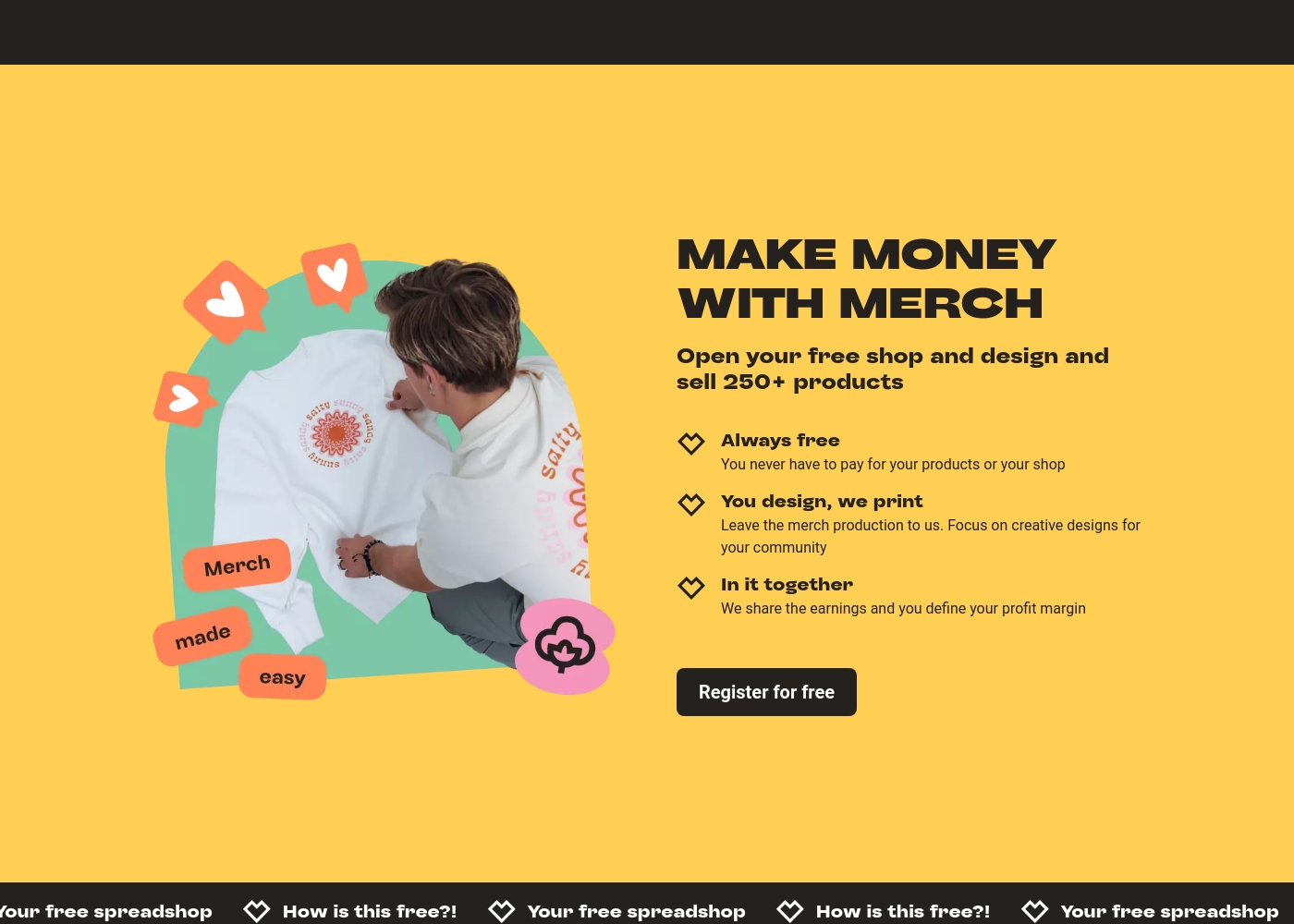
SPOD (Spreadshop) is entirely free to set up and run, offering print-on-demand services with no upfront costs, zero fees, and transparent pricing focused on seller margin.
Since the service is completely free, there are no tiered subscription plans to worry about. We can look at the two main ways you can utilize the platform to sell merch.
Free Spreadshop
Price: Free (Always free to set up and run) Best For: Creators/Individuals wanting a ready-made platform to design and sell custom products without inventory risk. Other Features:
- Access to 250+ custom products
- Easy dashboard and customizable templates
- We handle printing (20+ years experience)
- Integrate with social media and your website
- Define your own profit margin
- Always free setup and operation
- Design and sell 250+ products
- Define your profit margin
- Easy dashboard and customizable templates
- Integration with social media and website
- Always free setup and operation
- Advanced fulfillment provider (POD/dropshipping)
- Integrate with Shopify, Amazon, TikTok, etc.
- Fast fulfillment within 48 hours
- Retain full control over orders and customer data
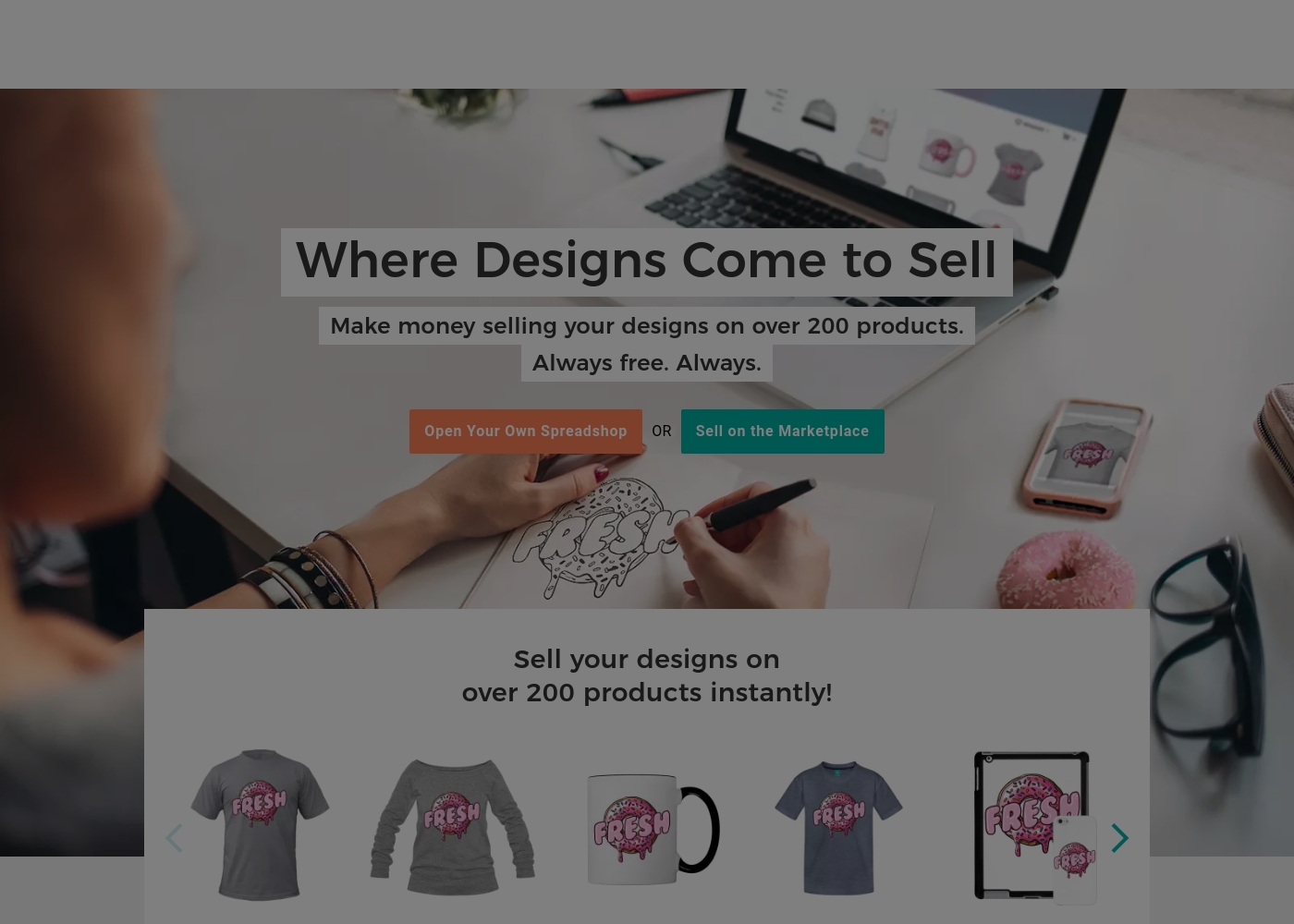
Spreadshirt is always free to use, offering two main ways to sell: Open Your Own Spreadshop and Sell on the Marketplace.
Spreadshirt lets you start selling immediately on over 200 products without worrying about platform fees. The process is designed to be risk-free and stress-free from the start.
Open Your Own Spreadshop
Price: Always free Best For: Building a dedicated brand storefront Other Features: Fee-free, Risk-free, Stress-free, Sell designs on over 200 products instantly
- Establish a dedicated brand storefront (Spreadshop)
- Sell designs on over 200 products instantly
- Fee-free, risk-free selling
- Stress-free platform use
- List designs directly on the Spreadshirt Marketplace
- Make money selling your designs on over 200 products
- Fee-free, risk-free selling
- Stress-free platform use
Pricing Notes
- Both SPOD and Spreadshirt are permanently free to use and charge zero setup fees.
- The business model relies entirely on the seller setting the retail price and keeping the profit margin above the base cost.
- SPOD's pricing structure targets advanced fulfillment integration for existing high-volume sellers.
- Spreadshirt emphasizes its risk-free, fee-free model for designers accessing its Marketplace.
- Neither provider offers a traditional subscription; costs are incurred per sale for base product and shipping only.
Pricing Head-to-Head
User Reviews
Spreadconnect (SPOD) holds a low 2.8-star rating on Trustpilot, reflecting highly polarized user experiences. On one hand, many users praise the excellent print quality, noting their automatic DTF/DTG selection yields bright, strong colors.
They also appreciate the seamless Shopify synchronization and, when functioning correctly, the speed; one user called it the "best POD" they have used, citing the fastest shipping available. However, reliability and customer support are frequent pain points.
This has been the best POD service I’ve used so far. The Shopify synchronization works perfectly, and the shipping is the fastest available. I love that my product colors are bright and strong due to their dynamic DTF/DTG printing methods.
Spreadshirt maintains a "Great" 4.1-star rating based on over 16,000 Trustpilot reviews. Users frequently praise the high quality and comfort of the base apparel materials, noting the products feel durable and superior to what some competitors offer.
The extensive customization options and an easy-to-use design configurator are consistently highlighted as strengths. However, feedback concerning execution and logistics is notably mixed.
Shirts arrived and the designs seem to be printed well; they survived the first wash without any issues. The price was good for no minimum per design, saving us time on setting up our own screen prints. It offers great convenience and value.
Our Verdict
It’s hard to choose between SPOD and Spreadshirt, as both are permanently free to use. Deciding which one wins depends entirely on your current business focus. SPOD’s absolute superpower is its incredible focus on logistics and speed. If you need guaranteed fulfillment that ships 95% of orders in 48 hours, SPOD is your partner. SPOD offers deep integrations with seven major external platforms like Shopify for serious scaling control. Spreadshirt shines brightest for its platform stability and seller accessibility. It earned a robust 4.1-star rating by offering a truly risk-free, reliable experience. Designers can use the Spreadshop or instantly access the huge Spreadshirt Marketplace traffic. The deciding factor is control versus reliability. If your core business lives on Shopify and requires ultra-fast, integrated fulfillment, choose SPOD. If your priority is easy launch, verified trust, and immediate Marketplace visibility, Spreadshirt is the wiser bet. Ultimately, Spreadshirt offers a better and more consistent solution for most new or design-focused sellers. SPOD is the specialized, high-velocity tool for established, integrated e-commerce brands.
Frequently Asked Questions
Which service, SPOD or Spreadshirt, offers faster fulfillment times?
SPOD is engineered for speed, aiming to ship 95% of orders within 48 hours of creation. While Spreadshirt offers generally fast shipping, it does not provide an explicit 48-hour guarantee like SPOD does. SPOD is the clear winner for maximum production velocity.
Does Spreadshirt allow integration with external shops like Shopify, similar to SPOD?
SPOD offers robust, dedicated connectors for Shopify, TikTok, and WooCommerce. Spreadshirt focuses more on its bundled Spreadshop or Marketplace channels. If deep integration into a third-party platform is mandatory, SPOD is the stronger fit.
Which platform is safer or more reliable based on user reviews: SPOD or Spreadshirt?
Spreadshirt is significantly more reliable, holding a 4.1-star rating on Trustpilot. SPOD has a lower 3.4-star rating due to reported inconsistencies. Spreadshirt also requires verified buyers for reviews, adding transparency.
Are there any setup fees or monthly charges for using SPOD or Spreadshirt?
No. Both SPOD and Spreadshirt operate on a permanently free business model. There are zero upfront costs or monthly fees for setting up your shop or listing your available designs. You only pay the base cost of the product upon making a sale.
Do I get more control over my design placement with SPOD or Spreadshirt?
Both offer easy drag-and-drop custom design tools. SPOD offers 250+ products and advanced printing methods for precise application. Spreadshirt is praised for its configurator and quality apparel materials.
Which company is better for scaling a business during peak sales periods?
SPOD is built for high-volume scaling, with facilities processing tens of thousands of daily orders. Its ultra-fast production capability ensures you can handle holiday surges effectively. Spreadshirt's capacity is also high but not numerically detailed like SPOD's.
Ready to Choose?
Both tools have their strengths. Choose based on your specific needs.