ShipEngine vs ShipStation
ShipEngine and ShipStation both optimize shipping, but they target wildly different users. ShipEngine is a powerful developer API for custom system integration and maximum flexibility. ShipStation is a direct, turn-key application built for e-commerce merchants and growing businesses. Your choice depends entirely on whether you need a shipping solution you build or one you simply buy.
Best for: Developer teams building shipping functionality into a new application, Enterprises managing 25,000+ monthly shipments with complex requirements
Best for: E-commerce businesses with orders spread across multiple online stores, Growing sellers who require rapid batch printing of up to 500 labels quickly
Pros
Cons
Powerful Shipping Automation, Weak Customer Support.
We find ShipStation offers powerful automation and deep carrier discounts, streamlining logistics for handling high volumes efficiently. Overall, while the technical capacity and feature set are strong, prospective users must be aware that the platform is regularly criticized for slow, unhelpful customer support and opaque billing practices.
Pros
- Seamless integration with unlimited selling channels (Starter plan and up).
- Access industry-leading carrier discounts (up to 90% off FedEx rates).
- Automates repetitive tasks, allowing users to batch print up to 500 labels.
- Robust automation rules like rate shopping simplify workflow significantly.
Cons
- Customer support is consistently reported as slow, outsourced, and ineffective.
- Users report critical failures with the two-factor authentication (MFA) login process.
- Concerns regarding unexpected fees, pricing opacity, and sharp subscription increases.
- Filing claims or securing refunds for lost packages or billing adjustments is often difficult.
AboutShipEngine
At its core, ShipEngine is a modern, reliable shipping API. Think of it as the central brain that connects all your shipping tasks. It’s built for developers and the merchants they support. You can plug it into your existing systems—like a marketplace, warehouse management tool, or a custom app—and get everything shipping in minutes. 💡 It’s designed to be the engine that powers your entire logistics operation.
AboutShipStation
ShipStation is a centralized logistics solution designed for businesses looking to streamline and scale their operations. It connects to over 400 existing integrations, linking your stores and providing access to more than 180 carrier partners. This single sign-on platform helps simplify your entire order fulfillment process. ShipStation actively manages everything from importing orders to tracking shipments. It is built to grow with you, supporting operations scaling to as many as 15,000 orders a day. ✅
Highlights
Feature Comparison
Features Overview
We highlight the main differences and pick a winner for each feature.
Core Focus
ShipEngine is a developer API for custom functionality; ShipStation is a direct, ready-to-use fulfillment platform.
ShipEngine is fundamentally a developer-centric Multi-Carrier Shipping API. Developers use it to embed shipping logic deeply into their company’s software stack. ShipStation is a merchant-facing, self-serve application built to manage daily shipping workflows. Merchants log in and ship directly within the ShipStation interface. ShipEngine requires development expertise to implement; ShipStation works immediately out of the box for any seller. Both tools achieve shipping automation, but their delivery method is completely different. If you are a retailer, ShipStation saves development time; if you are a software company, ShipEngine provides core capability.
Integration Model
ShipEngine facilitates deep WMS/ERP integration; ShipStation focuses on broad e-commerce channel connectivity.
ShipEngine’s strength is its API, allowing it to integrate shipping features into complex systems instantly. You connect once to access 200+ global carriers and deploy features using Elements. ShipStation specializes in connecting to 180+ integration partners and over 400 storefronts seamlessly. This gives merchants one unified dashboard to pull all orders instantly. ShipEngine integrates features into your backend platform; ShipStation integrates storefronts into its web application. ShipStation is the easier choice for immediate multi-channel sales management. ShipEngine is better if you need shipping inside systems like a custom 3PL platform or internal ERP.
High Volume Handling
ShipEngine targets true enterprise volume over 25,000 monthly; ShipStation excels at large batch processing (500 labels).
ShipEngine’s Enterprise tier is explicitly designed for operations exceeding 25,000 shipments monthly. This custom tier provides high API rate limits and dedicated implementation support. ShipStation can handle very high daily throughput, reporting capacity for 15,000+ orders per day. Its automation allows users to batch print up to 500 labels in one go. ShipEngine provides custom API scaling solutions for the largest corporations. ShipStation offers massive bulk processing suitable for large e-commerce sellers, not specialized enterprise needs.
Pricing Structure
ShipEngine uses variable usage-based pricing; ShipStation relies on predictable, fixed monthly subscription tiers.
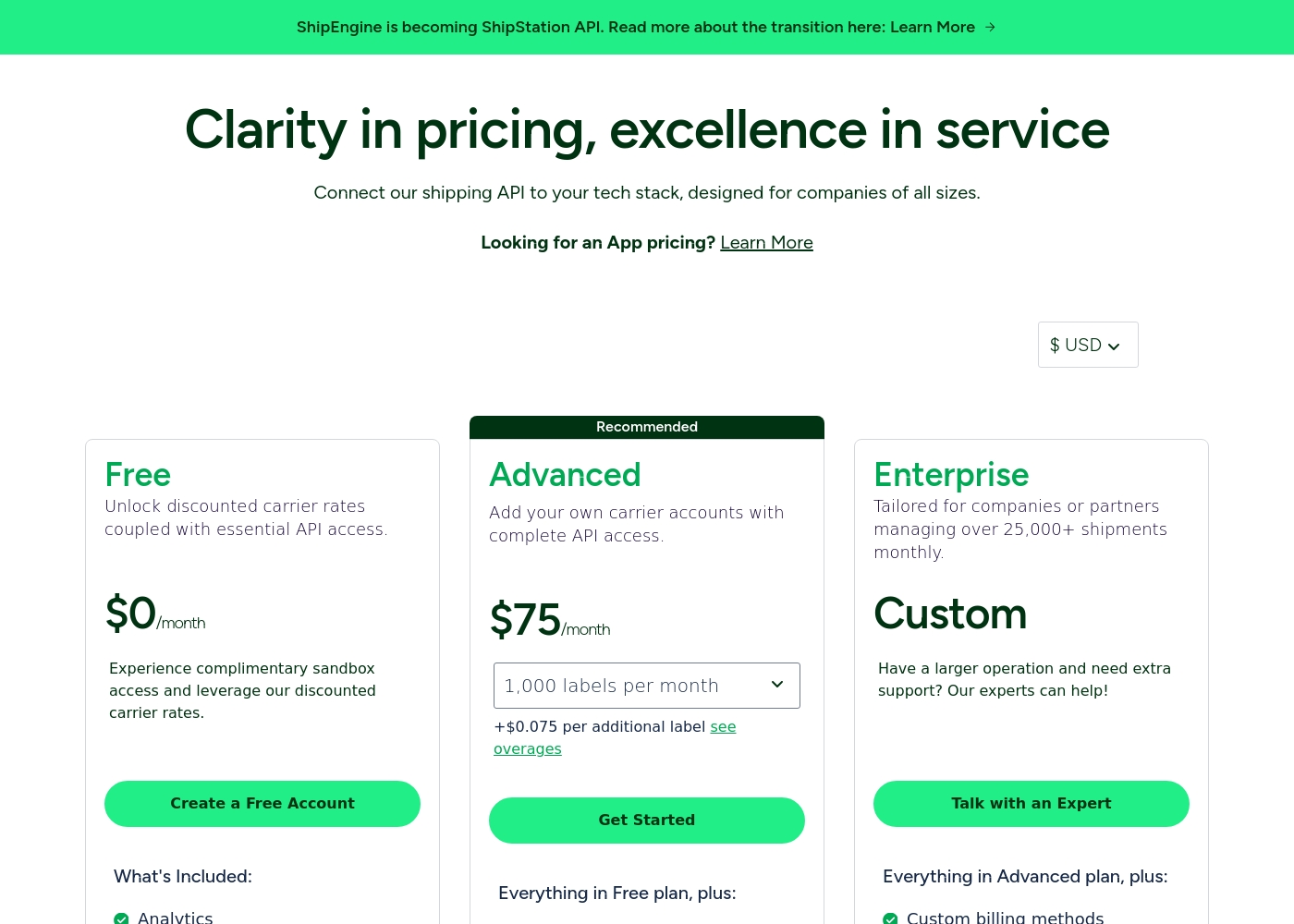
ShipEngine's Advanced plan is $75/month for 1,000 labels, with a $0.075 charge for every label beyond. Key API calls also have usage limits that incur additional pay-as-you-go costs. ShipStation offers fixed plan tiers based on users and maximum monthly volume, ranging up to $2025/month. This structure ensures your monthly expense is much more predictable. ShipEngine's cost fluctuates heavily based on your API interactions and label overages. ShipStation is better for businesses that prefer a stable, predictable monthly budget for software overhead. However, ShipEngine provides a truly subscription-free Free plan utilizing its discounted rates.
Custom Branding
ShipStation offers built-in post-purchase branding options; ShipEngine’s focus is pure integration functionality.
ShipEngine offers its API users tools like Elements to quickly embed functional UI components. These elements help integrate checkout features fast, such as accurate rate calculations. ShipStation includes specific features for full post-purchase branding management. You can customize emails, packing slips, tracking pages, and the returns portal easily. ShipStation makes it simple for merchants to maintain a consistent customer brand experience. ShipEngine expects the user’s front-end system to handle all branding and communication design.
Address Verification
ShipEngine provides native, explicit Address Validation via API; ShipStation does not list this as a core feature.
ShipEngine offers Address Validation as a crucial feature in its Advanced plan API toolkit. This validation process helps prevent costly failed deliveries and speeds up transit times. ShipStation emphasizes streamlining order import and label generation from connected storefronts. While necessary, address verification is not listed as a discrete feature provided by ShipStation’s core application. ShipEngine’s developer focus means they treat address verification as a distinct, billable service for system improvement. This makes ShipEngine essential for businesses needing to verify addresses before label creation.
ShipEngine pricing: ShipEngine offers a transparent pricing structure starting with a free tier and scaling to usage-based paid plans starting at $75/month. You can choose to stick with ShipEngine's carrier rates for free or bring your own accounts with an Advanced plan.
house. Note: ShipEngine is transitioning to ShipStation API.
Individual plan names and features are detailed below. Tracking and address validation API calls may incur additional costs based on volume.
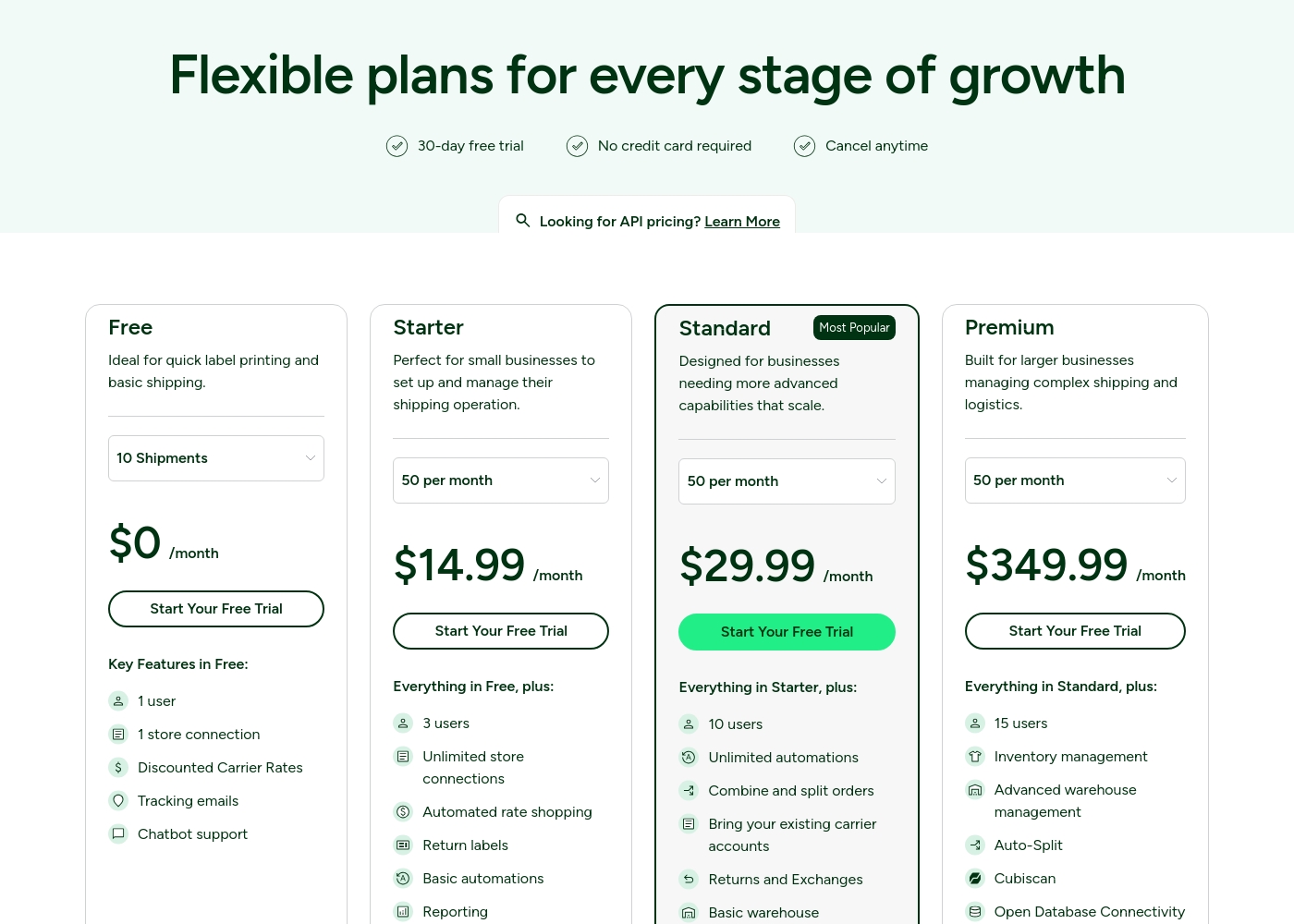
ShipStation costs between $0 and $349.99 per month with four plans: Free at $0/month, Starter at $14.99/month, Standard at $29.99/month, and Premium at $349.99/month.
Here's a look at the features included with each plan tier.
Free
Price: $0 per month Websites Supported: 1 Best For: Quick label printing and basic shipping. Refund Policy: Not applicable Other Features:
- 1 user
- Discounted Carrier Rates
- Tracking emails automatically sent
- Chatbot support included
- 1 user
- 1 store connection
- Discounted Carrier Rates
- Tracking emails
- Chatbot support
- 3 users
- Unlimited store connections
- Automated rate shopping
- Return labels
- Basic automations
- 10 users
- Unlimited automations
- Combine and split orders
- Bring your existing carrier accounts
- Returns and Exchanges
- 15 users
- Inventory management
- Advanced warehouse management
- Auto-Split
- Cubiscan
Pricing Notes
- ShipEngine's paid plans, including the Advanced tier ($75/month), utilize a usage-based model with overage fees for both labels ($0.075 each) and API calls.
- ShipStation relies on fixed monthly subscription tiers, offering more cost predictability for merchants than ShipEngine's variable usage fees.
- You must upgrade to ShipEngine's Advanced plan to use your own negotiated carrier accounts; the Free plan only uses ShipEngine's discounted accounts.
- ShipStation offers a strong 90-day money-back guarantee, which ShipEngine does not explicitly advertise.
Pricing Head-to-Head
User Reviews
ShipStation receives mixed yet clearly polarized feedback. Many users praise the platform for its efficiency, noting the seamless integration with various selling channels and the significant time saved when printing labels and managing high shipment volumes.
Customers frequently highlight the convenience of features, such as creating return labels and accessing competitive, discounted shipping rates. Positive experiences often mention excellent onboarding sessions led by helpful, specific representatives.
This was one of the best business decisions this year! Implementing ShipStation and shipping directly from our home office has been a total game-changer. It is an easy, seamless solution that saves us so much time.
Our Verdict
The decision between ShipEngine and ShipStation hinges on who will manage the system: a developer or a merchant. For the vast majority of growing e-commerce businesses, ShipStation is the easier, immediately usable choice. ShipEngine offers unmatched flexibility if you have the resources to build. ShipEngine's true power is its comprehensive API and rapid integration speed using SDKs and Elements. You can embed advanced services like global carrier access or address validation into any existing ERP or WMS. If your goal is to handle over 25,000 custom shipments monthly, ShipEngine is purpose-built to scale via API. ShipStation’s superpower is making multi-channel fulfillment simple for the merchant. It connects 400+ selling channels into one login, automating order management instantly. For time savings, ShipStation can batch print up to 500 labels quickly, optimizing high volume tasks. The core factor is how you want your shipping managed. ShipEngine provides the essential programming building blocks; ShipStation provides the optimized dashboard solution. If you need a plug-and-play app for your Shopify or eBay stores, choose ShipStation. If you are building a custom shipping system, ShipEngine is your powerful foundation.
Frequently Asked Questions
Which is better for small teams: ShipEngine or ShipStation?
ShipStation is generally better for small e-commerce teams because it’s ready to use instantly. ShipStation removes the need for developer resources and manages multiple storefronts easily. ShipEngine requires development time to integrate and customize its API features properly.
Does ShipEngine have a web fulfillment interface like ShipStation?
ShipEngine is primarily an API intended to run in the background of your existing systems. It does not provide a robust, dedicated fulfillment web application like ShipStation. ShipStation offers a complete, merchant-facing dashboard for order and shipment management.
Is ShipStation worth the extra cost over ShipEngine's usage fees?
ShipStation offers predictable, tiered monthly pricing, which many merchants prefer for budgeting. ShipEngine’s cost structure, based on label overages and API calls, can fluctuate heavily. If cost predictability is key, ShipStation is often worth the fixed monthly expense.
Can I use my custom carrier rates with the ShipEngine Free plan?
No, the ShipEngine Free plan only allows access to ShipEngine’s pre-discounted carrier accounts. To utilize your own existing negotiated carrier accounts, you must upgrade to the ShipEngine Advanced plan ($75/month) or higher.
Which tool is better for integrating with my existing ERP or WMS?
ShipEngine is specifically designed for deep integration into backend systems like ERP, WMS, and 3PL platforms. It provides the SDKs and APIs required for robust, customized system connections. ShipStation focuses on integrating your storefronts.
How do the free trials compare between ShipEngine and ShipStation?
ShipStation offers a full 30-day trial of its merchant app features without requiring a credit card. ShipEngine offers a 30-day trial specifically for its developer sandbox environment. ShipEngine’s Free plan, however, includes subscription-free access to its discounted rates indefinitely.
Ready to Choose?
Both tools have their strengths. Choose based on your specific needs.