ShipEngine vs ShippingEasy
This comparison pits developer-first flexibility against merchant-focused simplicity. ShipEngine is a powerful API solution for deep, customized integration. ShippingEasy provides a user-friendly dashboard for immediate rate savings and automation.
Best for: Developers needing to embed shipping features using a flexible API, Companies integrating shipping into existing WMS, ERP, or 3PL platforms
Best for: E-commerce merchants prioritizing the lowest available USPS shipping rates, Low-volume sellers using the free plan for up to 25 packages monthly
Pros
Cons
Great Rates, Questionable Reliability.
We find ShippingEasy provides impressive carrier discounts and a generous free plan, making it financially attractive for small businesses. However, external feedback reveals critical deficiencies in support responsiveness and system reliability, which overshadow the platform's core benefits.
Pros
- Access to the industry's lowest USPS and heavily discounted UPS rates.
- The Starter plan is completely free for up to 25 shipments monthly.
- Powerful automation features consolidate orders from multiple stores quickly.
- Generous 30-day free trial allows risk-free testing of the paid tiers.
Cons
- Customer support is frequently reported as unresponsive across multiple channels.
- Some users experience technical flaws that lock them out of the account system.
- Reports cite difficulty obtaining credits or refunds for canceled labels.
- Users report unexpected charges from carrier adjustments (e.g., UPS).
AboutShipEngine
At its core, ShipEngine is a modern, reliable shipping API. Think of it as the central brain that connects all your shipping tasks. It’s built for developers and the merchants they support. You can plug it into your existing systems—like a marketplace, warehouse management tool, or a custom app—and get everything shipping in minutes. 💡 It’s designed to be the engine that powers your entire logistics operation.
AboutShippingEasy
ShippingEasy provides a robust and easy-to-use platform specifically designed for merchants who sell products online. Whether you sell on your own website, through a marketplace, or in multiple places, this solution works for you. It automatically imports all your orders, putting everything in one centralized location so you can streamline your workflow.
Because the platform is built for ease—it's in the name!—you can ship faster and cheaper. This allows merchants like you to reclaim time and invest back into growing your business. Plus, ShippingEasy provides expert, unlimited support right from the start. ✅
Highlights
Feature Comparison
Features Overview
We highlight the main differences and pick a winner for each feature.
Integration Flexibility
ShipEngine is an API built for custom systems; ShippingEasy is a dashboard using pre-built connectors.
ShipEngine offers full API access, SDKs, and the 'Elements' tool for quick integration. Developers can embed shipping into ERPs or WMS platforms in minutes. ShippingEasy focuses on simple connections to online stores and marketplaces instead. It automatically imports orders into one centralized, intuitive merchant dashboard. For deep, customized software development, ShipEngine is vastly superior. For quick e-commerce store setup, ShippingEasy offers immediate simplicity.
Carrier Rate Savings
ShippingEasy promises the lowest USPS rates; ShipEngine offers competitive discounts across 200+ carriers.
ShipEngine provides access to its own large discounted carrier rates globally. Users benefit from a core rate comparison feature across its 200+ global carriers. ShippingEasy guarantees the absolute lowest USPS rates and includes serious UPS discounts. It includes exclusive cubic discounts (Flat Rate Green) immediately available to merchants. If maximal USPS savings are your priority, ShippingEasy offers a better upfront deal.
Pricing & Volume
ShipEngine scales to 25k+ shipments; ShippingEasy is cheapest but stops documenting at 200 shipments.
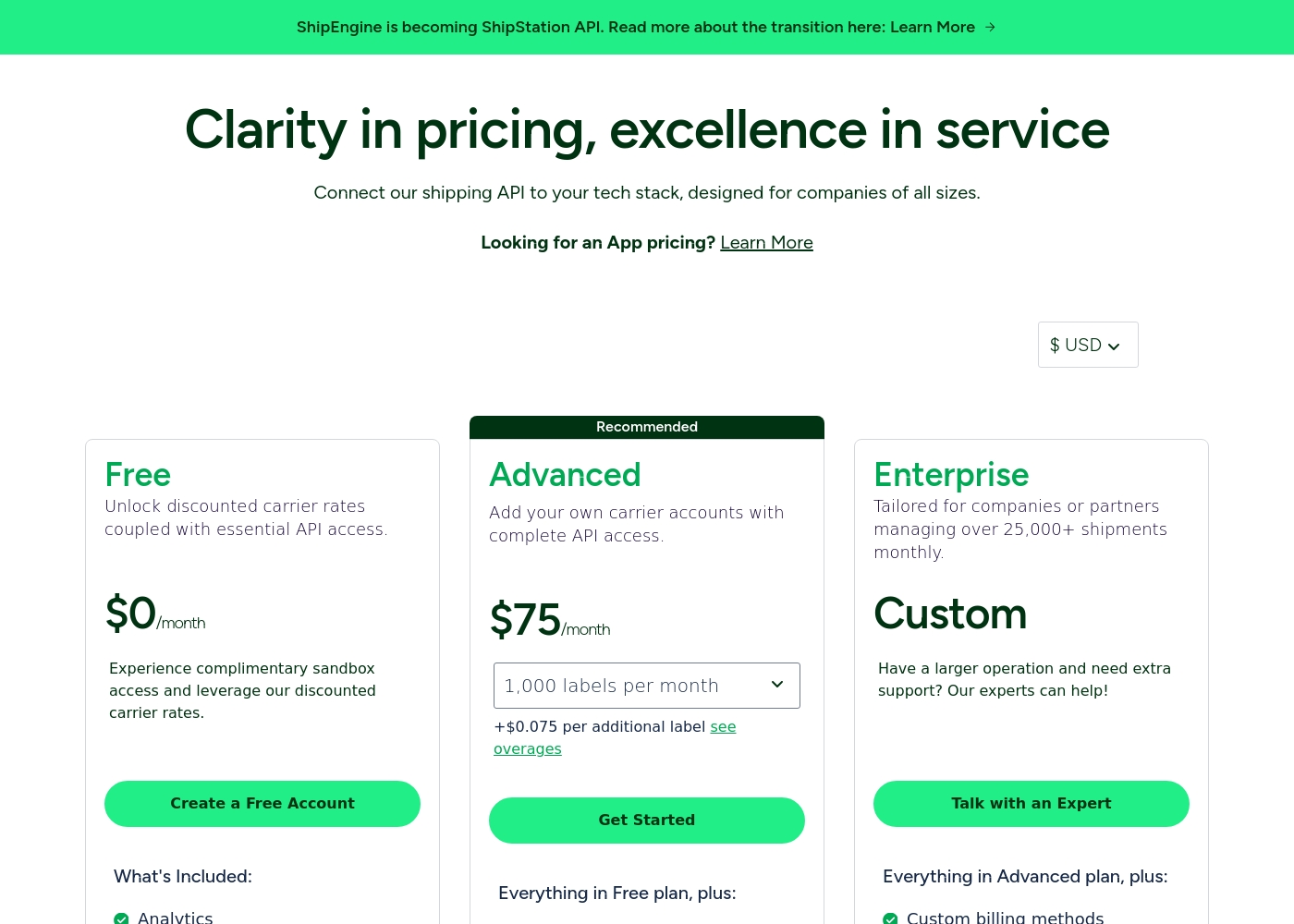
ShipEngine’s Advanced plan is $75 for 1,000 labels and charges $0.075 for overages. It explicitly targets high-volume Enterprise users shipping over 25,000 monthly packages. ShippingEasy has a generous $0 plan limit of 25 monthly shipments. The $19.99 Growth plan covers shipment volumes between 26 and 200 per month. ShippingEasy is generally more affordable for small to mid-volume sellers that prioritize savings. ShipEngine is the only viable infrastructure choice for extremely high-volume shippers.
Pre-Shipment Data
ShipEngine is superior for data quality; ShippingEasy focuses on order aggregation and processing.
ShipEngine's Advanced plan includes robust Address Validation via its API. This feature helps prevent costly failed deliveries and ensures data accuracy. ShipEngine also calculates taxes and duties for international shipments seamlessly. ShippingEasy integrates order data for quicker label generation from multiple sources. It relies on streamlined workflows and the ConnectEasy tool for automatic label printing. ShipEngine provides crucial data enrichment tools before the label is printed.
Customer Branding
ShippingEasy provides built-in branding tools; ShipEngine is an unbranded API platform.
ShippingEasy unlocks options for custom logos on shipping labels with the Growth plan. It also sends customized tracking emails and provides a dedicated branded tracking web link. ShippingEasy includes Customer Marketing tools to solicit reviews and drive repeat sales easily. ShipEngine focuses only on the core functionality, like automatic tracking updates via API. Merchants needing post-purchase marketing and branding tools must select ShippingEasy.
Support & Reliability
ShipEngine offers professional support; ShippingEasy reports widespread issues despite 'unlimited expert help.'
ShipEngine provides structured 24/7 email support to all users on every plan. Enterprise users receive a dedicated Implementation Manager and live chat support is available. ShippingEasy offers award-winning customer support via phone, email, and chat on paid plans. However, user reviews cite unresponsive support and core system reliability issues frequently. Given the reported customer frustrations, ShipEngine's structured support is likely more dependable.
ShipEngine pricing: ShipEngine offers a transparent pricing structure starting with a free tier and scaling to usage-based paid plans starting at $75/month. You can choose to stick with ShipEngine's carrier rates for free or bring your own accounts with an Advanced plan.
house. Note: ShipEngine is transitioning to ShipStation API.
Individual plan names and features are detailed below. Tracking and address validation API calls may incur additional costs based on volume.
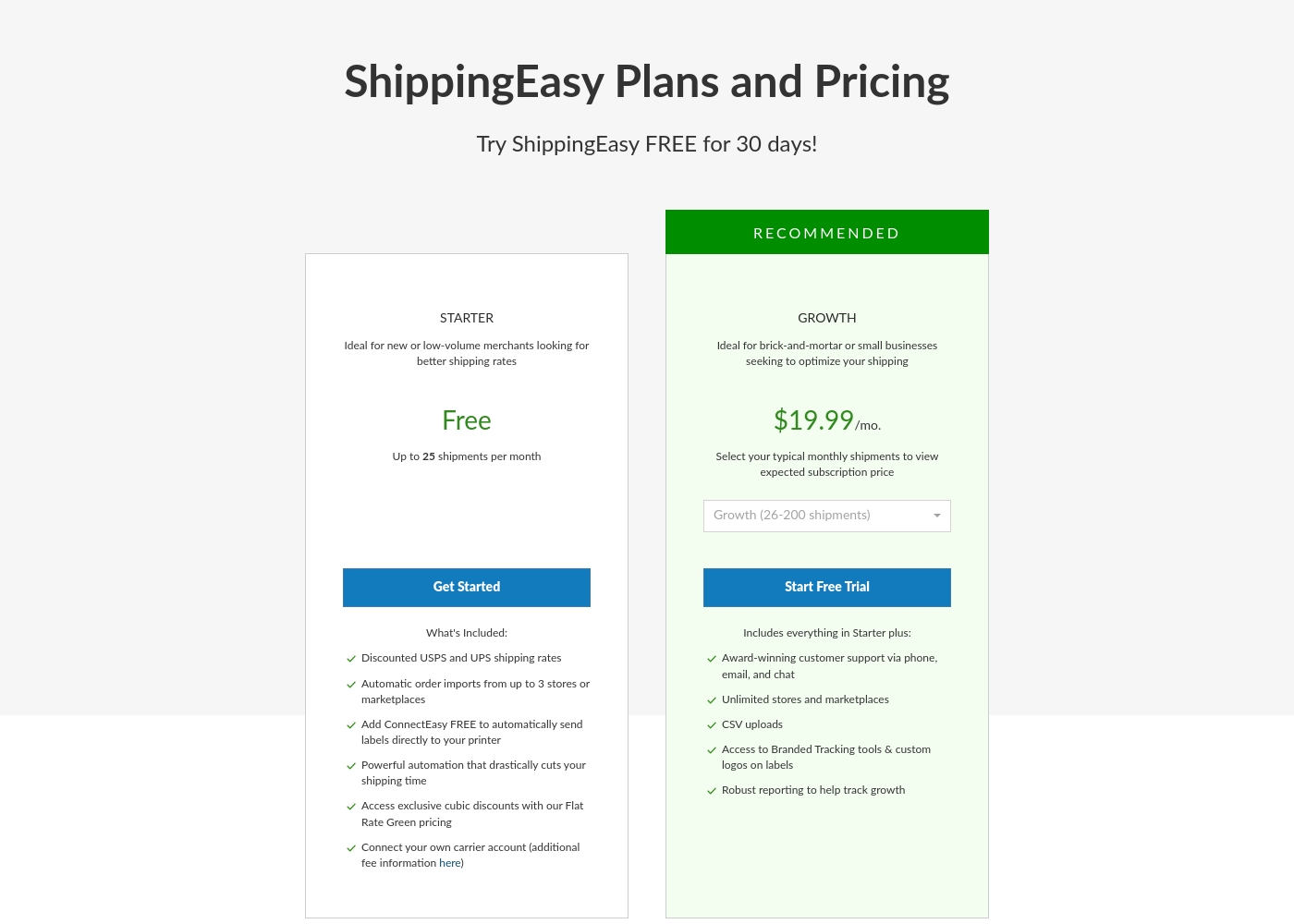
ShippingEasy costs between Free and $19.99 per month, with two plans visible: Starter at Free and Growth starting at $19.99.
Here is a closer look at the key features and limits for these initial plans. If you have higher shipment volumes, your price adjustment will depend on the expected subscription rate for your shipping bracket.
Starter
Price: Free Websites Supported: Up to 3 stores or marketplaces Best For: New or low-volume merchants looking for better shipping rates Other Features: * Discounted USPS and UPS shipping rates
- Automatic order imports from up to 3 stores
- Free ConnectEasy for automatic label printing
- Powerful shipping automation
- Access to exclusive cubic discounts (Flat Rate Green)
- Option to connect your own carrier account (additional fee applies)
- Discounted USPS and UPS shipping rates
- Automatic order imports from up to 3 stores or marketplaces
- Free ConnectEasy for automatic label printing
- Powerful shipping automation
- Access to exclusive cubic discounts (Flat Rate Green)
- All Starter features included
- Award-winning customer support (phone, email, chat)
- Unlimited stores and marketplaces integration
- CSV uploads
- Access to Branded Tracking tools & custom logos on labels
Pricing Notes
- ShipEngine's Advanced plan is volume-based, including 1,000 labels, with overage fees of $0.075 per additional label.
- ShippingEasy's Starter plan is free for up to 25 shipments monthly, which is ideal for very low-volume users.
- Connecting your own carrier account on ShippingEasy’s Starter plan involves an additional, non-disclosed fee.
- ShipEngine uses custom quotes for Enterprise customers who manage over 25,000 packages monthly.
- ShippingEasy's pricing is strictly tiered by shipment volume, with the cheapest paid tier starting at $19.99/month.
Pricing Head-to-Head
User Reviews
ShippingEasy is highly praised for offering competitive shipping rates, including the lowest USPS rates and serious UPS discounts. However, external user sentiment is generally quite negative, focusing primarily on operational reliability and support.
Users frequently report terrible customer service; many complaints detail unresponsive phone support and ignored emails, sometimes numbering over ten, especially when attempting to resolve billing issues or secure refunds. Recurring technical flaws also create huge headaches.
I am now waiting one month for ShippingEasy to pay back $100. They simply won't answer my emails, even after I sent more than 10. Once you pay, it feels like they stop caring about your business.
Our Verdict
ShipEngine and ShippingEasy serve entirely different needs for managing shipping operations. This isn't a feature battle; it is a structural comparison based on user needs. Your decision depends strictly on your technical capabilities and shipment volume requirements. ShipEngine’s core strength lies in its infinitely flexible API and enterprise-grade scalability. Need to embed address validation and rate comparison directly into your custom ERP? ShipEngine can handle that integration quickly using its dev tools. ShipEngine is built to manage massive volume, clearly targeting users shipping over 25,000 items monthly. ShippingEasy excels at merchant convenience and instant cost savings on the front end. It offers the lowest USPS rates and serious UPS discounts immediately available. ShippingEasy provides a centralized, seamless dashboard experience for users up to 200 shipments monthly. Furthermore, ShippingEasy includes great built-in tools for branded tracking and customer retention. The essential deciding factor is integration depth versus operational simplicity. Use ShipEngine if you need deep, custom development and complete data control for high volume. Choose ShippingEasy if you need immediate deep carrier discounts and a reliable, simple dashboard for standard e-commerce orders. If you are a developer or a rapidly scaling enterprise, ShipEngine is the necessary long-term infrastructure choice. For high-volume e-commerce merchants (under 200 monthly), ShippingEasy is simpler and cheaper, but consider the reported support and reliability issues.
Frequently Asked Questions
Which is better for small e-commerce merchants: ShipEngine or ShippingEasy?
ShippingEasy is often better for small merchants, offering a free plan up to 25 shipments. ShipEngine focuses more on API integration for developers and custom systems. ShippingEasy provides an immediate dashboard and deep carrier rate discounts.
Does ShipEngine offer lower USPS rates than ShippingEasy?
ShippingEasy specifically touts providing the lowest USPS rates in the industry. ShipEngine offers competitive discounted carrier rates across its 200+ global carriers. If USPS savings are your primary goal, ShippingEasy may offer more aggressive pricing.
Does ShippingEasy integrate via API like ShipEngine?
ShipEngine is fundamentally an API built for deep, custom integration into ERPs or WMS systems. ShippingEasy integrates primarily using pre-built connectors for online stores and marketplaces. ShippingEasy is designed to work as a standalone managed application for merchants.
Which software is better for managing my own negotiated carrier accounts?
ShipEngine supports users bringing their own carrier accounts starting with the Advanced ($75/month) plan. ShippingEasy allows connection of your own accounts, but an additional fee applies even on their free Starter plan.
How does ShipEngine's free plan compare to ShippingEasy's free plan?
ShippingEasy's free Starter plan limits you to 25 shipments per month but includes great discounts. ShipEngine's Free plan offers unlimited access to their API features and developer sandbox environment. ShipEngine is ideal for testing functionality; ShippingEasy is for low-volume shipping.
Can I use branded tracking emails with ShipEngine like I can with ShippingEasy?
ShippingEasy allows you to brand your labels and send customized tracking emails starting with the Growth plan. ShipEngine provides automatic tracking updates through its API but doesn't include built-in branding or customer marketing tools.
Ready to Choose?
Both tools have their strengths. Choose based on your specific needs.