Reword vs Writesonic
Reword and Writesonic offer AI writing, but their core goals are very different. Reword focuses on deep brand voice training and team collaboration. Writesonic is built to track and dominate generative AI search visibility and traffic. Critically, user reviews show a massive difference in reliability and trustworthiness.
Best for: Highly collaborative teams prioritizing deep brand tone consistency, Publishers who need integrated citation verification tools for credibility
Best for: SEO specialists and scaling marketing teams focused on traffic growth, Brands needing to track visibility across generative AI platforms (ChatGPT, Gemini)
Avoid Until Business Practices Change
We observe Reword offers robust features like custom AI training and unlimited usage plans, but these are overshadowed by severe customer complaints. Feedback universally reports a complete inability to cancel subscriptions, unresponsive customer service, and continuous unauthorized billing. Overall, we cannot recommend Reword due to documented evidence of highly unethical business and billing practices.
Pros
- Trainable custom AI Cowriter to match brand voice and style
- PRO plan offers unlimited drafts, projects, and users
- Designed for collaborative team use
- Features supporting article citations and enhanced credibility
Cons
- No visible or functioning method to cancel subscriptions
- Customer support is unresponsive and non-existent
- Users report continuous unauthorized monthly billing post-cancellation
- Service quality is viewed as subpar or generic compared to cheaper alternatives
AI Search Visibility and Content Powerhouse
We find Writesonic delivers powerful AI search visibility insights combined with remarkable speed in content generation. Overall, this platform is a strong choice for brands focused on winning organic traffic and maximizing their voice in the new generative AI landscape.
Pros
- Generates high-quality, professional copy rapidly and efficiently.
- Includes advanced SEO optimization tools that aid search ranking.
- Offers unique Generative Engine Optimization (GEO) tracking for AI visibility (Professional tier+).
- User interface is intuitive and easy to navigate.
Cons
- Access to AI Visibility Tracking (GEO) requires the Professional tier or higher ($199/mo billed annually).
- Users must manage a credit consumption system, which can be restrictive.
- Generated content may still require a final round of human editing.
AboutReword
Reword is built as a dedicated AI assistant and Cowriter that works alongside your current team. This platform embraces clever collaborative AI to fundamentally change how you approach content creation.
You aren't just using a generic tool, though. You can quickly start training your own AI assistant tailored to your needs.
This focus on collaboration and personalized training means you can consistently produce high-quality content. It’s an effective way to assure that every one of your articles connects deeply with your dedicated readers.
AboutWritesonic
Writesonic is an AI Search Visibility Tracking and Optimization Platform. It's built for organizations—from Series A start-ups to Fortune 500 companies—who need to master Generative Engine Optimization (GEO). The system helps you move beyond traditional metrics to see exactly how your brand is perceived and cited across major AI platforms like ChatGPT, Gemini, and Perplexity. It’s the essential tool for building winning SEO and content strategies based on what actually ranks, not just theory. ✅
Highlights
Feature Comparison
Features Overview
We highlight the main differences and pick a winner for each feature.
Core Focus & Strategy
Reword supports high-quality collaborative content creation. Writesonic is designed for maximum search visibility and traffic.
Reword's goal is building a consistent brand voice across collaborative teams. They offer tools for ideation, drafting, polishing, and simple publication. Reword seeks to become your dedicated AI Cowriter and team assistant. Writesonic's focus is fundamentally different: it optimizes content for AI search and Google ranking. Writesonic provides unique Generative Engine Optimization (GEO) tracking. The difference is internal quality assurance versus external traffic maximization. Writesonic wins for SEO-driven teams.
Custom Brand Voice
Reword allows extensive custom training to match your exact tone. Writesonic focuses on voice incorporation within factual content.
Reword lets you train a dedicated AI Cowriter on your existing successful content. This ensures drafts adopt your specific style and tone perfectly. Voice consistency is Reword's primary architectural directive. Writesonic's content engine incorporates brand voice but also prioritizes EEAT signals and fact-checking. Writesonic is optimized for ranking and citation quality. For deep, hyper-specific brand voice matching, Reword has a slight technical edge. Reword is primarily a content creation tool with high voice fidelity.
AI Visibility Tracking
Writesonic lets you track visibility across 10+ AI platforms. Reword does not offer any generative AI visibility insights.
Writesonic’s Professional plan introduces Generative Engine Optimization (GEO), a key differentiator. GEO tracks your visibility score across platforms like ChatGPT, Gemini, and Perplexity. Writesonic gives competitive intelligence to win citations from the AI models themselves. Reword only supports tracking published articles in generalized terms. Reword cannot provide the crucial, actionable data that Writesonic offers for AI dominance. Writesonic is essential for serious brand visibility in the modern era.
Technical SEO Repair
Writesonic instantly suggests fixes for critical technical barriers. Reword focuses only on editorial optimization, not site health.
Writesonic automatically detects technical barriers that block AI crawlers, like broken schemas or crawl errors. It generates solutions instantly, requiring no prior developer talent. This feature ensures content is perfectly structured for Google and AI models. Reword offers optimization tools for draft content but lacks these critical technical SEO audits. Writesonic provides a superior end-to-end SEO advantage. Automated fixes save significant developer time and prevent visibility loss.
Unlimited Usage Plans
Reword offers true unlimited use on their top plan. Writesonic uses a volume or credit-based system.
Reword's PRO plan includes unlimited drafts, projects, and teammate seats for a fixed monthly rate. This high-tier plan removes all constraints for massive content operations. Reword also uses a confusing usage-based scaling model on its cheaper GROW plan. Writesonic plans (Lite through Advanced) rely on usage metrics, credits, or capped user/project limits. For massive, constraint-free volume, Reword PRO is a stronger option. Reword wins here, specifically for very large teams needing fixed costs.
Customer Support & Reliability
Writesonic has responsive support and high reliability scores. Reword has severe, documented trust and billing issues.
Writesonic enjoys positive review sentiment, indicating reliable service and great support responsiveness. Users love Writesonic's speed and ease of use. Reword has an extremely low 2.3-star rating based on consistent reports of unauthorized billing. Users report being unable to cancel Reword subscriptions or receive support responses. The difference here is trust; Writesonic is proven reliable, Reword is flagged as unreliable by users.
Pricing Structure
Writesonic uses transparent tiered pricing, while Reword uses confusing usage-based scaling. Both offer annual discounts.
Reword’s GROW plan starts low at $48/month but charges extra if you exceed ten monthly drafts. This makes estimating monthly spend on Reword quite difficult. Writesonic tiers are clearer, from Lite ($39/mo) up to Advanced ($399/mo) billed annually. Writesonic requires the Professional tier ($199/mo) for AI Search Tracking (GEO). Writesonic's pricing provides much more predictable utility for most users. Reword's usage-based model makes cost planning difficult.
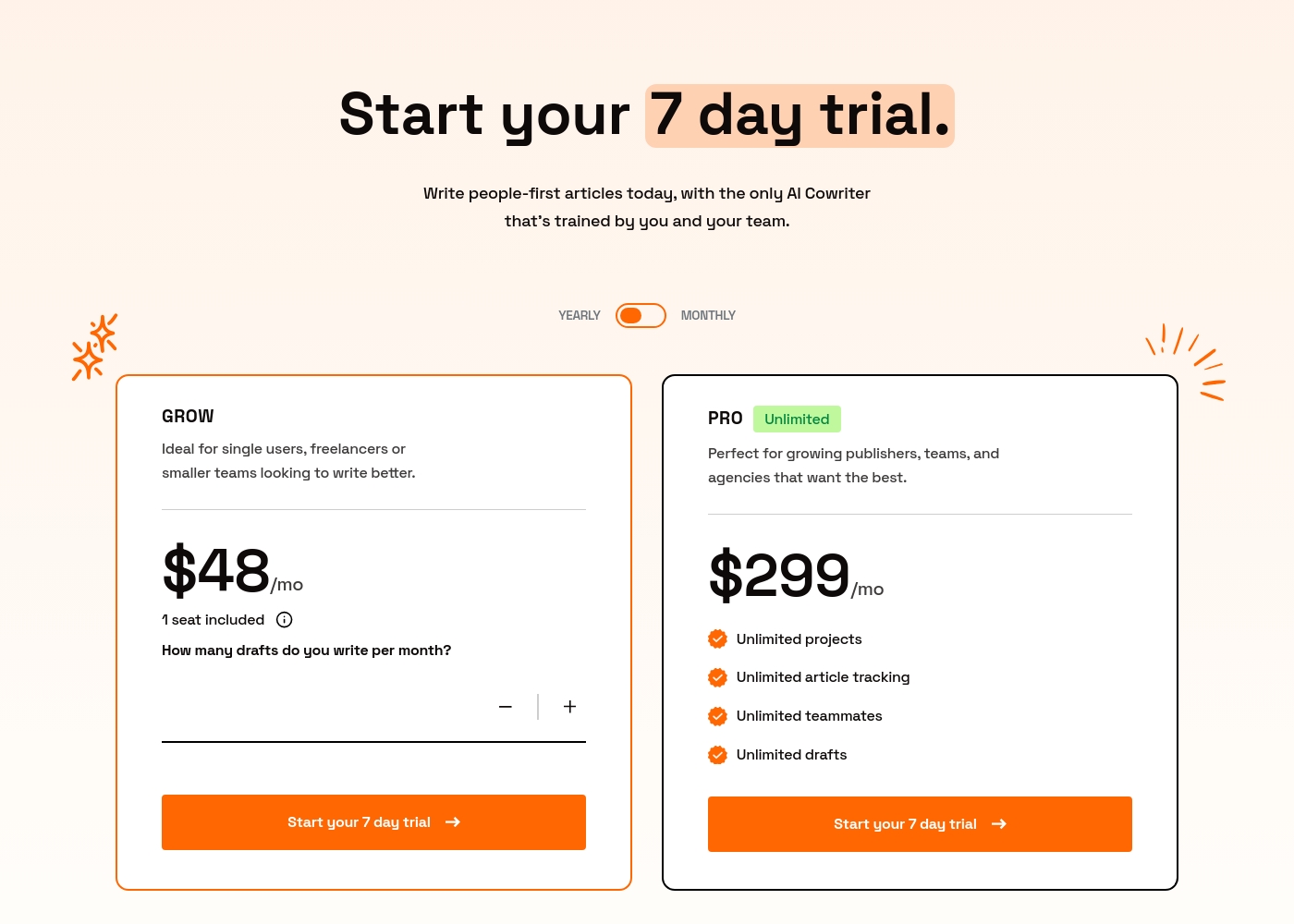
Reword costs between $48 and $359 per month with two primary plans: GROW at $48/month (billed yearly) and PRO at $299/month (billed yearly).
Let's explore what each subscription tier offers so you can find the perfect fit for your content needs.
GROW
Price: $48/month (billed annually) or $60/month (billed monthly) Best For: Single users, freelancers, or smaller teams Refund Policy: 14-day money-back guarantee on inactive accounts Other Features:
- 1 seat included
- Usage-based draft scaling (0-10 drafts free, costs increase up to $105 extra for 71–80 drafts)
- Up to 3 projects, Custom-trained voices
- AI assistance powered by GPT-4, Claude, and Gemini
- 1 seat included (Additional seats $30 or $15/month, depending on context)
- Usage-based draft scaling (0-10 included, costs increase beyond that)
- Up to 3 projects
- Custom-trained voices
- Unlimited projects
- Unlimited article tracking
- Unlimited teammates
- Unlimited drafts
- Unlimited published article tracking
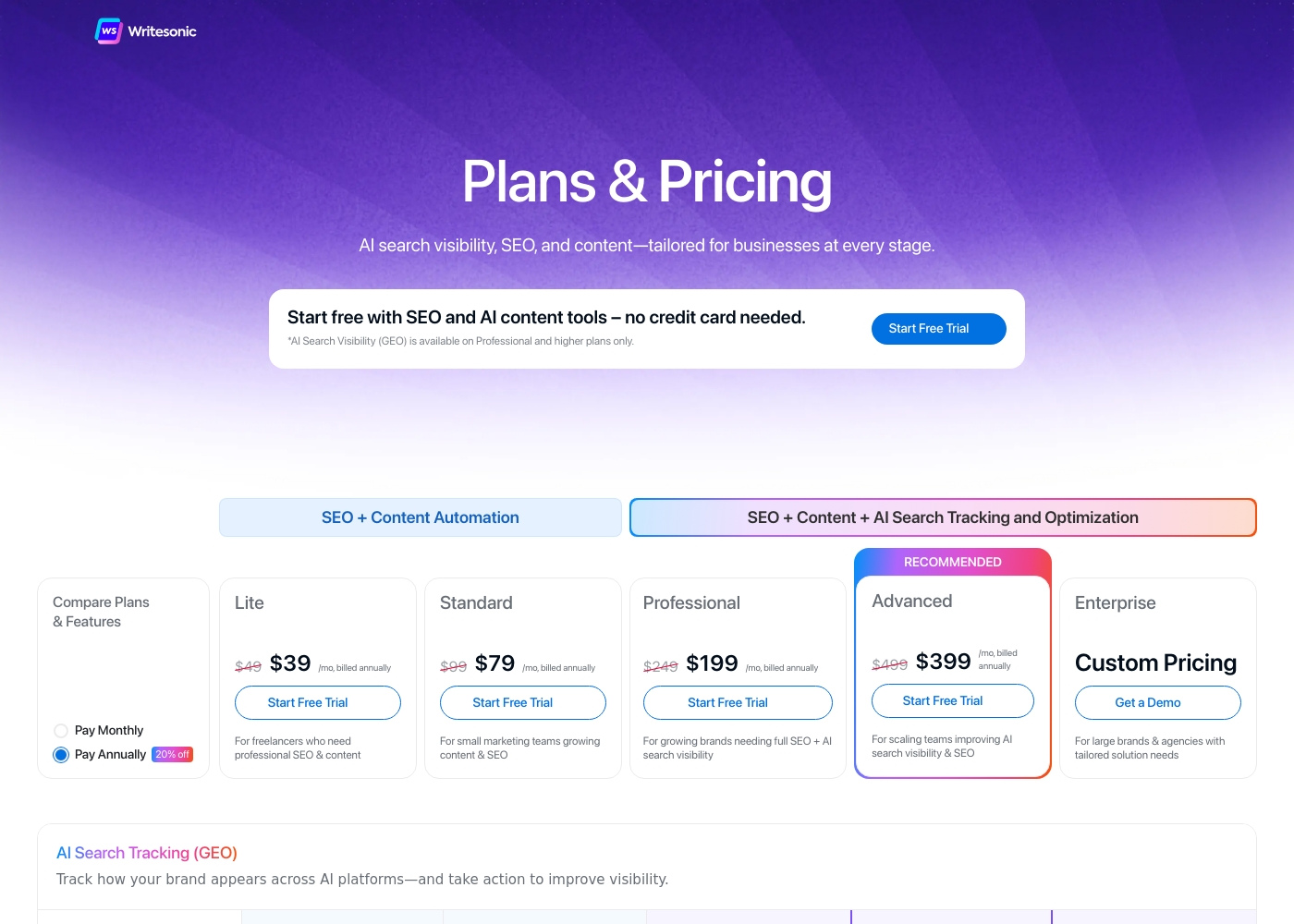
Writesonic costs between $39 and $399 per month when billed annually with five plans: Lite at $39/mo, Standard at $79/mo, Professional at $199/mo, Advanced at $399/mo, and Enterprise (Custom Pricing).
Here’s a closer look at the available options. The prices listed for the Lite through Advanced tiers reflect the monthly rate when you choose to pay annually, saving you 20%.
Lite
Price: $39/mo, billed annually Best For: freelancers who need professional SEO & content Other Features:
- SEO + Content Automation focused
- Start Free Trial available
- SEO + Content Automation focus
- For freelancers
- SEO + Content Automation focus
- For small marketing teams
- SEO + Content + AI Search Tracking and Optimization
- Includes AI Search Tracking (GEO)
- For growing brands
- SEO + Content + AI Search Tracking and Optimization
- Includes AI Search Tracking (GEO)
- Recommended plan
- For scaling teams
Pricing Notes
- Reword’s GROW plan uses usage-based draft scaling; costs increase rapidly if you exceed 10 drafts monthly.
- Writesonic offers a consistent 20% savings when choosing annual billing over the monthly rate.
- Accessing Writesonic's crucial AI Search Tracking (GEO) requires the $199/month Professional tier or higher.
- Reword offers a 14-day money-back guarantee, but only if the account remains inactive.
- Writesonic provides a free trial without requiring a credit card upfront, maximizing user confidence.
Pricing Head-to-Head
User Reviews
The external feedback for Reword is overwhelmingly negative, centering on critical billing, cancellation, and customer support issues. With a 2.3/5 TrustScore from limited reviews, the consistent and severe theme is the complete inability to cancel the service.
Multiple users reported being charged $50–$60 monthly even after attempting to cancel, deleting payment methods, or trying to halt the subscription via email for months. Customer service is cited as terrible; users receive no reply or resolution regarding charges or cancellation requests.
I tried to cancel my trial by emailing support, but they never responded and billed me anyway. There is no way to cancel on the website, forcing me to dispute the charge with my bank. Avoid this company at all costs.
Writesonic enjoys overwhelmingly positive external sentiment, reflected by its 4.7-star rating on Trustpilot derived from thousands of reviews. Users consistently praise the platform's incredible speed and efficiency, calling it a game-changer that doubles productivity and cuts writing time in half.
Many reviewers, especially solo entrepreneurs, highlighted the intuitive, user-friendly interface and the wide variety of templates available. Users find the AI generates high-quality, engaging copy quickly, often requiring minimal adjustments.
Writesonic has been a total game-changer for my content creation! It’s incredibly easy to use, and the AI generates high-quality, engaging copy in no time. I especially appreciate the ability to switch between different tones and styles, ensuring it matches my brand.
Our Verdict
This comparison largely determines itself based on user reliability and trust. Writesonic is the highly recommended choice for most users today. Reword offers interesting technology, but user feedback suggests severe risks. Reword's core strength is training a deeply custom AI Cowriter for perfect brand voice. If maintaining absolute tone consistency is your critical priority, Reword focuses squarely on collaborative content polishing. Reword’s expensive PRO plan supports truly unlimited drafts and teammates, ideal for large operations. Writesonic, however, is the engine built for modern organic success and speed. Its unique Generative Engine Optimization (GEO) tracks your brand's voice on platforms like ChatGPT and Gemini. Writesonic also instantly fixes technical SEO errors and helps you create content that ranks on Google and is accurately cited by AI. Writesonic's stellar 4.7-star review sentiment confirms reliable and super fast service. The deciding factor is service trust and corporate reliability. Reword faces severe, documented user accusations of non-existent support and unauthorized billing practices. You simply cannot ignore the financial risk associated with Reword. Choose Writesonic if you need powerful, reliable tools and a company you can trust. Only choose Reword if you are willing to accept extreme risk for that specific custom AI technology.
Frequently Asked Questions
Which is better for AI visibility and SEO: Reword or Writesonic?
Writesonic is the clear winner for SEO and visibility tracking. Writesonic includes Generative Engine Optimization (GEO) features on its Professional plan. Reword focuses primarily on content generation quality, not search performance metrics.
Can I trust Reword's billing practices compared to Writesonic?
Reviews indicate Writesonic is highly trustworthy with reliable service and clear pricing. Reword has a 2.3-star rating due to widespread user reports of unresponsive billing and unauthorized monthly charges. Writesonic is the much safer option.
Which tool is better for maintaining a consistent brand voice across my team?
Reword excels here with its core feature: the Custom Trained AI Cowriter. You train Reword on your published content to adopt your exact tone. Writesonic incorporates voice but prioritizes SEO function and efficiency.
Is Reword's PRO plan truly unlimited, or does Writesonic offer better scaling?
Reword PRO is truly unlimited for users, drafts, and projects at $299/month (annual). Writesonic's plans use usage limits and credits, meaning Reword offers better fixed-cost capacity for huge teams.
Does Writesonic require a credit card for the free trial like Reword?
No, Writesonic allows you to start a free trial for the core product without entering credit card details. Reword requires payment information upfront for its 7-day trial period.
Can Writesonic help me automatically fix technical SEO issues?
Yes, Writesonic is built to automatically detect technical errors like broken schemas or crawl issues. It instantly suggests and deploys fixes without requiring dedicated developer time. Reword does not offer this site health feature.
Ready to Choose?
Both tools have their strengths. Choose based on your specific needs.