Printify vs Spreadshirt
Printify and Spreadshirt are top print-on-demand platforms, but their models differ greatly. Printify connects your stores to a massive fulfillment network for global scale. Spreadshirt is completely fee-free and offers instant exposure via its built-in Marketplace. Choosing depends on if you prioritize platform control or easy audience access.
Best for: Scaling e-commerce businesses running multiple storefronts (5-10), Merchants needing deep integration into Shopify or Etsy ecosystems
Best for: Designers seeking a 100% free, zero-risk selling environment, Individuals who want instant exposure via a built-in Marketplace audience
Print-on-Demand Made Simple and Reliable
We found Printify delivers on its promise to simplify the print-on-demand fulfillment process for merchants of all sizes, offering a free entry point and access to a robust global network. The platform is highly intuitive, making it extremely easy for beginners to launch quickly and scale upward. Overall, we recommend Printify for its platform stability, exceptional user experience, and low initial risk.
Pros
- Powerful $0 Free plan allows risk-free startup with no credit card required.
- Extremely user-friendly interface and simple onboarding is ideal for beginners.
- Seamless integration with major sales platforms like Etsy and Shopify.
- Vast product catalog (over 1000 items) with high-quality printing observed on samples.
Cons
- Shipping costs are frequently reported as high, especially for international deliveries.
- Features like in-app image editing capabilities need improvement.
- Minor confusion exists regarding currency conversion settings during checkout.
- Some users reported snags when attempting to copy products between multiple stores.
Always Free, High Volume, Mixed Quality
We find that Spreadshirt offers an attractive, risk-free entry point for designers due to its entirely free platform model and strong commitment to review verification. While users appreciate the customization tools and material quality, recurring feedback points to some notable inconsistencies in sizing and print execution that sellers should consider. Overall, Spreadshirt is an excellent, high-volume platform perhaps best suited for those prioritizing cost and speed over achieving flawless print consistency on every single order.
Pros
- Completely fee-free and risk-free platform for designers and shop owners.
- High quality and durability reported for base apparel materials.
- Extensive customization options using an easy-to-use configurator.
- Strong platform commitment to transparent, verified customer feedback.
Cons
- Inconsistent print quality noted (e.g., streaks, color inaccuracy, or grainy textures).
- Apparel sizing sometimes runs large or is inconsistent across items.
- User experience issues encountered during account setup and log-in processes.
- Packaging occasionally fails to protect items fully from weather damage during shipping.
AboutPrintify
Printify is the trusted platform for creators ready to build a custom product line. This network connects your designs to production facilities located around the world 🌎. Sellers can choose from over 1000 products, including T-shirts, Mugs, Hoodies, and Posters. Printify handles the complexity of fulfillment, allowing you to focus on your brand and making your next bestseller.
AboutSpreadshirt
Spreadshirt is a brand committed to solid customer communication and feedback integrity. They keep customers informed using regular updates sent straight to your inbox. 💡 You will hear about new product offers, discount campaigns, and even exclusive competitions this way. Crucially, they manage customer reviews with a strong commitment to verification. This helps you trust the overall quality rating you see.
Highlights
Feature Comparison
Features Overview
We highlight the main differences and pick a winner for each feature.
Pricing Structure
Spreadshirt is 100% free forever; Printify offers discounts for paying subscribers.
Printify begins with a powerful $0 Free plan to minimize risk for beginners. If you scale, Printify Premium costs $29 monthly to unlock major savings. You only pay for product fulfillment costs after a successful sale. Spreadshirt is explicitly 'Always free' and 'Fee-free' for all designers and shops. There are zero monthly subscriptions or usage fees ever for selling on Spreadshirt. Printify aims to maximize margin growth with its paid tiers and bulk discounts. Spreadshirt opts for absolute simplicity and zero overhead costs. If you sell in high volume, the Printify Premium discount quickly pays for itself. If you only sell occasionally, Spreadshirt is cheaper.
E-commerce Integration
Printify connects deeply to external stores; Spreadshirt requires using their internal channels.
Printify offers seamless, deep integration with major platforms like Etsy, Shopify, and eBay. The Printify Free plan lets users manage up to five different external storefronts. Spreadshirt requires using their internal sales channels: either a dedicated Spreadshop or the Marketplace. Integration with established external stores is not the focus of Spreadshirt. Printify is a connector built to plug into your existing e-commerce ecosystem. Use Printify if you already have customers on Shopify or similar platforms. Spreadshirt is ideal if you just want to upload and sell quickly in one place.
Product Selection
Printify features 1000+ products, drastically more than Spreadshirt's 200+ options.
Printify offers a massive catalog of over 1000 items ready for your custom designs. This huge selection allows for extensive product diversification and niche targeting. Spreadshirt lets sellers design instantly on over 200 common products. This covers apparel, mugs, and basic posters needed for most campaigns. Printify is vital if your business constantly needs to launch new, unique product lines quickly. Spreadshirt covers the basics well but limits expansion into unique categories like phone cases. Printify clearly wins on raw variety and selection depth.
Global Reach
Printify uses a specified 141-facility network for superior global fulfillment stability.
Printify connects merchants to 141 production facilities located worldwide. This network reliably supports delivery to customers across 209 countries and territories. Spreadshirt confirms they handle fulfillment and logistics but provides no numbers on facility size or global coverage. Printify’s aggregated network approach is designed for resilient, efficient global delivery logistics. If your audience is highly international, Printify gives you more confidence in reach and speed. Spreadshirt relies on its own internal process, which is less transparent about scale.
Scaling Potential
Printify offers Enterprise tools for high-volume sales; Spreadshirt lacks a dedicated scale path.
Printify offers an Enterprise tier with custom pricing, additional discounts, and custom API integration. Enterprise merchants also receive a dedicated account manager for complex logistics. Spreadshirt operates with a single free model, which is excellent for starting out easily. There are no obvious dedicated support or technical tools for massive enterprise scaling. Printify is designed for merchants who plan to hit six or seven figures in sales volume. Spreadshirt focuses on democratizing design sales at any level. Printify maximizes long-term growth potential.
Audience Access
Spreadshirt provides a built-in audience; Printify requires you to bring your own traffic.
Spreadshirt allows sellers to list immediately on its popular Marketplace. This means your designs gain instant visibility from Spreadshirt’s existing customer traffic. Printify requires you to connect to an external store like Etsy or Shopify. Success relies solely on your external marketing efforts and organic traffic. If you lack a strong existing audience, Spreadshirt gets you sales faster. Printify offers better control over branding and customer data outside of the Marketplace environment.
Quality Reliability
Printify’s model results in better reliability; Spreadshirt receives more print consistency complaints.
Printify users generally rate order quality highly, finding even samples exceed expectations. The platform has successfully fulfilled over 59 million total orders reliably across its network. Spreadshirt reviews frequently cite issues like inconsistent print quality, including grainy prints. They also report clothing sizing being inconsistent across different apparel items. Printify uses competitive suppliers, giving merchants selection control for better quality. Spreadshirt's in-house fulfillment struggles more with specific execution consistency. For reliable results, Printify appears safer.
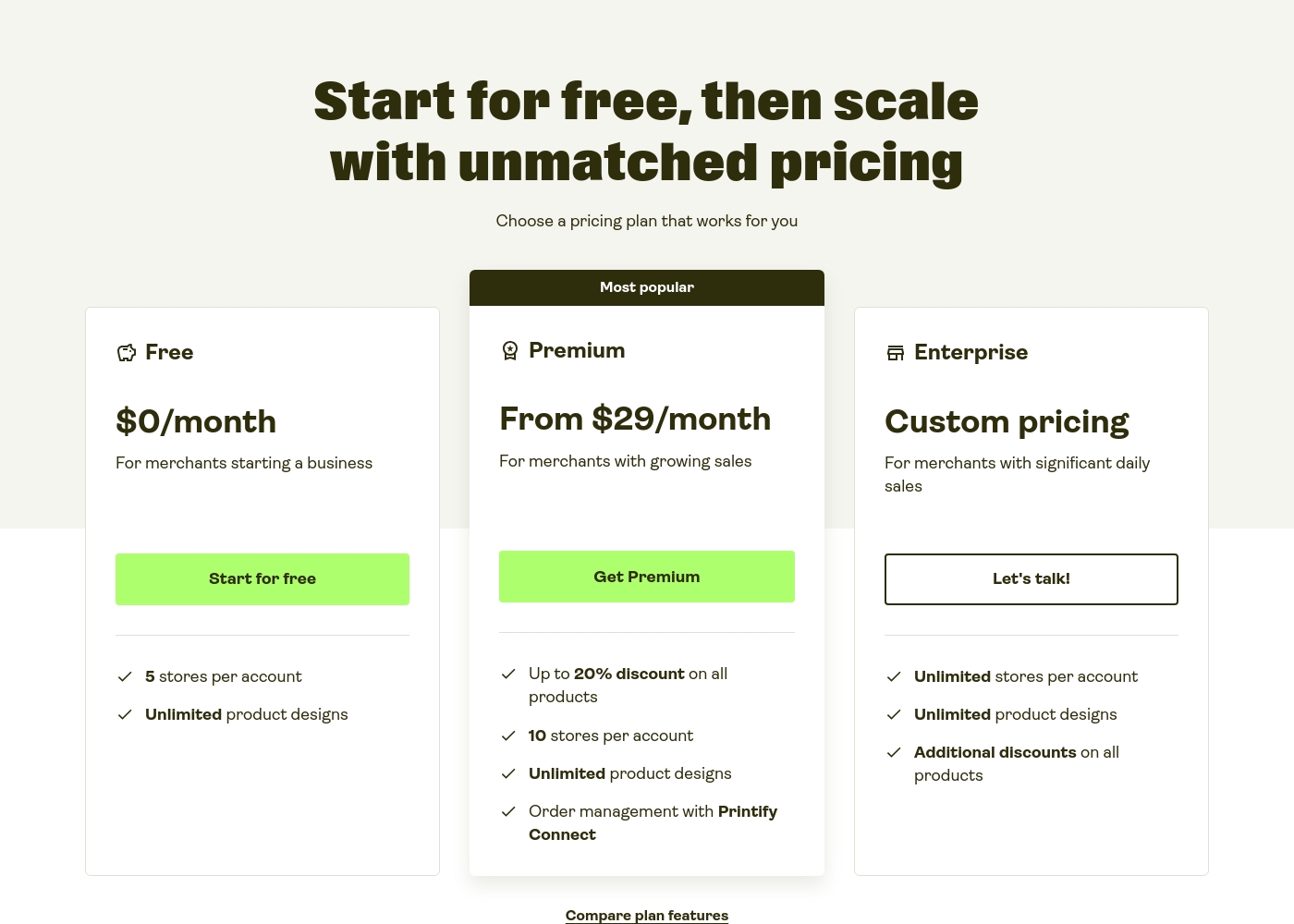
Printify costs between $0 and Custom Pricing per month with three plans: Free at $0/month, Premium starting at $29/month ($24.99/month annualized), and Enterprise at Custom pricing.
Printify offers a pricing plan for everyone, whether you are just starting your shop or managing high-volume enterprise sales.
Free
Price: $0/month Websites Supported: 5 stores per account Best For: Merchants starting a business Other Features: Unlimited product designs, product creator, integration with Shopify, Etsy, and eBay, 24/7 merchant support.
- 5 stores per account
- Unlimited product designs
- Product creator
- Integration with Shopify, Etsy, eBay and more
- Manual order creation
- Up to 20% discount on all products
- 10 stores per account
- Unlimited product designs
- Order management with Printify Connect
- Early access to new features
- Unlimited stores per account
- Unlimited product designs
- Additional discounts on all products
- Custom API integration
- Dedicated account manager
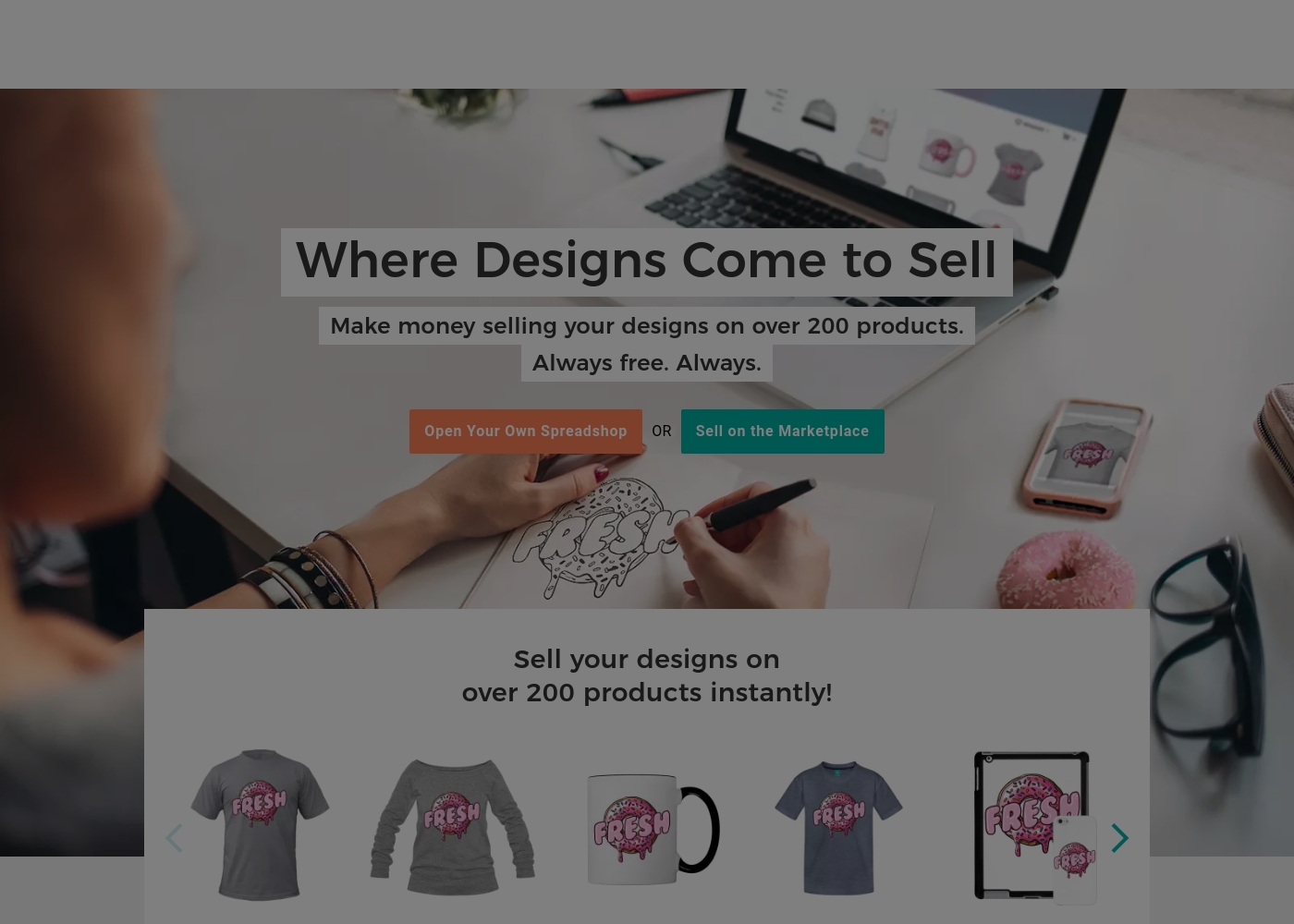
Spreadshirt is always free to use, offering two main ways to sell: Open Your Own Spreadshop and Sell on the Marketplace.
Spreadshirt lets you start selling immediately on over 200 products without worrying about platform fees. The process is designed to be risk-free and stress-free from the start.
Open Your Own Spreadshop
Price: Always free Best For: Building a dedicated brand storefront Other Features: Fee-free, Risk-free, Stress-free, Sell designs on over 200 products instantly
- Establish a dedicated brand storefront (Spreadshop)
- Sell designs on over 200 products instantly
- Fee-free, risk-free selling
- Stress-free platform use
- List designs directly on the Spreadshirt Marketplace
- Make money selling your designs on over 200 products
- Fee-free, risk-free selling
- Stress-free platform use
Pricing Notes
- Spreadshirt is completely "Always free" and "Fee-free," requiring no commitment from sellers.
- Printify offers a powerful $0 Free plan which allows up to five store connections instantly.
- Printify's Premium plan costs $29/month but unlocks product discounts up to 20% to maximize profit.
- The core expense for both platforms is the fulfillment charge, paid only after a customer sale.
- Printify incentivizes growth with cost-saving tiers; Spreadshirt prioritizes zero upfront fees.
Pricing Head-to-Head
User Reviews
Printify enjoys excellent external reception, maintaining a 4.6 Excellent rating across thousands of Trustpilot reviews. Users overwhelmingly praise the platform's user-friendliness, noting its intuitive interface makes both navigation and product creation simple, even for beginners.
The seamless integration with major sales platforms like Etsy and the risk-free $0 starting cost are widely appreciated for streamlining the selling process. Sellers frequently highlight the wide variety of customizable products available and commend the quality of the prints, which often exceed customer expectations.
I’m new to making shirts and merchandise, but Printify has been more than I expected! It’s easy to learn and navigate, and the tutorials are helpful. I started with T-shirts but have expanded my offerings quickly.
Spreadshirt maintains a "Great" 4.1-star rating based on over 16,000 Trustpilot reviews. Users frequently praise the high quality and comfort of the base apparel materials, noting the products feel durable and superior to what some competitors offer.
The extensive customization options and an easy-to-use design configurator are consistently highlighted as strengths. However, feedback concerning execution and logistics is notably mixed.
Shirts arrived and the designs seem to be printed well; they survived the first wash without any issues. The price was good for no minimum per design, saving us time on setting up our own screen prints. It offers great convenience and value.
Our Verdict
This comparison pits flexibility against simplicity, with clear winners in each lane. Printify is the choice for scaling businesses; Spreadshirt dominates easy, zero-risk entry. Printify helps ambitious entrepreneurs grow by connecting deeply to platforms like Shopify and Etsy. The Spreadshirt Marketplace gives immediate access to potential buyers. Printify’s superpower is its massive fulfillment network and potential for profit optimization. It allows integration with five stores for free and offers over 1000 unique customizable products. Upgrading to Printify Premium offers up to 20% savings on fulfillment, significantly boosting high-volume profit. Printify handles complex logistics well, operating across 209 countries. Spreadshirt's superpower is its truly risk-free ecosystem and built-in sales channel. The platform is entirely 'always free' and demands zero upfront commitment whatsoever. Selling on the Marketplace instantly gives designs high visibility among Spreadshirt’s existing customer audience. Spreadshirt manages all logistics, letting designers focus purely on artwork creation. Your sales approach is the deciding factor between the two platforms. Need maximum control, vast product options, and high scaled profit? Choose Printify. Do you prefer absolute simplicity, zero fees, and instant audience traffic? Spreadshirt is the far better platform for that. If you are graduating from Etsy and need discounts on 1000 products, pick Printify. If you are launching your first shirt design tonight for $0, Spreadshirt offers the quickest, easiest path to market.
Frequently Asked Questions
Which is better for maximizing profit margins: Printify or Spreadshirt?
Printify rewards scale with its Premium plan benefits. Subscribers get up to 20% discounts on product fulfillment costs, which significantly boosts profit. Spreadshirt is fee-free, but it offers no stated discount tiers for volume. Printify is better for optimized margins.
Does Spreadshirt offer e-commerce integrations similar to Printify's Shopify access?
No, Spreadshirt focuses on selling through their internal Spreadshop or Marketplace channels. Printify is superior for external integration, connecting with Shopify, Etsy, and eBay easily. Printify users plug designs into their pre-existing stores.
Which platform offers a larger selection of customizable products: Printify or Spreadshirt?
Printify leads significantly with access to over 1000 different customizable items. Spreadshirt allows selling on just over 200 products instantly. Printify is essential for sellers needing vast product diversification and niche options.
Is Spreadshirt worth choosing if I need instant visibility for my designs?
Yes, Spreadshirt excels here because you can list designs directly on its Marketplace. This instantly exposes your products to Spreadshirt’s large existing customer base. Printify requires you to drive your own external store traffic.
How many stores can I manage on Printify versus Spreadshirt?
Printify allows you to manage up to five integrated stores on its free plan. Premium plans allow ten stores. Spreadshirt is structured around a single dedicated Spreadshop or listing on their Marketplace.
Are there quality issues reported more frequently with Printify or Spreadshirt?
Spreadshirt reviews frequently mention inconsistencies in print quality and product sizing. Printify generally receives more reliable feedback regarding quality and order execution. For quality assurance, Printify is a safer choice.
Ready to Choose?
Both tools have their strengths. Choose based on your specific needs.