Leadpages vs Systeme.io
Leadpages and Systeme.io offer very different approaches to running your online business. Leadpages focuses intensely on maximizing individual page conversion rates using advanced testing capability. Systeme.io provides an easy, all-in-one platform for funnels, email, and websites in one unified place. The right choice depends entirely on whether you need deep optimization or total system consolidation.
Best for: Experienced marketers optimizing existing high-traffic funnels., Teams dedicated solely to conversion rate optimization (CRO).
Best for: Solo entrepreneurs launching their first cohesive online business., Small businesses seeking to replace multiple software subscriptions.
Powerful Builder, Risky Billing Model
We found Leadpages offers a powerful tool for quickly building high-converting landing pages complete with built-in A/B testing and direct sales features. Overall, we are deeply concerned about the platform’s reported severe failures concerning customer billing transparency and the subscription cancellation process, which overshadows the product's functional utility.
Pros
- Code-free, drag-and-drop landing page creation.
- Features robust A/B testing capabilities for optimization.
- Allows direct on-page sales and transactions.
- Unlimited traffic and leads are included across all plans.
Cons
- Frequent complaints regarding unauthorized or surprise billing.
- Cancellation mechanism often reported as intentionally misleading or broken.
- Customer service responsiveness is widely criticized as poor or ineffective.
- Users report sudden and steep price increases without proper notice.
All-in-one, approachable, valuable
We find Systeme.io a solid all-in-one platform that packs email, funnels, and automation in one place. Overall, we value its ease of use, transparent pricing from a freemium start, and responsive support, though some limits on features per plan mean teams should plan growth.
Pros
- All-in-one platform unifies CRM, email marketing, websites, funnels, and analytics.
- Easy-to-use interface and quick onboarding.
- Freemium plan plus affordable paid tiers offer solid value.
- Responsive, patient support with fast replies and clear guidance.
Cons
- Some plan details, like limits on contacts and funnels, aren’t fully spelled out in official materials.
- Refund policy and money-back guarantee aren’t clearly stated in the docs.
- Annual billing discounts are implied, not explicitly documented.
AboutLeadpages
Leadpages is a data-driven solution built for creating powerful, high-converting landing pages. It’s designed to be simple so you can avoid long development cycles. Best of all, you don't need to write a single line of code to get started.
This tool is powerful and versatile. It offers tailored solutions for Marketing Teams, Agencies, Businesses, and even larger Enterprise groups looking to streamline their marketing stack. Whether you need to scale performance or optimize lead collection, Leadpages empowers your success. ✅
AboutSysteme.io
Systeme.io is proudly known as the easiest all-in-one marketing platform available. This comprehensive tool exists specifically for people who want to launch their online business successfully and without unnecessary hassle. You get everything necessary gathered into one single spot, making the entire creation process much less complicated. It truly serves as the only tool you need to manage and grow your venture. 💡
Highlights
Feature Comparison
Features Overview
We highlight the main differences and pick a winner for each feature.
Ecosystem Consolidation
Systeme.io provides all marketing tools in one place; Leadpages needs many external integrations.
Systeme.io minimizes complexity by unifying CRM, email marketing, analytics, and funnel builders. It is specifically designed as the only tool you need to launch a business. This consolidation simplifies workflow and reduces your monthly software bill. Leadpages specializes in front-end assets, such as landing pages and pop-ups. You must connect Leadpages to your existing email service and CRM for leads to move forward. This acts more as a powerful add-on than a full ecosystem. Systeme.io is best if you want one bill, one login, and seamless connection between tools. Leadpages is ideal if you only need conversion optimization added to a mature tech stack. New businesses benefit greatly from Systeme.io's simple, unified approach. Leadpages is for experienced teams optimizing an already established architecture.
Pricing & Accessibility
Systeme.io starts immediately with a $0 free plan; Leadpages requires annual commitment for its best rates.
Systeme.io provides a permanent, risk-free Freemium plan at $0 per month. This allows users to test the platform completely before upgrading to an affordable paid tier. Starting with Systeme.io requires zero commitment or credit card. Leadpages heavily pushes annual billing to achieve its quoted prices like $37/month. Users must commit financially after a short 14-day trial period ends. This requires a quick, high-stakes decision. Systeme.io is dramatically more accessible, transparent, and removes financial barriers for entrepreneurs. Leadpages forces a financial commitment to unlock the advertised savings. Beginners should feel safer starting and learning within Systeme.io's completely free, transparent ecosystem. Leadpages is a committed investment from the very first month.
A/B Testing Depth
Leadpages offers robust, unlimited A/B testing on all paid plans; Systeme.io includes testing but is less specialized.
Leadpages includes unlimited A/B testing on its Standard and Pro plans. This feature is fundamental to its mission of maximizing page conversion rates consistently. Users optimize based on deep conversion data. You can easily test variations like calls-to-action or imagery for best results. Systeme.io utilizes A/B testing as a crucial part of its funnel building process. While available on paid plans, Leadpages promotes this feature with greater depth and focus. Specific testing limitations are not detailed in Systeme.io’s documentation. If maximizing a 1% conversion rate difference makes or breaks your business, Leadpages has the specialized advantage. Systeme.io offers testing as a supporting feature within its wider suite. Heavy CRO users needing daily data analysis will favor Leadpages’ infrastructure and optimization tools. Systeme.io is sufficient for standard funnel splitting tests.
Customer Support & Trust
Systeme.io support is fantastic and highly praised; Leadpages support is widely condemned by users.
Systeme.io reviews consistently praise the support team for being fast, patient, and thorough. They help users solve complex issues like DNS setup across 24/7 email support. Users feel supported and guided. Systeme.io holds a great 4.6 rating. Leadpages suffers severe criticism regarding its billing and customer service practices. Users report generalized, unhelpful responses and difficulty canceling unauthorized charges. Leadpages holds a severely low 2.3 rating. This stark difference in user reviews determines trust in the vendor relationship. Systeme.io provides reliable support and transparent business practices. Trust is paramount, especially when setting up critical business infrastructure. Systeme.io offers peace of mind where Leadpages introduces significant uncertainty and financial risk.
Integrated Lead Tools
Systeme.io provides a native CRM; Leadpages offers optional Lead Enrichment data gathering.
Systeme.io includes a full, integrated CRM right in the core platform for managing the contact lifecycle. This allows native segmentation, email sequencing, and tracking from one unified place. Everything is handled within the Systeme.io environment. Leadpages focuses its advanced features on lead gathering and qualification up-front. It offers Lead Enrichment as a $15/month add-on to automatically add company size and industry data. This is great for sales teams. B2B sales teams who need instant qualifying data might prioritize Leadpages' specific enrichment features. The core CRM functionality of Systeme.io, however, is far more comprehensive. For simple, native contact handling and follow-up, Systeme.io is better. If complex, external data gathering is key, Leadpages can provide it for an extra fee.
Built-in AI
Leadpages integrates AI for instant copy and image generation; Systeme.io does not explicitly list AI features.
Leadpages uses smart, AI-powered features to help users generate engaging content instantly. You can quickly create compelling copy and generate supporting marketing images with the built-in AI tools. This significantly speeds up time-to-launch. Systeme.io focuses its advanced features on functional tools like advanced webinar hosting features. Its documented feature set does not prominently include AI content generation capabilities. Users would need an external tool. Marketers needing to test new ideas and iterate content rapidly will benefit from the AI boost in Leadpages. Systeme.io requires traditional methods or separate tools for content creation. If speed and content creation efficiency are priorities, Leadpages offers a clear modern edge. Systeme.io keeps its focus on core funnels and platform unification.
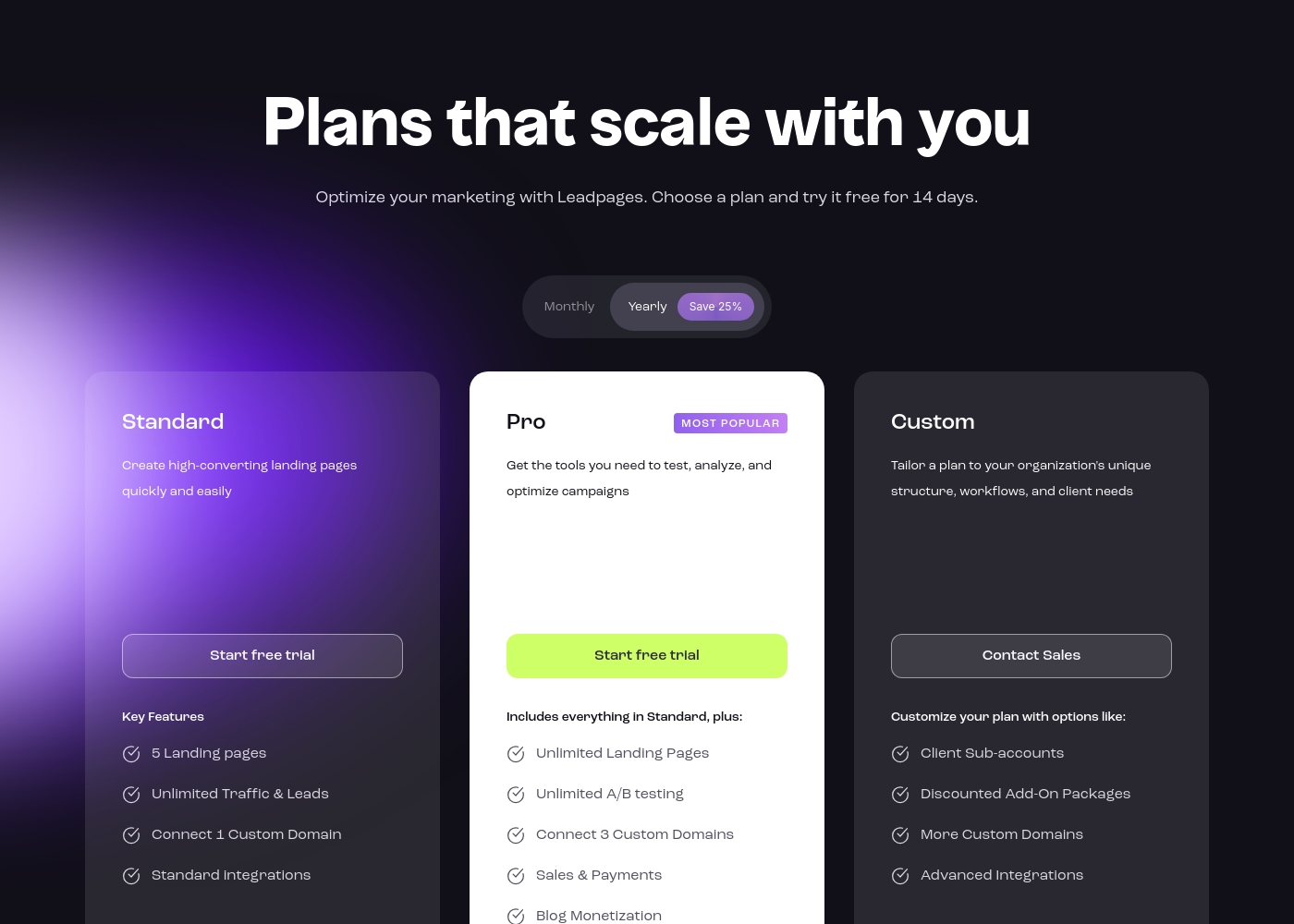
Leadpages costs between $37 and $74 per month (billed annually) with three plans: Standard at $37/month, Pro at $74/month, and Custom (Contact Sales).
The pricing structure is designed to be friendly and flexible, offering significant savings of 25% if you commit to annual billing. Here is a straightforward breakdown of what each plan includes to help you decide.
- 5 Landing pages
- Unlimited Traffic & Leads
- Connect 1 Custom Domain
- Standard integrations
- Unlimited A/B Testing
- Includes everything in Standard
- Unlimited Landing Pages
- Unlimited A/B testing
- Connect 3 Custom Domains
- Sales & Payments
- Client Sub-accounts
- Discounted Add-On Packages
- More Custom Domains
- Advanced Integrations
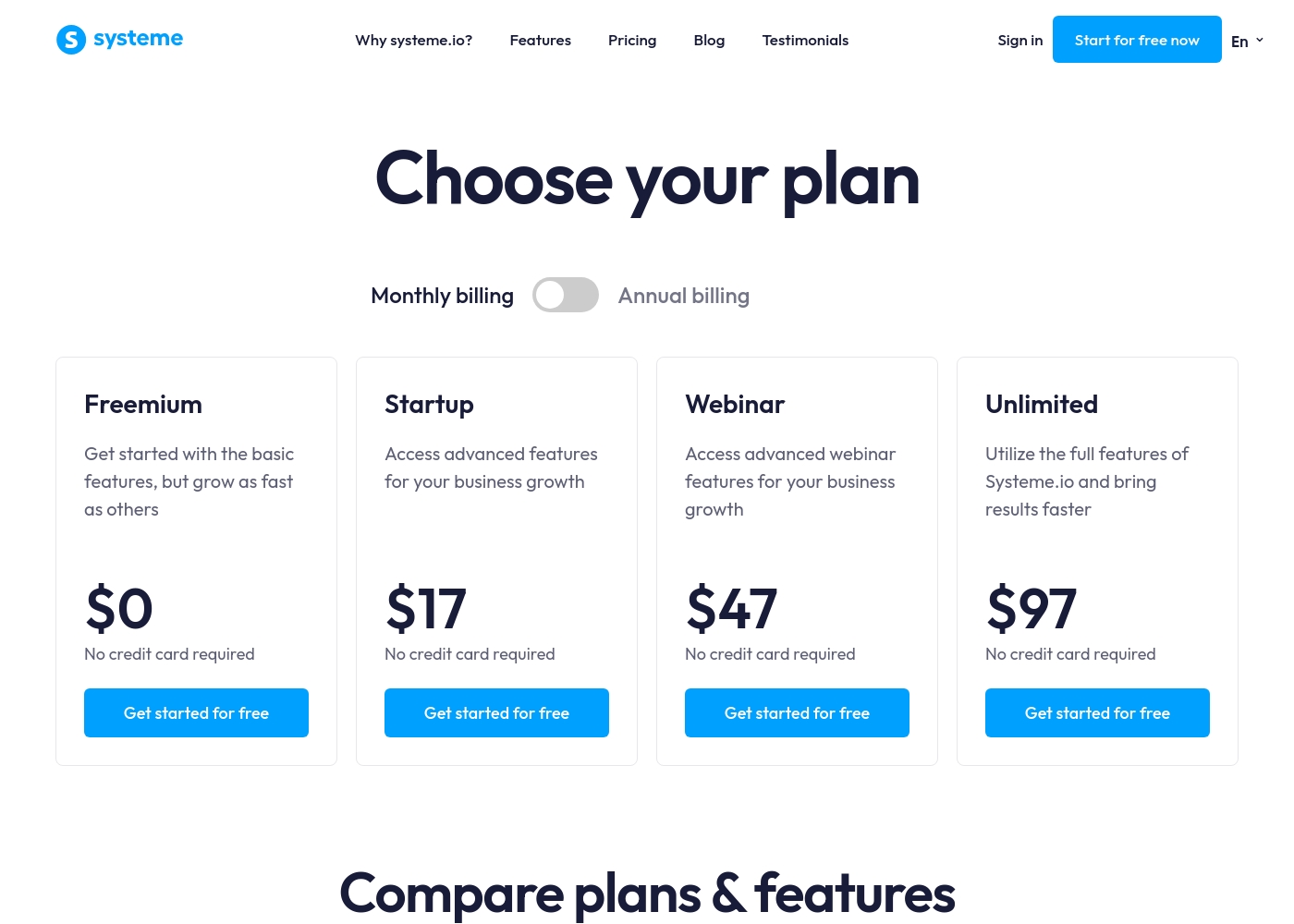
Systeme.io costs between $0 and $97 per month with 4 plans: Freemium at $0, Startup at $17, Webinar at $47, and Unlimited at $97.
Let's break down what each option offers for your business needs.
Freemium
Best For: Users who are getting started with basic features Other Features: No credit card required
- Get started with the basic features
- Access advanced features
- Access advanced webinar features
- Utilize the full features of Systeme.io
Pricing Notes
- Systeme.io provides a permanent, truly free $0 basic plan; Leadpages only offers a 14-day free trial.
- Leadpages heavily discounts prices (up to 25% off) but requires commitment to annual payment for the listed rates.
- Systeme.io is more transparent with monthly rates and removes the credit card requirement for the Freemium plan.
- Leadpages users frequently report unauthorized charges, severe billing issues, and hidden costs.
- Systeme.io's top-tier Unlimited plan at $97/mo bundles features Leadpages can't offer natively, driving excellent overall value.
Pricing Head-to-Head
User Reviews
Leadpages receives severe criticism regarding its billing and subscription management practices, reflected in a low Trustpilot rating. Many users report facing unexpected, high charges, sometimes tripling their annual subscription without proper notification or consent.
The account cancellation process is repeatedly called “shady” and “disgraceful,” with reports that the cancellation button often does not work or that the company continues billing after confirmation. Support responsiveness is a major concern, often described as unhelpful or completely generic.
So far so good. I found the platform to be very user friendly, right from the start. I like the ease of use when building new pages.
Trustpilot reviews consistently praise Systeme.io for being affordable, easy to use, and incredibly supportive. Users highlight the platform’s all-in-one design—CRM, email marketing, funnels, websites, and analytics—being intuitive and reducing setup friction.
The support team is repeatedly described as fast, patient, and thorough, with clear steps and screenshots that help even non-tech users. Customers also report prompt response times, smooth migrations, and useful onboarding resources, including help with domain and DNS setup.
Systeme.io is incredibly affordable and easy to use. It combines CRM, email marketing, websites, funnels, and analytics in one place, saving me time.
Our Verdict
The core choice between Leadpages and Systeme.io is consolidation versus deep conversion optimization. Systeme.io is the clear winner and best choice for almost everyone starting or scaling a business. Leadpages struggles significantly with customer trust, whereas Systeme.io is praised for transparency and value. Leadpages’ superpower lies in its dedicated conversion optimization tools and unlimited A/B testing. If you already have a mature marketing stack, Leadpages helps maximize lead capture. You can quickly deploy high-converting pages and use built-in AI for fast content generation. Systeme.io is an all-in-one game-changer, unifying CRM, email, funnels, and websites natively. You can start completely free with Systeme.io, requiring no financial commitment upfront. Its customer support is stellar, responsive, and consistently praised by users. The deciding factor should be trust and scope. Do you need one tool to manage everything simply? Choose Systeme.io for its comprehensive features and transparent pricing. If you only need a high-end page builder and accept the risk of reported billing issues, Leadpages offers deeper CRO features. Stick with Systeme.io for better long-term value and peace of mind.
Frequently Asked Questions
Can I start using Systeme.io for free, unlike Leadpages?
Yes, absolutely. Systeme.io offers a permanent Freemium plan at $0 per month with no credit card required to start. Leadpages only provides a 14-day free trial before requiring a paid annual commitment.
Which tool is better for marketing teams needing specialized A/B testing?
Leadpages is superior for dedicated conversion optimization and heavy testing. Leadpages provides unlimited A/B testing on paid plans, which is a core feature. Systeme.io includes testing, but Leadpages' focus on CRO is much deeper.
Does Leadpages offer a full CRM like Systeme.io?
No, Leadpages is primarily focused on landing page creation and lead capture. Systeme.io integrates a full CRM, email marketing, and funnels natively. Leadpages must integrate externally with a separate CRM tool.
Which tool is better known for its customer support quality?
Systeme.io wins hands-down for support. Users consistently praise Systeme.io's fast, clear, and patient support team. Leadpages users frequently report unresponsive support and severe difficulty resolving issues.
Are there reported billing issues with Leadpages or Systeme.io?
Leadpages has widespread, severe complaints regarding unauthorized billing and opaque cancellation policies. Systeme.io has transparent pricing, a free plan, and few reported billing conflicts. Systeme.io is considered much more trustworthy.
Is Systeme.io better for consolidating multiple software tools?
Yes, Systeme.io is designed specifically to be an all-in-one platform. It replaces the need for separate email marketing, funnels, and CRM subscriptions. Leadpages works great, but it must be stacked on top of other software.
Ready to Choose?
Both tools have their strengths. Choose based on your specific needs.