Kit (formerly ConvertKit) vs PartnerCentric
This isn't your typical apples-to-apples comparison. Kit is a DIY email platform for creators, while PartnerCentric is a full-service agency for brand performance marketing. Your choice depends entirely on whether you want to build it yourself or hire an expert team.
Best for: Authors and writers building a reader community, Newsletter creators focused on subscriber growth
Best for: E-commerce brands launching an affiliate program, Consumer brands wanting to activate influencers into sellers
Creator-friendly, but check support.
We find Kit a capable and intuitive email marketing platform tailored specifically for creators, offering strong automation and a clean interface. Overall, it's a great starting point for growing an audience, though users should weigh the mixed customer support reviews and potential pricing scale against their needs.
Pros
- Intuitive, clean interface designed for creators and non-technical users.
- Powerful visual automations and sequences to nurture audiences.
- Generous free plan for up to 10,000 subscribers.
- Strong focus on deliverability and building owned audiences.
Cons
- Customer support responsiveness and quality receive frequent criticism.
- Pricing can become steep as subscriber counts increase significantly.
- Some users report unexpected account suspensions or deliverability issues.
- Advanced analytics and collaboration features are limited.
Data-driven, premium performance partner.
We found PartnerCentric to be a specialized, high-touch agency focused on delivering measurable, incremental growth for affiliate and creator programs. Their proprietary FUSE technology and claimed 7x ROAS are compelling, but the lack of public, third-party reviews and transparent pricing means this is best suited for brands with established budgets seeking a dedicated strategic partner. Overall, it's a strong, credible choice for data-focused performance marketing.
Pros
- Specializes in incremental revenue measurement with proprietary FUSE software.
- Claims strong results, including generating over $2 billion in client revenue and a 7x average ROAS.
- Offers end-to-end, transparent management for affiliate and creator programs.
- Focuses on future-proofing with AI visibility audits and strategic oversight.
Cons
- Pricing is completely opaque and custom, requiring a consultation.
- No accessible external user reviews (e.g., Trustpilot, Capterra) were found to verify claims.
- No published free trial, money-back guarantee, or clear cancellation policy.
- May be a complex, resource-heavy solution unsuitable for very small or budget-constrained businesses.
AboutKit (formerly ConvertKit)
Kit is an email marketing platform specifically for creators like authors, podcasters, YouTubers, and entrepreneurs. It's the hub for growing your email list, sending beautiful newsletters, and selling digital products—all while keeping the experience intuitive and straightforward. 💡
AboutPartnerCentric
PartnerCentric is an independent performance marketing agency. They specialize in managing and growing your affiliate, influencer, and creator programs. It's for brands and advertisers who want to turn partnerships into a predictable revenue channel.
Highlights
Feature Comparison
Features Overview
We highlight the main differences and pick a winner for each feature.
User Interface
Kit offers a clean, self-serve dashboard. PartnerCentric provides a managed portal overseen by your agency team.
Kit's interface is consistently praised as intuitive and beginner-friendly. Creators can navigate lists, emails, and automations without a steep learning curve. It's designed for a single user to manage their entire email workflow. PartnerCentric doesn't provide a DIY interface. Instead, you interact with a strategic account manager and receive reports. Their 'interface' is the partnership and the performance data they share with you. The key difference is control. With Kit, you click every button. With PartnerCentric, you direct the strategy while they execute.
Automation
Kit gives you visual tools to build your own automations. PartnerCentric's team builds and runs the entire performance strategy for you.
Kit's visual automation builder lets you create welcome sequences and sales funnels in minutes. You can set up a new subscriber to receive a 5-part welcome series automatically. It's powerful and puts you in control. PartnerCentric's automation is human-led. Their experts use FUSE software to identify and activate the right partners. They handle recruitment, communication, and optimization of the entire program. You're trading DIY tools for a done-for-you service. Kit automates your emails; PartnerCentric automates your entire partner channel.
Reporting & Analytics
Kit tracks email opens and clicks. PartnerCentric focuses on proving which partners drive real, new sales (incrementality).
Kit provides an insights dashboard on its Pro plan. You can track subscriber growth, open rates (avg 40%+), and revenue from product sales. It answers: 'How is my list performing?' PartnerCentric's reporting is their core value. Their FUSE software proves which partners drive *new* customers, not just credit for sales that would happen anyway. They report on true incremental ROAS (average 7x). Kit's data is about your audience. PartnerCentric's data is about proving ROI to your finance team. They measure fundamentally different things.
Customer Support
Kit offers email/chat support, which users report is hit-or-miss. PartnerCentric provides a dedicated strategic account team.
Kit's support is available 24/7 on paid plans via email and chat. However, Trustpilot reviews frequently cite slow response times and unhelpful agents. Some users report issues like account suspensions. PartnerCentric's support model is a dedicated partnership. You get a team of experts managing your program. Support isn't a ticket; it's an ongoing strategic relationship. The difference is proactive vs. reactive. Kit's support fixes problems you encounter. PartnerCentric's team works to prevent them and drive growth proactively.
Pricing Model
Kit has transparent, tiered pricing based on subscribers. PartnerCentric uses custom, performance-based quotes after a free audit.
Kit's pricing is public and scales with your subscriber count. Plans range from $0 (free for 10k subscribers) to $79/month for the Pro plan at 1,000 subscribers. You know the cost upfront. PartnerCentric does not publish prices. Services are custom and likely involve management fees and performance incentives. You must request a free audit and consultation to get a quote. Kit is a predictable SaaS expense. PartnerCentric is a significant, variable investment in a growth engine. The models reflect their different customers: solopreneurs vs. brands.
Integration Ecosystem
Kit connects with 100+ apps like Shopify and Canva. PartnerCentric's integrations are custom and not publicly listed.
Kit has an App Store with over 100 integrations. You can connect to Shopify for e-commerce, Circle for communities, and Canva for design. This helps creators build a connected tech stack. PartnerCentric's integrations are part of their managed service. They would integrate with your existing tracking platforms, commerce systems, and reporting tools. The specifics are tailored to each client. Kit offers a menu of pre-built connections. PartnerCentric builds custom integrations as part of their agency service.
Scalability
Kit scales by adding more subscribers (and cost). PartnerCentric scales by adding more revenue-driving partners to your program.
Kit scales linearly. As your subscriber list grows, your monthly cost increases. The platform handles the volume, but your expense goes up accordingly. It's built for individual creator growth. PartnerCentric scales your revenue. Their model is to find and activate more partners (affiliates, creators) who can drive sales. The FUSE software helps identify high-value partners to expand your channel. Kit scales your audience. PartnerCentric scales your distribution network. They grow different parts of your business.
Value for Money
Kit offers direct value via a self-serve tool. PartnerCentric's value is in proven, incremental revenue growth for brands.
Kit's value is clear: you pay a subscription for powerful email tools. The free plan is generous. It's a great deal if you're a creator who will use the features actively. PartnerCentric's value proposition is ROI. They claim an average 7x return on ad spend. If they deliver, the service pays for itself many times over. The investment is high, but the potential return is higher. Kit is a cost-effective tool. PartnerCentric is a high-investment, high-return performance engine. The 'better' value depends on your business model.
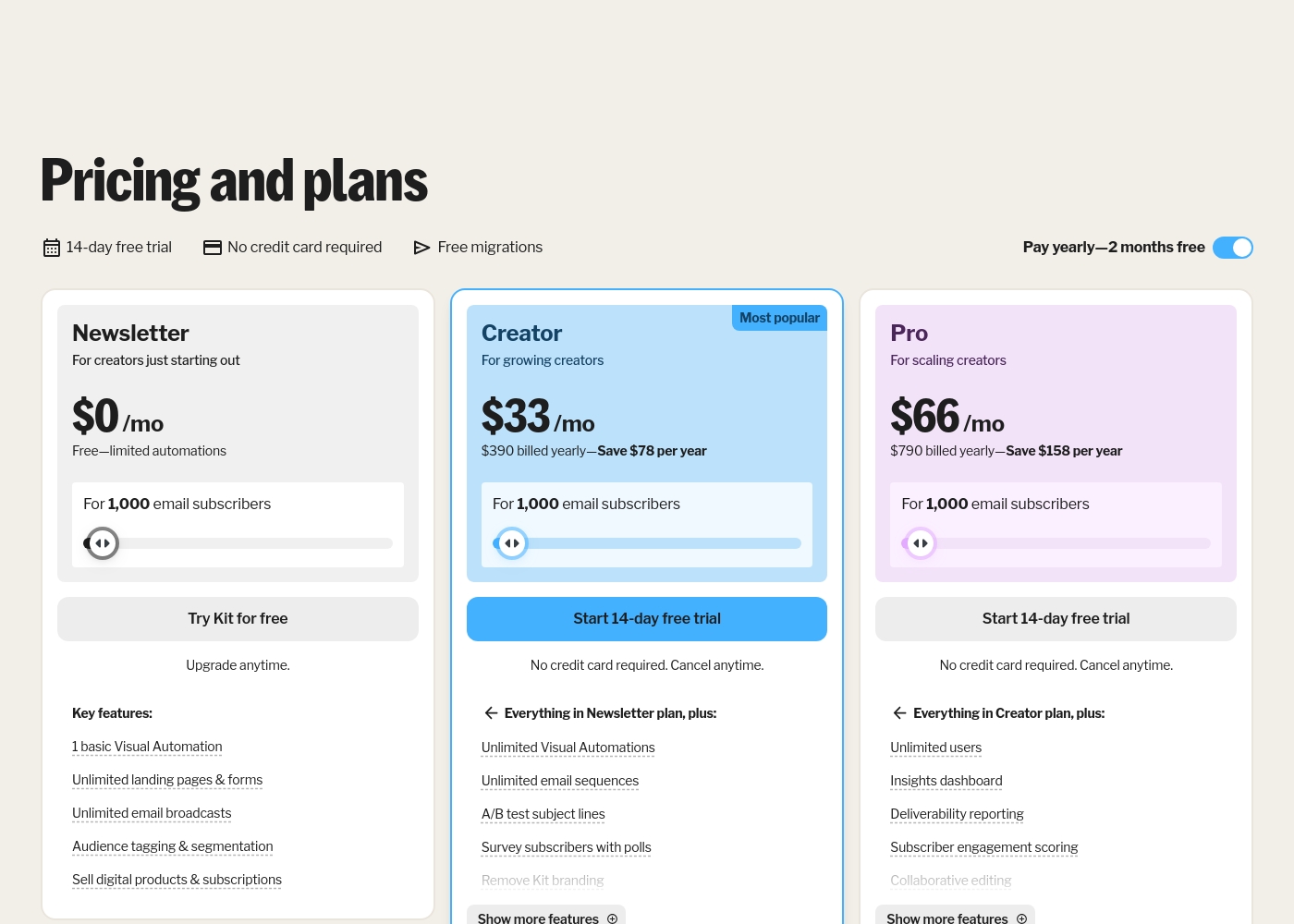
Kit (formerly ConvertKit) costs between $0 and $790 per year for 1,000 subscribers with 3 plans: Newsletter at $0, Creator at $390 billed yearly, and Pro at $790 billed yearly.
Take a look at the breakdown below to see which features fit your current creative goals.
Newsletter
Price: $0 per month Best For: New creators starting out Other Features: Unlimited landing pages, Audience tagging, Digital product sales, 1 basic Visual Automation
- 1 basic Visual Automation
- Unlimited landing pages & forms
- Unlimited email broadcasts
- Audience tagging & segmentation
- Sell digital products & subscriptions
- Everything in Newsletter plan
- Unlimited Visual Automations
- Unlimited email sequences
- A/B test subject lines
- Remove Kit branding
- Everything in Creator plan
- Unlimited users
- Insights dashboard
- Deliverability reporting
- Newsletter referral system
You can explore our service offerings below to see how our expertise and technology drive growth.
Managed Affiliate & Creator Services
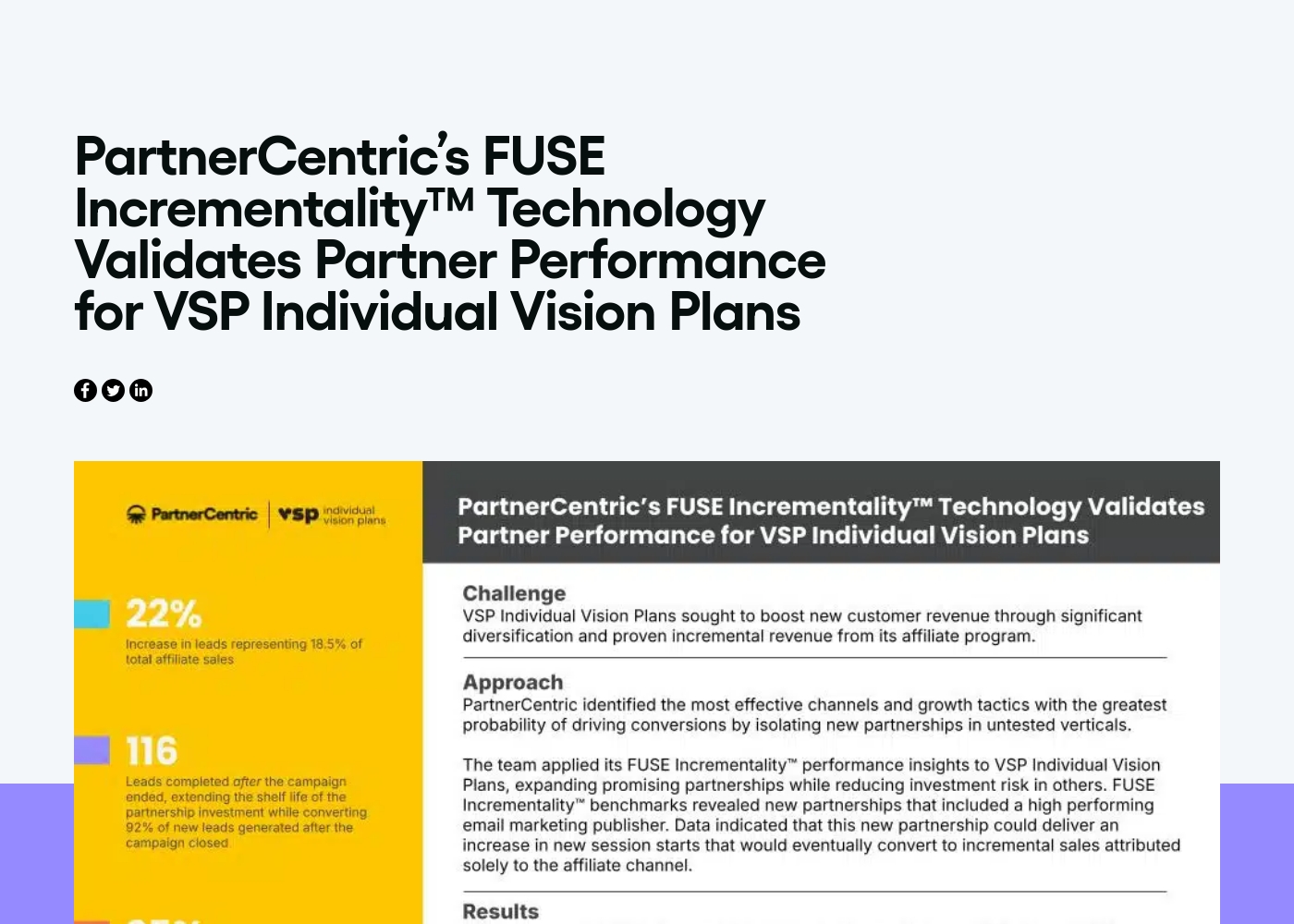
Best For: Brands looking for end-to-end management and data-backed ROI Other Features: FUSE Incrementality™ software, Strategic expert oversight, AI visibility audits, Performance attribution tracking
If you're a powerhouse brand looking to turn your affiliate program into a conversion machine, this is for you. We pair strategic human expertise with proprietary technology to ensure you only pay for true growth. 🚀
- End-to-end program management
- Incremental revenue focus
- Transparent payouts
- Proprietary incrementality software
Pricing Notes
- Kit's free Newsletter plan supports up to 10,000 subscribers with limited automation.
- Kit's paid plans (Creator/Pro) start at $39-$79/month for 1,000 subscribers and scale up.
- PartnerCentric requires a consultation and free audit before providing any pricing details.
- PartnerCentric's model is likely a mix of management fees and performance incentives, not a flat subscription.
- Kit offers a 14-day free trial on paid plans with no credit card required.
Pricing Head-to-Head
User Reviews
On Trustpilot, Kit (formerly ConvertKit) receives mixed feedback. Users frequently praise its ease of use, highlighting a simple, intuitive interface perfect for creators and beginners.
Many appreciate the automation features and clean design for emails and landing pages. However, a significant number of reviews cite poor customer support, with long response times and unhelpful agents.
ConvertKit is super easy to use. I love how simple it is to set up automations and sequences without any tech headaches. It's perfect for my newsletter.
Our research into external reviews for PartnerCentric hit a wall, as the Trustpilot page returned a technical error (403 Forbidden), preventing access to user feedback. The Capterra profile also does not exist or is unavailable.
Consequently, we cannot synthesize a balanced summary of user sentiment from these platforms. We must rely solely on the company's self-reported claims and our own website analysis.
Our Verdict
This is a comparison between a screwdriver and a master carpenter. They're in completely different categories. Kit is your DIY email tool. PartnerCentric is a full-service agency team. Kit's superpower is giving creators control. You build your own email list, automations, and sales funnels. Its visual builder and 100+ integrations let you craft the exact system you need. The free plan for 10,000 subscribers is unbeatable. PartnerCentric's superpower is driving scalable revenue for brands. Their FUSE software proves which partners bring in *new* customers. They claim an average 7x ROAS and have generated over $2 billion in client revenue. That's the kind of scale most creators don't need. The deciding factor is your role. Are you the creator, or are you the brand hiring creators? If you write the newsletters and sell the courses, Kit is for you. If you manage the marketing budget and need to prove ROI to the CMO, PartnerCentric is your partner. Choose Kit (formerly ConvertKit) if you're building an audience business. Choose PartnerCentric if you're scaling a brand's partnership channel. Trying to use PartnerCentric for your newsletter would be like hiring a Formula 1 pit crew to change your car's oil. Just doesn't make sense.
Frequently Asked Questions
Which is better for small teams: Kit (formerly ConvertKit) or PartnerCentric?
Kit is better for small teams. Its Pro plan allows unlimited users, and it's priced for solopreneurs and small creators. PartnerCentric is an agency service aimed at larger brands with bigger budgets and programs.
Can I migrate from Kit (formerly ConvertKit) to PartnerCentric easily?
They serve different purposes, so migration isn't direct. You'd be changing your entire marketing model from DIY email to managed affiliate programs. PartnerCentric discusses transition plans during their onboarding consultation.
Is PartnerCentric worth the extra cost over Kit (formerly ConvertKit)?
This isn't an extra cost—it's a completely different service. Kit is a low-cost tool (~$0-80/month). PartnerCentric is a high-investment agency for brands. The 'value' depends on if you need managed performance marketing.
Does PartnerCentric offer a free trial like Kit (formerly ConvertKit)?
No, PartnerCentric does not offer a free trial. However, they do offer a free audit to assess your current marketing strategy. Kit offers a 14-day free trial on all paid plans.
Which tool has better customer support?
PartnerCentric offers dedicated strategic account management as part of their service. Kit offers 24/7 email and chat support on paid plans, though user reviews on Trustpilot frequently cite slow and unhelpful responses.
What's the main difference in how they track results?
Kit tracks email metrics like opens and clicks. PartnerCentric uses patented FUSE software to track 'incrementality'—proving which partners drive truly new sales that wouldn't have happened otherwise.
Ready to Choose?
Both tools have their strengths. Choose based on your specific needs.