Kafkai vs Rytr
Kafkai and Rytr are AI writing powerhouses, but they serve different masters. Kafkai focuses intensely on deep SEO strategy and competitor insights. Rytr delivers fast, ultra-affordable short-form content generation for volume. Choose wisely based on your content length and goals.
Best for: Marketing agencies handling high-volume SEO for multiple clients, Startups needing validated content roadmaps to rank quickly
Best for: Freelancers needing unlimited, affordable short-form content generation, Marketers producing high volumes of social media copy and ad variations
SEO Content Engine for Speed
Kafkai delivers specialized AI content that is deeply integrated with competitor SEO insights, which significantly speeds up production. We found that the core generation is effective, provided users stay within trained topics. Overall, Kafkai is a powerful tool for high-volume SEO content generation, though its user account management systems need significant refinement.
Pros
- Saves users a significant amount of time in content production.
- Rapidly increases content output rate (up to 4x increase reported).
- Generates original articles that require minimal post-editing.
- Considered well-priced for high-volume content demands.
Cons
- Article quality is highly variable outside of established niches.
- Recurring issues with login failures and accessing the service.
- Subscription management and cancellation process is frequently criticized.
- Some users experience unexpected charges during the free trial period.
Fast, Affordable AI Writing Power.
We found Rytr delivers exceptional speed and value, living up to its reputation as an effective short-form content tool for reducing time-consuming tasks. It helps users efficiently tackle repetitive tasks like emails and product descriptions. Overall, Rytr offers a highly usable, low-cost solution, but we caution users regarding the widely reported lack of responsive customer support and difficult billing practices.
Pros
- Generates non-plagiarized content quickly.
- Highly effective for fast, short-form content creation.
- Extremely affordable pricing, including a generous free plan.
- Intuitive interface is praised for simplicity and ease of use.
Cons
- Customer service is frequently reported as unhelpful and dismissive.
- Users report difficulty canceling subscriptions and securing refunds.
- Content quality can be generic or low quality for longer-form writing.
- Some outputs may repeat phrasing.
AboutKafkai
Kafkai is an AI-powered strategic tool designed for anyone serious about improving their search visibility. It’s built to automate the heavy lifting of complex SEO research.
This platform doesn't just write; it uses advanced keyword analysis and insights gleaned from real-world competitor data to build proven content strategies. You provide direction, and the tool suggests keywords, titles, and outlines for compelling content creation. Kafkai handles the optimization structure, allowing you to focus on adding your necessary expertise. 🤖
AboutRytr
Rytr is a powerful AI writing assistant designed specifically for short-form content. It serves as your essential shortcut to creating original, high-quality material.
Over 8 million copywriters, marketers, and entrepreneurs trust this tool every day. You're joining a trusted community with a high 4.9/5 satisfaction rating.
The tool works wherever you do, thanks to the helpful Chrome Extension that installs easily. It's designed to make professional content creation simple and accessible to everyone.
Highlights
Feature Comparison
Features Overview
We highlight the main differences and pick a winner for each feature.
SEO Strategy
Kafkai is a strategic SEO tool; Rytr offers functional, basic SEO templates.
Kafkai acts as an SEO content strategizer first, focusing on serious competitive analysis. It uses Correlate Strategy tools to guide deep keyword clustering and topics. Kafkai delivers expertly structured article outlines specifically optimized for ranking. Rytr offers specific SEO tools like generators for Meta Titles and Descriptions. Its SEO assistance is template-based for convenience and speed. Rytr does not integrate deep competitor market research or strategic planning. The core difference is strategy versus template usage. Kafkai automates strategic research based on market reality, which is its primary function. Rytr requires the user to input the strategy before using its output templates. If generating content that actively competes in dense SEO fields is crucial, Kafkai is the necessary choice.
Pricing & Limits
Rytr offers unlimited words; Kafkai strictly caps monthly article quotas.
Kafkai uses fixed article quotas on all plans, topping out at 300 monthly articles. This quota model is clearly defined but limits high-volume usage. Kafkai's plans start at €19 monthly. Rytr provides true unlimited generation on its paid Unlimited and Premium plans. This scalability is excellent for users who need massive, continuous output. Rytr starts at a very aggressive $9 monthly. The contrasting pricing models are the deciding factor here. Kafkai charges for specialized strategic articles, priced higher per piece. Rytr provides endless text generation for a low monthly fee. Users who prioritize budget and raw word volume will find Rytr offers far superior value for money and scalability.
Content Length Focus
Kafkai specializes in long-form drafts; Rytr excels exceptionally at short copy.
Kafkai is optimized for generating full SEO-optimized articles, focusing on structure and length. It targets agencies needing high-quality, long-form content drafts quickly. Kafkai drastically reduces the time spent on initial research and outlining. Rytr is celebrated for its incredible speed with short-form content like ad copy, social posts, and product descriptions. It is highly efficient for smaller tasks. Users frequently report Rytr's long-form content output can require extensive rewriting. These tools target opposite ends of the content spectrum. If your output is mainly 1500+ word articles, Kafkai is purpose-built for that structure. If you need 50 headlines daily, Rytr is the clear winner. Both tools solve specific speed needs, but for very different types of content production goals.
Workflow Integration
Rytr works anywhere with its Chrome Extension; Kafkai relies on its portal.
Kafkai guides users rigidly through its strategic web portal and internal workflow. You must follow the steps of competitor setup and strategy selection first. There is no mention of a browser extension for Kafkai. Rytr provides a seamless Chrome Extension installed right into your browser. This tool enables users to generate content quickly in Google Docs, CMS platforms, or any writing box. The extension promotes high productivity. Accessibility is key here. Rytr’s extension means you never have to leave your current application to access the AI assistant. Kafkai requires dedicated time within its platform to run the strategic analysis first. For creators wanting maximum flexibility and on-the-go content generation, Rytr provides the best integration experience.
Customization & Voice
Rytr customizes specific tones; Kafkai customizes article structure using data.
Kafkai's customization focuses on input strategy and structure based on competitor data. It generates an optimized outline based on market reality. You then customize the final article for crucial E-E-A-T. Rytr allows users to create multiple custom tones by analyzing existing writing samples. This ensures the generated copy consistently matches your specific brand voice. Tone customization drastically reduces editing time. Rytr is clearly superior for brand voice and linguistic flexibility with 40+ language options. Kafkai's flexibility lies in strategic direction, not linguistic output style. Freelancers managing multiple distinct brands or international clients benefit immediately from Rytr's tone matching features on the Premium plan.
User Experience Reliability
Both tools face heavy user criticism regarding confusing account management.
Kafkai users report strong core content quality but frequently encounter login failures and administrative hiccups. The subscription management and cancellation process is a persistent criticism. Users sometimes report unexpected charges during the trial. Rytr users praise the tool's core functionality but often criticize its customer service as dismissive. Billing problems and extreme difficulty canceling subscriptions are recurring issues. It seems both companies struggle with their backend systems and support responsiveness. This technical friction affects the overall user experience significantly for both Kafkai and Rytr. Potential users need to approach both subscriptions cautiously, knowing cancellation attempts might prove frustrating depending on the service level.
Kafkai costs between €19 and €199 per month with 4 plans: Starter at €19, Growth at €49, Pro at €99, and Agency at €199.
Here is a breakdown of what each subscription level offers.
Starter
Price: €19 /month Websites Supported: 1 project Best For: Small projects or individuals just starting SEO content generation Other Features: 10 Monthly Articles, 1 Competitor, Up to 400 Keywords, Correlate Strategy Not Included, Automatic Source Citations Not Included
- 1 Project
- 1 Competitor
- Up to 400 Keywords
- 1 Project
- 3 Competitors
- Up to 2400 Keywords
- 100 monthly Correlate searches
- Automatic Source Citations
- 3 Projects
- 3 Competitors
- Up to 3600 Keywords
- 300 monthly Correlate searches
- Automatic Source Citations
- 5 Projects
- 5 Competitors
- Up to 6000 Keywords
- 500 monthly Correlate searches
- Automatic Source Citations

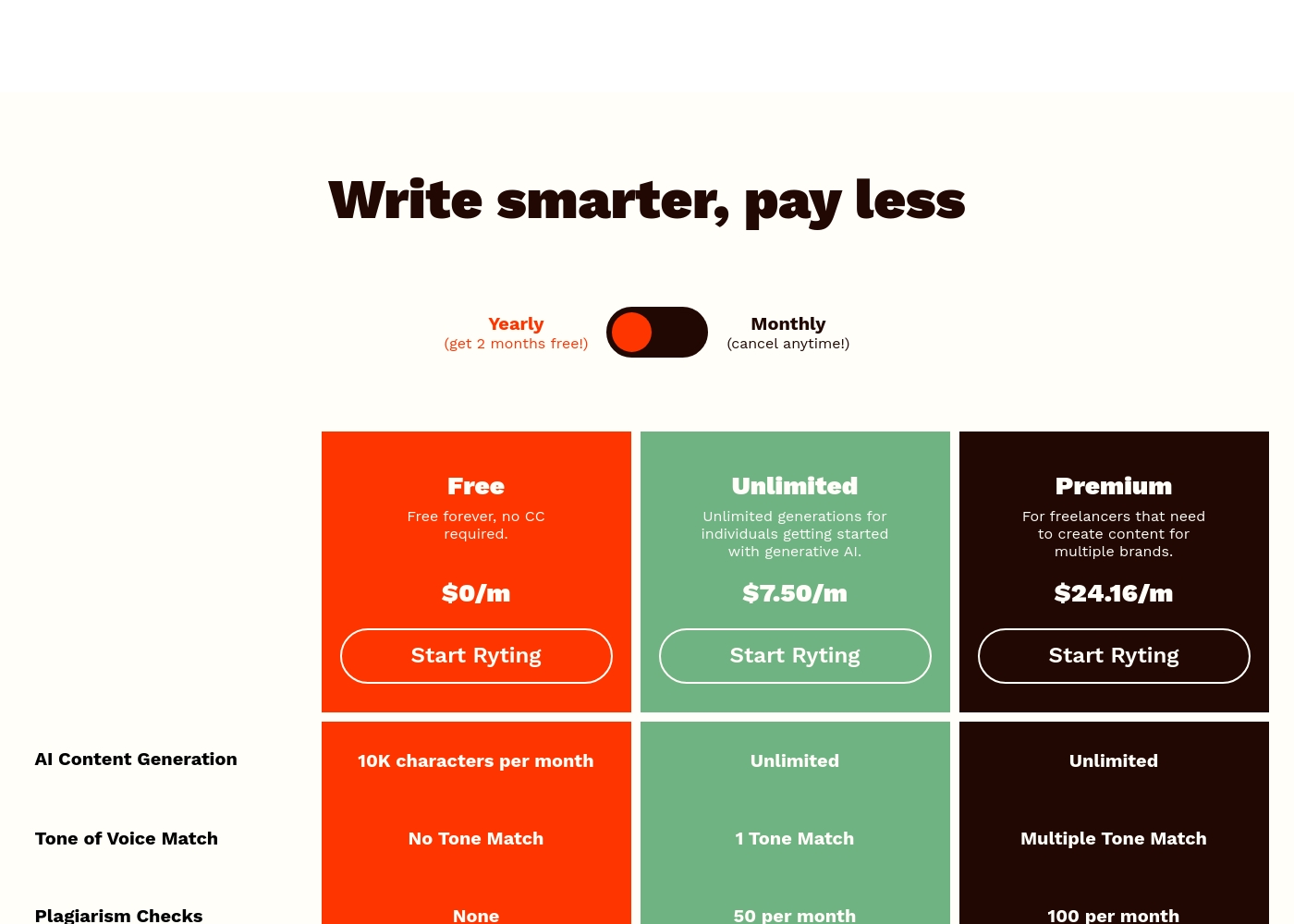
Rytr costs between $0 and $24.16 per month with 3 plans: Free at $0/m, Unlimited at $7.50/m, and Premium at $24.16/m (when billed annually).
Let's explore what each plan offers so you can pick the best fit for your needs.
Free
Price: $0/m Other Features: 10K characters per month, Access 40+ use-cases, Write in 20+ tones, Chrome extension
- 10K characters per month
- No Tone Match
- None plagiarism checks
- Access 40+ use-cases
- Write in 20+ tones
- Unlimited generations
- 1 Tone Match
- 50 plagiarism checks per month
- Access 40+ use-cases
- Write in 20+ tones
- Unlimited generations
- Multiple Tone Match
- 100 plagiarism checks per month
- Write in 40+ languages
- Increased character input limits
Pricing Notes
- Rytr offers a permanent Free plan, while Kafkai provides a 3-article trial project.
- Rytr paid plans offer true unlimited generation; Kafkai caps article production at 300 monthly.
- Rytr's Premium plan ($29/month) is substantially cheaper than Kafkai's first paid tier (€19/month).
- Rytr provides a 20% discount for annual commitment; Kafkai details monthly pricing only.
Pricing Head-to-Head
User Reviews
Kafkai holds a moderate 3.5-star rating on Trustpilot, driven primarily by strong efficiency benefits mixed with notable administrative concerns. Users consistently report that Kafkai is extremely effective at boosting content production speed, sometimes quadrupling output.
This provides excellent value for those needing high volumes of articles quickly. The generated content is often praised as original and requiring only minimal editing.
I love the tool and use it with my content teams for all projects. It's solid and has helped us increase our production rate by 4x. This is a massive time saver for our SEO workflow.
Rytr maintains a strong 4.5-star rating across thousands of Trustpilot reviews, highlighting its powerful utility as a speedy AI writing assistant. Users widely praise the tool for its ease of use, affordable pricing, and capability to produce high-quality, accurate content quickly, especially for short-form needs like social media posts and emails.
Many consider it a "godsend" for overcoming writer's block and managing daily content demands. Value is a key strength, with the free and low-cost tiers appealing greatly to individuals and freelancers.
Rytr transformed how I approach writing. Juggling multiple roles means I need quick, high-quality content, and Rytr delivers every time. The interface is intuitive, and the variety of tones makes it incredibly versatile. It's like my permanent copywriter on standby.
Our Verdict
Choosing between Kafkai and Rytr boils down to depth versus affordability. Do you need deep strategy baked into every article, or just sheer, affordable speed? For most users maximizing content volume without complex SEO strategy, Rytr is the immediate winner. Kafkai is highly specialized for serious SEO professionals. Kafkai’s superpower is its strategic SEO engine, not just basic writing. Kafkai uses Correlate and competitor data to guide keyword selection and structural optimization. If you need 100+ research-backed articles monthly for multiple client projects, Kafkai provides the strategic blueprint. Kafkai successfully prevents you from wasting time writing content that won't rank. Rytr dominates in affordability and unlimited, short-form generation capacity. Starting at just $9 monthly, Rytr offers true unlimited character generation for endless copy. Rytr is the best choice for fast copy such as ads, emails, and social media posts. The Rytr Chrome extension lets you access powerful tools anywhere you write. The key differentiator is the pricing and content type focus. Kafkai charges per strategy-backed article and focuses on long drafts. Rytr gives you unlimited words for short, high-velocity content needs. You must compare Kafkai's rigid article quota to Rytr's boundless, low-cost creativity. Choose Kafkai if strategic SEO ranking success is your absolute top priority and you manage high-level client projects. Choose Rytr if you are a freelancer or small business needing endless, fast copy without spending top dollar, using the unlimited plan.
Frequently Asked Questions
Which is better for SEO optimization: Kafkai or Rytr?
Kafkai is built specifically for strategic SEO optimization and competitor research. It uses market data and Correlate Strategy to generate ranking outlines. Rytr only offers basic SEO generators like meta descriptions and titles.
Which software offers unlimited content generation, Kafkai or Rytr?
Rytr offers true unlimited character generation on its paid Unlimited plan starting at $9/month. Kafkai uses a fixed quota model, capping output at 300 articles monthly even on its highest tier.
Is Rytr worth the extra cost compared to Kafkai?
Rytr is actually significantly more affordable than Kafkai. Rytr's highest Premium plan costs $29/month, while Kafkai's entry-level paid plan starts around $20. Kafkai’s higher price reflects its specialized SEO strategic features.
Can I use Kafkai or Rytr while writing outside their app?
You can use Rytr anywhere thanks to its productive Chrome Extension for instant content generation. Kafkai currently requires you to use its dedicated web portal for its strategic workflow.
Which tool is better for high-volume content agencies?
Kafkai’s Agency plan supports five projects and includes strategic competitor research for client SEO. Rytr favors affordability and volume but lacks the built-in multi-project capacity and strategic depth of Kafkai.
Does Rytr include integrated tools like the competitor tracking Kafkai provides?
No, Rytr does not feature the deep strategic competitor tracking found in Kafkai. Kafkai allows you to monitor up to five rivals and use the data to inform your content strategy.
Ready to Choose?
Both tools have their strengths. Choose based on your specific needs.