Kafkai vs Reword
Kafkai and Reword both promise great AI content, but they target very different content goals. Kafkai prioritizes rapid speed and deep SEO strategy using competitor research. Reword focuses on brand fidelity and team collaboration via a custom trained AI. This comparison separates reliable high-volume scaling from specialized, high-credibility content production.
Best for: SEO agencies focused on high-volume production speed, Startups needing rapid, defensively structured SEO content
Best for: Large publishing houses needing unlimited drafts (with extreme caution), Teams requiring highly customized brand voice consistency
SEO Content Engine for Speed
Kafkai delivers specialized AI content that is deeply integrated with competitor SEO insights, which significantly speeds up production. We found that the core generation is effective, provided users stay within trained topics. Overall, Kafkai is a powerful tool for high-volume SEO content generation, though its user account management systems need significant refinement.
Pros
- Saves users a significant amount of time in content production.
- Rapidly increases content output rate (up to 4x increase reported).
- Generates original articles that require minimal post-editing.
- Considered well-priced for high-volume content demands.
Cons
- Article quality is highly variable outside of established niches.
- Recurring issues with login failures and accessing the service.
- Subscription management and cancellation process is frequently criticized.
- Some users experience unexpected charges during the free trial period.
Avoid Until Business Practices Change
We observe Reword offers robust features like custom AI training and unlimited usage plans, but these are overshadowed by severe customer complaints. Feedback universally reports a complete inability to cancel subscriptions, unresponsive customer service, and continuous unauthorized billing. Overall, we cannot recommend Reword due to documented evidence of highly unethical business and billing practices.
Pros
- Trainable custom AI Cowriter to match brand voice and style
- PRO plan offers unlimited drafts, projects, and users
- Designed for collaborative team use
- Features supporting article citations and enhanced credibility
Cons
- No visible or functioning method to cancel subscriptions
- Customer support is unresponsive and non-existent
- Users report continuous unauthorized monthly billing post-cancellation
- Service quality is viewed as subpar or generic compared to cheaper alternatives
AboutKafkai
Kafkai is an AI-powered strategic tool designed for anyone serious about improving their search visibility. It’s built to automate the heavy lifting of complex SEO research.
This platform doesn't just write; it uses advanced keyword analysis and insights gleaned from real-world competitor data to build proven content strategies. You provide direction, and the tool suggests keywords, titles, and outlines for compelling content creation. Kafkai handles the optimization structure, allowing you to focus on adding your necessary expertise. 🤖
AboutReword
Reword is built as a dedicated AI assistant and Cowriter that works alongside your current team. This platform embraces clever collaborative AI to fundamentally change how you approach content creation.
You aren't just using a generic tool, though. You can quickly start training your own AI assistant tailored to your needs.
This focus on collaboration and personalized training means you can consistently produce high-quality content. It’s an effective way to assure that every one of your articles connects deeply with your dedicated readers.
Highlights
Feature Comparison
Features Overview
We highlight the main differences and pick a winner for each feature.
SEO Strategy
Kafkai is a data-driven SEO engine; Reword focuses more on writing quality and voice.
Kafkai automates complex SEO research using real competitor tracking data. It offers the Correlate feature for identifying high-impact keyword clusters easily. Reword provides topic ideation and research within its platform. However, Reword lacks the deep, integrated competitive SEO strategy that Kafkai provides. If ranking quickly is the goal, Kafkai’s market-driven approach is superior. Kafkai wins for external market strategy; Reword focuses on internal voice consistency.
Brand Voice Training
Reword excels at customizing AI tone; Kafkai provides quick optimized outlines.
Reword allows users to train a custom AI Cowriter on their existing successful content. This training ensures content maintains consistency across multiple drafts and authors. Kafkai focuses on generating SEO-optimized drafts quickly (under five minutes). Kafkai's output requires more post-generation customization for unique voice. Reword is perfect for maintaining strict, organization-wide brand guidelines easily. Use Reword to automate consistency; use Kafkai to automate strategy.
Article Volume
Reword offers truly unlimited volume; Kafkai provides fixed, predictable quotas.
Kafkai scales with fixed article quotas, maxing out at 300 Monthly Articles. This predictable volume management is excellent for budgeting specific needs. Reword offers a PRO plan which removes all constraints: unlimited drafts and projects. Reword is superior for companies requiring truly massive, unconstrained AI usage. Kafkai is better if you require predictable, structured output tied to research.
Integration Ecosystem
Reword connects with major platforms; Kafkai does not list explicit integrations.
Reword integrates directly with platforms like WordPress, Shopify, and GSC. These connections streamline publishing and content analysis workflows. Kafkai does not mention any explicit third-party software integrations on its site. If publishing directly from your writing tool is essential, Reword is the clear choice. Reword’s connectivity supports faster iteration from research to publication.
Pricing Clarity
Kafkai uses fixed, clear pricing; Reword mixes usage-based fees and unlimited tiers.
Kafkai plans are fixed, scaling clearly from 10 to 300 articles monthly (e.g., €19 to €199). This fixed structure makes monthly expense budgeting entirely predictable. Reword’s GROW plan uses variable usage fees if users exceed 10 drafts monthly. Reword’s usage-based model makes budgeting less straightforward on lower plans. Choose Kafkai to avoid unexpected costs related to usage tier jumps.
Financial Reliability
Kafkai is reliable despite flaws; Reword has severe, widespread billing failures.
Kafkai users report recurring issues with login failures and subscription process management. Reword, however, has severe reports of continuous unauthorized billing post-cancellation. Reword users cite non-existent customer support for refund or cancellation requests. Kafkai provides reliable core functionality; Reword seems financially untrustworthy. Choose Kafkai to ensure you can actually stop paying when you choose to stop.
Credibility Tools
Both facilitate sourcing, but Reword streamlines manual verification for users.
Reword helps writers easily add necessary citations directly into their drafts. This focus on verifiable research supports strong article credibility and E-A-T. Kafkai offers Automatic Source Citations starting at its Growth plan (€49/month). Reword makes research checking easier; Kafkai automates the sourcing process. Both tools support better content sourcing, just using slightly different approaches.
AI Models Utilized
Reword utilizes leading models; Kafkai does not specify its underlying technology.
Reword leverages multiple advanced foundation models: GPT-4, Claude, and Gemini. Using these sophisticated models provides robust output quality assurance quickly. Kafkai does not detail which underlying AI models power its generation. Transparency in model usage gives Reword a slight technical edge. Advanced models potentially mean higher quality raw content generation capacity.
Kafkai costs between €19 and €199 per month with 4 plans: Starter at €19, Growth at €49, Pro at €99, and Agency at €199.
Here is a breakdown of what each subscription level offers.
Starter
Price: €19 /month Websites Supported: 1 project Best For: Small projects or individuals just starting SEO content generation Other Features: 10 Monthly Articles, 1 Competitor, Up to 400 Keywords, Correlate Strategy Not Included, Automatic Source Citations Not Included
- 1 Project
- 1 Competitor
- Up to 400 Keywords
- 1 Project
- 3 Competitors
- Up to 2400 Keywords
- 100 monthly Correlate searches
- Automatic Source Citations
- 3 Projects
- 3 Competitors
- Up to 3600 Keywords
- 300 monthly Correlate searches
- Automatic Source Citations
- 5 Projects
- 5 Competitors
- Up to 6000 Keywords
- 500 monthly Correlate searches
- Automatic Source Citations

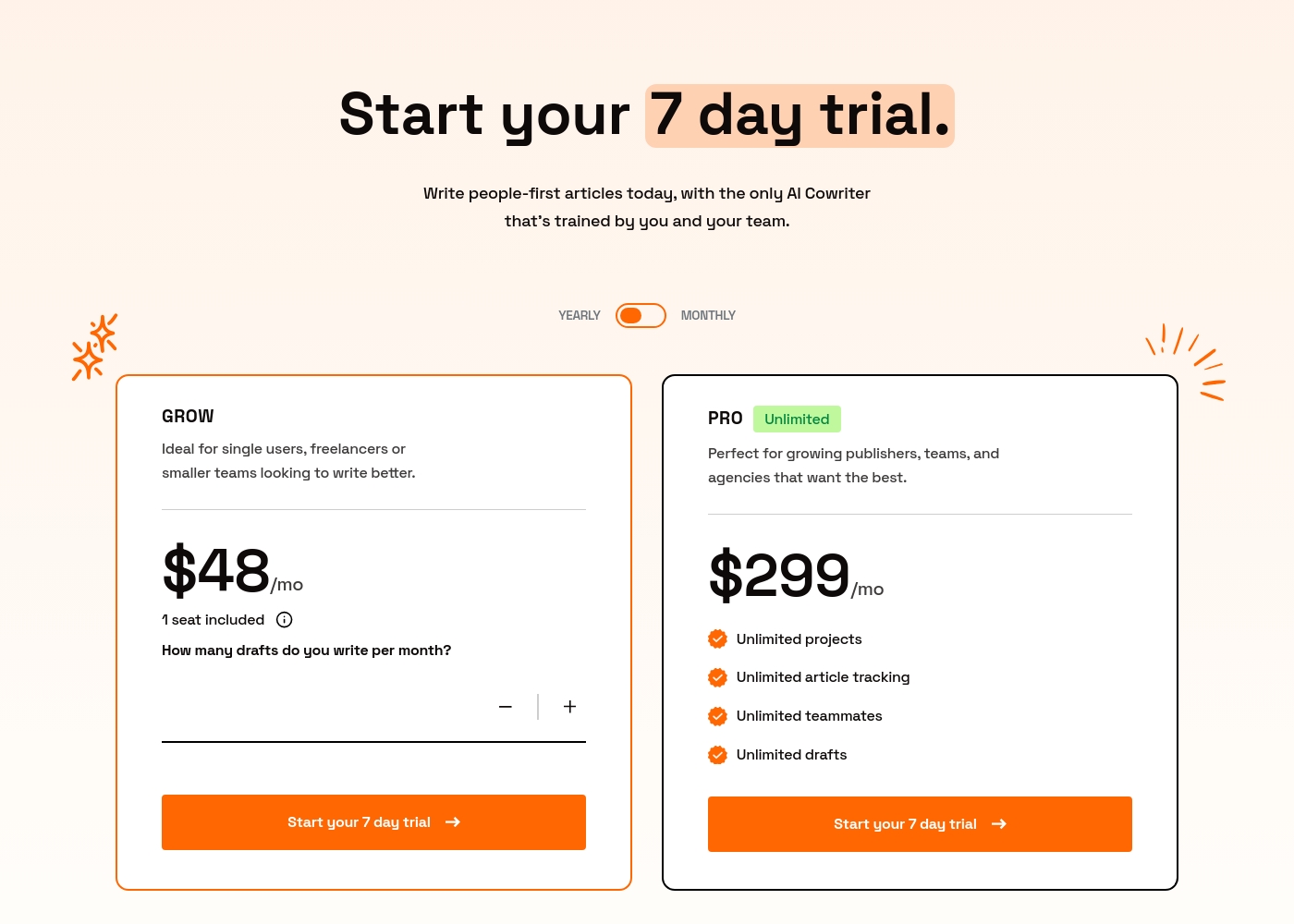
Reword costs between $48 and $359 per month with two primary plans: GROW at $48/month (billed yearly) and PRO at $299/month (billed yearly).
Let's explore what each subscription tier offers so you can find the perfect fit for your content needs.
GROW
Price: $48/month (billed annually) or $60/month (billed monthly) Best For: Single users, freelancers, or smaller teams Refund Policy: 14-day money-back guarantee on inactive accounts Other Features:
- 1 seat included
- Usage-based draft scaling (0-10 drafts free, costs increase up to $105 extra for 71–80 drafts)
- Up to 3 projects, Custom-trained voices
- AI assistance powered by GPT-4, Claude, and Gemini
- 1 seat included (Additional seats $30 or $15/month, depending on context)
- Usage-based draft scaling (0-10 included, costs increase beyond that)
- Up to 3 projects
- Custom-trained voices
- Unlimited projects
- Unlimited article tracking
- Unlimited teammates
- Unlimited drafts
- Unlimited published article tracking
Pricing Notes
- Kafkai uses predictable, fixed article quotas ranging from 10 to 300 per month.
- Reword’s GROW plan can incur incremental usage fees if production exceeds 10 drafts monthly.
- Reword offers a PRO plan with truly unlimited usage for drafts, projects, and teammates.
- Kafkai’s €19 Starter plan is highly competitive for low-volume, research-focused SEO content.
- Reword offers a 20% discount if the user commits to annual billing.
Pricing Head-to-Head
User Reviews
Kafkai holds a moderate 3.5-star rating on Trustpilot, driven primarily by strong efficiency benefits mixed with notable administrative concerns. Users consistently report that Kafkai is extremely effective at boosting content production speed, sometimes quadrupling output.
This provides excellent value for those needing high volumes of articles quickly. The generated content is often praised as original and requiring only minimal editing.
I love the tool and use it with my content teams for all projects. It's solid and has helped us increase our production rate by 4x. This is a massive time saver for our SEO workflow.
The external feedback for Reword is overwhelmingly negative, centering on critical billing, cancellation, and customer support issues. With a 2.3/5 TrustScore from limited reviews, the consistent and severe theme is the complete inability to cancel the service.
Multiple users reported being charged $50–$60 monthly even after attempting to cancel, deleting payment methods, or trying to halt the subscription via email for months. Customer service is cited as terrible; users receive no reply or resolution regarding charges or cancellation requests.
I tried to cancel my trial by emailing support, but they never responded and billed me anyway. There is no way to cancel on the website, forcing me to dispute the charge with my bank. Avoid this company at all costs.
Our Verdict
The decision between Kafkai and Reword is fundamentally about reliability versus risk. Kafkai is the established, trustworthy choice despite its minor admin hiccups. Reword's documented customer complaints about unauthorized, continuous billing are a huge red flag. You should only consider Kafkai if you value financial security and dependable service. Kafkai’s superpower is making volume content rank using strategic SEO research. It analyzes up to five competitors to build targeted, optimized content outlines quickly. Kafkai is perfect for high-volume agencies, offering predictable, fixed article quotas up to 300/month. This platform provides the essential research required to guarantee successful content planning and execution. Reword shines theoretically by training a custom AI to match your exact brand tone and style. It offers truly unlimited scaling potential for massive organizations on the PRO plan. Reword also focuses on credibility, offering citations and solid integrations like WordPress and Shopify. The deciding factor must be trust, which Reword currently appears to have destroyed with its user base. Kafkai, despite some administrative flaws, allows users to manage their billing effectively. Reword's reported inability to cancel the service makes it a dangerous prospect for investment. Final Verdict: Choose Kafkai if you need reliable, high-volume SEO content driven by cold hard data. Kafkai is trusted by thousands and offers clear, predictable pricing. Avoid Reword until they demonstrably resolve the severe, documented issues concerning billing and subscription management practices.
Frequently Asked Questions
Which tool is better for integrating with WordPress: Kafkai or Reword?
Reword integrates directly with WordPress, Shopify, and Google Search Console. Kafkai does not list any explicit third-party integrations on its site. If publishing directly is essential, Reword is the better choice for integration.
Does Kafkai offer unlimited content generation like Reword's PRO plan?
No, Kafkai uses fixed monthly article quotas, maxing out at 300 articles on the Agency plan. Reword’s PRO plan provides truly unlimited usage for drafts and projects. Reword scales without hard limits, while Kafkai scales predictably.
Which tool is better for deep SEO strategy and real competitor analysis?
Kafkai is highly specialized for SEO and competitor analysis strategy. It offers 5 specific strategic modes using real competitor data tracking for ranking success. Reword focuses more on internal brand consistency rather than external market strategy.
Is Kafkai's Starter plan worth the cost compared to Reword’s entry level?
Kafkai offers predictable article volume and dedicated SEO features starting at €19/month. Reword’s lower plan has complex usage-based fees, making Kafkai superior for clear value. Kafkai is the safer, more reliable entry point.
Which tool supports more languages for content creation?
Reword supports content creation in over 30 languages globally. Kafkai's interface supports English and Japanese, but global language support for content is not explicitly provided. Reword wins for international teams needing multi-language content.
What are the key differences in how Kafkai and Reword price their subscriptions?
Kafkai uses strictly fixed tiers based on article volume and feature access. Reword uses a mix: usage-based fees for GROW and fully unlimited access for PRO. Kafkai offers far cleaner and more predictable monthly budgeting.
Ready to Choose?
Both tools have their strengths. Choose based on your specific needs.