Kafkai vs KoalaWriter
Kafkai and KoalaWriter both aim for SEO domination, but they use different weapons. Kafkai focuses intensely on core strategy and competitor analysis. KoalaWriter provides massive scale and premium AI model access. Decide if you need smart strategy or brute-force volume.
Best for: Content writers managing SEO for up to five clients or brands, Businesses prioritizing strategic competitive intelligence and market mapping
Best for: Large agencies requiring millions of words of AI content monthly, Users who demand access to the latest models like GPT-5 and Claude 4
SEO Content Engine for Speed
Kafkai delivers specialized AI content that is deeply integrated with competitor SEO insights, which significantly speeds up production. We found that the core generation is effective, provided users stay within trained topics. Overall, Kafkai is a powerful tool for high-volume SEO content generation, though its user account management systems need significant refinement.
Pros
- Saves users a significant amount of time in content production.
- Rapidly increases content output rate (up to 4x increase reported).
- Generates original articles that require minimal post-editing.
- Considered well-priced for high-volume content demands.
Cons
- Article quality is highly variable outside of established niches.
- Recurring issues with login failures and accessing the service.
- Subscription management and cancellation process is frequently criticized.
- Some users experience unexpected charges during the free trial period.
Feature-Rich, Highly Polarized, High Risk
KoalaWriter presents an impressively vast feature set, including high-end AI model access and deep SEO tools aimed at maximizing scale. However, external user feedback is critically negative regarding the reliability of the generated content and the company's customer service practices. Overall, we advise potential users to proceed with extreme caution due to concerning allegations spanning quality control failures and core business integrity.
Pros
- Access to advanced models like GPT-5 and Claude 4 is included in base plans.
- Highly scalable pricing tiers support usage from 15,000 up to 10 million words monthly.
- Bundled platform includes KoalaChat and KoalaImages, enhancing overall tool utility.
- Provides crucial SEO features like deep research and automatic internal linking.
Cons
- Multiple severe complaints regarding content quality leaving automated footprints, resulting in Google bans.
- Customer support is frequently described as non-existent, delayed, or unwilling to troubleshoot issues.
- Allegations of aggressive business practices, including threatening customers and canceling paid lifetime subscriptions.
- Integrations, such as with Ghost websites, sometimes fail without effective support intervention.
AboutKafkai
Kafkai is an AI-powered strategic tool designed for anyone serious about improving their search visibility. It’s built to automate the heavy lifting of complex SEO research.
This platform doesn't just write; it uses advanced keyword analysis and insights gleaned from real-world competitor data to build proven content strategies. You provide direction, and the tool suggests keywords, titles, and outlines for compelling content creation. Kafkai handles the optimization structure, allowing you to focus on adding your necessary expertise. 🤖
AboutKoalaWriter
KoalaWriter is presented as the premier tool for creating SEO marketing content using artificial intelligence. It focuses entirely on outputting content ready for search engines. It's a key part of the larger Koala AI ecosystem of content tools. These specialized tools help you create better content. The underlying goal is to make your content creation process dramatically faster and more efficient. ✅
Highlights
Feature Comparison
Features Overview
We highlight the main differences and pick a winner for each feature.
Strategic SEO Focus
Kafkai is built for strategy; KoalaWriter is built for execution speed.
Kafkai uses specialized modes like Correlate Strategy for deep market analysis. It forces you to choose a strategic approach before writing. Kafkai excels at using competitor insights to guide content generation. KoalaWriter focuses on core SEO technical outputs like internal linking and factual data. It provides Deep Research tools on higher tiers, but lacks Kafkai's structured competitor approach. Kafkai’s structured approach ensures your content targets market gaps immediately. KoalaWriter requires more manual strategic direction from the user. For agencies needing a predictable content direction, Kafkai handles the necessary pre-writing market intelligence.
AI Model Access
KoalaWriter uses GPT-5/Claude 4; Kafkai relies on its proprietary models.
Kafkai relies on its proprietary model, promising original articles requiring minimal editing post-generation. Kafkai has generated over 500,000 articles since 2019 using this approach. KoalaWriter bundles access to cutting-edge models like GPT-5 and Claude 4 in all plans. Using KoalaWriter's premium models doubles the word count usage against your monthly quota. KoalaWriter offers clearer visibility into the underlying AI technology used for generation. Kafkai relies on the success of its internal, customized model. If bleeding-edge quality from the latest models is essential, KoalaWriter is the clear choice for access.
Content Volume & Scale
KoalaWriter handles massive scale; Kafkai is limited by articles per month.
Kafkai offers a maximum of 300 monthly articles, suitable for dedicated marketers or small agencies. Kafkai usage is defined by fixed article quotas, suitable for predictable workflows. KoalaWriter scales up to 10 million words per month for huge enterprise operations. KoalaWriter also offers up to 3x faster bulk creation on its top tiers. KoalaWriter is superior for massive operations needing extreme scalability and high-volume delivery. Kafkai is designed for strategic quality over raw numerical volume. Content processors needing millions of words should choose KoalaWriter to meet their intensive output needs.
Platform Integration
KoalaWriter integrates directly with WordPress; Kafkai integrations are unlisted.
Kafkai does not explicitly list integrations with platforms like WordPress or Shopify on its website. Kafkai focuses intensely on the article generation phase. KoalaWriter provides one-click publishing via WordPress and Ghost, plus API access. KoalaWriter also includes webhook support for seamless workflow automation. Seamless API and CMS integration make KoalaWriter much easier to deploy in large environments. Kafkai requires more manual effort to transfer published content. Agencies automating publishing workflows will find KoalaWriter’s native integrations highly valuable.
Auxiliary Tools
KoalaWriter bundles a chat and image generator; Kafkai does not mention extras.
Kafkai is highly specialized, presenting primarily as a strategic research and content generation tool. No ancillary features like chat or image generation are noted in the plans. KoalaWriter bundles KoalaChat and KoalaImages into all subscriptions for enhanced utility. Professional tiers also unlock KoalaLinks and KoalaMagnets. KoalaWriter provides a complete, integrated AI platform for many content tasks beyond just writing. Kafkai is focused purely on the strategic writing output. If you are looking for an all-in-one content creation suite, KoalaWriter offers dramatically more utility tools.
Customer Support Risk
Kafkai has better reported support; KoalaWriter users report non-existent support.
Kafkai users often criticize billing and account management friction, but resolutions are usually reported. Kafkai holds a fair rating despite these frustrating operational issues. KoalaWriter's 2.7-star rating is heavily dragged down by constant support complaints in reviews. Multiple users claim support is delayed, non-existent, or actively unhelpful. Kafkai's support might be slow but it addresses issues like sudden charges or cancellations. KoalaWriter's lack of support suggests a higher risk of being stuck with problems. If reliable customer service during critical moments is necessary, Kafkai offers a less concerning user experience.
Pricing Structure
Kafkai uses fixed article quotas; KoalaWriter uses flexible word counts.
Kafkai offers four structured tiers from €19 to €199 based on articles and competitor tracking. Its pricing model is predictable based on fixed quotas assigned monthly. KoalaWriter starts cheaper at $9 but has nine tiers up to $2,000 monthly. KoalaWriter's word count system is affected by premium model usage multiplication. Kafkai’s pricing is simpler and remains consistent for fixed article generation. KoalaWriter's word count multiplier adds complexity to usage tracking. Users needing predictable content consumption will prefer Kafkai’s fixed article quotas.
SEO Detail Features
Kafkai offers unique citation features; KoalaWriter offers Amazon data.
Kafkai provides Automatic Source Citations starting at its Growth plan tier. Kafkai integrates real SEO data to guarantee articles are optimized out of the box. KoalaWriter pulls live Amazon data for relevant affiliate articles dynamically. KoalaWriter also features automatic internal linking on plans Professional and higher. Kafkai supports E-E-A-T optimization through its Source Citations feature. KoalaWriter focuses on current data and site structure elements. Affiliate marketers specifically targeting Amazon products will gain an edge using KoalaWriter’s unique data access.
Kafkai costs between €19 and €199 per month with 4 plans: Starter at €19, Growth at €49, Pro at €99, and Agency at €199.
Here is a breakdown of what each subscription level offers.
Starter
Price: €19 /month Websites Supported: 1 project Best For: Small projects or individuals just starting SEO content generation Other Features: 10 Monthly Articles, 1 Competitor, Up to 400 Keywords, Correlate Strategy Not Included, Automatic Source Citations Not Included
- 1 Project
- 1 Competitor
- Up to 400 Keywords
- 1 Project
- 3 Competitors
- Up to 2400 Keywords
- 100 monthly Correlate searches
- Automatic Source Citations
- 3 Projects
- 3 Competitors
- Up to 3600 Keywords
- 300 monthly Correlate searches
- Automatic Source Citations
- 5 Projects
- 5 Competitors
- Up to 6000 Keywords
- 500 monthly Correlate searches
- Automatic Source Citations

KoalaWriter costs between $9 and $2,000 per month with nine plans: Essentials at $9, Professional at $49, Boost at $99, Growth at $179, Elite at $350, Advanced at $500, Scale I at $750, Scale II at $1,250, and Scale III at $2,000.
Selecting the right plan depends mostly on your monthly content volume and chat messaging needs. You can choose monthly billing or save 20% by purchasing an annual subscription.
Essentials
Price: $9 per month Refund Policy: 15-day money-back (Less than 15,000 words/100 messages used) Other Features:
- KoalaWriter: 15,000 words per month
- KoalaChat: 250 messages per month
- Includes GPT-5 and Claude 4
- Real-time factual data and AI-Powered SEO Optimization
- API Access, Google Sheets, WordPress, and webhook integrations
- KoalaChat included
- KoalaImages included
- GPT-5 and Claude 4 support
- AI-Powered SEO Optimization
- Live Amazon data for affiliate articles
- Everything in Essentials
- Automatic internal linking
- Deep Research
- AI-powered editing
- KoalaLinks and KoalaMagnets
- Everything in Professional
- 2x faster bulk article creation
- Everything in Boost
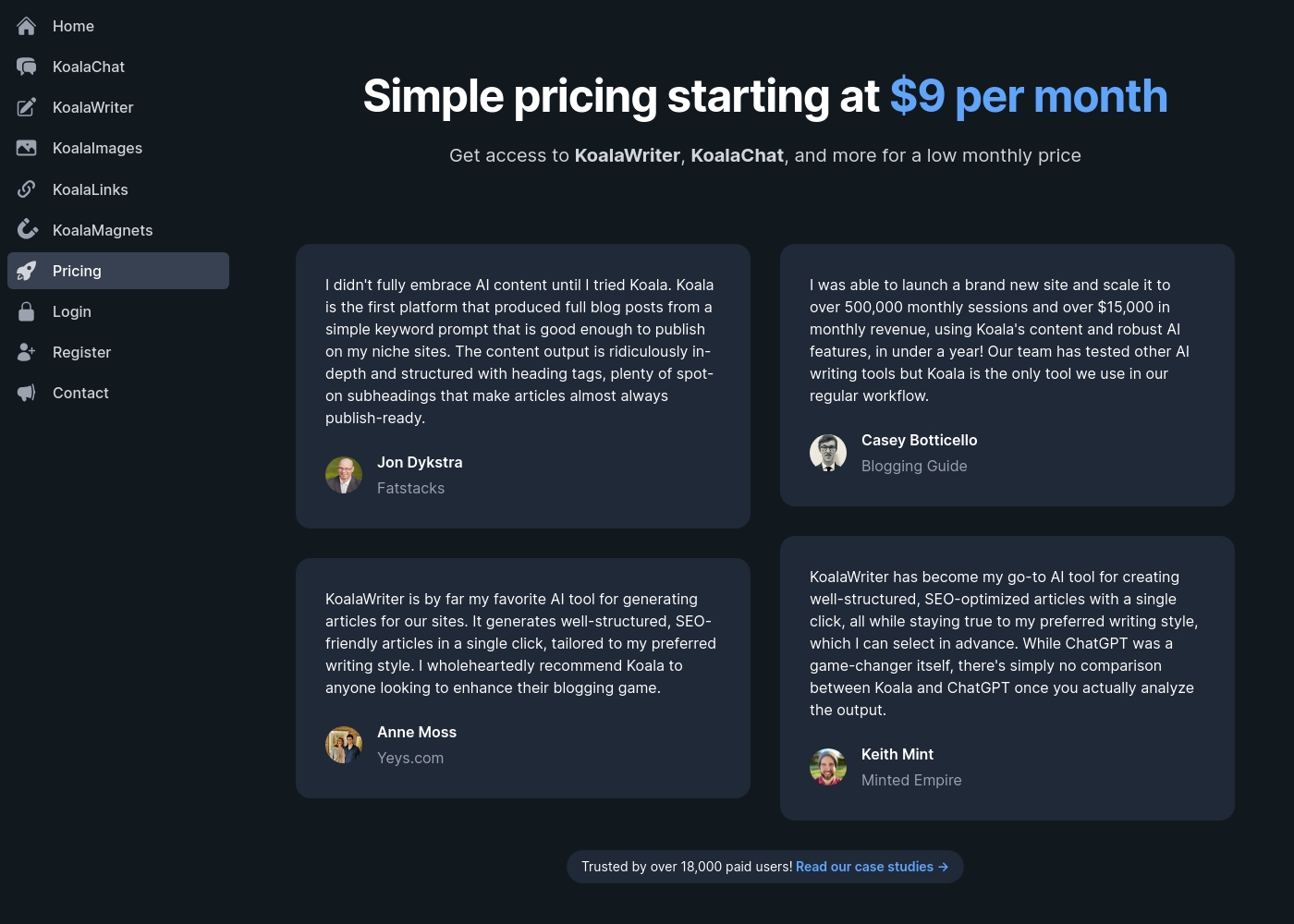
Pricing Notes
- Kafkai is priced in Euros (€), with plans ranging from €19 to €199 based on fixed article quotas.
- KoalaWriter starts lower at $9 but scales dramatically up to $2,000 for maximum volume.
- KoalaWriter offers a significant 20% discount if you opt for yearly prepayment.
- Using premium models (GPT-5/Claude 4) in KoalaWriter doubles the word count deducted from your plan.
- Kafkai's free trial includes 3 articles; KoalaWriter's trial offers 5,000 words and 25 chat messages.
Pricing Head-to-Head
User Reviews
Kafkai holds a moderate 3.5-star rating on Trustpilot, driven primarily by strong efficiency benefits mixed with notable administrative concerns. Users consistently report that Kafkai is extremely effective at boosting content production speed, sometimes quadrupling output.
This provides excellent value for those needing high volumes of articles quickly. The generated content is often praised as original and requiring only minimal editing.
I love the tool and use it with my content teams for all projects. It's solid and has helped us increase our production rate by 4x. This is a massive time saver for our SEO workflow.
KoalaWriter receives extremely polarized feedback on Trustpilot, resulting in a significantly low 2.6 rating overall. While positive users describe it as the “best AI writer” they have tried—praising its versatility, integrated Koala Chat, Koala Images, and automatic SEO features like interlinks—a substantial number of customers raise serious alarm bells 🛑.
Multiple reviewers report that content generated by the tool leaves “obvious footprints of automation,” which they claim directly led to their websites being banned or penalized by Google. Customer support is consistently the biggest pain point, often labeled as “non-existent” or unresponsive; staff allegedly offered refunds rather than troubleshooting complex integration failures.
Koala is definitely the best AI writer I have tried, beating many competitors hands down. It's super versatile, and having Koala Chat and Koala Images bundled in is a game changer for my workflow.
Our Verdict
Choosing between Kafkai and KoalaWriter means deciding on strategy versus brute force scale. For most content teams, Kafkai provides a much safer, more strategic foundation. Kafkai shines as an effective SEO strategy engine; it handles complex market research for you. It uses Correlate and 4Cs modes to map content gaps against competitor performance. Kafkai guides you to the correct, targeted keywords before generating a word. KoalaWriter wins massively on sheer volume and integrated advanced technology. It can deliver up to 10 million words monthly using cutting-edge GPT-5 models. KoalaWriter uniquely bundles tools like KoalaChat, KoalaImages, and direct WordPress publishing. The key differentiator here is critical reliability and user trust, drawn from external reviews. Kafkai maintains a safe rating despite frustrating account management bugs. KoalaWriter raises serious alarms with users alleging Google content penalties and unresponsive support. Choose Kafkai if strategic safety and competitive research are primary requirements. Opt for KoalaWriter only if you require extreme scale and can accept the reported risks.
Frequently Asked Questions
Which is better for small teams: Kafkai or KoalaWriter?
Kafkai is generally better for small teams needing strategic direction and competitive research. Kafkai offers clear, fixed quotas starting at just €19 monthly. KoalaWriter’s value proposition focuses mostly on massive volume and scale.
Does Kafkai integrate with WordPress like KoalaWriter?
No, Kafkai does not explicitly list native integrations like KoalaWriter does. KoalaWriter provides dedicated one-click integrations for platforms like WordPress and Ghost. Kafkai requires manual copy-pasting or custom workflows for publishing.
Is KoalaWriter worth the extra cost over Kafkai?
KoalaWriter is worth the cost only if you need millions of words and the bundled tools. Kafkai provides better value for strategic content up to 300 articles monthly. KoalaWriter's pricing complexity and usage multipliers should be considered carefully.
Which tool is safer based on reported Google penalty risk?
Kafkai is the safer choice based on overwhelmingly negative user reviews for KoalaWriter. Multiple KoalaWriter users report Google penalties due to recognizable automation footprints. Kafkai’s operational issues are less severe than site-breaking risks.
How does Kafkai's competitor tracking compare to KoalaWriter's Deep Research?
Kafkai’s Correlate Strategy actively blends your input with competitor ranking data. This results in targeted content ideas against 5 rivals. KoalaWriter offers Deep Research focused on real-time factual data for accuracy, not rival strategy.
Can I use the latest AI models (like GPT-5) in both Kafkai and KoalaWriter?
KoalaWriter explicitly includes access to GPT-5 and Claude 4 in all its subscription tires. Kafkai utilizes its own proprietary model and does not list access to these advanced, third-party models.
Ready to Choose?
Both tools have their strengths. Choose based on your specific needs.