Insense vs PartnerCentric
Insense and PartnerCentric both help brands harness creator power, but they play in different leagues. Insense is a self-serve platform for scaling UGC campaigns fast. PartnerCentric is a high-touch agency for driving measurable affiliate revenue.
Best for: DTC brands scaling UGC production, Marketing teams needing fast content for ad testing
Best for: Brands building or reviving an affiliate program, Companies needing to prove incremental revenue from partners
High volume access, highly polarized results.
We recognize Insense’s powerful ability to connect brands with a large creator pool and automate essential campaign workflows. However, user feedback suggests that deliverable quality and brand-side support are inconsistent, which diminishes the platform's overall value proposition. Overall, Insense is a specialized tool best suited for experienced buyers willing to tolerate significant risk for high creative throughput.
Pros
- Access to a vetted marketplace of over 70,000 creators across 35 countries.
- Clear, upfront pricing with separate fees for platform access and creator payments.
- Highly efficient campaign speed, with content delivered within 14 days.
- Creators report reliable payments and high offers compared to competitors.
Cons
- Brands report low quality or unusable content, making the services expensive.
- Inconsistent customer support; support is noted as superb for creators but often problematic and unresponsive for brands.
- Mandatory minimum contract periods viewed as a trap if the platform underperforms.
- Users report app glitches and difficulties with account management/logins.
Data-driven, premium performance partner.
We found PartnerCentric to be a specialized, high-touch agency focused on delivering measurable, incremental growth for affiliate and creator programs. Their proprietary FUSE technology and claimed 7x ROAS are compelling, but the lack of public, third-party reviews and transparent pricing means this is best suited for brands with established budgets seeking a dedicated strategic partner. Overall, it's a strong, credible choice for data-focused performance marketing.
Pros
- Specializes in incremental revenue measurement with proprietary FUSE software.
- Claims strong results, including generating over $2 billion in client revenue and a 7x average ROAS.
- Offers end-to-end, transparent management for affiliate and creator programs.
- Focuses on future-proofing with AI visibility audits and strategic oversight.
Cons
- Pricing is completely opaque and custom, requiring a consultation.
- No accessible external user reviews (e.g., Trustpilot, Capterra) were found to verify claims.
- No published free trial, money-back guarantee, or clear cancellation policy.
- May be a complex, resource-heavy solution unsuitable for very small or budget-constrained businesses.
AboutInsense
Insense offers a comprehensive platform designed to scale high-performing creator content and influencer partnerships. It’s trusted by over 2,500 DTC brands, mobile apps, and advertising agencies looking to streamline their creative production.
Flexibility is central to the Insense experience. You don't have to choose between managing your campaigns or outsourcing them; Insense supports both approaches. You can use the Self-Service Platform for total control, managing campaigns from start to finish. Alternatively, choose Managed Services when you need hands-on, end-to-end guidance and support. Many brands combine both solutions for a customized approach that fits their specific needs.💡
AboutPartnerCentric
PartnerCentric is an independent performance marketing agency. They specialize in managing and growing your affiliate, influencer, and creator programs. It's for brands and advertisers who want to turn partnerships into a predictable revenue channel.
Highlights
Feature Comparison
Features Overview
We highlight the main differences and pick a winner for each feature.
Core Focus
Insense is a creator marketplace platform. PartnerCentric is a performance marketing agency.
**Insense** is built for brands needing a high volume of UGC and influencer content. You use their platform to find creators, manage campaigns, and produce assets like videos and photos. It's a tool for execution. **PartnerCentric** focuses on building and scaling your entire affiliate and creator program. They manage relationships, strategy, and technology to drive measurable revenue. They are a strategic partner for growth. The key difference is control. With Insense, you're hands-on in the creator workflow. With PartnerCentric, you're handing off program management to experts focused on ROI.
Creator Sourcing
Insense offers a direct marketplace. PartnerCentric builds a managed network.
**Insense** gives you instant access to a vetted marketplace of over 70,000 creators. You post a brief and get applications within 48 hours. You manage the selection and hiring directly. **PartnerCentric** doesn't provide a self-serve marketplace. Instead, their team strategically identifies, recruits, and activates the right partners (affiliates, influencers) for your specific brand goals. Insense is faster for one-off content bursts. PartnerCentric builds a sustainable, long-term partner ecosystem for your brand.
Measurement & Attribution
Insense tracks campaign delivery. PartnerCentric proves incremental revenue.
**Insense** tracks key campaign metrics like content delivery and creator performance against your brief. You see what you got and what it cost. Their automation saves time on reporting. **PartnerCentric** uses patented FUSE software to measure *incrementality*. They prove which partners drive sales that wouldn't have happened otherwise. This solves the classic attribution mystery. For basic UGC tracking, Insense works. If you need to prove true ROAS and avoid paying for organic sales, PartnerCentric's measurement is more sophisticated.
Ad Amplification
Insense simplifies whitelisting. PartnerCentric focuses on the partnership layer.
**Insense** excels at helping you launch Meta Partnership Ads and TikTok Spark Ads. They help you find eligible creators and get account access with a single click. This turns content into paid ads quickly. **PartnerCentric**'s core is managing the affiliate relationship and performance, not the ad-buying mechanics. Their focus is ensuring the partner driving the click is properly attributed and compensated. Insense is the better tool for the tactical act of amplifying creator content. PartnerCentric is better for the strategic layer of ensuring that amplification drives provable, incremental growth.
Strategic Support
Insense offers tiered support. PartnerCentric provides end-to-end expert oversight.
**Insense**'s support varies by plan. The Brand plan includes pre-launch feedback. The Agency plan gives you a dedicated Customer Success Manager. Most support is platform and campaign-focused. **PartnerCentric** provides full strategic oversight as part of their service. They don't just help with platform questions; they build your program strategy, optimize partner performance, and align tracking with your business goals. Insense supports you in using their tool. PartnerCentric supports your overall performance marketing strategy.
Ease of Getting Started
Insense has a quick self-serve onboarding. PartnerCentric starts with a strategic audit.
**Insense** lets you sign up, choose a plan, and launch a campaign in days. The Trial plan is designed for testing. The process is straightforward and self-directed. **PartnerCentric** begins with a free audit and strategic consultation. There's no self-serve signup. You engage with their team to understand your needs before any service begins. If you want to jump in immediately, Insense is faster. If you want a vetted expert partnership, PartnerCentric's process is more thorough.
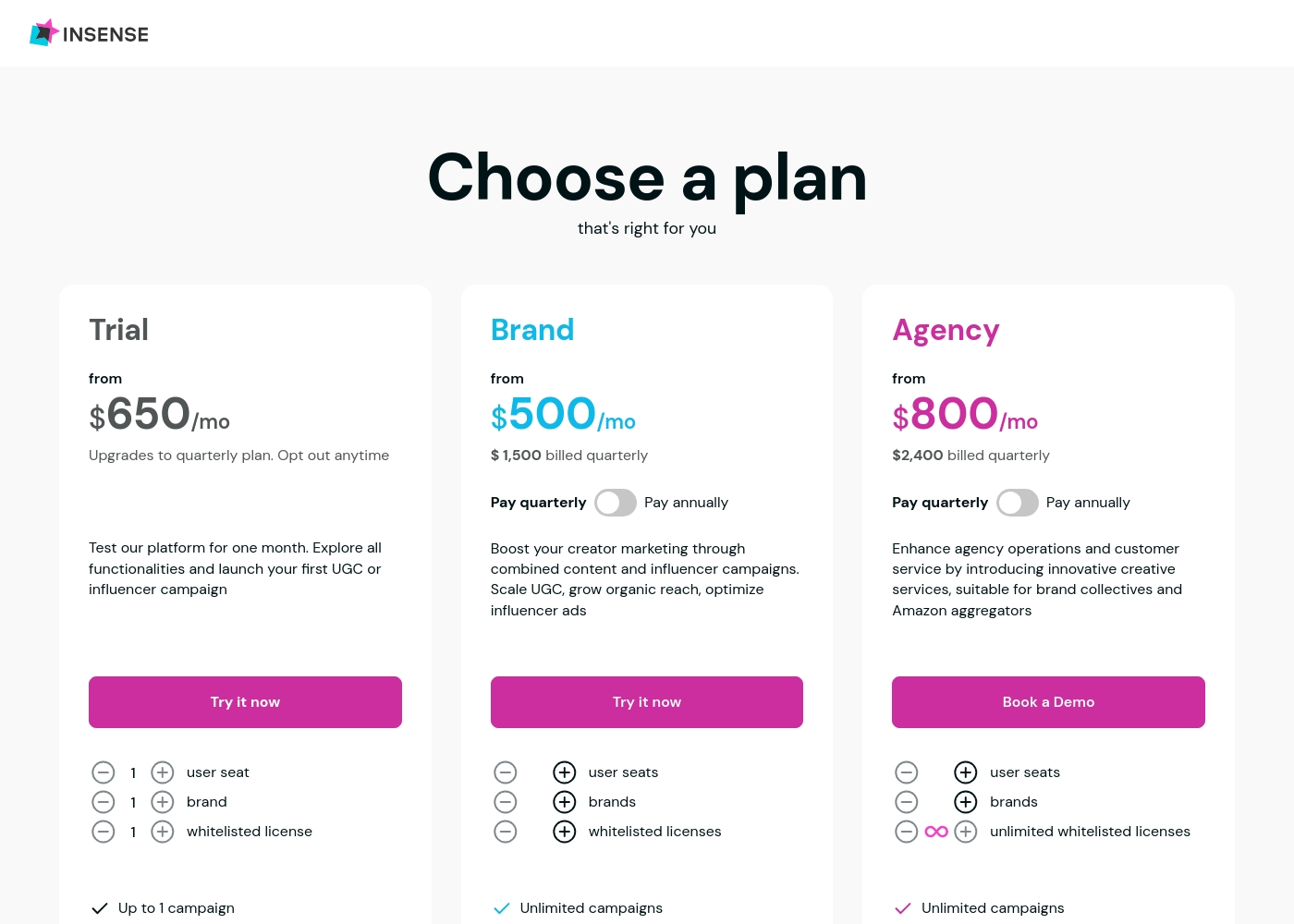
Insense costs between $400 and $800 per month with three plans: Trial at $650 per month, Brand starting at $400 per month, and Agency starting at $640 per month.
Below, you'll find a detailed look at what each tier includes and the necessary marketplace fees that apply to creator payments.
Trial
Price: $650 per month Websites Supported: 1 Brand Best For: Testing the platform for one month Refund Policy: Conditional guarantee (subscription refund if 5 relevant applicants aren't provided) Other Features: 1 user seat, Up to 1 campaign, Up to 10 creators to hire, 20% marketplace fee
- Test platform for one month
- Launch first UGC or influencer campaign
- Up to 1 campaign
- Up to 10 creators to hire
- 20% marketplace fee
- Boost creator marketing
- Scale UGC, grow organic reach
- Optimize influencer ads
- Unlimited campaigns and creators
- 10% marketplace fee
- Enhance agency operations and customer service
- Suitable for brand collectives and Amazon aggregators
- Unlimited campaigns and creators
- Dedicated customer support
- 7% marketplace fee
You can explore our service offerings below to see how our expertise and technology drive growth.
Managed Affiliate & Creator Services
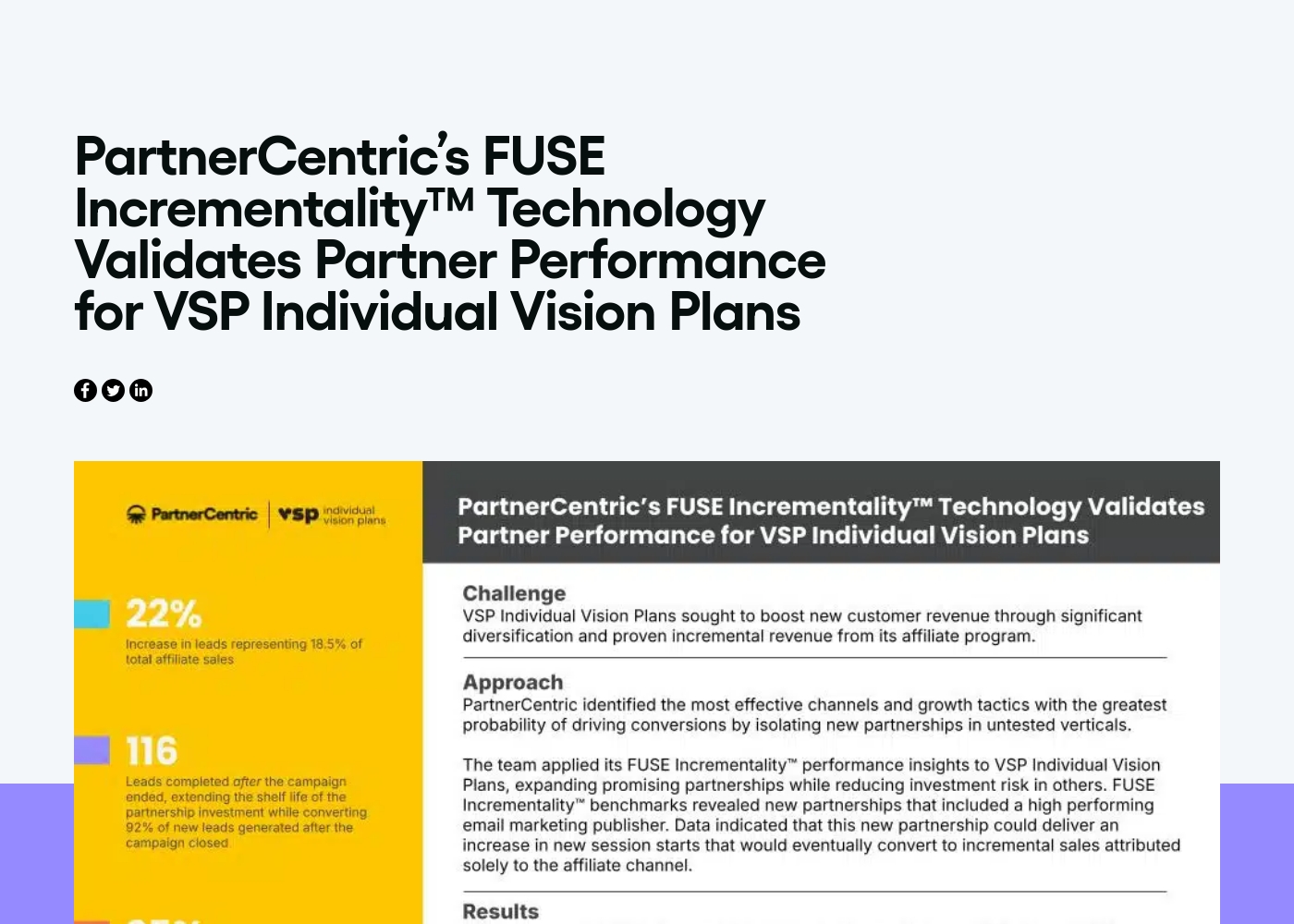
Best For: Brands looking for end-to-end management and data-backed ROI Other Features: FUSE Incrementality™ software, Strategic expert oversight, AI visibility audits, Performance attribution tracking
If you're a powerhouse brand looking to turn your affiliate program into a conversion machine, this is for you. We pair strategic human expertise with proprietary technology to ensure you only pay for true growth. 🚀
- End-to-end program management
- Incremental revenue focus
- Transparent payouts
- Proprietary incrementality software
Pricing Notes
- Insense has clear, published subscription tiers. PartnerCentric's pricing is completely custom and requires a consultation.
- Insense separates platform cost from creator payments. The marketplace fee ranges from 7% to 20% depending on the plan.
- PartnerCentric offers a free audit, but no free trial. Insense offers a 30-day paid Trial plan.
- Insense has a conditional money-back guarantee. PartnerCentric has no stated refund policy.
Pricing Head-to-Head
User Reviews
Insense reviews show a highly polarized experience, particularly across different user groups. For creators, the platform is often described as a gold mine 💰.
They praise its streamlined payment process, reliable contracts, and high offers, calling it one of the best UGC platforms available. However, the brand experience is often the opposite.
I spent $1500 hoping for quality UGC content. Their customer service was appalling—rude, dismissive, and utterly unhelpful once they had my money. The mandatory subscription lock-in feels like a deliberate trap.
Our research into external reviews for PartnerCentric hit a wall, as the Trustpilot page returned a technical error (403 Forbidden), preventing access to user feedback. The Capterra profile also does not exist or is unavailable.
Consequently, we cannot synthesize a balanced summary of user sentiment from these platforms. We must rely solely on the company's self-reported claims and our own website analysis.
Our Verdict
This isn't a simple apples-to-apples comparison. Insense and PartnerCentric solve very different problems for brands. Your choice depends entirely on your primary goal. Insense's superpower is speed and volume for content creation. It's a powerful platform for finding and managing creators to produce a high volume of UGC and influencer assets quickly. If you need dozens of videos for ad testing next month, Insense's marketplace gets you there. PartnerCentric's superpower is strategic revenue growth. They are experts at building and managing entire affiliate programs to drive provable, incremental sales. If your main problem is proving which partners actually grow your business, their FUSE technology is built for that. The deciding factor is your need: Do you need a content factory (Insense) or a revenue engine (PartnerCentric)? Choose Insense if your bottleneck is creative output and you want hands-on control. Choose PartnerCentric if your bottleneck is proving ROI and you want a strategic partner to own your program. For most DTC brands focused on ad creative, Insense is the more immediate, tactical tool. For larger brands focused on channel growth and long-term profitability, PartnerCentric is the more strategic investment.
Frequently Asked Questions
Which is better for small teams: Insense or PartnerCentric?
Insense is better for small teams. Its self-serve platform and clear pricing make it easier to start without a large budget. PartnerCentric's agency model is likely better suited for established brands with dedicated marketing budgets.
Does Insense help with affiliate program management like PartnerCentric?
Insense helps you find creators and enroll them in affiliate programs, and it handles payments. PartnerCentric manages the entire strategy, tracking, and optimization of your affiliate channel end-to-end. They are fundamentally different levels of service.
Is PartnerCentric worth the extra cost over Insense?
PartnerCentric's cost isn't directly comparable. They offer a strategic service for driving measurable revenue growth, not a content platform. It's worth it if your primary goal is maximizing and proving your affiliate channel's ROAS.
Can I run TikTok Spark Ads with PartnerCentric?
PartnerCentric's focus is on the partnership and attribution layer, not the ad-buying mechanics. Insense has specific tools to help you launch TikTok Spark Ads by connecting you with eligible creators.
Which tool has better customer support?
It depends on your perspective. Insense reviews are mixed, with creators praising support and brands often criticizing it. PartnerCentric provides dedicated strategic oversight as part of their managed service, which is a higher-touch model.
Do I own the content created through Insense?
Yes. When you pay for content through Insense, you automatically receive perpetual usage rights for both the edited footage and raw assets. This is a key feature for building a reusable content library.
Ready to Choose?
Both tools have their strengths. Choose based on your specific needs.