Insense vs Kit (formerly ConvertKit)
Insense and Kit (formerly ConvertKit) serve completely different marketing needs. Insense connects brands with creators for UGC and influencer content. Kit (formerly ConvertKit) helps creators build audiences and automate emails. Choosing between them depends entirely on your core goal.
Best for: DTC brands scaling UGC production, Marketing agencies managing multiple clients
Best for: Authors and writers building a reader community, Newsletter creators focused on subscriber growth
High volume access, highly polarized results.
We recognize Insense’s powerful ability to connect brands with a large creator pool and automate essential campaign workflows. However, user feedback suggests that deliverable quality and brand-side support are inconsistent, which diminishes the platform's overall value proposition. Overall, Insense is a specialized tool best suited for experienced buyers willing to tolerate significant risk for high creative throughput.
Pros
- Access to a vetted marketplace of over 70,000 creators across 35 countries.
- Clear, upfront pricing with separate fees for platform access and creator payments.
- Highly efficient campaign speed, with content delivered within 14 days.
- Creators report reliable payments and high offers compared to competitors.
Cons
- Brands report low quality or unusable content, making the services expensive.
- Inconsistent customer support; support is noted as superb for creators but often problematic and unresponsive for brands.
- Mandatory minimum contract periods viewed as a trap if the platform underperforms.
- Users report app glitches and difficulties with account management/logins.
Creator-friendly, but check support.
We find Kit a capable and intuitive email marketing platform tailored specifically for creators, offering strong automation and a clean interface. Overall, it's a great starting point for growing an audience, though users should weigh the mixed customer support reviews and potential pricing scale against their needs.
Pros
- Intuitive, clean interface designed for creators and non-technical users.
- Powerful visual automations and sequences to nurture audiences.
- Generous free plan for up to 10,000 subscribers.
- Strong focus on deliverability and building owned audiences.
Cons
- Customer support responsiveness and quality receive frequent criticism.
- Pricing can become steep as subscriber counts increase significantly.
- Some users report unexpected account suspensions or deliverability issues.
- Advanced analytics and collaboration features are limited.
AboutInsense
Insense offers a comprehensive platform designed to scale high-performing creator content and influencer partnerships. It’s trusted by over 2,500 DTC brands, mobile apps, and advertising agencies looking to streamline their creative production.
Flexibility is central to the Insense experience. You don't have to choose between managing your campaigns or outsourcing them; Insense supports both approaches. You can use the Self-Service Platform for total control, managing campaigns from start to finish. Alternatively, choose Managed Services when you need hands-on, end-to-end guidance and support. Many brands combine both solutions for a customized approach that fits their specific needs.💡
AboutKit (formerly ConvertKit)
Kit is an email marketing platform specifically for creators like authors, podcasters, YouTubers, and entrepreneurs. It's the hub for growing your email list, sending beautiful newsletters, and selling digital products—all while keeping the experience intuitive and straightforward. 💡
Highlights
Feature Comparison
Features Overview
We highlight the main differences and pick a winner for each feature.
Core Purpose & Platform
Insense is a creator campaign platform. Kit is an email marketing tool.
Insense helps brands manage UGC and influencer campaigns from outreach to content delivery. It's built for marketers and agencies. Kit (formerly ConvertKit) helps creators build email lists, send newsletters, and sell products. It's built for individual creators. The fundamental difference is audience: Insense connects brands to creators. Kit connects creators to their audience.
Creator & Content Sourcing
Insense has a massive creator marketplace. Kit relies on integrations.
Insense provides access to over 70,000 vetted creators across 35+ countries. You launch a campaign and get applications within 48 hours. Kit (formerly ConvertKit) doesn't source creators. It helps you grow your own email list and connect with other creators via Recommendations. Insense is for acquiring external creator content. Kit is for nurturing your own audience.
Automation Capabilities
Insense automates campaign logistics. Kit automates email sequences.
Insense automates contracts, payments, and creator workflows. This saves teams over 40 hours monthly on administrative tasks. Kit (formerly ConvertKit) automates email sequences, welcome series, and sales funnels. Creators report 30% sales growth from these automations. Insense automates the business of creator marketing. Kit automates the marketing of your own business.
Monetization & Sales
Kit enables direct digital product sales. Insense focuses on content creation.
Insense's primary output is licensed content for brands to use in ads and organic posts. There's no built-in sales feature. Kit (formerly ConvertKit) lets you sell digital products, memberships, and subscriptions directly through email with a 3.5% transaction fee. Kit has a built-in revenue stream. Insense is a cost center for content acquisition.
Audience Building & Ownership
Kit excels at building owned audiences. Insense doesn't focus on this.
Insense helps brands acquire content to reach audiences on social platforms. The brand owns the content, not the creator's audience. Kit (formerly ConvertKit) is designed around building an email list you own. It offers a 99.8% deliverability rate and tools to grow subscribers directly. Kit prioritizes audience ownership. Insense prioritizes content acquisition.
Pricing Structure
Insense has high fixed costs plus variable fees. Kit scales with your audience size.
Insense costs $400-$800/month for platform access. You also pay creators a 7-20% marketplace fee on top of that. Kit (formerly ConvertKit) offers a free plan for up to 10,000 subscribers. Paid plans start at $29/month and scale with your list size. Insense requires significant upfront investment. Kit has a low barrier to entry.
Reporting & Analytics
Both offer basic reporting. Kit's is more focused on email metrics.
Insense provides campaign performance data like creator applications and content delivery timelines. Kit (formerly ConvertKit) offers deliverability reporting, A/B testing for subject lines, and an insights dashboard on paid plans. Kit has more detailed analytics for email performance. Insense focuses on campaign management metrics.
Customer Support Experience
Both have mixed reviews. Kit's support is more accessible on paid plans.
Insense offers chat support on all plans. Agency plan customers get a dedicated success manager. Brand reviews often cite poor responsiveness. Kit (formerly ConvertKit) provides 24/7 email and chat on paid plans, with priority support on Pro. Reviews also mention slow responses. Both platforms receive criticism for support. Kit's is more consistently available on paid tiers.
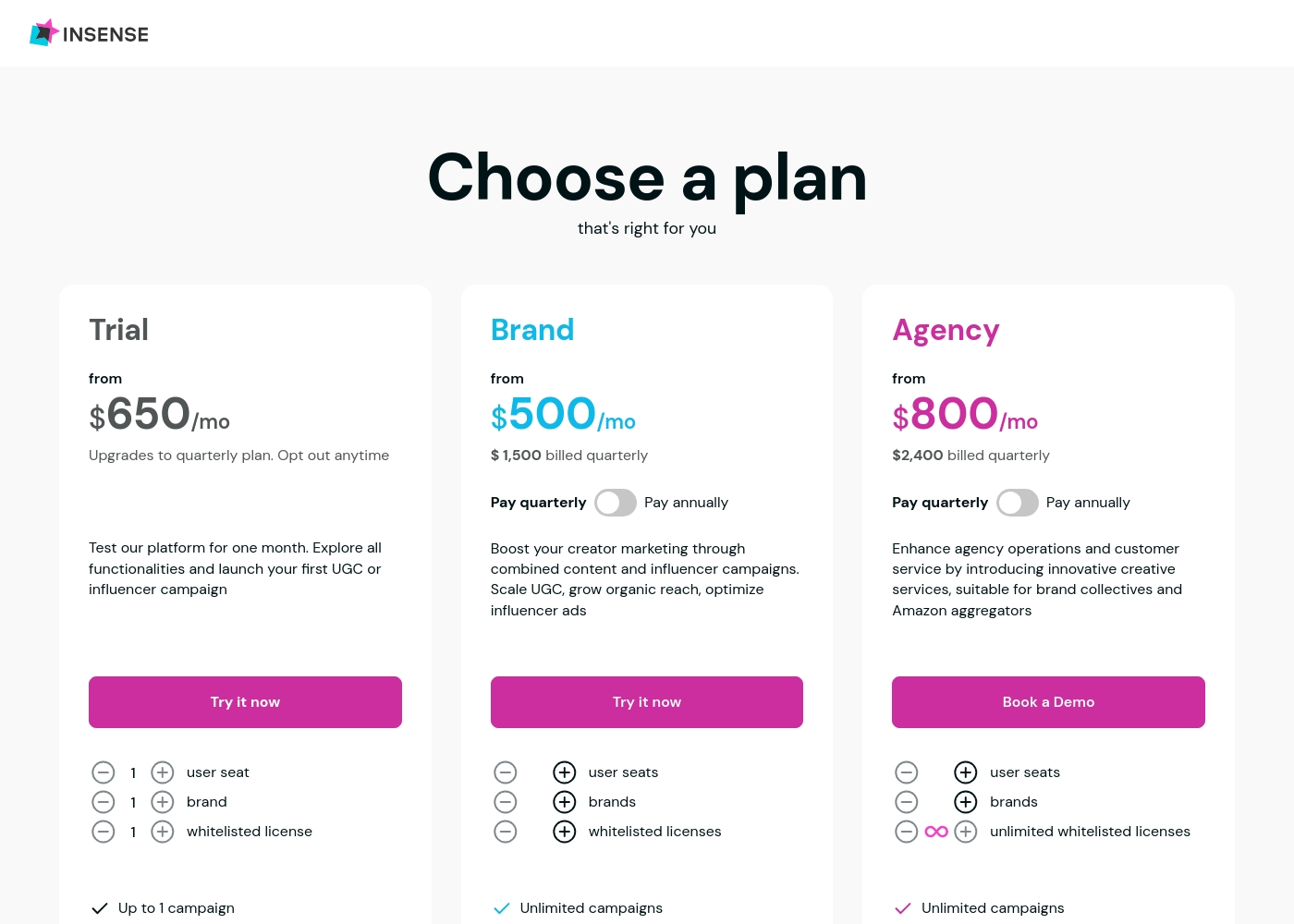
Insense costs between $400 and $800 per month with three plans: Trial at $650 per month, Brand starting at $400 per month, and Agency starting at $640 per month.
Below, you'll find a detailed look at what each tier includes and the necessary marketplace fees that apply to creator payments.
Trial
Price: $650 per month Websites Supported: 1 Brand Best For: Testing the platform for one month Refund Policy: Conditional guarantee (subscription refund if 5 relevant applicants aren't provided) Other Features: 1 user seat, Up to 1 campaign, Up to 10 creators to hire, 20% marketplace fee
- Test platform for one month
- Launch first UGC or influencer campaign
- Up to 1 campaign
- Up to 10 creators to hire
- 20% marketplace fee
- Boost creator marketing
- Scale UGC, grow organic reach
- Optimize influencer ads
- Unlimited campaigns and creators
- 10% marketplace fee
- Enhance agency operations and customer service
- Suitable for brand collectives and Amazon aggregators
- Unlimited campaigns and creators
- Dedicated customer support
- 7% marketplace fee
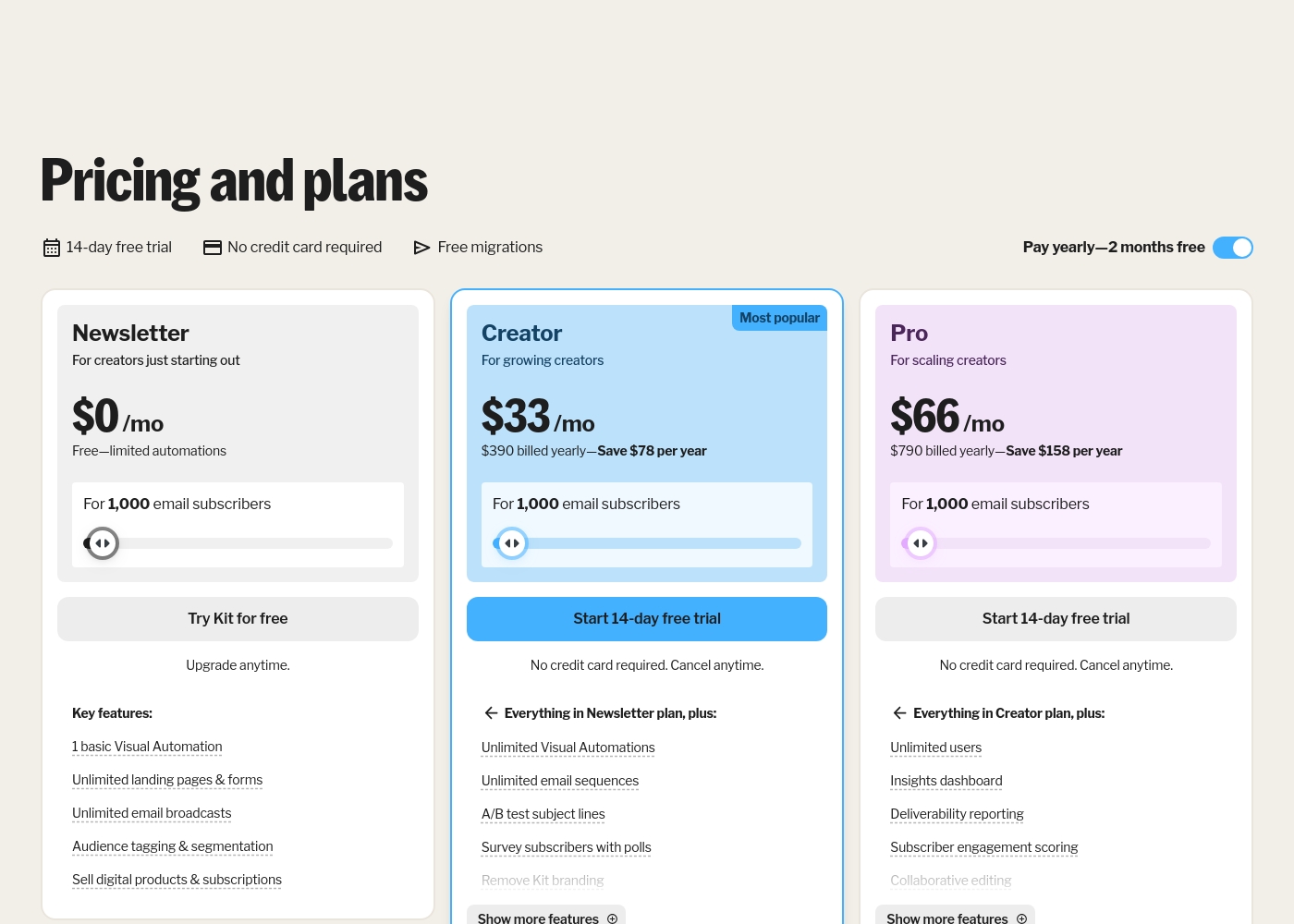
Kit (formerly ConvertKit) costs between $0 and $790 per year for 1,000 subscribers with 3 plans: Newsletter at $0, Creator at $390 billed yearly, and Pro at $790 billed yearly.
Take a look at the breakdown below to see which features fit your current creative goals.
Newsletter
Price: $0 per month Best For: New creators starting out Other Features: Unlimited landing pages, Audience tagging, Digital product sales, 1 basic Visual Automation
- 1 basic Visual Automation
- Unlimited landing pages & forms
- Unlimited email broadcasts
- Audience tagging & segmentation
- Sell digital products & subscriptions
- Everything in Newsletter plan
- Unlimited Visual Automations
- Unlimited email sequences
- A/B test subject lines
- Remove Kit branding
- Everything in Creator plan
- Unlimited users
- Insights dashboard
- Deliverability reporting
- Newsletter referral system
Pricing Notes
- Insense requires separate budget for creator payments (7-20% fee).
- Insense's Brand plan drops to $400/month billed annually.
- Kit's free plan supports up to 10,000 subscribers.
- Kit's pricing scales directly with your active subscriber count.
- Insense offers a conditional subscription refund guarantee.
- Kit charges 3.5% + $0.30 for digital product sales.
Pricing Head-to-Head
User Reviews
Insense reviews show a highly polarized experience, particularly across different user groups. For creators, the platform is often described as a gold mine 💰.
They praise its streamlined payment process, reliable contracts, and high offers, calling it one of the best UGC platforms available. However, the brand experience is often the opposite.
I spent $1500 hoping for quality UGC content. Their customer service was appalling—rude, dismissive, and utterly unhelpful once they had my money. The mandatory subscription lock-in feels like a deliberate trap.
On Trustpilot, Kit (formerly ConvertKit) receives mixed feedback. Users frequently praise its ease of use, highlighting a simple, intuitive interface perfect for creators and beginners.
Many appreciate the automation features and clean design for emails and landing pages. However, a significant number of reviews cite poor customer support, with long response times and unhelpful agents.
ConvertKit is super easy to use. I love how simple it is to set up automations and sequences without any tech headaches. It's perfect for my newsletter.
Our Verdict
Insense and Kit (formerly ConvertKit) aren't really competitors—they're tools for completely different jobs. Most people won't need both. Insense's superpower is its creator marketplace. It connects you to over 70,000 creators and delivers licensed UGC within 14 days. It automates the messy parts of influencer marketing. Kit (formerly ConvertKit)'s superpower is audience ownership. It helps you build an email list you control, with automations that nurture subscribers 24/7. Creators report 30% sales growth from its sequences. The deciding factor is your core need. Choose Insense if you're a brand needing a steady stream of creator content for ads. Choose Kit (formerly ConvertKit) if you're a creator building a direct relationship with your audience. If you're a DTC brand with $400+/month budget for UGC, Insense is purpose-built for you. If you're a solo creator wanting to own your audience and sell directly, Kit (formerly ConvertKit)'s free plan is a fantastic starting point.
Frequently Asked Questions
Which is better for small teams: Insense or Kit (formerly ConvertKit)?
Kit (formerly ConvertKit) is generally better for small teams and solopreneurs due to its free plan and lower cost. Insense requires a significant monthly subscription (starting at $400) plus creator fees, making it a major investment.
Does Insense have email marketing features like Kit (formerly ConvertKit)?
No, Insense does not offer email marketing. It is a platform for managing UGC and influencer campaigns. Kit (formerly ConvertKit) is dedicated to email automation, landing pages, and audience growth.
Is Kit (formerly ConvertKit) worth the extra cost over Insense?
They solve different problems, so cost depends on your goal. Kit (formerly ConvertKit) is cheaper and helps you build an owned asset (your email list). Insense is more expensive but delivers scalable content for advertising.
Can I migrate from Insense to Kit (formerly ConvertKit) easily?
Migration isn't straightforward as they are different tools. Insense manages creator campaigns; Kit (formerly ConvertKit) manages email audiences. You would likely use both for separate purposes, not migrate one to the other.
Which platform has better customer support?
Kit (formerly ConvertKit) offers 24/7 email and chat on paid plans. Insense provides chat support but brand reviews often cite poor responsiveness. Kit's support is generally considered more accessible.
Do I need both Insense and Kit (formerly ConvertKit)?
You could. A brand might use Insense to source UGC from creators and Kit (formerly ConvertKit) to manage email campaigns to their customers. They serve separate stages of the marketing funnel.
Ready to Choose?
Both tools have their strengths. Choose based on your specific needs.