InboxAlly vs Warmy
InboxAlly and Warmy both promise premium email deliverability, but they prioritize different approaches. InboxAlly focuses on structured plans and deep, real-time engagement insights. Warmy wins with superior AI automation and specialized B2B/B2C warming networks. It's control versus customization; here's how to choose.
Best for: Marketing agencies managing multiple clients needing clear limits (up to 10 profiles), Businesses needing predictable, tiered monthly expenses ($149/mo minimum)
Best for: Businesses targeting highly segmented audiences (either primarily B2B or B2C), Users prioritizing speed, needing setup in less than 30 seconds
Strong deliverability with caveats
We view InboxAlly as a focused deliverability toolkit built for list owners and agencies. We see real-time insights, warmup workflows, and clear dashboards that support measurable gains in inbox placement. Overall, we find it valuable for accuracy and reliability, though pricing remains a consideration for smaller teams.
Pros
- Real-time engagement tracking shows progress
- Effective email warmup that trains providers to prioritize your messages
- Improved inbox placement across major providers
- Comprehensive, actionable deliverability reports
Cons
- Pricing can feel high for smaller teams
- Enterprise pricing not publicly disclosed
- Some users want more sender profiles per price or customization
- Refund/money-back policy not clearly stated
Essential AI Tool for Inbox Deliverability
We find Warmy to be an exceptionally reliable tool for automating domain warming and maximizing email deliverability. Its AI engine effectively manages complex reputation factors, freeing up significant user time. Overall, the measurable impact on minimizing spam placement makes Warmy a premium and worthwhile investment despite requests for better pricing flexibility.
Pros
- Significantly improves email deliverability and open rates (avoiding spam/promotions folder).
- Automation seamlessly replaces inconsistent, manual email warming efforts.
- Setup is quick and the platform is incredibly easy to use.
- Provides responsive support, particularly helpful with complex technical configurations (e.g., DMARC).
Cons
- Pricing structure is considered too high or inflexible for some small businesses.
- Users desire more detailed reporting features and advanced analytics.
- Needs more customization options for automation/sending patterns.
AboutInboxAlly
InboxAlly is a unique email deliverability tool built for mailing list owners, agencies, and ESPs. It teaches inbox providers to understand that the emails you send from your domain are important and valued by your recipients, helping emails land in the Inbox and boosting engagement 🚀.
AboutWarmy
Warmy is an AI-driven, high-technology deliverability tool that streamlines email warm-up processes. It uses sophisticated, optimizing algorithms and advanced AI to make your entire email channel reliable. You can be confident that your domains and IPs are prepared for email outreach campaigns, ensuring strong delivery.
This powerful solution is designed for businesses, marketers, entrepreneurs, and affiliates looking to maximize their email success. Warmy works by utilizing cutting-edge technology, including integration with Google Postmaster, to make sure emails bypass spam filters and build essential recipient trust. 💡
Highlights
Feature Comparison
Features Overview
We highlight the main differences and pick a winner for each feature.
Pricing & Transparency
InboxAlly uses clear tiers; Warmy requires you to book a demo for custom pricing.
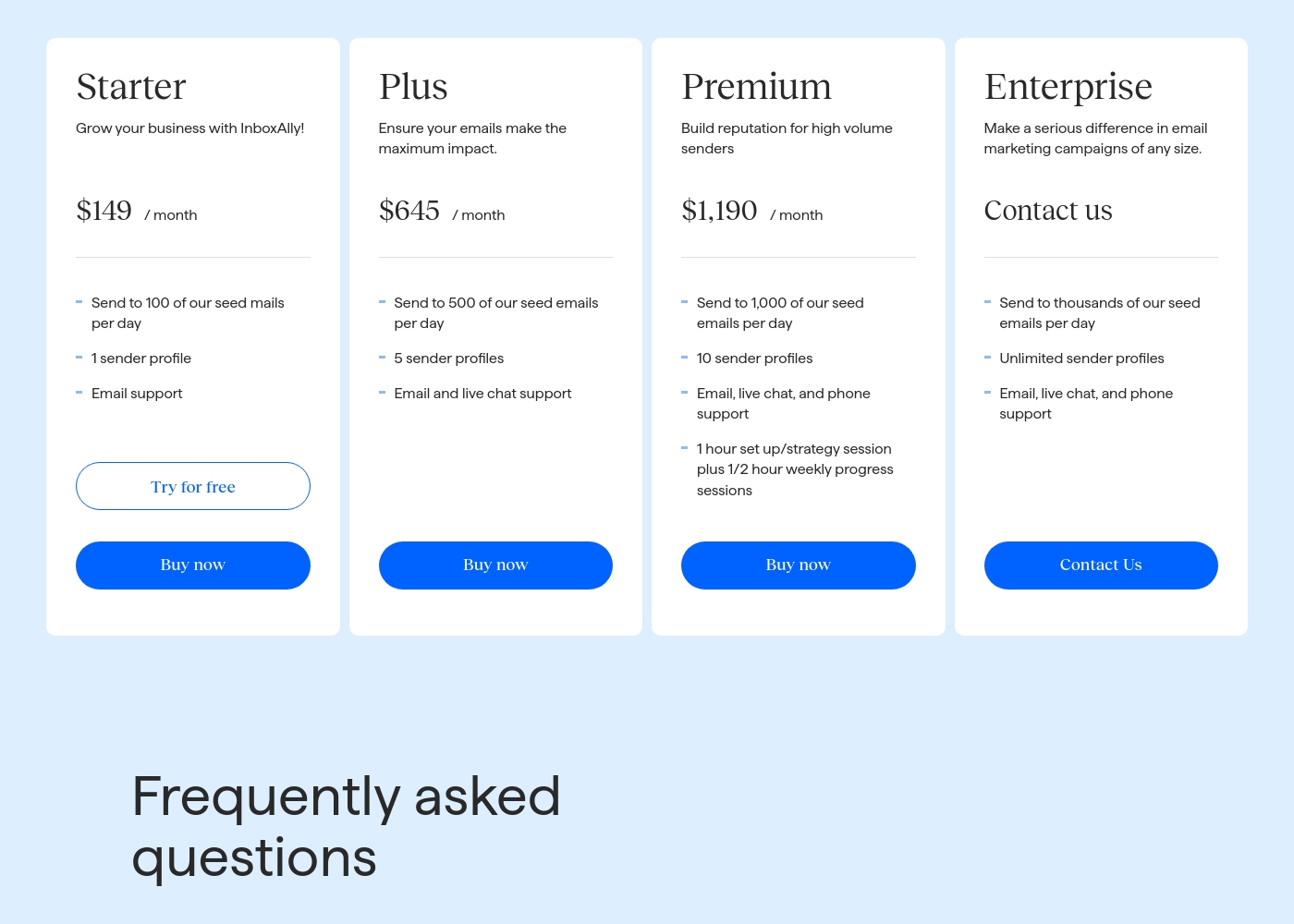
InboxAlly lists four clear and transparent plans, ranging from $149/month up to $1,190/month. Costs are directly tied to defined seed email limits (100–1,000 per day). Warmys pricing is strictly volume-based across its B2B, B2C, and Custom plan options. You must book a demo and receive a personalized, non-public quote to determine cost. This is a major difference: InboxAlly offers simple, predictable budgeting upfront. Warmy offers tailored pricing but risks sticker shock for smaller users. If budget predictability is essential for your business, InboxAlly is the much easier choice.
Setup Speed
Warmy is online instantly (25 seconds); InboxAlly averages about five minutes.
Warmy boasts a lightning-fast setup time, claiming you can be ready to warm domains in only 25 seconds. This minimized configuration is a core benefit. InboxAlly setup takes slightly longer, around five minutes, which is still very fast for a deliverability tool. Higher InboxAlly tiers include onboarding sessions. Warmy wins on instant deployment, minimizing friction and delays for new campaigns. Instant setup means you start building reputation almost immediately, without delay.
Audience Specialization
Warmy targets B2B or B2C networks; InboxAlly provides a generalized warmup.
Warmy offers two highly specialized warming plans: B2B for G Suite/MS365 and B2C for Gmail/Yahoo/Outlook. This focus builds hyper-specific trust. InboxAlly offers a powerful general warmup process that works across all major providers indiscriminately. It doesn't separate business and consumer networks. If your entire outreach is corporate, Warmy’s B2B sender plan optimizes efforts perfectly. Warmy’s specialization allows for superior targeting of difficult consumer inboxes, too.
Automation Technology
Warmy uses AI automation; InboxAlly uses defined rules based on fixed limits.
Warmy relies on sophisticated, self-optimizing AI algorithms to manage the entire warm-up process automatically. The system adjusts dynamically based on reputation. InboxAlly operates on clearly defined daily limits for seed emails (e.g., 500 per day). The structure is fixed and governed by the plan you select. If you want the technology to handle all complexity fully and dynamically, Warmy's AI is the better choice. InboxAlly offers more budgetary and usage control through clear, fixed parameters.
Expert Support Access
Warmy includes an expert in all plans; InboxAlly requires paying for Premium support.
Every standard Warmy plan includes access to a dedicated deliverability expert for guidance. This is critical for diagnosing complex technical issues. InboxAlly’s entry-level plans include email and live chat support, but dedicated phone support starts at $1,190/month. The Premium plan also includes weekly progress checks. Warmys model provides specialized help to everyone, regardless of their payment tier. InboxAlly requires you to purchase their most expensive public plan for premium, human guidance.
Reporting and Real-time Data
InboxAlly tracks engagement rates; Warmy tracks placement status and domain health.
InboxAlly provides detailed real-time engagement tracking and progress dashboards. You can see how seed emails are interacting immediately. Warmy monitors placement status in real-time, showing if messages land in the inbox, promotions tab, or spam folder. It also integrates Google Postmaster data. InboxAlly's focus on engagement tracking helps pinpoint poor subject lines or weak content. Warmy focuses more on technical health metrics and final destination placement.
The details below align with the plan options shown in the pricing view.
Starter
Price: $149 / month Best For: Campaigns with a daily send volume of 2000 emails or less Other Features:
- Send to 100 of our seed mails per day
- 1 sender profile
- Email support
Choose Starter if you're just starting out and want a low-risk way to begin building reach. 👍
- Send to 100 of our seed mails per day
- 1 sender profile
- Email support
- Send to 500 of our seed emails per day
- 5 sender profiles
- Email and live chat support
- Send to 1,000 of our seed emails per day
- 10 sender profiles
- Email, live chat, and phone support
- 1 hour set up/strategy session plus 1/2 hour weekly progress sessions
- Send to thousands of our seed emails per day
- Unlimited sender profiles
- Email, live chat, and phone support
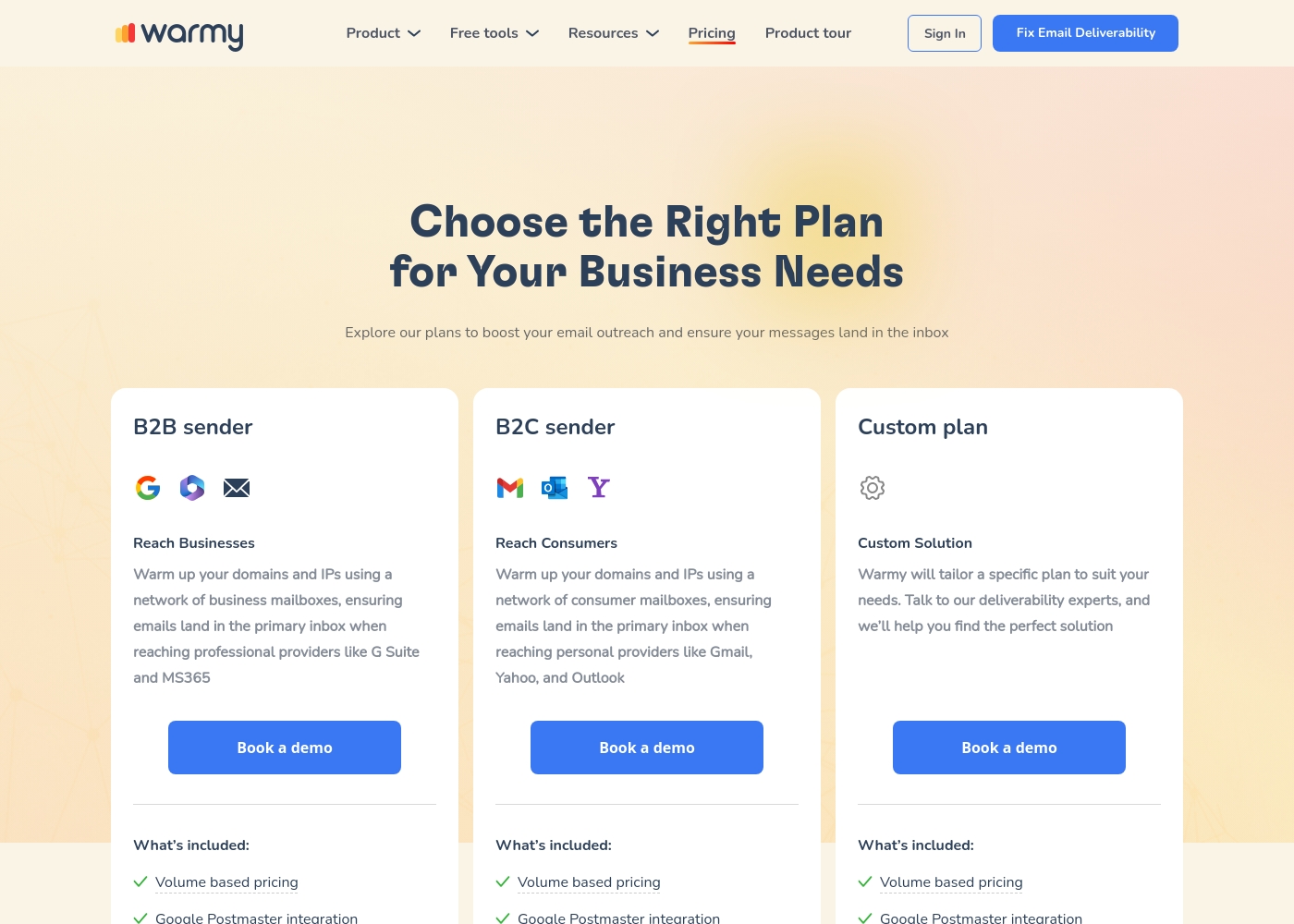
Warmy structures its solutions around who you need to reach, simplifying your choice significantly. Let's explore the options to boost your email deliverability.
B2B sender
Best For: Reaching professional providers like G Suite and MS365. Other Features:
- Volume based pricing
- Google Postmaster integration
- Deliverability monitor
- Dedicated deliverability expert
This plan is perfect if your primary goal is reaching businesses. It focuses on warming your domains using a network of business mailboxes to land you in the primary inbox with professional users.
- Warm up domains/IPs using a network of business mailboxes for professional providers (G Suite, MS365)
- Volume based pricing
- Google Postmaster integration
- Deliverability monitor
- Dedicated deliverability expert
- Warm up domains/IPs using a network of consumer mailboxes for personal providers (Gmail, Yahoo, Outlook)
- Volume based pricing
- Google Postmaster integration
- Deliverability monitor
- Dedicated deliverability expert
- Tailored specific plan to suit your needs
- Volume based pricing
- Google Postmaster integration
- Deliverability monitor
- Dedicated deliverability expert
Pricing Notes
- InboxAlly offers fixed, transparent monthly pricing starting at $149/month, defined by seed email limits.
- Warmy's pricing is volume-based and requires a consultation, cited by users as potentially high or inflexible.
- Both offer a free trial, InboxAlly's is tied to the Starter plan, and Warmy offers a 7-day trial without a credit card.
- Warmy includes a dedicated deliverability expert in all standard plans, offering high support value immediately.
- To get weekly high-touch support sessions, you must purchase InboxAlly's Premium plan costing $1,190/month.
Pricing Head-to-Head
User Reviews
Trustpilot reviews consistently praise InboxAlly for real-time engagement tracking, easy setup, and responsive support. They highlight measurable gains in inbox placement across major providers and note practical onboarding that helps teams get started quickly.
Some users call pricing a concern for smaller teams, though many feel the value scales with usage and volume. Captera reviews echo similar themes of ease of use and tangible results, with emphasis on onboarding and reliability.
Highly recommend InboxAlly. It's hands-down the best email warmup software I've used and it improved deliverability quickly.
Warmy receives excellent feedback from users, earning a high 4.4-star rating on Trustpilot across 336 reviews. Reviewers consistently praise the significant improvement in email deliverability, noting that their messages immediately started landing in the primary inbox instead of the spam folder.
Users found the platform incredibly easy to use, highlighting the quick, seamless setup process and effective automation, which replaces tedious manual warming efforts. Dedicated features like the Seed List and Google Postmaster integration are often cited as highly valuable.
Before Warmy, I was manually sending warming emails from different accounts; it was a huge time-sink and super inconsistent. This tool automates the entire process perfectly. I especially love the Google Postmaster integration, which gives me real insight into my domain health.
Our Verdict
Choosing between InboxAlly and Warmy means deciding between structured control and advanced automation. Both are premium tools, but Warmy often wins due to its specialized targeting and speed. InboxAlly is the smart choice for agencies or list owners who prioritize price predictability and structured reporting. InboxAlly provides clear seed email limits and structured support, including weekly sessions for its Premium clients. Use InboxAlly if detailed real-time engagement tracking is critical for content adjustments. Warmy's superpower is its hyper-specialized, self-optimizing AI and instant setup time. Warmy can integrate and start warming in just 25 seconds for immediate results. Crucially, Warmy provides specialized B2B or B2C warming networks for focused outreach. Accessibility of expertise is the major differentiator. Warmy includes a dedicated deliverability expert in every single plan tier. InboxAlly requires you to pay much more to gain access to hands-on strategy and phone support. If you target niche audiences (B2B or B2C) and prioritize hands-off AI optimization, go with Warmy. If transparent, fixed pricing and comprehensive engagement analytics are essential, InboxAlly is the better fit.
Frequently Asked Questions
Which offers better pricing visibility: InboxAlly or Warmy?
InboxAlly is far more transparent with publicly listed tiered plans starting at $149/month. Warmy uses volume-based pricing and requires a demo to get a custom quote. This lack of pricing transparency is a drawback for Warmy users.
Does Warmy have specialized warming networks like InboxAlly?
Yes, Warmy specializes heavily in warming networks based on audience type. Warmy offers separate plans for B2B (MS365, G Suite) and B2C (Gmail, Yahoo) providers. InboxAlly uses a robust, general warming process for all major providers.
Which tool is faster to set up for a new domain?
Warmy is dramatically faster, claiming a setup time of only 25 seconds for immediate use. InboxAlly is also quick, taking about five minutes for initial configuration. Warmy is the winner for instant deployment speed.
Which tool is better for marketing agencies with many clients?
InboxAlly offers structured, tiered plans with up to 10 sender profiles for clear agency management. Warmy can scale massively via custom plans but lacks InboxAlly’s transparent multi-client structure.
Does Warmy include a dedicated deliverability expert in all plans?
Yes, every standard Warmy plan includes access to a dedicated deliverability expert. InboxAlly includes structured phone support and strategy only in its Premium ($1,190/mo) and Enterprise tiers.
Which tool uses AI for automation and continuous optimization?
Warmy heavily emphasizes its AI-driven, self-optimizing algorithms for hands-off warming. InboxAlly uses an effective, limits-based warmup methodology but relies less on active AI optimization.
Ready to Choose?
Both tools have their strengths. Choose based on your specific needs.