Hoverwatch vs Mobicip
Hoverwatch and Mobicip approach device monitoring from two opposite angles. Hoverwatch is designed for discreet, deep surveillance on Android and Windows devices. Mobicip is a robust parental control system ensuring consistency across many different device types. Mobicip focuses on setting boundaries, while Hoverwatch gathers silent, high-visibility data.
Best for: Users focused strictly on deep, invisible Android surveillance, Monitoring devices where the user absolutely cannot know they are tracked
Best for: Families with a mix of operating systems (iOS, Android, Windows, Mac), Busy parents needing clear screen time schedules and limits
Pros
Cons
Comprehensive Features, Criticized Reliability.
We found Mobicip offers comprehensive, multi-platform features like robust screen time limits and social media monitoring at a competitive annual price. Overall, we are concerned by multiple reports indicating that controls are easily circumvented by tech-savvy children, which fundamentally undermines the security promise of the product.
Pros
- App blocking and time schedules work effectively for basic enforcement.
- Supports a wide range of platforms (iOS, Android, Windows, Chromebooks).
- Competitive annual pricing tiers based on family device count.
- Email customer support is rated highly and is helpful during initial setup.
Cons
- Controls are easily bypassed by children changing device time or disabling the VPN.
- Settings frequently get corrupted or unblocked following software updates.
- Administrative functions, like account cancellation, are not available in the web portal and require contacting support.
- Technical glitches can cause connectivity problems and significant battery drain.
AboutHoverwatch
Hoverwatch is a monitoring application for Android devices. 💡 It’s designed for parents who want to ensure their children’s safety, and for employers managing company devices. The software runs quietly in the background, tracking activity without disrupting the user. It works by recording data from the device itself.
AboutMobicip
Mobicip is a comprehensive Smart Parental Control App built specifically for the needs of busy families. It aims to simplify digital parenting by offering reliable protection across many different platforms. 💡
Unlike tools restricted to a single company, Mobicip bridges the gap by applying consistent settings across nearly any device. It protects your family on iOS, Android, macOS, Windows, Chromebook, and even Kindle. The app is simple to set up and keeps detailed track of everything your child does online.
Highlights
Feature Comparison
Features Overview
We highlight the main differences and pick a winner for each feature.
Discretion & Stealth
Hoverwatch is built for complete invisibility and deep data logging. Mobicip is a visible parental control tool.
Hoverwatch operates completely invisibly on the target device. It runs in the background and collects data without alerting the user. Logs include messages, calls, and media attachments. Mobicip requires Uninstall Protection but is clearly visible to the user. It functions as a boundary enforcer, not a spy tool. This is the biggest distinction: Hoverwatch is surveillance, Mobicip is transparent management. Choose Hoverwatch if invisibility is your primary, non-negotiable requirement.
Platform Coverage
Mobicip supports six main platforms consistently, while Hoverwatch focuses heavily on Android and Windows.
Hoverwatch covers Android phones, Windows PCs, and macOS computers easily. It is highly optimized for Android data capture. Mobicip supports iOS, Android, macOS, Windows, Chromebook, and Kindle devices. This cross-platform reach is vital for diverse families. Mobicip applies consistent digital boundaries across every type of device your child uses. If your family has iPhones, Chromebooks, and Androids, Mobicip offers unified control.
Screen Time Control
Mobicip provides robust scheduling and limits; Hoverwatch offers reporting only.
Hoverwatch simply reports on usage history after the fact. It lacks any proactive control mechanisms. Mobicip lets parents set mandatory daily time limits and customized schedules. You determine exactly when apps are available. You can remotely lock devices instantly using Mobicip when intervention is necessary. This active management helps parents establish healthy digital routines and device-free periods.
Advanced Filtering
Mobicip uses AI to proactively block content; Hoverwatch is purely retrospective logging.
Hoverwatch logs website history and lists installed applications for review later. It cannot stop access in real-time. Mobicip utilizes powerful AI web filtering to block adult content proactively. It operates before questionable content loads. The Mobicip App Blocker targets usage in category groups like social media and gaming. Proactive filtering gives Mobicip a significant edge in content safety and prevention.
Unique Spying Data
Hoverwatch captures unique high-level surveillance data like front-camera shots and SIM alerts.
Hoverwatch captures a front-camera photograph every time the screen is successfully unlocked. It records the environment around the user. Hoverwatch also sends an alert notification if the user changes the SIM card on the monitored device. Mobicip does not offer camera capture or SIM notifications; it focuses on social media conversation analysis instead. If you need immediate visual context of device access, the Hoverwatch camera feature is critical.
Cost Per Device
Mobicip offers better value for family volume; Hoverwatch allows true monthly flexibility.
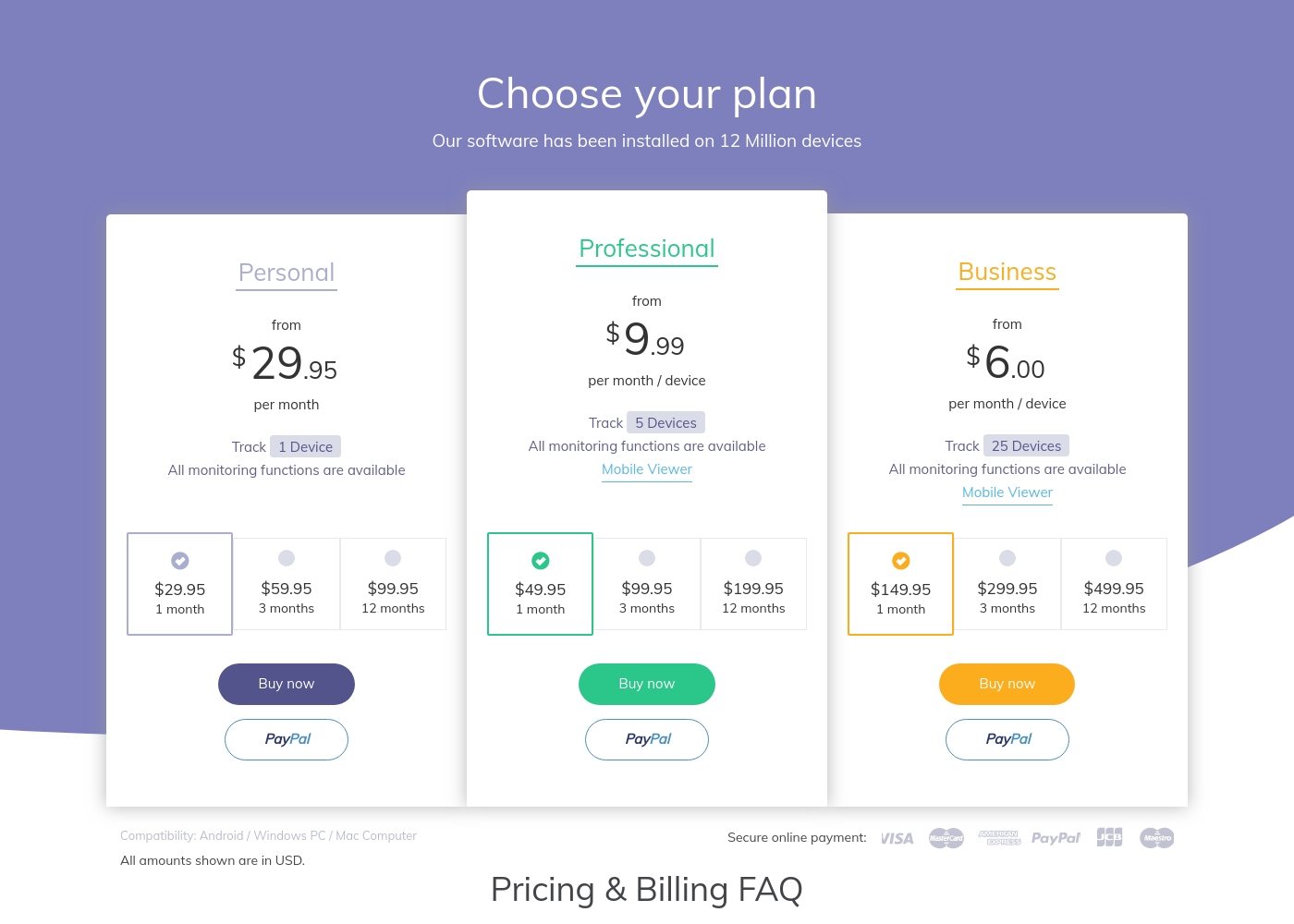
Hoverwatch offers monthly billing flexibility but costs range up to $499.95/month for large plans. A 5-device plan is more expensive monthly. Mobicip requires an annual commitment, but pricing for 20 devices tops out at only $7.99 per month. This is excellent volume value. Mobicip's low, structured tiers (5/10/20 devices) are specifically designed for the family budget. If budget stability and high device count are key, Mobicip provides vastly superior family value.
Hoverwatch pricing: Plans from $0/month Plans range: $0–$499.95/month Billing options: Monthly subscription
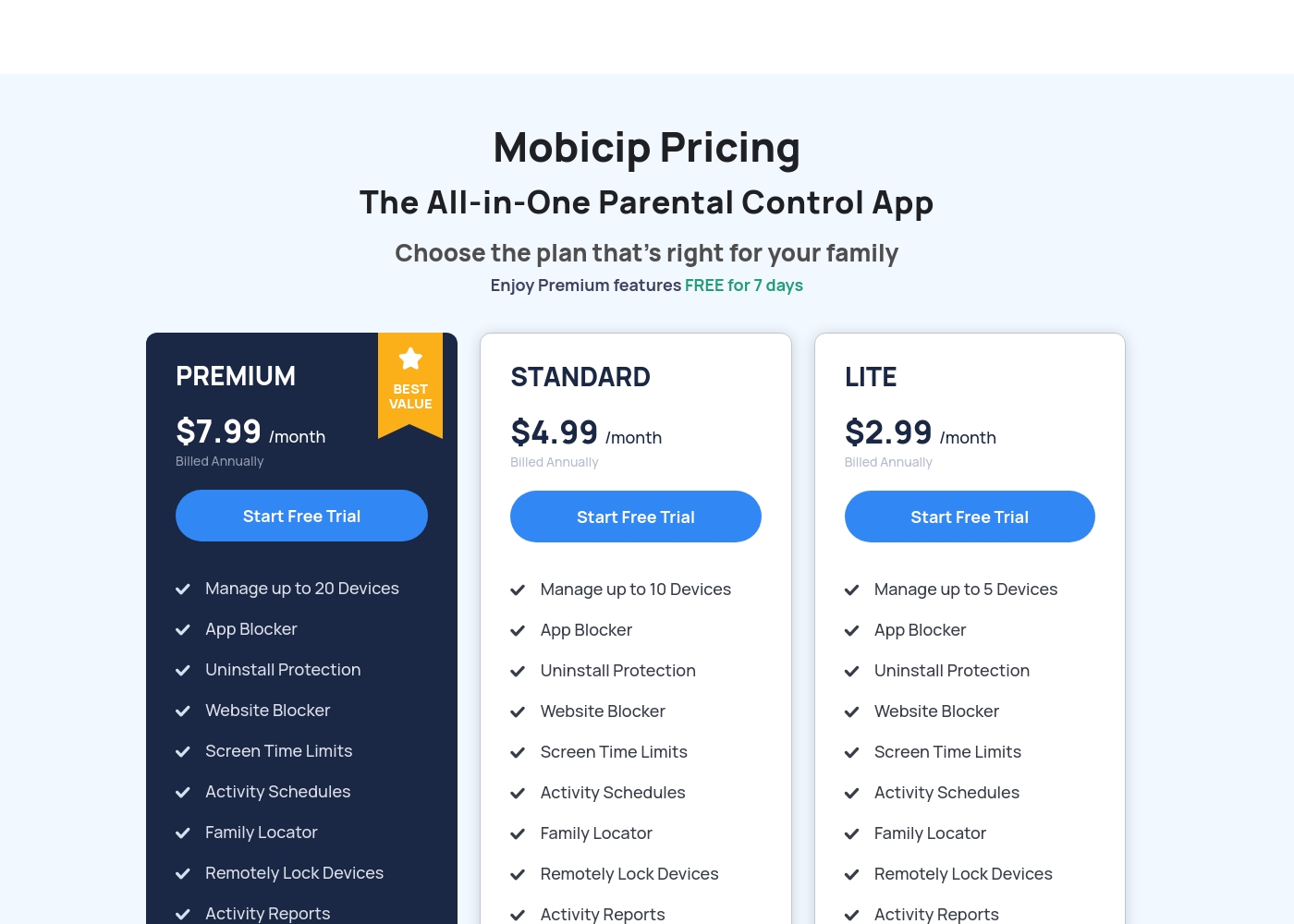
Mobicip costs between $2.99 and $7.99 per month (when billed annually) with three plans: LITE at $2.99/month, STANDARD at $4.99/month, and PREMIUM at $7.99/month.
You can easily choose the right plan for your family's needs below. All options include a 7-day free trial of Premium features.
LITE
Price: $2.99/month (Billed Annually) Best For: Families with 5 or fewer devices Other Features: Uninstall Protection, Website Blocker, Screen Time Limits, Activity Schedules, Activity Reports, Family Locator
- Manage up to 5 Devices
- App Blocker
- Uninstall Protection
- Website Blocker
- Screen Time Limits
- Manage up to 10 Devices
- App Blocker
- Uninstall Protection
- Website Blocker
- Screen Time Limits
- Manage up to 20 Devices
- App Blocker
- Uninstall Protection
- Website Blocker
- Screen Time Limits
Pricing Notes
- Hoverwatch pricing is flexible with monthly subscriptions available, offering $0 entry options.
- Mobicip requires an annual commitment despite displaying low monthly pricing; this locks you in for improved value.
- Mobicip offers a 7-day free trial across all Premium features before commitment is necessary.
- Hoverwatch costs significantly more at the top end, reflecting high-volume or enterprise-level needs ($499.95/month).
Pricing Head-to-Head
User Reviews
Mobicip holds a "Great" 4.1-star rating on Trustpilot, though this score is based on a very limited number of reviews. Users generally appreciate the core functions like app blocking and setting screen time schedules, which successfully helps keep young children focused, and email customer service has been highly praised as "Excellent" during setup.
However, significant reliability concerns challenge Mobicip's effectiveness as a true parental control tool. Several parents report that the app is easily bypassed—teenagers can circumvent controls by changing phone time, disabling the VPN, or simply deleting the app to regain full access.
App blocking and screen time schedules work well, especially for keeping my children focused during class time. We successfully use it across both iPhones and Windows PCs. It is an effective tool for setting digital boundaries.
Our Verdict
Hoverwatch and Mobicip both monitor device activity, but their missions are entirely opposite. Choosing between them depends on whether you value stealth or comprehensive management. For most larger families seeking consistency and proactive control, Mobicip is the clear choice. Hoverwatch’s true superpower is its deep, discreet surveillance capability. It operates completely invisibly, gathering critical data like messages, calls, and location without alerting the user. If you need professional-grade monitoring across Windows, Mac, and Android, Hoverwatch delivers absolute logging visibility. Hoverwatch even captures a front-camera photo when the device screen is unlocked. Mobicip focuses on consistent rules across difficult-to-manage devices like iOS, Chromebooks, and Kindle. Mobicip manages scheduling, time limits, and uses powerful AI to proactively block content. Its lower, tiered pricing model makes Mobicip an exceptionally better value for families tracking up to 20 devices. The core decision rests on your approach: spy versus control. Hoverwatch is for secrecy and deep data access on fewer platforms. Mobicip emphasizes boundary setting, collaboration (Guardians), and teaching kids self-regulation through its Child Dashboard. If structured screen limits, AI filtering, and multi-platform coverage are key, go with Mobicip. If you need high-visibility, invisible logging specifically on Android and Windows, Hoverwatch is your specialized solution.
Frequently Asked Questions
Which software is better for managing screen time and schedules?
Mobicip is vastly superior for structured time management. It lets you set daily screen time limits and create custom schedules for specific apps or times of day. Hoverwatch does not offer any proactive control features like scheduling.
Does Hoverwatch or Mobicip offer better support for mixed devices like iOS and Android?
Mobicip offers robust, consistent support across iOS, Android, Windows, and Chromebooks. Hoverwatch is strong on Android and Windows, but is less effective for full cross-platform family management across all systems.
What is the key feature Hoverwatch has that Mobicip lacks?
Hoverwatch main advantage is its absolute stealth mode, which Mobicip lacks entirely. Additionally, Hoverwatch can capture a front-camera photo whenever the device screen is unlocked. Mobicip does not have this specific surveillance feature.
Is Mobicip worth the annual commitment over Hoverwatch’s monthly pay structure?
If you need long-term, low-cost monitoring for many devices, Mobicip is worth the annual commitment. Mobicip is significantly cheaper per device. However, Hoverwatch offers valuable flexibility with true monthly subscription payment options.
Which tool is better for collaborative parenting?
Mobicip is designed for collaboration and shared digital boundaries. Its Guardians feature lets you share parenting tasks with other trusted adults. Hoverwatch is strictly intended for single-user dashboard access and control.
Does Mobicip monitor private conversations like Hoverwatch?
Hoverwatch logs detailed messages and media from apps like Snapchat and Telegram. Mobicip focuses on monitoring conversations on the top three social apps to analyze and alert you about harmful content.
Ready to Choose?
Both tools have their strengths. Choose based on your specific needs.