Goflow vs ShipStation
Goflow and ShipStation both handle multichannel e-commerce, but they solve different problems. Goflow is a unified operations hub for orders, inventory, and EDI. ShipStation is a shipping powerhouse focused on fulfillment and carrier discounts. Here's how to pick the right one for you.
Best for: E-commerce Directors managing complex, multichannel operations, Operations Managers handling EDI and 3PL networks
Best for: Small to mid-sized businesses focused on shipping efficiency, Companies looking to drastically cut shipping costs with carrier discounts
Powerful unifier for scaling sellers.
Overall, we find Goflow to be a comprehensive and capable platform designed to bring order to multichannel operations. It excels at centralizing workflows and offers a clear path for growth, though its value is best realized at higher volume tiers.
Pros
- Truly unified dashboard for orders, inventory, and shipping across channels.
- Extensive integration network with over 250+ marketplaces and tools.
- Strong automation for core workflows, reducing manual data entry.
- Scalable pricing model with a free tier for getting started.
Cons
- Significant jump in price from the free to Launch plan.
- Order volume limits on lower tiers could restrict growing businesses.
- Specific external user reviews were inaccessible for sentiment analysis.
Powerful Shipping Automation, Weak Customer Support.
We find ShipStation offers powerful automation and deep carrier discounts, streamlining logistics for handling high volumes efficiently. Overall, while the technical capacity and feature set are strong, prospective users must be aware that the platform is regularly criticized for slow, unhelpful customer support and opaque billing practices.
Pros
- Seamless integration with unlimited selling channels (Starter plan and up).
- Access industry-leading carrier discounts (up to 90% off FedEx rates).
- Automates repetitive tasks, allowing users to batch print up to 500 labels.
- Robust automation rules like rate shopping simplify workflow significantly.
Cons
- Customer support is consistently reported as slow, outsourced, and ineffective.
- Users report critical failures with the two-factor authentication (MFA) login process.
- Concerns regarding unexpected fees, pricing opacity, and sharp subscription increases.
- Filing claims or securing refunds for lost packages or billing adjustments is often difficult.
AboutGoflow
Goflow is a multichannel e-commerce software designed for online sellers, especially those with complex, high-volume operations. ✨ It acts as a single, powerful bridge connecting all your sales channels, fulfillment centers, and operational tools. Whether you're an E-commerce Director, CTO, or Operations Manager, it centralizes everything from orders and inventory to shipping and reporting into one easy-to-use dashboard.
AboutShipStation
ShipStation is a centralized logistics solution designed for businesses looking to streamline and scale their operations. It connects to over 400 existing integrations, linking your stores and providing access to more than 180 carrier partners. This single sign-on platform helps simplify your entire order fulfillment process. ShipStation actively manages everything from importing orders to tracking shipments. It is built to grow with you, supporting operations scaling to as many as 15,000 orders a day. ✅
Highlights
Feature Comparison
Features Overview
We highlight the main differences and pick a winner for each feature.
Core Focus & Use Case
Goflow unifies your entire e-commerce operation. ShipStation specializes in shipping and fulfillment.
Goflow is a full operations platform. It centralizes orders, inventory, warehouses, and EDI from 250+ channels into one dashboard. It's built for e-commerce directors managing complex, multichannel businesses. ShipStation is a logistics hub. It connects 400+ selling channels and 180+ carriers. Its core goal is to automate shipping, print labels, and get the best carrier rates. The key difference is scope. Goflow aims to be your entire operations backbone. ShipStation aims to be your best shipping tool. If you need to manage inventory and EDI alongside shipping, Goflow is the clearer choice. If your main pain point is shipping costs and label speed, ShipStation shines.
Pricing & Value
Goflow is volume-based and gets expensive. ShipStation starts cheaper but has mixed user sentiment on cost.
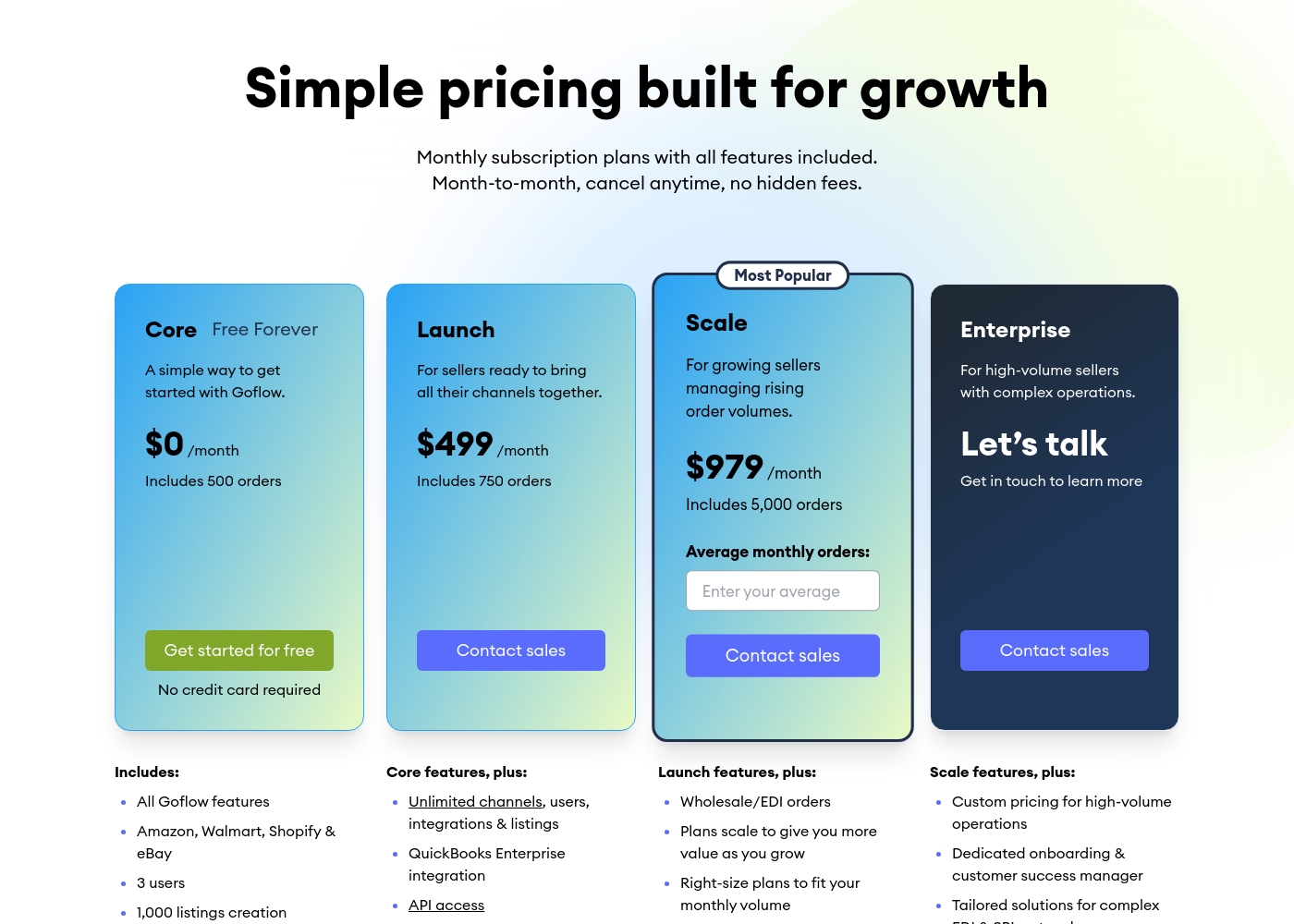
Goflow offers a free plan (500 orders). Paid plans start at $499/month (Launch) and scale to $979/month (Scale). Enterprise is custom. Pricing is based on monthly order volume. ShipStation offers a free plan (10 shipments). Paid plans start at $14.99/month (Starter) and go to $349.99/month (Premium). It has a 30-day free trial and a 90-day money-back guarantee. ShipStation's entry price is significantly lower. However, reviews mention unexpected fee jumps and pricing opacity. Goflow's pricing is more predictable but jumps sharply from free to paid. For a small business watching costs, ShipStation's free trial and lower entry point are more accessible. For a growing business needing unified ops, Goflow's volume-based model may align better despite the higher sticker price.
Integration Ecosystem
ShipStation connects to more channels and carriers. Goflow focuses on deep operational integrations.
ShipStation boasts 400+ integrations and 180+ carrier partners. This includes marketplace, store, and carrier connections. It also supports your existing negotiated carrier rates. Goflow integrates with over 250+ marketplaces and tools. It emphasizes deep integrations for order, inventory, and EDI workflows. This includes major platforms like Amazon, Shopify, and QuickBooks Enterprise. ShipStation has a broader network, especially for carriers. Goflow's integrations are more focused on creating a unified operational system. If you need to connect a vast array of niche selling channels and carriers, ShipStation's network is larger. If you need deep, automated integration between sales, inventory, and accounting, Goflow's approach is more targeted.
Automation Capabilities
Goflow automates your entire workflow. ShipStation automates the shipping process specifically.
Goflow automates end-to-end processes: order processing, inventory planning, shipping, and EDI. It handles tasks like picking, packing, carrier selection, and purchase order management automatically. ShipStation's automation is shipping-focused. It automates rate shopping, order tagging, and label creation. It allows batch printing of up to 500 labels. It creates 15x more labels per hour than manual methods. The trade-off is depth vs. focus. Goflow's automation is broader, covering your whole business operation. ShipStation's automation is deeper and faster for the specific task of shipping fulfillment. For a business needing to automate its entire supply chain, Goflow is more comprehensive. For a business whose bottleneck is shipping label speed and cost, ShipStation's automation is more directly impactful.
Scalability & Volume
Both scale well, but for different reasons. Goflow for complex operations, ShipStation for high-volume shipping.
Goflow is built for scaling high-volume, complex operations. Its Scale plan handles 5,000+ monthly orders, and Enterprise is custom for large volumes. It's designed for operations managers handling EDI and 3PL networks. ShipStation explicitly supports scaling to 15,000 orders per day. It's built to handle massive shipping volume. Users report scaling operations by 40x using the platform. Both tools scale, but in different dimensions. Goflow scales the complexity of your operations. ShipStation scales the sheer volume of your shipments. If you anticipate your business growing more complex with more channels and warehouse partners, Goflow's scalability is key. If you just need to ship more packages faster, ShipStation's high-volume support is the better fit.
User Experience & Support
ShipStation has mixed user reviews. Goflow's user feedback is limited but appears more positive.
ShipStation has a 3.3 rating. Reviews are polarized. Users praise efficiency but report slow, outsourced customer support, security login issues (MFA), and unexpected fee increases. Onboarding can be good, but problem resolution is often poor. Goflow has a 4.2 rating. However, detailed external user reviews were inaccessible for analysis. The platform is described as simple and guided, but specific user sentiment on support is unknown. The key difference is user sentiment on support. ShipStation's support is a documented pain point. Goflow's support quality is less clear from the data. For a business that values reliable customer support, ShipStation's reviews are a red flag. Goflow's higher rating suggests better user satisfaction, but more research is needed.
Mobile Experience
ShipStation has a mobile app. Goflow does not mention mobile capabilities.
ShipStation includes a mobile app. This lets you manage shipments and stay connected to your operation from anywhere. It's a tangible feature for on-the-go management. Goflow's data does not mention a mobile app or specific mobile experience. The platform appears to be primarily a web-based dashboard. This is a clear feature gap. If you need to manage fulfillment from a phone or tablet while traveling, ShipStation has a dedicated solution. For a business owner or warehouse manager who is frequently mobile, ShipStation's app provides a real advantage.
Security & Reliability
Both have security policies, but ShipStation faces login issues. Goflow's security details are vague.
ShipStation uses two-factor authentication (MFA) for security. However, user reviews report the login process as 'insane' and 'harder than my bank'. This suggests a frustrating user experience with security features. Goflow states it has a Privacy Policy and Terms & Conditions. Specific security certifications or compliance details are not provided in the data. It recommends reviewing documents or contacting sales. The issue here is transparency and user experience. ShipStation's security measure, while present, creates a known friction point. Goflow's security stance is less clear. For users needing clear security certifications, neither provides full details in this data. However, ShipStation's MFA issues are a documented user complaint.
Carrier & Shipping Discounts
ShipStation offers major, guaranteed discounts. Goflow does not mention carrier discounts.
ShipStation provides significant carrier discounts. You can save up to 90% off FedEx Standard List Rates and 87% off USPS Retail Prices. It uses automated rate shopping to ensure the lowest rate every time. Goflow's data does not mention specific carrier discounts or rate shopping capabilities. Its focus is on order management and fulfillment workflows, not directly on shipping cost savings. This is a huge differentiator. ShipStation is explicitly designed to save you money on shipping. Goflow is not. If reducing shipping costs is a top priority, ShipStation's discount features are a major advantage. If your main goal is to unify operations and you manage shipping costs separately, Goflow's omission is less critical.
Branded Customer Experience
ShipStation offers branded tracking and returns. Goflow's data doesn't cover this.
ShipStation allows you to customize the post-purchase experience. You can create custom emails, packing slips, branded tracking pages, and a dedicated returns portal. This helps extend your brand during shipping. Goflow's feature sections and data do not mention branded tracking pages, custom emails, or returns portals. Its focus is on operational efficiency and centralization. This is a specific feature where ShipStation provides direct value for customer experience. Goflow appears to lack these specific branding tools. For businesses where the shipping experience is a key part of their brand identity, ShipStation's tools are valuable. For those focused purely on internal operations, this is less important.
Goflow pricing: Goflow offers tiered monthly subscription plans starting from a free forever option up to $979+/month. All features are included across paid tiers, with pricing primarily scaling based on your monthly order volume and integration needs ✨.
Check out the breakdown of their plans below to see which fits your growth stage best.
Core
Price: $0/month Best For: New sellers getting started with Goflow Other Features: Includes 500 orders, 3 users, 1,000 listings, Amazon, Walmart, Shopify & eBay integrations.
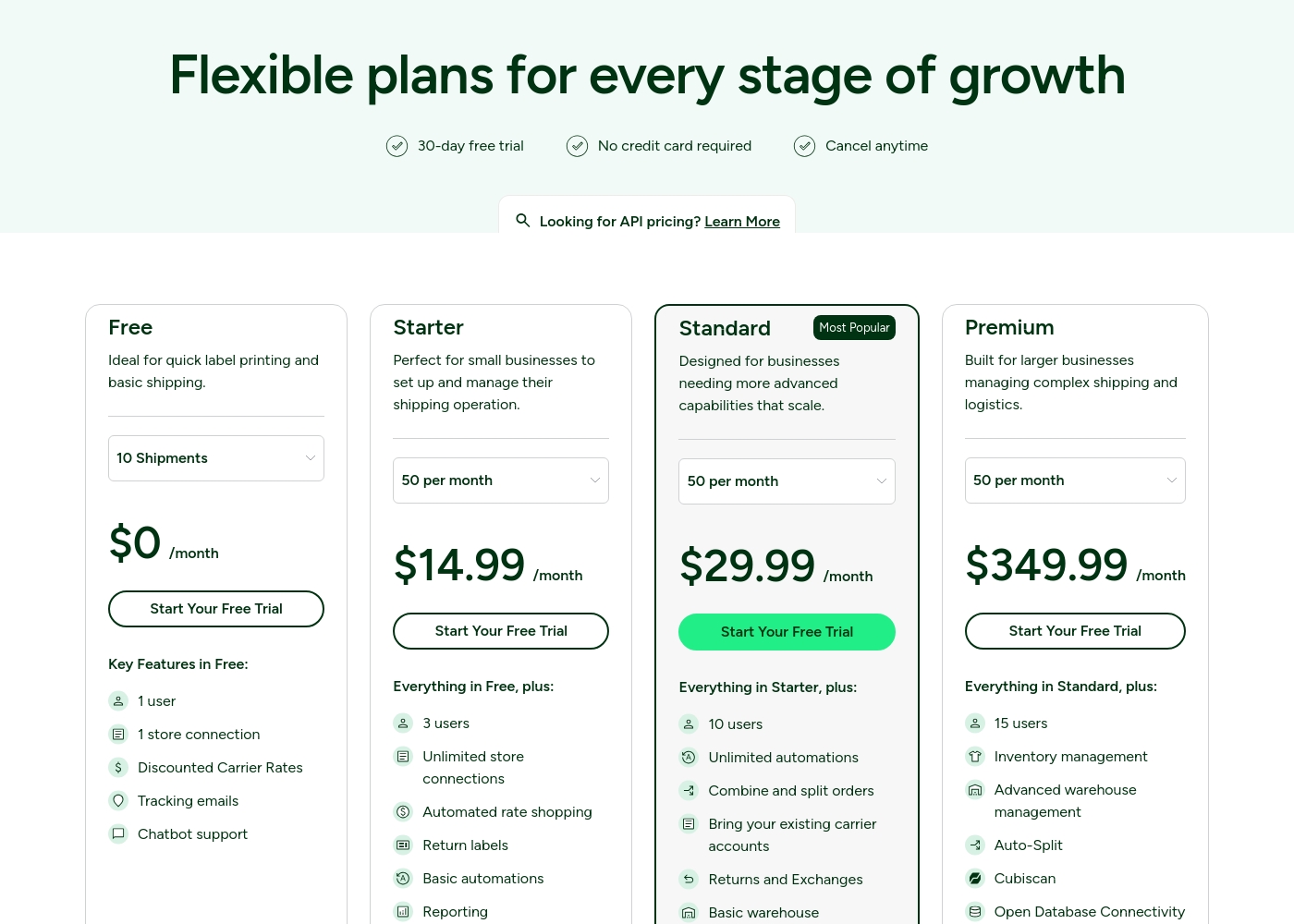
ShipStation costs between $0 and $349.99 per month with four plans: Free at $0/month, Starter at $14.99/month, Standard at $29.99/month, and Premium at $349.99/month.
Here's a look at the features included with each plan tier.
Free
Price: $0 per month Websites Supported: 1 Best For: Quick label printing and basic shipping. Refund Policy: Not applicable Other Features:
- 1 user
- Discounted Carrier Rates
- Tracking emails automatically sent
- Chatbot support included
- 1 user
- 1 store connection
- Discounted Carrier Rates
- Tracking emails
- Chatbot support
- 3 users
- Unlimited store connections
- Automated rate shopping
- Return labels
- Basic automations
- 10 users
- Unlimited automations
- Combine and split orders
- Bring your existing carrier accounts
- Returns and Exchanges
- 15 users
- Inventory management
- Advanced warehouse management
- Auto-Split
- Cubiscan
Pricing Head-to-Head
User Reviews
Unfortunately, we couldn't access the full content of the Trustpilot or Capterra review pages due to access restrictions. Without the actual review snippets, we cannot synthesize specific user feedback on themes like accuracy, ease of use, or support. We recommend checking these links directly for the latest user sentiment. The pricing and website content indicate a robust platform, but external validation is currently unavailable for this summary.
ShipStation receives mixed yet clearly polarized feedback. Many users praise the platform for its efficiency, noting the seamless integration with various selling channels and the significant time saved when printing labels and managing high shipment volumes.
Customers frequently highlight the convenience of features, such as creating return labels and accessing competitive, discounted shipping rates. Positive experiences often mention excellent onboarding sessions led by helpful, specific representatives.
This was one of the best business decisions this year! Implementing ShipStation and shipping directly from our home office has been a total game-changer. It is an easy, seamless solution that saves us so much time.
Our Verdict
Goflow and ShipStation solve two different halves of the e-commerce puzzle. Goflow is your operational command center, unifying orders, inventory, and EDI across 250+ channels. ShipStation is your shipping specialist, focused on automating fulfillment and saving you up to 90% on carrier rates. Goflow's superpower is its unified 360° dashboard. It brings together disconnected systems for total visibility and control. You manage everything from one place, which is a huge advantage for complex operations. ShipStation's superpower is its shipping automation and deep carrier discounts. It can print 500 labels at once and save you millions in shipping costs. It's built for speed and savings in the fulfillment process. The deciding factor is your primary pain point. Choose Goflow if your operations are fragmented and you need a single system to manage orders, inventory, and EDI. Choose ShipStation if your main bottleneck is shipping cost and label speed, and you want to automate your fulfillment workflow. Final verdict: For most growing e-commerce businesses, Goflow is the more comprehensive solution. If you're a high-volume seller needing to unify complex operations, Goflow is the pick. If you're a seller whose main challenge is shipping cost and efficiency, ShipStation is the clear winner. Both are strong, but they serve different masters.
Frequently Asked Questions
Which is better for small teams: Goflow or ShipStation?
ShipStation is better for small teams. Its Starter plan starts at $14.99/month with 3 users and unlimited store connections. Goflow's paid plans start at $499/month, which is a big jump from its free tier. For a small team on a budget, ShipStation is more accessible.
Does Goflow have shipping discounts like ShipStation?
No, Goflow's data does not mention carrier discounts. ShipStation offers discounts up to 90% off FedEx and 87% off USPS rates. If saving on shipping costs is a priority, ShipStation has a clear advantage.
Can I use my existing carrier rates with ShipStation?
Yes, ShipStation lets you bring your existing negotiated carrier accounts (like UPS or FedEx). This feature is included with the Standard plan and higher, with no additional fee.
Is ShipStation worth the extra cost over Goflow?
ShipStation's paid plans are actually cheaper than Goflow's. ShipStation starts at $14.99/month, while Goflow's first paid plan is $499/month. The value depends on your needs. ShipStation saves money on shipping. Goflow unifies your entire operations.
Can I migrate from Goflow to ShipStation easily?
There's no direct migration tool mentioned. Moving data between systems would likely require manual export/import. Consider your specific integrations and data needs before switching.
Which tool has better customer support?
Goflow has a higher user rating of 4.2 vs ShipStation's 3.3. ShipStation reviews frequently complain about slow, unhelpful support. Goflow's support details are less clear, but its rating suggests better user satisfaction.
Ready to Choose?
Both tools have their strengths. Choose based on your specific needs.