Equifax vs Home Title Lock
Equifax guards your credit report, while Home Title Lock secures your most valuable asset: your home title. They target completely different, critical financial threats. Choosing the right one means protecting your peace of mind and equity.
Best for: Consumers preparing for a major financial milestone (home or car purchase)., Individuals focused on improving or securing their singular Equifax credit report.
Best for: Homeowners with significant equity concerned primarily about deed theft., Individuals owning multiple investment properties requiring title security.
Necessary Service, Troubling Execution.
We see Equifax offers valuable services like credit monitoring and identity theft protection starting at a competitive price point. However, user experiences consistently reveal significant challenges regarding data accuracy, platform accessibility, and responsiveness. Overall, we advise extreme caution, as the widespread reports of poor customer support and technical failure fundamentally undermine the product’s core utility.
Pros
- Entry-level credit monitoring starts at $9.95 per month.
- Higher tiers include up to $1MM in identity theft insurance.
- Users have the ability to lock their personal Equifax credit report.
- Plans provide professional identity restoration services.
Cons
- Extremely long hold times and unresponsive customer service are common complaints.
- Reports of unauthorized charges and difficulty processing subscription cancellations.
- Frequent issues with outdated technology and website downtime.
- Users cite major inaccuracies and slow updates on credit reports.
Comprehensive title defense for homeowners.
We found Home Title Lock offers robust protection with its Million Dollar TripleLock® system, focusing solely on deed monitoring and fraud restoration. The 24/7 alerts and dedicated U.S.-based team address a genuine risk for homeowners. Overall, this service provides valuable, specialized security for your most important asset, though some users report questionable marketing tactics.
Pros
- Includes $1 Million TripleLock® Restoration Coverage.
- Provides continuous 24/7 monitoring and urgent fraud alerts.
- Access to U.S.-based restoration experts and support team.
- Service successfully alerted users to false ownership activity.
Cons
- Some users criticized marketing tactics as 'pushing fear.'
- Reports of unprofessional customer support during cancellation.
- Critics argue title checks can often be performed for free regionally.
- Relatively small overall pool of external reviews (45 on Trustpilot).
AboutEquifax
Equifax Consumer Services provides tools to help you manage your financial journey and secure your identity. Their core offering, EQUIFAX Complete™, bundles crucial credit monitoring alongside comprehensive ID theft protection services for one adult. It gives you the knowledge you need to make informed decisions about your credit report. They aim to keep you informed and better protected from potential fraud. 💡
AboutHome Title Lock
Home Title Lock provides dedicated protection for your most valuable asset: your home title. Think of it like a specialized smoke alarm for your property’s legal ownership. Their signature service is called the Million Dollar TripleLock® Protection.
This system offers continuous 24/7 monitoring to detect any tampering with your title documents or mortgage. It’s an essential security layer for any homeowner who wants to protect their equity. This protection is especially crucial for longtime homeowners who often have significant equity that thieves might target. 🏡
Highlights
Feature Comparison
Features Overview
We highlight the main differences and pick a winner for each feature.
Core Protection Focus
Equifax guards personal credit data; Home Title Lock protects property ownership documents.
Equifax focuses on monitoring personal credit reports and preventing identity theft. It tracks critical changes to your Equifax file. This is crucial for anticipating major financial milestones like loans. Home Title Lock protects your home equity from fraudulent deed changes. It monitors your property title and address 24/7. This defense prevents unauthorized transfers or loans against your house. You must decide if protecting your credit rating or your physical asset is the immediate priority. Equifax secures your identity; Home Title Lock secures your real estate deed. If you are a homeowner, supplementing Equifax monitoring with Home Title Lock’s asset defense is recommended.
Restoration Coverage
Equifax offers identity restoration; Home Title Lock provides up to $1M for title restoration.
Equifax provides professional identity restoration services focusing on recovering your profile. Higher plans include up to $1 million in ID theft insurance for recovery costs. This funding is focused on identity and credit remediation. Home Title Lock includes $1 Million TripleLock® restoration coverage. This fund explicitly pays for necessary legal fees and complicated filing costs. U.S.-based experts manage the entire legal process to restore your title. Home Title Lock's coverage is dedicated solely to property recovery costs. Equifax addresses a broader range of financial identity issues. Home Title Lock provides higher dedicated financial protection for title fraud. If deed fraud occurs, Home Title Lock's targeted fund and experts greatly simplify the legal burden.
Monitoring Scope
Home Title Lock tracks specific asset documents; Equifax provides broader, credit bureau tracking.
The base Equifax plan monitors only your Equifax credit report for changes. Premier tiers expand this to include comprehensive 3-bureau credit features. This offers wider visibility into your financial liabilities. Home Title Lock exclusively monitors your property's title and address. It deliberately avoids tracking PII or general credit reports. This specialization improves focus on property fraud detection. Home Title Lock provides deep specialization in one high-value area: your asset deed. Equifax provides broad protection across personal financial data. You need both to cover all major fraud vectors. Consider pairing Equifax for general ID protection with Home Title Lock for dedicated property defense.
Credit Report Control
Equifax offers an essential report lock feature; Home Title Lock focuses purely on deed security.
Equifax allows users to easily lock their personal Equifax credit report. This instantly prevents many third parties from accessing the file. Locking your credit is vital when you suspect fraud or before seeking large loans. Home Title Lock does not offer any credit report monitoring or locking capabilities. Its security function is limited entirely to monitoring the home title itself. This tool won't help if your personal credit data is stolen. If control and security over your credit profile are your main goal, Equifax is the clear choice. Home Title Lock is not a substitute for standard credit protection. Equifax gives you active power over who views your financial history, which Home Title Lock cannot do.
Customer Support Quality
Home Title Lock offers highly praised U.S.-based experts; Equifax user reviews cite extremely poor support.
Equifax reviews repeatedly cite unacceptable delays and unresponsive customer support. Users report holding for over an hour and having difficulty canceling subscriptions. Getting technical or billing issues resolved through Equifax is a major challenge. Home Title Lock relies on U.S.-based restoration experts and support staff. Users consistently praise the quick response and knowledgeable assistance provided. Support quality is a huge selling point for Home Title Lock. Home Title Lock offers genuine peace of mind with excellent support if fraud occurs. Equifax support is reportedly a major liability users wish to avoid. In a crisis, dedicated, competent experts like those at Home Title Lock are far more valuable than the unresponsive support often found at Equifax.
Pricing Transparency
Home Title Lock offers transparent tiers; Equifax premium pricing is not publicly stated.
Equifax starts at $9.95 per month for basic credit monitoring benefits. Equifax's pricing for higher tiers (Premier and Family plans) is not publicly stated. This makes comparing the premium packages challenging. Home Title Lock ranges from $17.95 to $19.95 per month. The cost is fully transparent across monthly, annual, and two-year commitments. All tiers include the key $1 million restoration fund. Home Title Lock wins on transparency and clearly linking cost to specific, high-value asset protection. Equifax forces users to inquire for details on essential features. If you want predictable costs for comprehensive coverage, Home Title Lock provides clearer long-term value than Equifax.
Trial and Guarantee
Home Title Lock is risk-free to try; Equifax requires payment immediately upon sign-up.
Equifax does not explicitly offer a free trial or an initial money-back guarantee. Payment is charged immediately upon subscribing to Equifax services. Refunds are limited only to fully unused portions of annual plans. Home Title Lock generously provides a 14-day free trial with a promo code. Every subscription is also backed by a comprehensive 30-Day Satisfaction Guarantee. Users can explore Home Title Lock coverage risk-free. Trying Home Title Lock is easy and commitment-free before purchasing a plan. Equifax requires full financial commitment upfront for new users. This makes testing Home Title Lock's effectiveness far easier than trying to navigate the rigid payment policies of Equifax.
Digital Accessibility
Equifax provides a dedicated mobile app; Home Title Lock relies primarily on expert human interaction.
Equifax offers the dedicated myEquifax app for management and tracking. Consumers can navigate their entire credit journey and access services on the go. This provides convenient mobile access for frequent checks. Home Title Lock's service is alert-based and relies on professional consultation upon detection. A dedicated mobile app for constant management is not marketed as a core feature. Interaction is often channeled through U.S.-based experts. For frequent, self-managed credit monitoring, the Equifax app provides convenience. Home Title Lock prioritizes expert response over daily app management. Equifax is better for users who want to check their status daily via a mobile device.
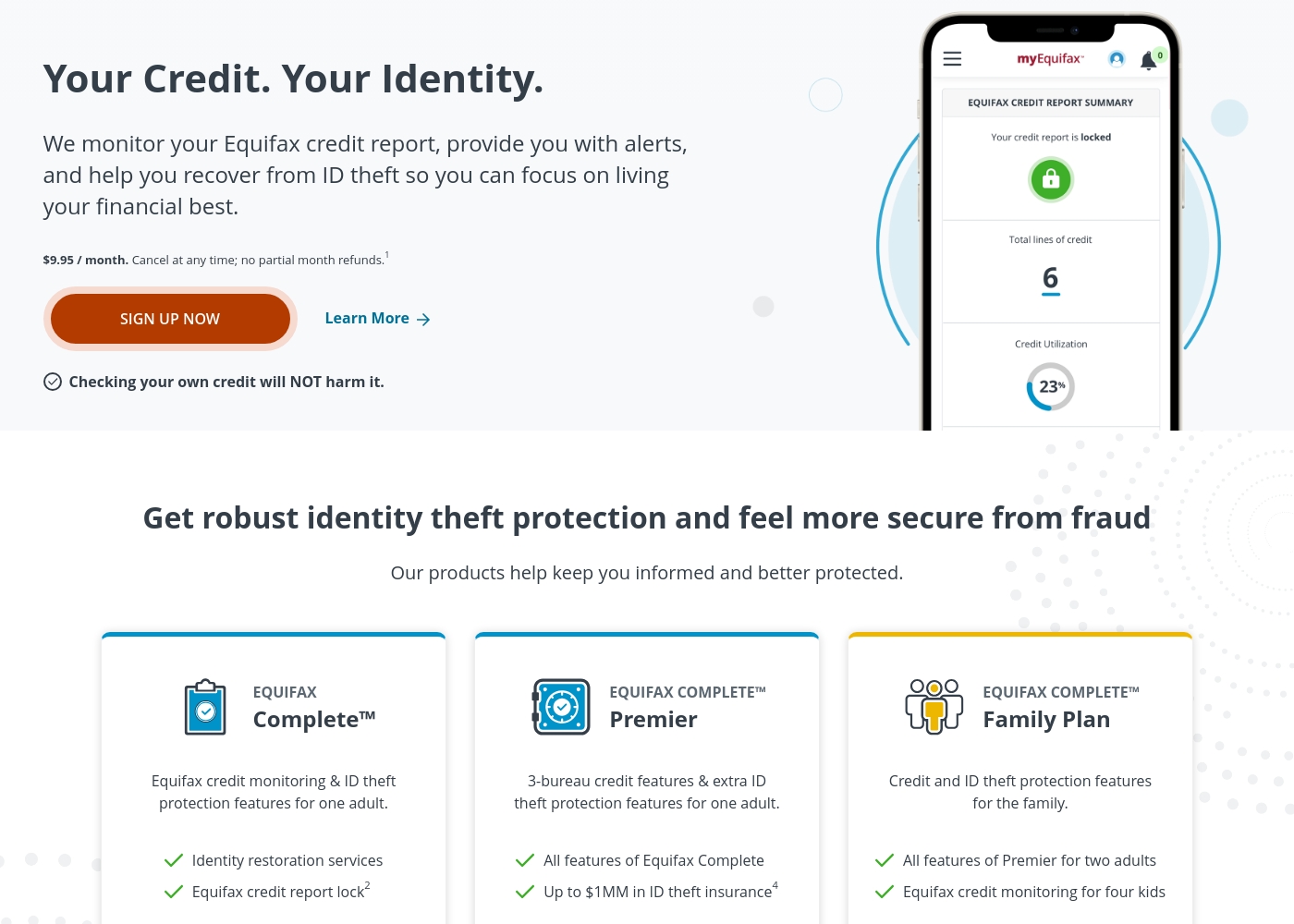
There are three primary plans: EQUIFAX Complete™ at $9.95/month, EQUIFAX Complete™ Premier, and EQUIFAX Complete™ Family Plan.
We provide different options so you can select the right level of protection for your unique financial situation.
EQUIFAX Complete™
Price: $9.95 / month Best For: One adult Refund Policy: Cancel at any time; no partial month refunds. Other Features: Identity restoration services, Equifax credit report lock.
- Equifax credit monitoring & ID theft protection features for one adult
- Identity restoration services
- Equifax credit report lock
- All features of Equifax Complete
- 3-bureau credit features & extra ID theft protection features for one adult
- Up to $1MM in ID theft insurance
- Credit and ID theft protection features for the family
- All features of Premier for two adults
- Equifax credit monitoring for four kids
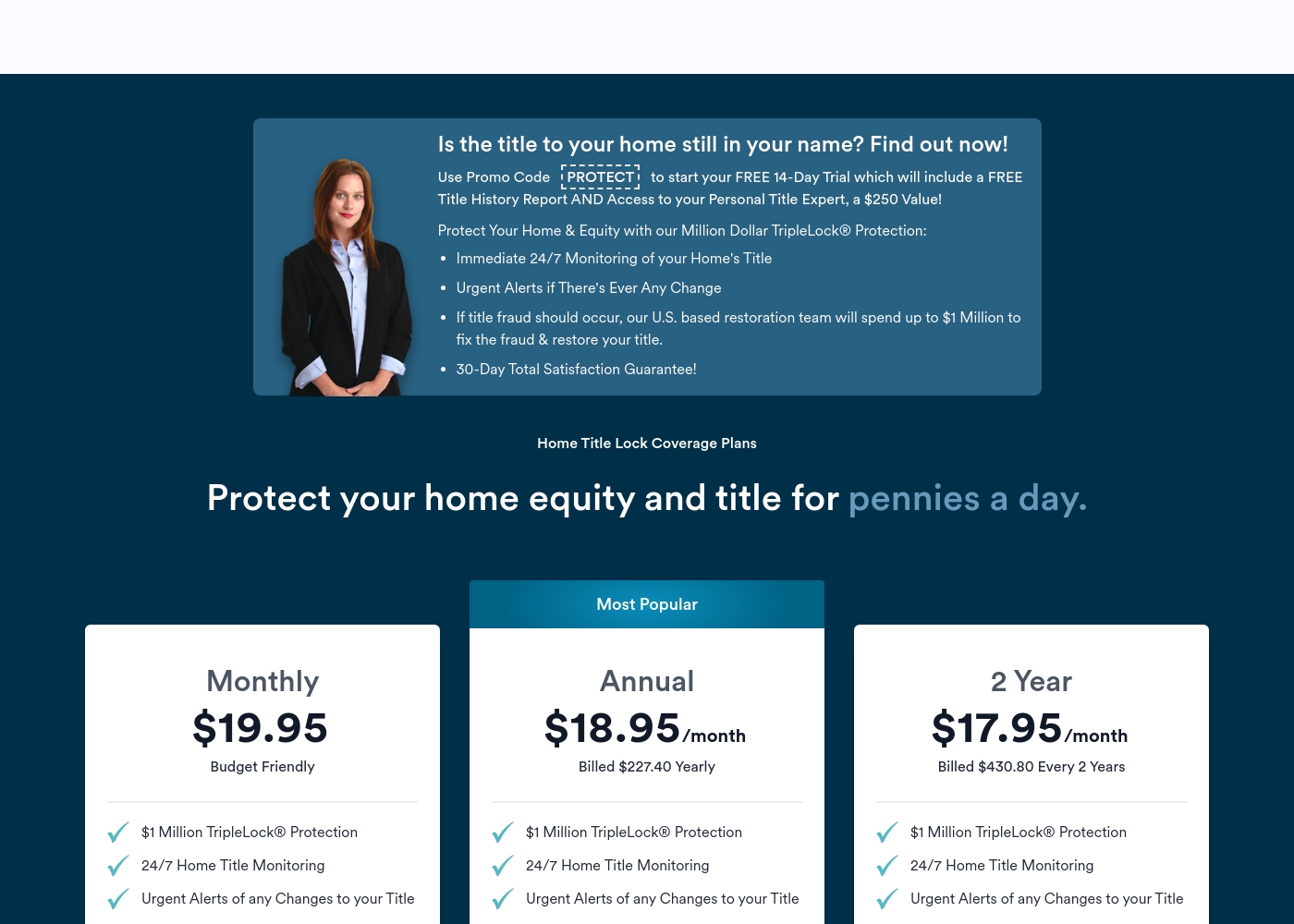
Home Title Lock costs between $17.95 and $19.95 per month with three plans: Monthly at $19.95, Annual at $18.95/month, and 2 Year at $17.95/month.
Below are the details for each plan, allowing you to choose the level of protection that best fits your budget.
Monthly
Price: $19.95 per month Best For: Budget Friendly Refund Policy: 30-Day Total Satisfaction Guarantee Other Features:
- $1 Million TripleLock® Protection
- 24/7 Home Title Monitoring
- Urgent Alerts of any changes to your Title
- Access to US Based Team of Restoration Experts
- $1 Million TripleLock® Protection
- 24/7 Home Title Monitoring
- Urgent Alerts of any Changes to your Title
- Access to our US Based Team of Restoration Experts
- $1 Million TripleLock® Protection
- 24/7 Home Title Monitoring
- Urgent Alerts of any Changes to your Title
- Access to our US Based Team of Restoration Experts
- $1 Million TripleLock® Protection
- 24/7 Home Title Monitoring
- Urgent Alerts of any Changes to your Title
- Access to our US Based Team of Restoration Experts
- 2-Year Price Lock Protection
Pricing Notes
- Equifax base plans are cheaper, starting at $9.95/month, but premium pricing is opaque.
- Home Title Lock offers transparent pricing across all commitments, detailing rates up to $19.95/month.
- Home Title Lock includes a 14-day free trial and a 30-day money-back guarantee.
- Equifax requires payment immediately and only offers refunds for fully unused annual months.
- Home Title Lock provides better long-term savings with its 2-Year Price Lock Protection.
Pricing Head-to-Head
User Reviews
Overall feedback for Equifax on Trustpilot shows overwhelmingly negative sentiment. The most significant complaint centers on customer support 😩, which users describe as non-existent, featuring extremely long hold times (sometimes hours), abrupt disconnections, and representatives who are difficult to understand due to strong accents or poor training.
Many users report being trapped in automated phone loops trying to resolve issues. Furthermore, the technology is often cited as outdated; users struggle with website downtime, difficulty downloading credit reports, and major account access challenges, including being repeatedly locked out after authentication hurdles.
I sat on hold for over 80 minutes trying to fix a security issue with my prepaid card. The customer service experience was truly unacceptable, and I was unable to resolve my simple query.
Home Title Lock maintains a relatively strong 3.9-star rating on Trustpilot based on 45 reviews. Users frequently cite the peace of mind the service provides, especially for long-term protection and securing future inheritance.
Specific incidents highlight the team’s effectiveness; one user reported receiving seven alerts and praised a representative named Jamie for quick and clear assistance. Other customers appreciate the very quick response times and knowledgeable staff, such as Ms.
As soon as I started this protection they called me to clarify any questions I may have. Now I have a good piece of mind about this insurance. I recommend this to others.
Our Verdict
Choosing between Equifax and Home Title Lock is about protecting two different risk categories. Equifax guards your credit history and personal identity data. Home Title Lock provides a specialized defense for your valuable home equity and title from deed fraud. For ultimate safety, having both types of protection is the smartest strategy. Equifax’s superpower is giving you granular control over your financial profile. You receive direct credit monitoring and identity theft protection starting low at $9.95/month. Equifax also offers the crucial ability to lock your Equifax credit report from certain inquiries. However, be ready for potential frustration if you ever need Equifax customer support. Home Title Lock focuses entirely on safeguarding your single most valuable asset. The $1 Million TripleLock® restoration coverage is Home Title Lock's defining feature. Home Title Lock provides constant 24/7 title monitoring and swift, urgent fraud alerts. Their U.S.-based experts are highly praised and handle the complicated legal mess. The deciding factor is the type of fraud risk you fear most right now. Do you need to manage your credit score and ID profile effectively? Choose Equifax, but expect service deficiencies. Are you a homeowner worried about the catastrophic loss from deed theft? Home Title Lock is a necessary, specialized defense with great support. Ultimately, if customer experience and dedicated asset protection are key, Home Title Lock provides a superior service. Equifax addresses broad credit risks, but Home Title Lock prevents a specific, financially devastating event. Home Title Lock offers significantly better support than Equifax.
Frequently Asked Questions
Which tool is better for credit score management: Equifax or Home Title Lock?
Equifax is specifically designed to help monitor and manage your credit score. Home Title Lock does not involve any credit reporting or scoring access. Equifax offers credit report locking features which are essential for credit control.
Does Home Title Lock monitor my credit like Equifax does?
No, Home Title Lock does not monitor your credit reports or PII (Personally Identifiable Information). Home Title Lock focuses only on 24/7 monitoring of your property title and address. Equifax focuses on monitoring your Equifax credit profile.
What is the main difference in restoration coverage between Equifax and Home Title Lock?
Equifax restoration services focus on recovering a stolen personal identity profile. Home Title Lock provides up to $1 Million to cover legal fees and costs for property title restoration. Home Title Lock's coverage is strictly dedicated to your home title.
Who has better customer support: Equifax or Home Title Lock?
Home Title Lock has significantly better user feedback and highly-rated U.S.-based experts. Equifax receives widespread complaints about unresponsive support and extremely long hold times. Home Title Lock is the clear winner for reliable support.
Does Equifax offer a free trial like Home Title Lock?
Home Title Lock provides a 14-day free trial plus a 30-day money-back guarantee. Equifax does not offer a free trial; payment is required immediately upon subscribing. Equifax only refunds fully unused portions of annual plans.
Is Home Title Lock expensive compared to Equifax?
Home Title Lock starts at $17.95/month, focusing on high-value asset protection. Equifax starts lower at $9.95/month but focuses on generalized identity protection. Home Title Lock provides greater dedicated value for homeowners.
Ready to Choose?
Both tools have their strengths. Choose based on your specific needs.