Dreamstime vs TuneReel
Dreamstime and TuneReel both offer essential creative assets but focus on very different media types. Dreamstime is the king of general stock photos, video, and audio assets combined. TuneReel specializes in high-quality, worry-free royalty-free music licensing only. This comparison helps you decide if you need media variety or premium, focused audio tools.
Best for: Large marketing agencies requiring high volumes of mixed media (photos, 4K video, audio), Design teams needing reliable mobile asset access (iOS/Android)
Best for: Content creators and YouTubers needing secure, monetizable background music, Freelance video editors needing simple licensing for client projects
Great Value with Excellent Support
We found Dreamstime excels in offering a massive asset library paired with highly responsive customer service, often resolving thorny issues like accidental double charges instantly. However, we caution new users about the automatic renewal practices and a growing prevalence of AI-generated images that clutter search results. Overall, the platform delivers strong value for high-volume content creators who prioritize helpful human support.
Pros
- High quality and vast selection of stock photos, videos, and audio.
- Exceptional and responsive customer service that promptly handles refunds.
- Simple and efficient image uploading process for contributors.
- User-friendly platform that is easy for most users to navigate.
Cons
- Subscription system lacks clarity regarding automatic renewals and cancellation.
- High volume of difficult-to-filter, low-quality AI-generated content.
- Search functionality sometimes struggles to return relevant results.
- Photographers report significant recent drops in sales and high payout threshold ($100).
Flexible licensing and high-quality tracks.
We found TuneReel offers a great selection of high-quality, copyright-safe music with excellent proactive support available via chat or email. However, opaque subscription cancellation methods are a genuine concern for user trust and independence. Overall, we recommend TuneReel for its strong catalog and competitive pricing model.
Pros
- Competitive annual pricing model starting under $90.
- High-quality music tracks with professional production sound.
- Support staff provides fast, detailed, and responsive communication.
- Offers simple, worry-free, lifetime royalty-free licensing.
Cons
- Reported difficulty finding the self-service subscription cancellation option.
- The dedicated billing portal link is not easily accessible via the main profile settings.
- Limited number of external reviews available (12 on Trustpilot).
AboutDreamstime
Dreamstime is known as the world's largest stock photography community. It was established in 2000 and has since grown immensely. Talented contributors worldwide enrich the vast collection daily. This resource is perfect for everyone, from large corporations to small magazines and personal blogs. You'll find professional assets regardless of your budget. 💡
AboutTuneReel
TuneReel is a professional music licensing library built specifically for content creators. This platform serves the next generation of filmmakers, video editors, podcasters, and small business owners. You can license high-quality, stock music composed by talented, world-renowned composers and indie artists. It’s truly an excellent music library for commercial production. 💡
Highlights
Feature Comparison
Features Overview
We highlight the main differences and pick a winner for each feature.
Media Library Scope
Dreamstime offers all media types; TuneReel is strictly curated music.
Dreamstime boasts over 314 million stock photos, illustrations, and videos up to 4K. It is a full media solution including extensive audio archives and editorial content. TuneReel focuses solely on high-quality royalty-free production music tracks. TuneReel's library is highly curated, featuring exclusive tracks from skilled artists. Dreamstime is about volume and variety; TuneReel is about specialized audio quality.
Licensing & Rights
TuneReel offers simple 'license forever' rights; Dreamstime uses complex tiered plans.
TuneReel offers secure, simple licensing that is copyright-safe for client work and monetization. Licenses last forever, minimizing long-term confusion for TuneReel users. Dreamstime uses credit packages or tiered subscriptions with automatic renewal clauses. Dreamstime offers different usage rights (online vs. print) based on the specific plan chosen. TuneReel excels by making commercial usage rights clear at the Pro tier. TuneReel actively helps resolve YouTube copyright issues quickly and efficiently.
Pricing Affordability
TuneReel is exceptionally cheap for unlimited audio; Dreamstime costs scale rapidly with volume.
Dreamstime pricing is varied, featuring high-volume subscriptions and separate credit packages. High-volume image subscriptions with Dreamstime reach over $200 per month. TuneReel is highly affordable for unlimited use, with the Pro plan costing only $159 annually. TuneReel's monthly equivalent price for unlimited music is under $14. TuneReel delivers much better value if you only need audio assets regularly.
Customer Support Focus
Dreamstime resolves billing issues professionally; TuneReel resolves specific YouTube claim issues.
Dreamstime support is praised for quickly handling billing errors, cancellations, and issuing efficient refunds. User testimonials highlight prompt and professional support staff when dealing with subscriptions. TuneReel's support is known for being quick, detailed, and actively resolving YouTube copyright claims. TuneReel provides peace of mind regarding claim disputes immediately. Both offer excellent support but solve different critical problems for the user.
Asset Discovery
Dreamstime uses visual AI tools; TuneReel uses specialized audio filters and inspiration tools.
Dreamstime leverages AI for automatic image classification, smart cropping, and keyword suggestions. The PhotoEye™ tool helps users search through its massive 314M+ library effectively. TuneReel uses Smart Search to filter music by genre, instrument, BPM, and brightness. TuneReel also has a unique 'Inspire Me' button for quick, guided track discovery. Both prioritize speed but focus on very different media search optimizations.
Team Scaling Clarity
TuneReel clearly states a 100-user limit; Dreamstime requires contacting sales for specifics.
Dreamstime offers Multi-seat licenses starting around $59/month but requires custom quotes for large teams. Larger Dreamstime organizations must contact sales for specific corporate plans. TuneReel clearly licenses its Pro Membership for organizations up to 100 people. This is a clear, fixed annual price for many expanding mid-sized teams. TuneReel provides greater cost transparency for mid-sized teams (up to 100 users).
Mobile Workflow
Dreamstime supports a dedicated mobile app; TuneReel has no specific mobile app data.
Dreamstime offers a dedicated mobile application for both iOS and Android platforms. Users can search and download needed assets while away from their primary computer. This allows users to maintain a continuous creative workflow remotely. TuneReel does not explicitly mention a dedicated mobile application or specific mobile workflow support. For creators who frequently work on the go, Dreamstime provides essential flexibility.
Dreamstime costs between $14.99 (one-time) and $219 per month with several plans available: 5 images at $25, 10 images at $39, up to 750 images at $219 per month, or $2,028 billed annually.
Dreamstime offers flexible pricing through credit packages or standard time-based subscriptions. Let's explore the best fit for your content needs.
Credit Packages (Pay per Download)
Price: Starts at $14.99 (for 3 credits) Best For: Users who need images occasionally or high-value media Other Features:
- Credits are the site currency for all downloads.
- Credits are valid for one full year from purchase.
- Use credits for RF, EL images, videos, and professional audio.
- Prices differ depending on media size, level, format, or license.
- Pay per download (using site currency)
- Used for RF, EL images, videos, audio
- Valid for 1 Year
- 5 total downloads per month
- Unused downloads roll over
- Automatic renewal
- Includes lifetime license
- 200 downloads per month
- Unused downloads roll over
- Includes lifetime license and unlimited online usage
- Gives unlimited printed and electronic copies
- 750 downloads per month
- Automatic renewal
- Downloads roll over
- Includes lifetime license and unlimited online usage

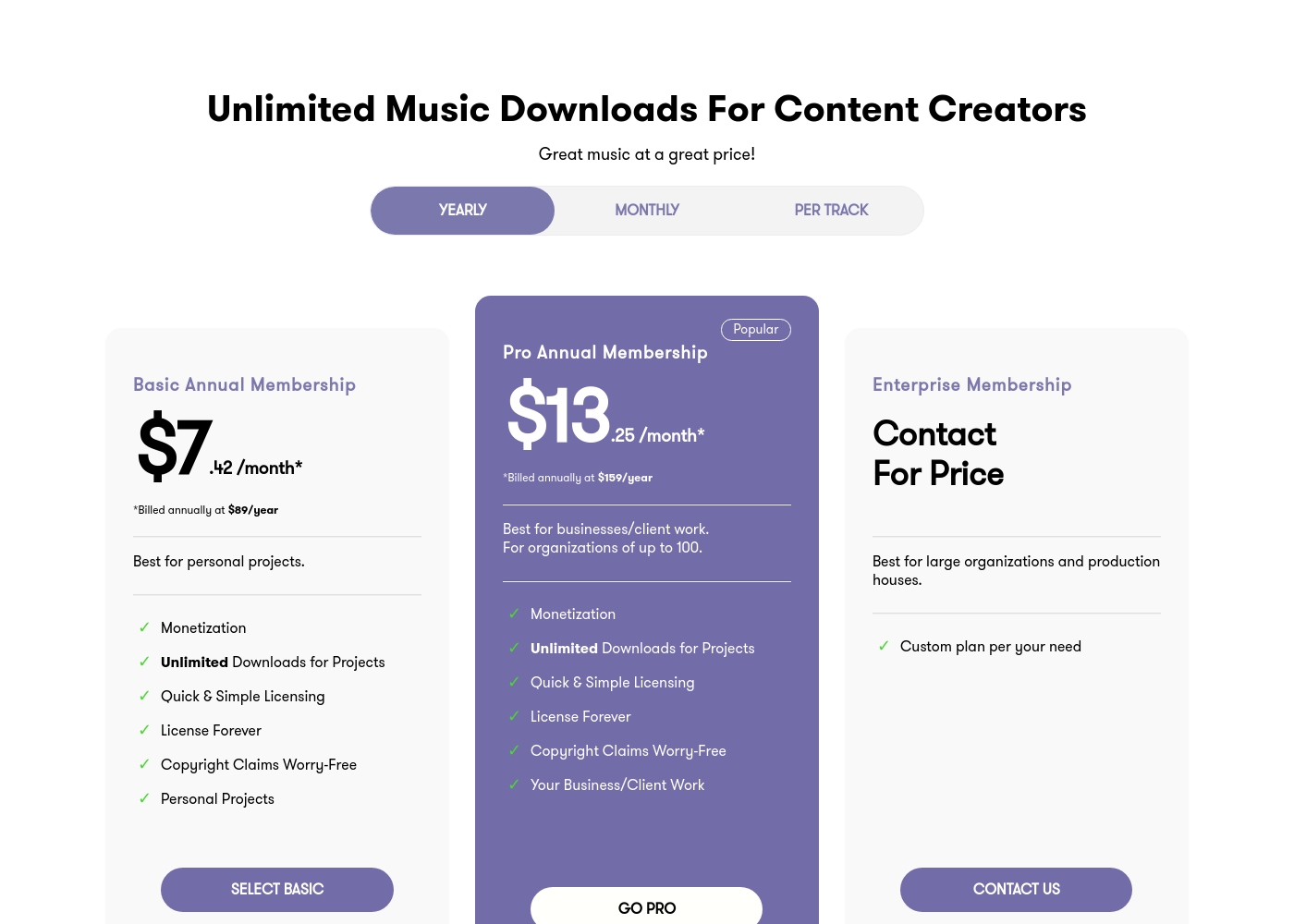
TuneReel costs between $89 and $159 per year with 3 plans: Basic Annual Membership at $89/year, Pro Annual Membership at $159/year, and Enterprise Membership (Contact for Price).
Let's look closely at what each subscription tier offers creators and businesses.
Basic Annual Membership
Price: $89/year (billed annually, equivalent to $7.42/month) Best For: Personal projects Refund Policy: Money-back guarantee if you have not licensed music Other Features:
- Unlimited downloads for projects
- Quick and simple licensing
- Music license lasts forever
- Copyright claims are worry-free
- Includes monetization rights
- Monetization
- Unlimited Downloads for Projects
- Quick & Simple Licensing
- License Forever
- Copyright Claims Worry-Free
- Monetization
- Unlimited Downloads for Projects
- Quick & Simple Licensing
- License Forever
- Copyright Claims Worry-Free
- Custom plan per your need
Pricing Notes
- Dreamstime offers a free 7-day trial, but users must be cautious of the automatic renewal process after the trial ends.
- TuneReel does not offer a free trial but provides a money-back guarantee if no music has been licensed.
- TuneReel's Pro Annual Membership ($159) is exceptionally affordable for unlimited commercial music licensing.
- Dreamstime's highest volume plans (750 images/month) are significantly more expensive ($2,028/year) than TuneReel's offerings.
- Dreamstime uses credit packages for flexible pay-per-download usage for non-subscription users.
Pricing Head-to-Head
User Reviews
Dreamstime generally receives positive feedback from its large user base, scoring a 3.6/5 on Trustpilot. Customers frequently praise the high quality of the images available and the platform's user-friendly nature, noting that uploading and navigating the site is straightforward and easy.
Exceptional customer support is a standout feature; reviewers often highlight the staff's professionalism, quick response times, and efficiency in handling issues like accidental double billing or subscription problems. Contributors enjoy the strong sense of community and the fast approval process for their work.
I accidentally upgraded my free trial and was charged immediately. Dreamstime customer service efficiently processed my cancellation and provided a full refund quickly since I hadn't used any downloads. I really appreciate their prompt support!
TuneReel generally receives positive feedback, primarily cited for its exceptional value and responsive support team. Users frequently praise the competitive annual membership pricing ($89–$159) and the high quality of the music library, noting that the tracks are high-end and diverse.
Many appreciate the flexibility of licensing, mentioning the easy, straightforward process, and the option to make one-off track purchases without long subscriptions. Reviewers highlighted the second-to-none customer service, citing fast response times and helpful, detailed explanations regarding licensing complexities, monetization, and client work.
We had lots of questions about licensing and authorization for client work. The team at TuneReel explained everything in incredible detail. Their support is truly second to none.
Our Verdict
The decision between Dreamstime and TuneReel is less of a competition and more about your specific asset needs. Are you creating a multimedia project or just seeking perfect background music? Dreamstime provides a massive, all-in-one resource for visuals and audio. It’s the stable choice for high-volume agencies needing comprehensive stock media assets instantly. Dreamstime’s superpower is its sheer breadth and volume, offering 314 million images, 4K video, and strong editorial content. Dreamstime also provides excellent customer support, efficiently handling tricky subscription issues and refunds. You get flexible credit options and high-volume monthly plans with Dreamstime. TuneReel’s superpower is making audio licensing worry-free for professional content creation. TuneReel offers unlimited access to high-quality, curated music for extremely competitive annual pricing. The TuneReel team actively resolves YouTube copyright claims, completely safeguarding your monetization efforts. The deciding factor is whether you require unlimited, specialized audio without licensing confusion, or a massive library of mixed photos and video. If visuals are secondary, TuneReel wins on audio value and licensing peace of mind. Choose Dreamstime if your work requires a steady stream of imagery and video alongside audio. The final verdict: Pick TuneReel if your primary focus is video production and reliable, affordable music licensing. Select Dreamstime if you are an agency whose main need is high-volume images and supportive billing practices.
Frequently Asked Questions
Which service is cheaper for unlimited assets: Dreamstime or TuneReel?
TuneReel is significantly cheaper for unlimited audio assets, costing just $159 per year for commercial use. Dreamstime’s unlimited Zero Gravity plan is limited to specific, 'Level 0' assets only. Dreamstime's core subscriptions scale up significantly based on monthly download volume.
Does Dreamstime offer copyright protection like TuneReel?
TuneReel explicitly offers active support to resolve YouTube copyright claims, giving users peace of mind. Dreamstime offers full licensing but lacks a specialized program to resolve third-party claims quickly. TuneReel is the clear winner for protecting video monetization rights.
Can I buy a single license from Dreamstime or TuneReel?
Yes, both offer pay-per-use options for single assets. Dreamstime uses credit packages that are valid for one year after purchase. TuneReel offers 'Per Track' licensing for users who only need a single song once.
Is TuneReel worth it if I only need images and not music?
No, TuneReel focuses exclusively on high-quality royalty-free production music. If you only need images, photos, or video, Dreamstime is the necessary choice. Dreamstime offers over 314 million images for these visual needs.
How does mobile access differ between Dreamstime and TuneReel?
Dreamstime offers a dedicated mobile app on iOS and Android for downloading assets on the go. TuneReel does not mention a specific mobile application for its audio library workflow. Dreamstime supports a more flexible mobile workflow.
Which tool is better for a mid-sized team of 50 users?
TuneReel is much clearer for medium teams, supporting up to 100 users on its Pro Annual Membership. Dreamstime requires you to contact sales for a custom quote for specific multi-seat licenses. TuneReel provides transparent pricing for growing teams.
Ready to Choose?
Both tools have their strengths. Choose based on your specific needs.