Drata vs Vanta
Drata and Vanta are both top contenders for automating compliance, but they have different strengths. Drata focuses on a powerful AI-driven Trust Center to close deals faster. Vanta shines with its integrated risk management and a 24/7 AI agent for task automation.
Best for: Sales-driven organizations needing to accelerate deal cycles with a premium Trust Center., Companies requiring advanced, AI-powered third-party risk assessment as a core feature.
Best for: Security teams wanting a single, unified platform for compliance, risk management, and audit prep., Organizations that value a 24/7 AI assistant (the Vanta Agent) to handle routine GRC tasks.
Powerful, automated compliance platform.
We find Drata to be a robust platform that significantly automates compliance workflows and evidence collection. Overall, it's a strong choice for organizations aiming to streamline audits and prove trust continuously, though pricing details are not transparently listed.
Pros
- Automates evidence gathering and control monitoring.
- Supports a wide range of compliance frameworks.
- Includes AI features for questionnaires and risk assessment.
- Helps reduce audit preparation time and costs.
Cons
- Pricing is customized and not publicly listed.
- Lacks a stated free trial or money-back guarantee.
- Complex features may be more than small teams need.
- Onboarding may require significant initial setup.
Powerful compliance automation for growing teams.
We found Vanta excels at automating compliance workflows and reducing manual effort, which aligns with its promise to save time and accelerate deals. Its tiered pricing offers flexibility, but the lack of transparent costs and a free trial means committing to a demo before understanding the full investment.
Pros
- Automates evidence collection and monitoring for frameworks like SOC 2.
- AI-powered questionnaire automation speeds up vendor assessments.
- Unified platform for compliance, risk management, and audit prep.
- Trust Center helps showcase security posture to customers.
Cons
- Pricing requires a custom quote, with no public tiers or free trial.
- Add-ons for key features like Third-Party Risk Management increase costs.
- Initial setup and policy onboarding may have a learning curve.
- Some users report integration challenges with specific tools.
AboutDrata
Drata is an Agentic Trust Management Platform designed for security, compliance, and trust teams. 🛡️ It automates the complex work of governance, risk, and compliance (GRC). The platform helps you map controls, collect evidence, and monitor your security posture in real-time across multiple frameworks like SOC 2, ISO 27001, and more.
AboutVanta
Vanta is an Agentic Trust Platform designed for startups, mid-market, and enterprise companies. It automates the entire process of getting and staying compliant with frameworks like SOC 2, ISO 27001, and HIPAA. The platform combines compliance, risk management, and audit preparation into one place. It's built for security leaders who want to scale their programs without adding headcount. 💡
Highlights
Feature Comparison
Features Overview
We highlight the main differences and pick a winner for each feature.
AI Questionnaire Automation
Both use AI to draft security responses. Drata's AI learns from your entire knowledge base. Vanta's automation is tiered with usage limits per plan.
Drata's AI questionnaire assistance learns from your Knowledge Base to provide accurate, consistent answers. It's designed to save teams hundreds of hours annually. The system gets smarter over time. Vanta's AI-powered Questionnaire Automation drafts responses for you. The Plus plan includes 25 questionnaires per year, while the Professional plan includes 144. Additional questionnaires can be purchased as an add-on. The key difference is learning versus limits. Drata emphasizes continuous learning for accuracy, while Vanta provides a clear, tiered quota. Both aim to eliminate manual work. For teams handling high volumes, Drata's approach may offer more scalability without worrying about hitting an annual cap.
Trust Center
Drata's Trust Center is a core, AI-powered sales tool. Vanta's Trust Center is included but has advanced features as add-ons.
Drata's AI-Powered Trust Center lets prospects review your security posture instantly. It supports branded pages, Docusign/Ironclad NDA integration, and Salesforce/HubSpot sync. It's built to accelerate deals. Vanta's Real-Time Trust Center is included in all plans. Basic access is standard, but advanced features like a buyer-facing chatbot, custom domains, and ROI reporting are available as add-ons in higher tiers. Drata positions the Trust Center as a proactive revenue accelerator. Vanta includes it as a foundational transparency tool. Drata's advanced integrations may give it an edge for complex sales motions. If closing enterprise deals quickly is your priority, Drata's more integrated Trust Center might be the deciding factor.
Third-Party Risk (TPRM)
Drata offers agentic, AI-driven vendor assessment in advanced plans. Vanta provides TPRM as a separate add-on module.
Drata's Agentic Third-Party Risk Management uses AI agents to automate vendor evaluations. It handles criteria creation, document collection from vendor Trust Centers, and follow-ups. It's part of the Enterprise GRC plan. Vanta's Third-Party Risk Management is available as an add-on. It includes automated vendor discovery, security reviews, and continuous monitoring. You need to select a plan and then add this module. The difference is inclusion versus add-on. Drata bundles advanced TPRM into its top tier. Vanta sells it as a specialized module, which could offer flexibility but also add complexity to your quote. Organizations with a large vendor ecosystem might prefer Drata's integrated approach if they're already on an Enterprise plan.
Platform & GRC Approach
Drata separates Compliance and Assurance platforms. Vanta unifies compliance, risk, and audit in one place.
Drata offers distinct products: Compliance (GRC) for internal automation and Assurance (Trust Center) for external sharing. Each has its own tiered plans (Foundation, Advanced, Enterprise). Vanta positions itself as a single Agentic Trust Platform. It integrates compliance automation, risk management, and audit preparation into one unified dashboard and experience. Drata's approach offers deep specialization but requires choosing between product lines. Vanta's unified approach simplifies vendor management but might feel less specialized in one area. Your choice depends on whether you want best-of-breed tools or a single system of record for all trust activities.
Pricing Transparency
Neither platform lists public pricing. Both require a custom sales quote.
Drata's pricing is fully customized based on employee count, frameworks, and plan. The Foundation plan supports up to 50 FTEs. Higher tiers like Advanced and Enterprise lift these limits. Vanta's pricing is also customized across its four tiers: Essentials, Plus, Professional, and Enterprise. Costs depend on business scale and compliance frameworks. The key similarity is the lack of transparency. You must contact sales for both. Drata mentions a 50 FTE limit on its starter plan, giving a slight data point. Vanta's tier names are more descriptive of progression. For budgeting, expect to invest time in a sales demo and quote process with either vendor.
User Experience & Onboarding
Both are powerful but may have a learning curve. Onboarding requires dedicated time.
Drata testimonials mention an initial setup period and learning curve. The platform's advanced features for automation and AI may require configuration. Support is noted as responsive. Vanta users also report a learning curve during initial setup. Onboarding can take a couple of weeks according to reviews. The platform aims for intuitiveness once configured. The experience is comparable. Both are enterprise-grade tools, not simple apps. The difference lies in the specific workflow design you'll adapt to. Plan for dedicated onboarding resources with either platform to ensure a smooth transition from manual processes.
AI Agent Capabilities
Vanta's 'Vanta Agent' is a 24/7 GRC assistant. Drata's AI features are more specialized (questionnaires, TPRM).
Vanta prominently features the 'Vanta Agent' as a core part of its platform. It's described as a 24/7 assistant that drafts policies, completes questionnaires, and calls out issues. Drata's AI is embedded in specific workflows: AI questionnaire assistance and Agentic TPRM assessment. These are powerful but focused on individual tasks. Vanta markets a more general, always-on AI assistant. Drata's AI is task-specific and deep. Vanta's agent might feel more omnipresent, while Drata's feels more targeted. If you want an AI that feels like a constant team member, Vanta's agent is a key differentiator. If you need best-in-class AI for specific tasks, Drata's focused tools are compelling.
Plan Flexibility
Drata has two separate product lines with their own tiers. Vanta has one unified, four-tier structure.
Drata offers Compliance and Assurance as separate product lines, each with Foundation, Advanced, and Enterprise plans. This means you buy a specific product set. Vanta provides a single path with four tiers: Essentials, Plus, Professional, and Enterprise. You scale up within one platform. Drata's model allows for more tailored, potentially cost-effective starts if you only need one function. Vanta's unified model simplifies the decision but might bundle features you don't need yet. Your choice depends on whether you want to piece together specialized tools or commit to an integrated platform from day one.
Here is a breakdown of the available plans for your compliance journey.
Foundation Compliance Automation
Best For: Small teams building their first program Other Features: Up to 50 FTEs, 1 Pre-Mapped Framework, Trust Center Standard, AI Questionnaire Assistance, Standard Risk Management
This plan helps you reach audit-ready orbit fast. It's a great choice if you're a startup needing to tackle one core framework like SOC 2 or ISO 27001 without manual headaches. 🚀
- Up to 50 FTEs
- 1 Pre-Mapped Framework
- Trust Center Standard
- AI Questionnaire Assistance
- Standard Risk Management
- Any Available Framework
- Custom Connections and Tests
- Custom Fields and Formulas
- Advanced GRC features
- Enterprise Dashboards
- Risk Management Pro
- Compliance as Code Pro
- Third-Party Risk Management Pro
- User Access Review
- Approved Domains up to 100
- Branded Trust Center
- Knowledge Base
- Clickwrap NDA Support
- AI Questionnaire Assistance (10)
Take a look at the details for each tier below to see which fits your company's current stage.
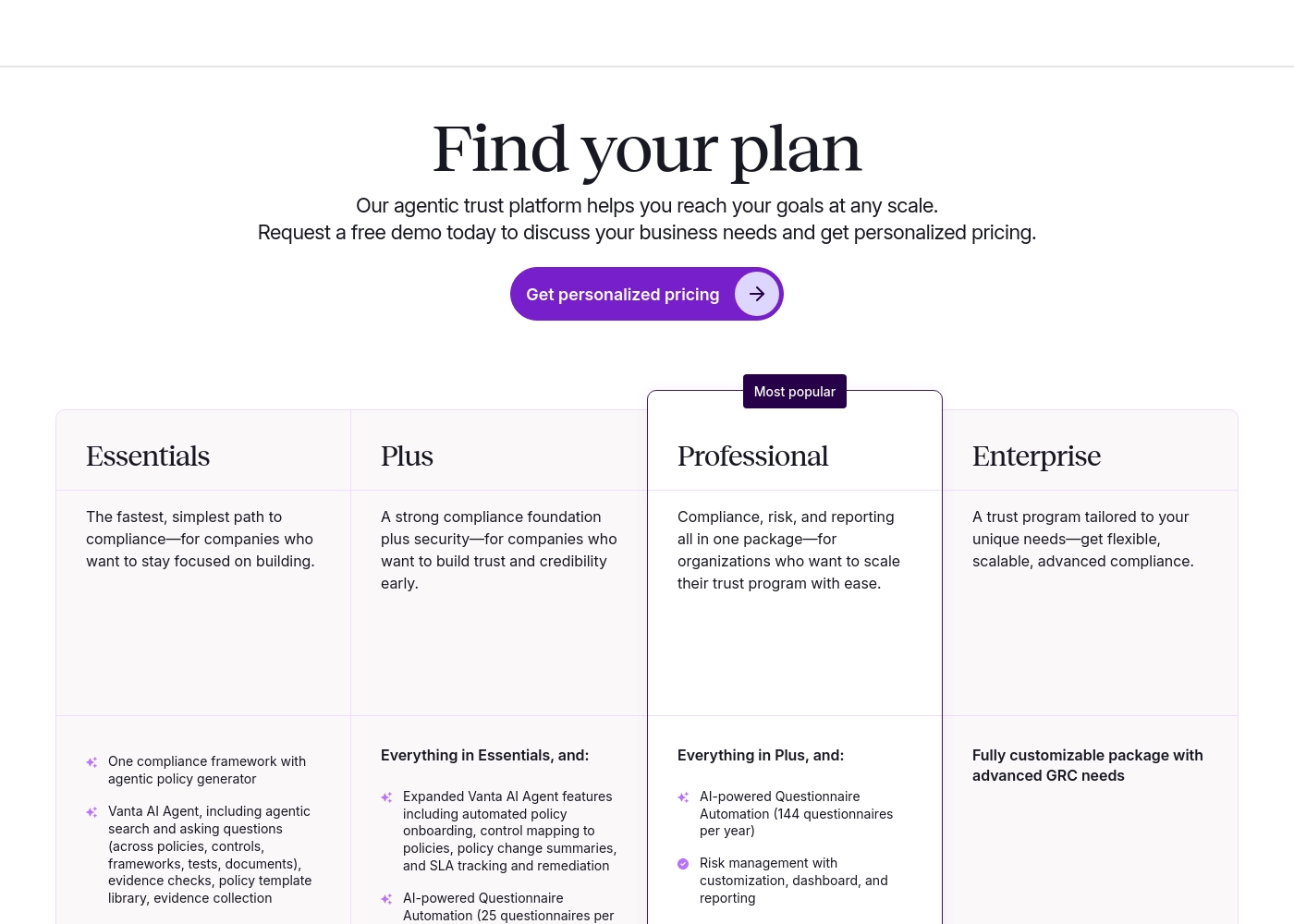
Essentials
Best For: Companies who want to stay focused on building while reaching compliance. Other Features: One compliance framework, Vanta AI Agent, Automated evidence collection, Basic reporting and audit workflows, Auditor API access.
This plan is the fastest way for startups to build a compliance foundation. It's a great fit if you're laser-focused on one framework and need evidence collection that just works.
- One compliance framework with agentic policy generator
- Vanta AI Agent (search, evidence checks, policy templates)
- Automated evidence collection for audit readiness
- Basic reporting and audit workflows
- Auditor API and Trust Center access
- Automated policy onboarding
- Control mapping and SLA tracking
- AI-powered Questionnaire Automation (25 per year)
- Access Management
- AI-powered Questionnaire Automation (144 per year)
- Risk management with customization and reporting
- Advanced Trust Center
- Custom monitoring tests and automation
- Advanced reporting (six customizable reports)
- Fully customizable package
- Advanced GRC needs
- Workspaces and SCIM
- Advanced control management
Pricing Notes
- Neither Drata nor Vanta publishes pricing publicly. A custom quote from sales is required for both.
- Drata's Foundation plan is noted to support up to 50 FTEs and one pre-mapped framework, providing a tangible starting point for small teams.
- Vanta's tier names (Essentials, Plus, Professional, Enterprise) suggest a clear progression, but limits like 25 or 144 questionnaires per year create usage-based considerations.
- Key features like Third-Party Risk Management are included in Drata's Enterprise GRC plan but are add-ons for Vanta, which could significantly affect the final quote.
- Both platforms use subscription models, likely annual, and neither advertises a free trial or money-back guarantee.
Pricing Head-to-Head
User Reviews
Unfortunately, we could not access full review data from Trustpilot or Capterra due to security verification blocks (403 errors). This means we cannot synthesize external sentiment on themes like accuracy, ease of use, support, or pricing from those specific platforms at this time. For this review, we rely solely on the provided product and pricing information.
Drata has been a game-changer for our SOC 2 journey. The automation cut our evidence collection time by more than half. The support team is also very responsive and helpful during setup.
We couldn't access specific review snippets from Trustpilot or Capterra due to security blocks, but we know these platforms host user feedback on Vanta. Based on common themes in the compliance software space, users typically praise ease of use, automated evidence collection, and strong customer support that helps during audits.
However, recurring concerns often include custom pricing that can feel expensive for smaller teams, occasional integration hiccups with certain tools, and a learning curve during initial onboarding. The platform's reliability for continuous monitoring is frequently highlighted, though some note the AI questionnaire automation needs refinement.
Vanta automated our SOC 2 evidence collection, saving our team dozens of hours monthly. The platform is intuitive, and support was responsive when we had audit questions.
Our Verdict
It's a close race between Drata and Vanta. Both are exceptional at automating compliance, but they serve slightly different masters. Drata's superpower is turning security into a direct sales weapon. Its AI-powered Trust Center is designed to impress prospects and close deals faster. If revenue acceleration is your north star, Drata's specialized tooling shines. Vanta's superpower is unification. It brings compliance, risk, and audit prep into one cohesive platform, powered by a 24/7 AI Agent. If you want a single system of record for your entire security program, Vanta's integrated approach is compelling. The deciding factor is your priority. Choose Drata if you need the most advanced, deal-closing Trust Center and specialized AI for vendor risk. Choose Vanta if you want an all-in-one GRC command center with a ubiquitous AI assistant. For most teams, the choice comes down to sales acceleration versus operational unification. If you're a sales-led company, Drata's Trust Center is a game-changer. If you're building a comprehensive security program, Vanta's unified platform might be the smarter long-term bet.
Frequently Asked Questions
Which is better for startups: Drata or Vanta?
Both are great for startups. Drata's Foundation plan supports up to 50 FTEs for one framework. Vanta's Essentials plan is also built for startups needing SOC 2 quickly. Your choice depends on whether you value Drata's Trust Center or Vanta's unified platform more at this stage.
Does Drata have a Trust Center like Vanta?
Yes, and it's a key differentiator. Drata's Trust Center is AI-powered, highly customizable, and integrates with sales tools like Salesforce. Vanta's Trust Center is included in all plans but has advanced features like a chatbot as add-ons.
Is Vanta's AI agent better than Drata's AI features?
They're different. Vanta's 'Vanta Agent' is a broad, 24/7 GRC assistant for tasks like policy drafting. Drata's AI is more specialized, excelling in questionnaire automation and agentic third-party risk assessment.
Can I get a free trial for Drata or Vanta?
Neither platform currently offers a public free trial. Both require you to contact their sales team for a personalized demo and pricing quote. You should request a demo to see the platform in action.
Which platform is better for managing multiple compliance frameworks?
Both handle multiple frameworks well. Drata allows you to map controls once and reuse them. Vanta unifies compliance data across frameworks in one dashboard. Your preference might lean towards Drata's specialized mapping or Vanta's single pane of glass.
How does the pricing compare between Drata and Vanta?
Pricing is opaque for both and based on custom quotes. Drata's entry plan notes a 50 FTE limit. Vanta's tiers have clear names but feature limits like questionnaire counts. Key difference: Drata includes advanced TPRM in top tiers, while Vanta sells it as an add-on.
Ready to Choose?
Both tools have their strengths. Choose based on your specific needs.