DataHawk vs Etsy
DataHawk and Etsy are worlds apart. DataHawk is a powerful analytics tool for sellers, while Etsy is the marketplace itself. Choosing depends entirely on your role.
Best for: Ecommerce brands selling on multiple marketplaces (Amazon, Walmart), Marketing agencies managing analytics for several clients
Best for: Artisans, crafters, and independent creators, Sellers of unique, handmade, vintage, or personalized items
Powerful Analytics, But Opaque Pricing
We see DataHawk as a strong contender for businesses needing a unified, AI-powered view of their ecommerce data. The platform promises to simplify complex analytics. Overall, it appears capable, but the custom pricing model and lack of public reviews are key considerations for potential buyers.
Pros
- Unifies data from multiple marketplaces into one dashboard.
- Includes AI-guided insights to uncover performance opportunities.
- Designed for ease of use, reducing manual data work.
- Scalable platform with features like daily alerts.
Cons
- Pricing is entirely custom and not publicly disclosed.
- Requires booking a demo for any cost information.
- No standard or transparent monthly/annual rates listed.
- Limited public user reviews make independent validation difficult.
Unique finds, operational headaches.
We recognize Etsy’s powerful concept of offering unique, handmade goods and strong personalization options. However, external reviews reveal chronic operational issues, particularly concerning system stability and customer care responsiveness. Overall, the platform’s valuable market niche is severely undermined by widespread failures impacting key reliability factors for both buyers and sellers.
Pros
- Access to a vast selection of unique, handmade, and vintage items.
- Enables strong product personalization (engraving, embroidery).
- Pricing model uses low listing fees rather than mandatory monthly subscriptions.
- Effective platform for supporting independent and small businesses.
Cons
- Customer support is widely reported as unhelpful, inadequate, or entirely nonexistent.
- Both buyer and seller accounts are frequently suspended without clear reason or explanation.
- High incidence of misleading product listings and scam sellers (poor accuracy).
- Widespread reliability issues concerning delivery, shipping delays, and faulty tracking.
AboutDataHawk
DataHawk is a unified analytics platform for ecommerce. 🎯 It combines data from different sources into one place. The system uses artificial intelligence to help you understand your performance better. It’s designed for ecommerce businesses that want clearer, smarter insights.
AboutEtsy
Etsy is a vibrant online marketplace dedicated to all things distinctive and handmade or vintage. It is where you find items beyond the typical store purchase, ensuring your shopping feels personal. This destination is perfect for shoppers looking for original items, spanning from mugs and home goods to jewellery and apparel. Etsy focuses on delivering gifts as special as the recipient, prioritizing unique craftsmanship. It's a great place to discover essential items tailored to specific hobbies too. 💡
Highlights
Feature Comparison
Features Overview
We highlight the main differences and pick a winner for each feature.
Core Purpose
DataHawk analyzes your sales data. Etsy is where you make sales.
**DataHawk** is a dedicated analytics platform. It pulls data from marketplaces like Amazon and Walmart into one dashboard. **Etsy** is the marketplace itself. You list your handmade or vintage items here to sell them directly to customers. **Key difference**: DataHawk is a tool *for* sellers. Etsy is the platform sellers *use*. **Real-world example**: An agency uses DataHawk to report on client performance. A maker uses Etsy to sell their jewelry.
Data & Analytics
DataHawk's AI insights vs. Etsy's basic seller stats.
**DataHawk** offers AI-powered insights and a unified dashboard for cross-marketplace data. It's built for deep performance analysis. **Etsy** provides basic seller stats and order management. It's not designed for advanced data analysis across multiple platforms. **Key difference**: DataHawk gives you strategic, AI-driven analysis. Etsy gives you transactional operational data. **Real-world impact**: DataHawk helps you spot a sales dip trend. Etsy just tells you an order was placed.
Pricing & Fees
DataHawk's custom annual contracts vs. Etsy's pay-per-sale model.
**DataHawk** uses custom annual pricing. You must book a demo to get a quote; no public rates are listed. **Etsy** charges per listing ($0.20) and per sale (6.5% transaction fee + payment processing). There are no monthly subscriptions. **Key difference**: DataHawk is a significant, predictable annual investment. Etsy's costs scale directly with your sales volume. **Trade-off**: DataHawk's cost is opaque upfront. Etsy's fees are clear but accumulate with each transaction.
Marketplace Connectivity
DataHawk connects to multiple marketplaces. Etsy is one marketplace.
**DataHawk** integrates with Amazon, Walmart, and other marketplaces. It's designed for multi-channel analytics. **Etsy** is a single, self-contained marketplace. Your shop only exists within Etsy's ecosystem. **Key difference**: DataHawk lets you compare performance across platforms. Etsy confines your operations to one platform. **Example use case**: A brand selling on both Amazon and Walmart uses DataHawk to compare ROI. An Etsy seller focuses solely on Etsy traffic.
User Experience
DataHawk simplifies complex data. Etsy simplifies selling unique goods.
**DataHawk** aims to make powerful analytics straightforward and accessible for non-technical users. It focuses on executive-ready dashboards. **Etsy** offers a consumer-friendly marketplace experience for buyers and a straightforward listing process for sellers. **Key difference**: DataHawk's UX is about data clarity. Etsy's UX is about product discovery and transaction simplicity. **Real-world impact**: DataHawk saves you from spreadsheet chaos. Etsy saves you from building a website from scratch.
Support & Reliability
DataHawk's support is unspecified. Etsy's support is widely criticized.
**DataHawk** doesn't specify its support channels or response times in the provided data. You'd need to ask during the sales process. **Etsy** has a well-documented reputation for poor customer support. Reviews cite unhelpful responses, account suspensions, and withheld funds. **Key difference**: DataHawk's support quality is unknown. Etsy's support is a known, significant pain point for many users. **Trade-off**: With DataHawk, you might get good support. With Etsy, you're likely to face frustrating support issues.
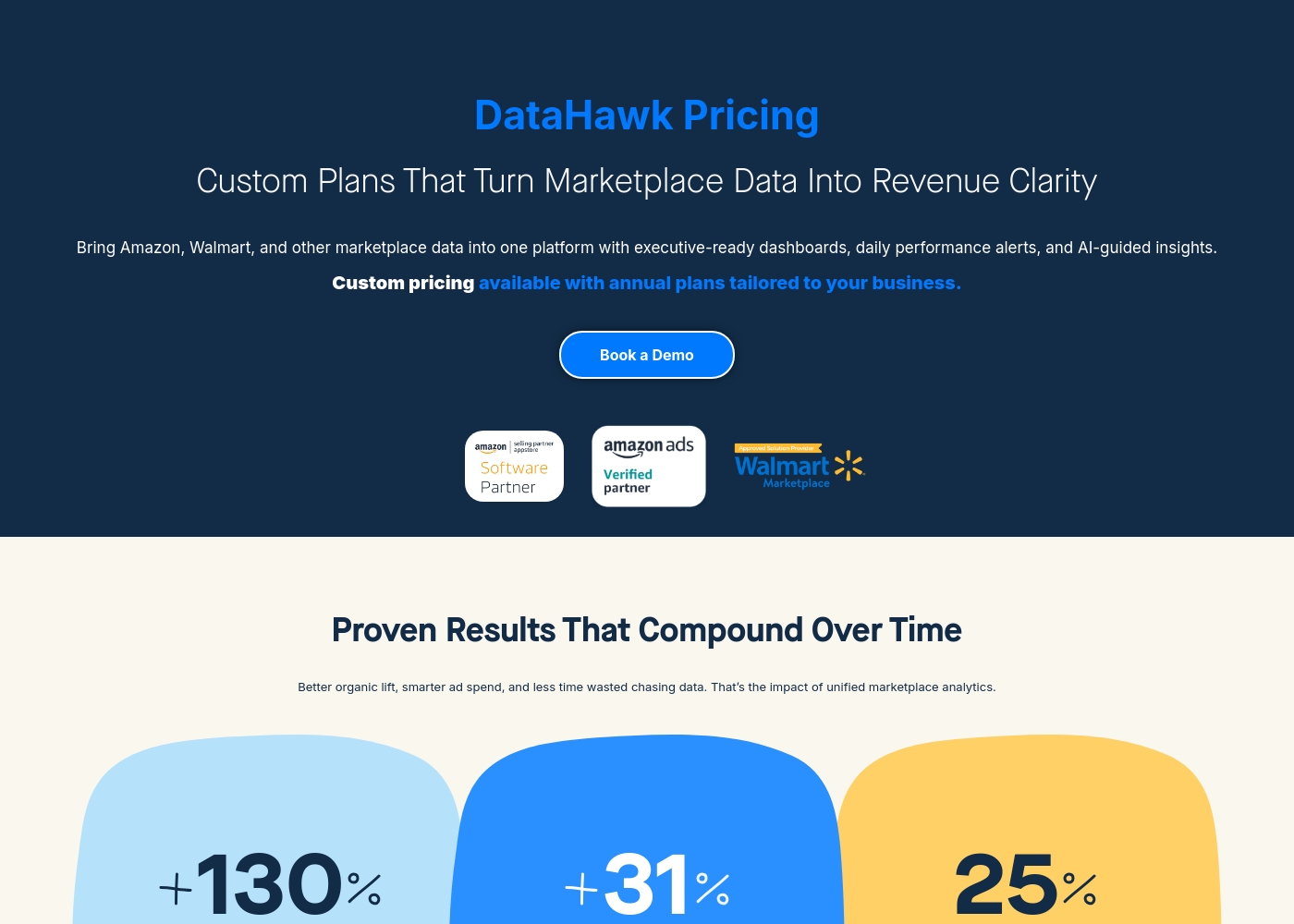
DataHawk pricing: DataHawk offers custom pricing models tailored specifically to your business needs and marketplace scale. Instead of flat fees, they provide annual plans based on the depth of analytics and connectivity required for your eCommerce operations Explorer dashboards and AI insights included everywhere. 🚀
Custom
Websites Supported: Amazon, Walmart, and other marketplaces Best For: Brands and agencies needing unified marketplace analytics and automated reporting Other Features: Executive-ready dashboards, Daily performance alerts, AI-guided insights, Amazon Ads partner verification, Walmart Marketplace integration
This plan is perfect for growing businesses that have outgrown manual spreadsheets. It brings multiple marketplace data sources into one clean view so you can focus on strategy rather than data cleaning. You get professional-grade tools regardless of your technical background.
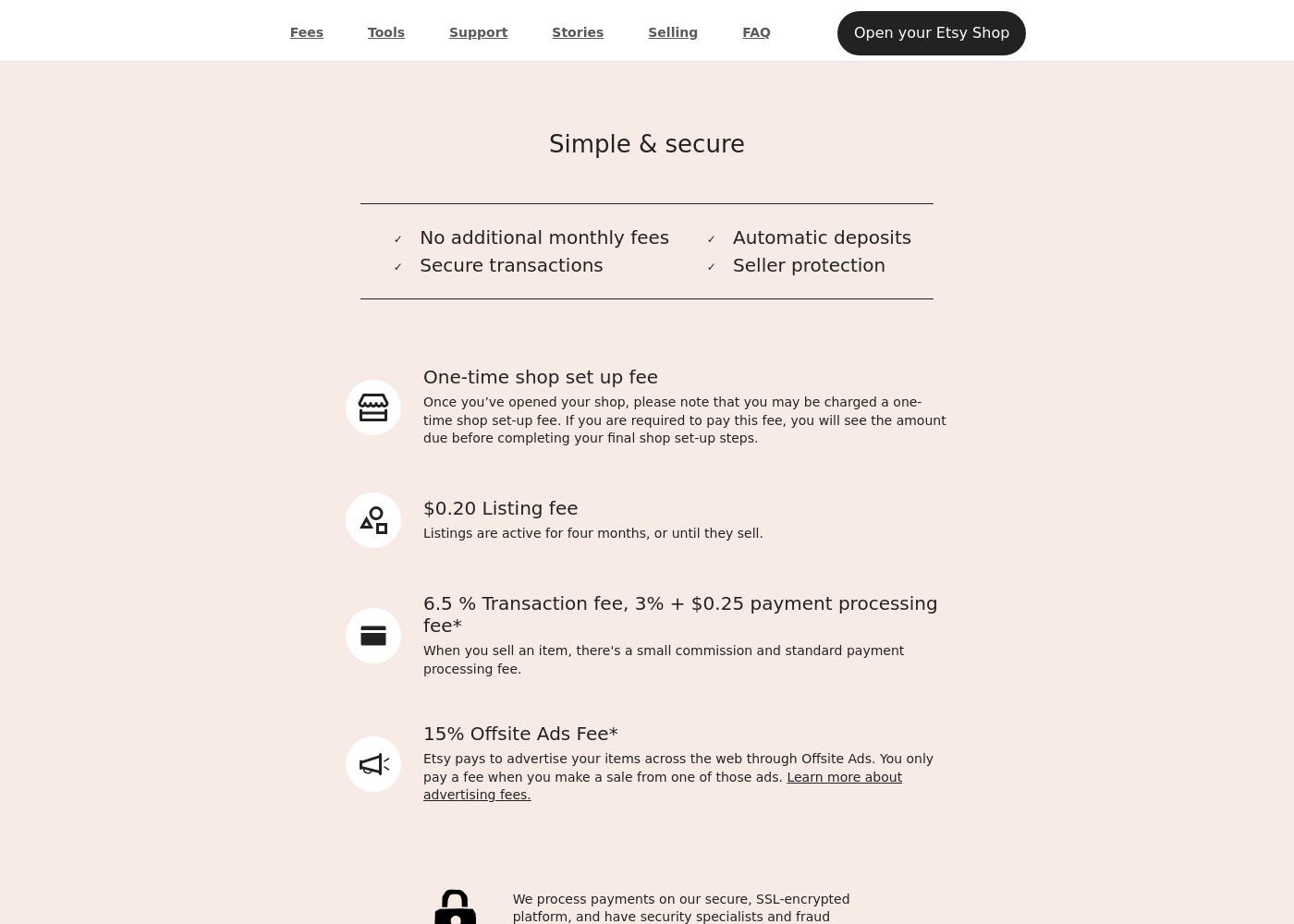
Etsy costs primarily involve fees when you list items or make a sale, with no mandatory additional monthly fees. The minimum fixed fee is $0.20 per listing, and transaction fees start at 6.5% plus a payment processing fee.
To understand how selling on Etsy works, we break down the necessary fees you should expect when setting up your shop and selling products.
Listing Fee
Price: $0.20 per listing Best For: All sellers who want to publish items on the platform Other Features:
- Listings are active for four months
- Fee applies until the item sells
- $0.20 USD per listing
- Active for four months or until sold
- Required to publish item
- 6.5% Transaction fee on sale price
- 3% + $0.25 Payment processing fee
- Only paid upon successful sale
- 15% fee when a sale is generated by an ad
- Etsy handles advertising on major external sites
- Optional for most sellers
Pricing Head-to-Head
User Reviews
We found that user sentiment on Trustpilot and Capterra is currently inaccessible due to technical blocks (CAPTERRA returns a 403 error, and Trustpilot requires browser verification). This means we cannot synthesize specific recurring themes like accuracy, ease of use, support, pricing, or onboarding from live reviews at this time. We advise checking the review platforms directly for the latest user feedback.
The public sentiment regarding Etsy is highly critical, ranking extremely low with a multitude of negative experiences reported by both buyers and sellers. While the core idea of supporting independent creators is valued, the platform’s execution is consistently criticized.
A major theme is the failure of support responsiveness: users find customer service unhelpful, inaccessible, and often described as providing only generic responses. Reliability is another significant issue; many buyers report items arriving late, tracking numbers failing, or not receiving their purchases at all.
My account was permanently banned for absolutely no reason, and they will not specify why. I tried contacting support repeatedly about the suspension, but I only received generic, unhelpful messages in return. It’s frustrating.
Our Verdict
**The Bottom Line:** This isn't a fair fight. DataHawk and Etsy are for completely different people and jobs. **DataHawk's Superpower:** It's the data brains for your ecommerce business. If you sell on Amazon and Walmart, it pulls all your sales data into one place. Its AI helps you spot trends you'd miss on your own. It's for analyzing, not selling. **Etsy's Superpower:** It's the marketplace for unique, handmade goods. If you make jewelry or vintage clothes, Etsy gives you a storefront and millions of buyers. It's for selling, not analyzing complex data across platforms. **The Deciding Factor:** Your role is everything. Are you an analytics pro or a creative maker? Do you need cross-marketplace data or a simple shop? That's the only question that matters. **Final Verdict:** Pick **DataHawk** if you're a brand or agency needing to unify and analyze performance data. Pick **Etsy** if you're a creator selling unique items and want access to a built-in audience. They're not competitors; they're tools for different parts of the ecommerce journey.
Frequently Asked Questions
Which is better for small teams: DataHawk or Etsy?
For a small team of creators, Etsy is better. It lets you sell directly with low upfront costs. DataHawk is for teams analyzing sales data across platforms, which is a different need.
Can I use DataHawk to analyze my Etsy shop data?
The data says DataHawk connects to Amazon, Walmart, and other marketplaces. It does not specifically mention Etsy integration. You'd need to confirm this with their sales team.
Is Etsy worth the extra cost over DataHawk?
It's not a fair comparison. Etsy is a marketplace where you pay fees per sale. DataHawk is an analytics tool you pay for annually. You'd use both if you sold on Etsy and needed advanced data analysis.
Which one has better customer support?
DataHawk's support quality isn't specified in the data. Etsy's support is widely criticized as unhelpful and slow in user reviews. DataHawk likely has the better support by default.
Do I need both DataHawk and Etsy?
Only if you're a creative seller on Etsy who also wants advanced analytics. For most users, you'd pick one: Etsy to sell your goods, or DataHawk to analyze your existing sales data from other platforms.
Which is easier to set up?
Etsy is easier to set up for selling. You pay $0.20 to list an item and start selling. DataHawk requires a sales demo and custom annual contract setup, which is more involved.
Ready to Choose?
Both tools have their strengths. Choose based on your specific needs.