Crossplag vs GPTZero
Choosing an AI detector is tough, especially when comparing free vs. paid reliability. Crossplag offers basic, free checking but suffers from severe user accuracy concerns. GPTZero demands a subscription but promises and claims industry-leading 99% detection accuracy.
Best for: Individuals checking very short assignments (under 3,000 characters), Users requiring a zero-cost detector with no subscription risk
Best for: K-12 and higher education institutions requiring LMS integration, Writers or publishers needing high-volume, reliable detection (500K+ words)
Accuracy concerns make it unreliable.
We find that while Crossplag offers a free and fast AI detection tool, the reported severe accuracy problems detailed by users cannot be ignored. Overall, we cannot recommend relying on this product until major improvements are made to its core detection algorithm, despite the attractive zero price point.
Pros
- Completely free to use with no hidden fees or subscriptions.
- Fast, almost instant, real-time text analysis.
- Simple interface; easy to use (paste text and check).
- User data is not stored, ensuring high privacy.
Cons
- Reliability is severely inconsistent according to user reports.
- Fails to accurately detect AI-generated text, defeating its purpose.
- Incorrectly flags human-written text as highly AI-generated.
- Character limit for checks is restricted to 3,000 characters.
Promising technology, heavily flagged by users.
We find GPTZero’s claims of 99% accuracy compelling, especially its features for transparency and support for ESL writers. Overall, due to persistent user complaints regarding inaccurate false positives, coupled with aggressive, non-transparent billing practices and absent customer support, we cannot recommend it without reservation.
Pros
- Clearly explains and highlights potential AI sections for user validation.
- Claims high accuracy rates (99%) validated by independent research.
- Model is de-biased to reduce false positives for Non-native English (ESL) writers.
- Useful for educators scanning large volumes of assignments quickly.
Cons
- Frequent and widely reported false positives on authentic human-written content.
- Significant issues with subscription cancellation transparency and unauthorized charges.
- Customer support is largely unresponsive and inadequate, according to users.
- Some users report the detection accuracy deteriorating over time.
AboutCrossplag
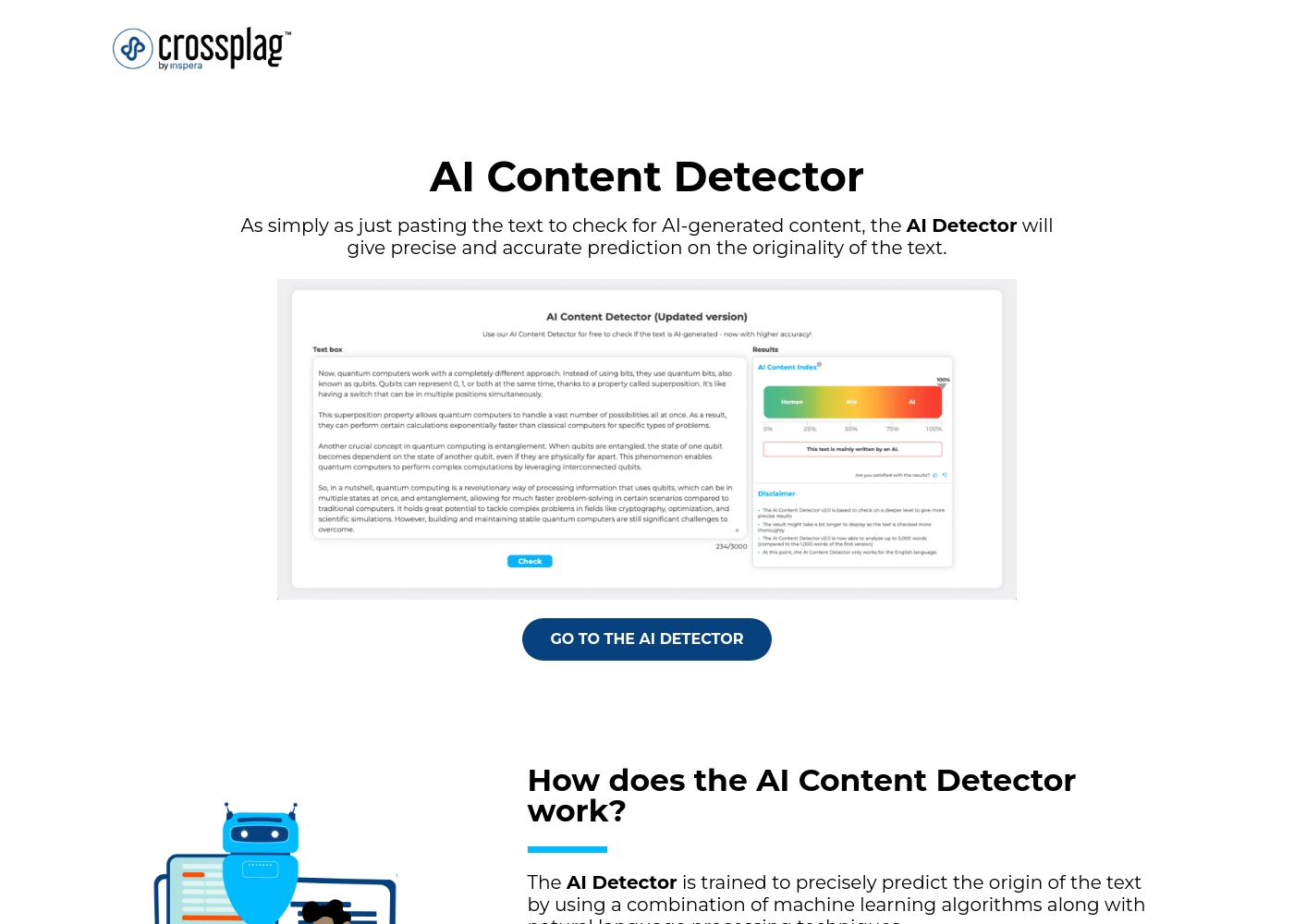
The Crossplag AI Content Detector is a tool designed to determine the origin of your text. It tells you whether content was genuinely human-written or created using an AI chatbot, like platforms generating emails, articles, or product descriptions. This detector uses a blend of sophisticated machine learning algorithms and natural language processing techniques 💡.
It analyzes text patterns based on training data that includes over 1.5 billion parameters for precise results. Since the model is trained with English language datasets, currently, that's the only language that is supported. However, they are planning on adding more languages as the detector develops further.
AboutGPTZero
GPTZero is a dedicated AI content checker that recognizes machine-generated text in any document. This powerful proprietary model helps you identify exactly which parts of a text originated with a large language model (LLM).
How does it work? It analyzes text for key patterns that distinguish machine writing from human writing. These factors include checking for predictability (perplexity), variation in sentence structure (burstiness), and whether the tone is overly generic or repetitive.
Since its founding in January 2023, GPTZero has quickly become essential. It has served over 10 million users and is used by hundreds of institutions, especially in education. It is truly built for contexts where authentic and quality writing matters most. 💡
Highlights
Feature Comparison
Features Overview
We highlight the main differences and pick a winner for each feature.
Cost vs. Features
Crossplag is 100% free, while GPTZero offers powerful features behind a monthly subscription.
The Crossplag AI Detector is entirely free for all users with no credits needed. This makes Crossplag an undeniable winner for individuals prioritizing zero financial commitment. GPTZero is a subscription service starting at $8.33 per month (billed annually). This payment unlocks high volume limits, plagiarism checks, and team collaboration features.
Detection Accuracy
GPTZero claims 99% accuracy supported by independent research; Crossplag has widespread reporting of severe inconsistency.
User reports frequently criticize Crossplag for fundamental flaws and unreliable results. Human-written text is often incorrectly flagged as 100% AI by Crossplag, rendering it useless. GPTZero advertises industry-leading 99% accuracy, validated by Penn State's AI Research Lab. GPTZero's model is also 96.5% accurate on complex documents mixing human and AI text.
Volume and Limits
Crossplag is restricted to 3,000 characters per check; GPTZero handles high volume scanning up to 500,000 words monthly.
You can only analyze up to 3,000 characters in a single submission using Crossplag. This limits Crossplag significantly when reviewing longer documents or academic papers. GPTZero's paid plans provide massive allowances starting at 150,000 words per month. The Professional tier even allows scanning up to 250 files simultaneously for large batches.
Multilingual Support
Crossplag only supports English, but GPTZero reliably covers five major global languages.
The Crossplag AI Detector currently supports the English language exclusively. The core model was trained using large English language datasets for optimal results. GPTZero offers full, reliable support for English, German, Portuguese, French, and Spanish. This broad coverage makes GPTZero much better for international organizations and teams.
Interpretability & Feedback
GPTZero shows exactly why text is flagged; Crossplag only offers a single confidence percentage.
Crossplag provides a confidence percentage rating for the likelihood of AI generation. It does not offer visual aids or natural language context on the decision behind the score. GPTZero is highly transparent, actively explaining why text is flagged as AI-written. It uses color-coded highlights and sentence-level analysis to show specific machine-generated phrases.
Data Privacy Approach
Crossplag explicitly states submitted data is not stored, a strong privacy guarantee.
Crossplag commits to data privacy by confirming submitted text is never stored by the detector. The tool processes and analyzes content in real-time, then discards the submitted text. GPTZero mentions 'Enterprise grade security' for paid plans, but lacks the same storage guarantee. If maximum privacy assurance is critical, the explicit promise from Crossplag is compelling.
Academic Focus
GPTZero is designed for education with LMS integration and ESL de-biasing, unlike Crossplag.
Crossplag serves educators but lacks specific features tailored for large educational institutions. It requires manual pasting and is limited by the strict 3,000-character count. GPTZero features LMS integrations and is actively de-biased for ESL writers. This means GPTZero greatly reduces unfair false positives for non-native English students.
Integration and API
GPTZero provides a robust developer API; Crossplag does not mention any integration capabilities.
There is no explicit mention of an API or integrations for the Crossplag AI detector. Usage of Crossplag seems limited entirely to its basic web interface post-account creation. GPTZero offers a powerful developer API with reusable code in 17 different languages. This allows high-volume users to integrate GPTZero seamlessly into their existing workflows.
Crossplag's AI Content Detector is available for free with 1 plan: Free AI Content Detector at $0.00.
Here’s a breakdown of the single, accessible option for checking your content's originality.
Free AI Content Detector
Price: $0.00 Best For: Anyone needing fast, accurate verification of text authenticity (e.g., bloggers, educators, recruiters) Refund Policy: Not applicable (Free service) Other Features:
- Fast and almost instant verification
- Accurate prediction using machine learning
- Easy to use: paste text and click "Check"
- Supports the English language
- Submitted text is not stored by the detector
- Fast, almost instant authenticity verification
- Accurate prediction using machine learning
- Easy to use: paste text and click 'Check'
- Real-time analysis
- Submitted data is not stored
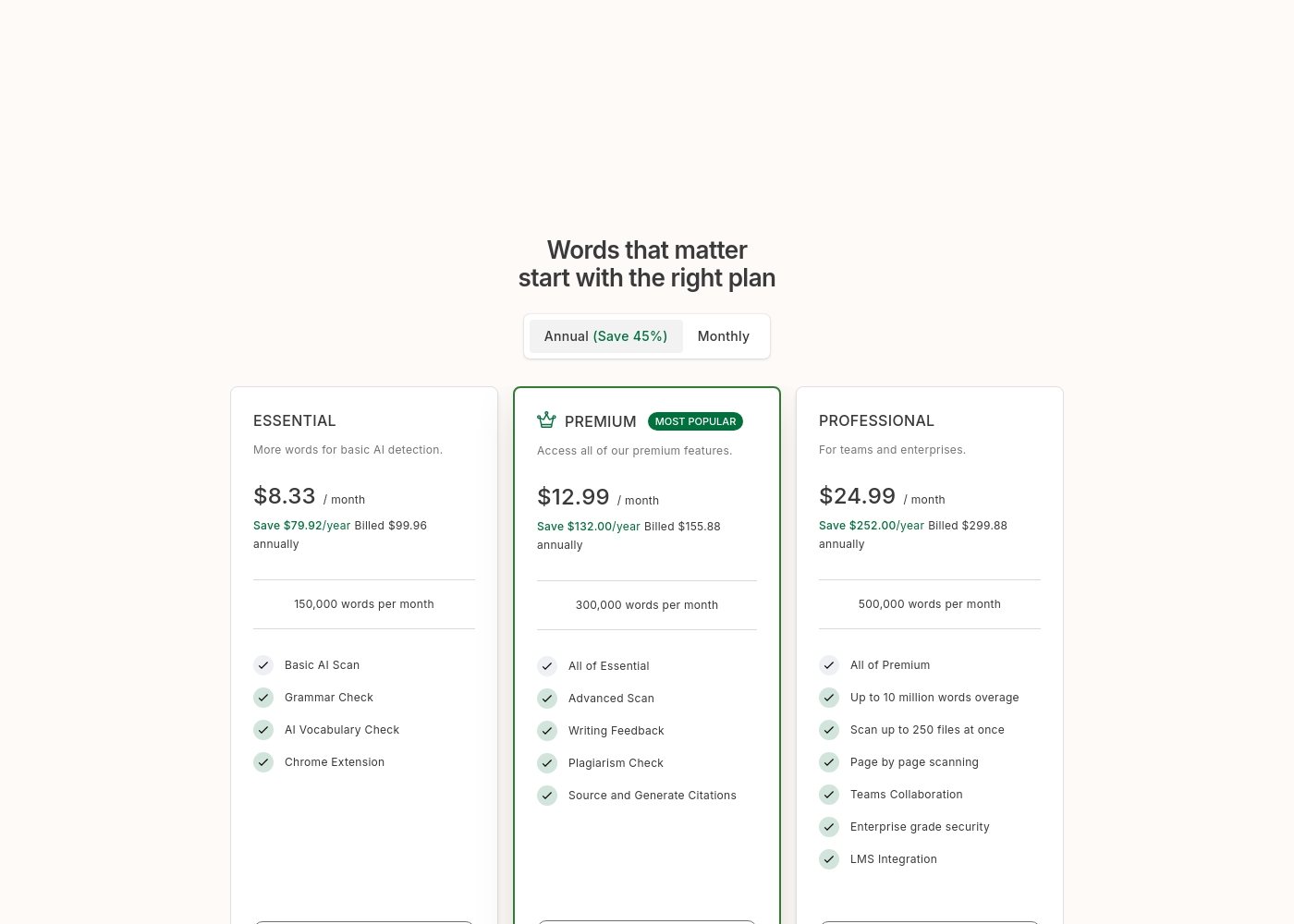
GPTZero costs between $8.33 and $24.99 per month (when billed annually) with three plans: Essential at $8.33, Premium at $12.99, and Professional at $24.99.
These prices reflect a significant discount when you choose annual billing. Let's explore the details of each tier and what you get.
ESSENTIAL
Price: $8.33/month (Billed $99.96 annually) Best For: More words for basic AI detection. Other Features:
- 150,000 words per month
- Basic AI Scan
- Grammar Check
- AI Vocabulary Check
- Chrome Extension
- 150,000 words per month
- Basic AI Scan
- Grammar Check
- AI Vocabulary Check
- Chrome Extension
- 300,000 words per month
- All Essential features included
- Advanced Scan
- Writing Feedback
- Plagiarism Check
- 500,000 words per month
- All Premium features included
- Up to 10 million words overage
- Scan up to 250 files at once
- Page by page scanning
Pricing Notes
- Crossplag is 100% free, requiring no purchase of credits or payment plan.
- GPTZero bases its pricing strictly on usage volume, measured in monthly word counts (150K to 500K+).
- Selecting annual billing for GPTZero offers substantial savings, up to 45% off.
- GPTZero has received user complaints about difficult subscription cancellation and unauthorized charges.
- Since Crossplag is free, refund and cancellation policies are non-applicable.
Pricing Head-to-Head
User Reviews
The external feedback for Crossplag is currently very limited and overwhelmingly negative. The most serious concern reported by early users relates to the severe lack of reliability and accuracy in the AI detection service.
While the tool is offered for free and promotes fast processing, user reports indicate fundamental flaws in its core function. Specifically, users report that content written entirely by a human was consistently and incorrectly flagged as 100% AI-generated.
This tool returned very poor results for me. I recently checked content written entirely without AI, and Crossplag flagged it as 100% AI-generated. If the results are not accurate and reliable, I simply cannot use it for professional work.
Users reviewing GPTZero present two distinct experiences. Positively, many educators and professionals find the tool quick, efficient, and useful for validation, noting its effectiveness in identifying purely machine-generated text or confirming genuine human submissions.
Some users praise the free plan for providing a valuable summary of potential AI use. However, a significant portion of feedback focuses on fundamental reliability and transparent business practices.
This detector is excellent and accurate. Text written from scratch is very rarely detected as AI, which is what I needed. I have tested it on different writing types and found it very reliable.
Our Verdict
This comparison boils down to a risk assessment: free and potentially flawed versus paid and promising. If budget is your only constraint, Crossplag is the obvious choice since it costs absolutely nothing. However, be ready for wildly inconsistent results; users report Crossplag often flags human text as 100% AI-generated. GPTZero is the clear leader in feature depth, volume, and claimed accuracy. It offers robust multilingual support and specialized tools like plagiarism checking and writing feedback. GPTZero is essential for academic institutions and enterprises needing verifiable results up to 500,000 words a month. The deciding factor is authentication integrity versus financial savings. If you strictly need a reliable verdict, pay for GPTZero's tested 99% accuracy. If you only need a quick, no-cost glimpse and can tolerate unreliable results, try Crossplag instead. For any high-stakes content, the accuracy gap makes the paid GPTZero subscription worthwhile.
Frequently Asked Questions
Which tool is better for academic use: Crossplag or GPTZero?
GPTZero is far superior for academic integrity and education use cases. GPTZero offers LMS integration, handles massive word volumes, and is de-biased for ESL writers. Crossplag’s 3,000-character limit and poor user-reported accuracy make it unsuitable for serious academic scrutiny.
Is Crossplag's free AI detector accurate?
Externally, users report severe reliability and accuracy issues with Crossplag. Many reviews state that human-written text is frequently misidentified as AI-generated. You should treat findings from Crossplag as tentative guides, not definitive proof.
Does GPTZero support languages other than English?
Yes, GPTZero fully supports English, German, Portuguese, French, and Spanish with high accuracy. In contrast, Crossplag’s detection model is currently limited to only the English language.
Why would I pay for GPTZero if Crossplag is free?
You pay for GPTZero for features, volume, and substantially higher claimed accuracy (99%). GPTZero includes plagiarism checks, grammar tools, and can scan huge documents. Crossplag is free but offers only basic, low-volume, and reportedly inconsistent detection.
Which tool offers stronger privacy protection for my text?
Crossplag offers the strongest privacy guarantee by explicitly stating submitted text is never stored. While GPTZero offers 'Enterprise grade security' on paid plans, it doesn't give the same explicit non-storage commitment.
Can I integrate either Crossplag or GPTZero with my existing platform?
You can integrate GPTZero into your platform using their powerful developer API. Crossplag does not publicly offer any integration methods or an API for its free AI detector tool.
Ready to Choose?
Both tools have their strengths. Choose based on your specific needs.