Copyleaks vs GPTZero
Battling AI detectors? Copyleaks and GPTZero both claim near-perfect accuracy rates. Copyleaks focuses heavily on enterprise security and global compliance standards. GPTZero offers far greater usage volume and improved transparency for less money.
Best for: Enterprise organizations requiring SOC 2/3 and GDPR compliance., Educational institutions needing custom LMS integrations for massive scanning volumes.
Best for: Freelancers needing 300,000+ words of scanning volume affordably., Educators concerned about unfairly flagging non-native English (ESL) student assignments.
Flawed Detection, Challenging User Experience
We observe a significant gap between Copyleaks’ marketed technical claims of over 99% accuracy and the frequent, severe false positives reported by professional users. Currently, the platform requires improved transparency regarding its complex credit-based pricing model and must urgently address widespread complaints about unhelpful customer support. Overall, while the core AI detection technology may hold promise, its poor implementation leads to frustrating and costly uncertainty for users.
Pros
- Validated by Cornell Tech researchers for LLM detection accuracy.
- Supports advanced features like cross-language translation detection.
- Provides strong enterprise compliance with GDPR and SOC 2/3 certifications.
- Detects AI outputs and plagiarism across over 100 languages.
Cons
- Reported high false-positive rates frequently flag human writing as 100% AI.
- Detection sometimes easily circumvented by minor content changes.
- Credit system and billing practices are perceived as misleading and costly.
- Customer support is often cited as unresponsive or automated.
Promising technology, heavily flagged by users.
We find GPTZero’s claims of 99% accuracy compelling, especially its features for transparency and support for ESL writers. Overall, due to persistent user complaints regarding inaccurate false positives, coupled with aggressive, non-transparent billing practices and absent customer support, we cannot recommend it without reservation.
Pros
- Clearly explains and highlights potential AI sections for user validation.
- Claims high accuracy rates (99%) validated by independent research.
- Model is de-biased to reduce false positives for Non-native English (ESL) writers.
- Useful for educators scanning large volumes of assignments quickly.
Cons
- Frequent and widely reported false positives on authentic human-written content.
- Significant issues with subscription cancellation transparency and unauthorized charges.
- Customer support is largely unresponsive and inadequate, according to users.
- Some users report the detection accuracy deteriorating over time.
AboutCopyleaks
Copyleaks is a robust platform focusing on digital authenticity. It uses advanced AI technology to analyze unique text patterns.
This focus allows the system to flag content created by various Large Language Models (LLMs), including GPT-5, Gemini, Claude, and dozens more. The tool helps you clearly identify AI writing because it looks for signals left behind by statistical modeling.
You can also get detailed reports that separate elements written by humans from AI-generated text, even when both are mixed. The platform is truly built for accuracy and scalability.
AboutGPTZero
GPTZero is a dedicated AI content checker that recognizes machine-generated text in any document. This powerful proprietary model helps you identify exactly which parts of a text originated with a large language model (LLM).
How does it work? It analyzes text for key patterns that distinguish machine writing from human writing. These factors include checking for predictability (perplexity), variation in sentence structure (burstiness), and whether the tone is overly generic or repetitive.
Since its founding in January 2023, GPTZero has quickly become essential. It has served over 10 million users and is used by hundreds of institutions, especially in education. It is truly built for contexts where authentic and quality writing matters most. 💡
Highlights
Feature Comparison
Features Overview
We highlight the main differences and pick a winner for each feature.
Accuracy & Validation
Both claim 99% accuracy; Copyleaks specifies a 0.2% false positive rate.
Cornell Tech researchers validated Copyleaks as highly accurate for LLM detection. It claims an industry-leading 0.2% false positive rate for its minimum error threshold. This tool focuses on minimizing flagging genuine human text across high volumes. Studies from Penn State’s AI Research Lab support GPTZero's 99% accuracy rate. GPTZero keeps its general false positive rate comfortably below 1% overall. It maintains 96.5% accuracy even on documents mixing human and AI writing. Both tools rely heavily on external academic validation for their high accuracy claims. Copyleaks publishes a specific, lower false positive number (0.2%). In practice, both Copyleaks and GPTZero provide reliable detection backed by academic research. The difference lies in their specific focus area of validation.
Pricing Model & Volume
Copyleaks uses credits per word; GPTZero uses high monthly word limits.
Copyleaks pricing is strictly based on a credit system for scanning. One credit covers 250 words or less, making usage tracking complex and potentially costly. Plans range from $13.99 to $99.99 per month for individuals. GPTZero plans are tiered based on generous monthly word allowances. The Professional plan offers a massive 500,000 words monthly base limit. Prices range from $8.33 to $24.99 per month when billed annually. Copyleaks' credit system can feel punitive if users exceed or waste credits on re-scans. GPTZero offers clearer volume limits for high-frequency, high-word-count scanning. For users requiring heavy volume, GPTZero provides significantly better value and less friction than the credit model used by Copyleaks.
Security & Compliance
Copyleaks offers explicit, industry-leading security compliance for enterprises.
Copyleaks ensures enterprise-grade security and is fully GDPR compliant. It holds stringent SOC 2 and SOC 3 data standards certifications. This compliance is essential for institutional and large corporate adoption. GPTZero includes 'Enterprise grade security' in its Professional plan. Specific technical details or documented compliance with standards like SOC 2 are not publicly published. If your organization requires documented, auditable compliance certificates, Copyleaks is the only choice. GPTZero's public security claims are currently vague in comparison. Choosing Copyleaks mitigates legal and security risk necessary for handling sensitive student or corporate data under strict regulations.
Transparency & Reporting
GPTZero excels at showing *why* text is flagged using natural language explanation.
Copyleaks provides detailed reports, separating human and AI text effectively within the platform. The 'AI Logic' feature helps users understand the scoring process somewhat transparently. GPTZero features advanced interpretability and offers natural language explanations of findings. It uses specific color-coded highlights to show the exact AI-generated phrase or sentence. Both offer transparency, but GPTZero emphasizes highlighting segments and explaining metrics like perplexity. This visual method makes results much faster to review and comprehend. Users can immediately pinpoint areas written by an LLM in GPTZero, leading to quicker content validation decisions.
Language and Coverage
Copyleaks supports far more languages overall, especially for plagiarism checks.
Copyleaks supports AI detection in 30+ languages, confirming its global utility. Its comprehensive plagiarism check further covers over 100 languages for content validation. GPTZero fully supports English, German, Portuguese, French, and Spanish with reliable accuracy. While used globally, it has fewer officially guaranteed languages for detection. If global content verification or checking obscure languages for plagiarism is a requirement, Copyleaks dominates. Its 100+ language support is unmatched by GPTZero. Copyleaks is the better option for international educational institutions or multinational publishing organizations needing broad language coverage.
De-Biasing for ESL Writers
GPTZero is uniquely trained to reduce false positives for non-native English speakers.
Copyleaks does not explicitly mention specialized models or training focused on non-native speakers. It applies its core detection logic uniformly across content. GPTZero is the only AI detector specifically de-biased for ESL learners in its model training. This ensures a remarkably low 1% false positive rate for this user group. This feature is critical for educators and institutions worried about unfairly flagging diverse student work. Copyleaks lacks this specific, crucial academic safeguard. GPTZero promotes fairness and equity, ensuring that nuanced writing styles of non-native speakers are correctly identified as human.
Plagiarism Check Integration
Both tools offer integrated AI and plagiarism checks within higher tiered plans.
Copyleaks combines plagiarism scans and AI detection into a single comprehensive report. This feature is powerful because it works across 100+ languages simultaneously. GPTZero features a Plagiarism Check within its Premium and Professional plans, useful for academic settings. It also adds a feature for source and citation generation. Copyleaks has superior language breadth for plagiarism detection globally. GPTZero adds the value of academic formatting tools like citation generation. For general, multi-lingual commercial use, Copyleaks is stronger. For students or academics, GPTZero's added citation features are very helpful.
API and Integration
Copyleaks restricts API access to Enterprise; GPTZero offers API access in all paid plans.
Copyleaks API access is primarily restricted to custom, high-tier Enterprise and Education plans. This creates a high cost barrier for small or mid-sized development teams. GPTZero provides a powerful, multi-language developer API starting in its lowest paid plan. This integration capability is accessible for just $8.33/month. If you are a developer or startup needing automated text validation, GPTZero offers a significantly lower financial entry point. Copyleaks requires much deeper integration commitment. Teams integrating detection into their internal tools will find GPTZero much more flexible and affordable to deploy via the API.
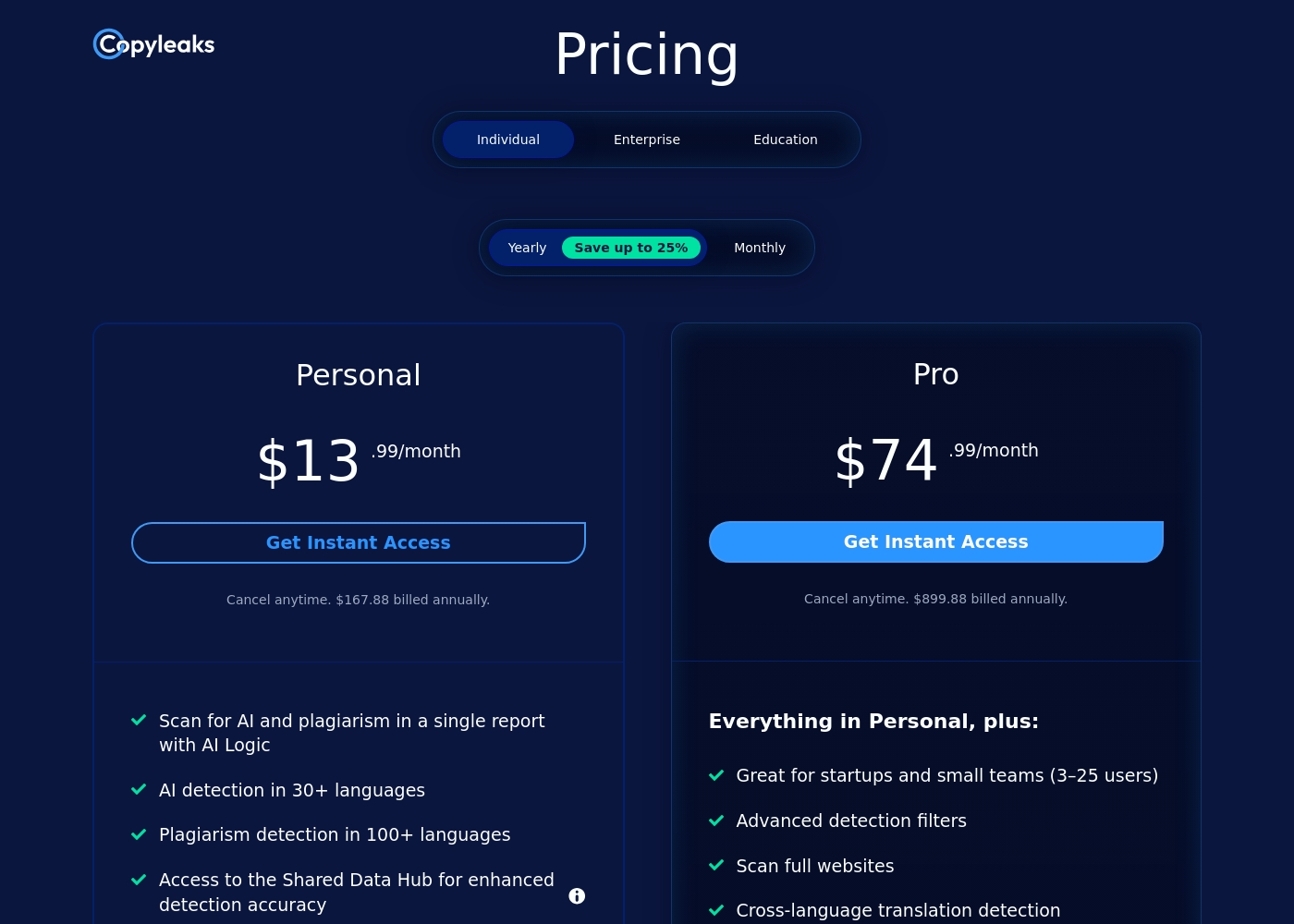
Copyleaks costs between $13.99 and $99.99 per month for individuals with four main pricing paths: Personal at $13.99/month, Pro at $74.99/month, and custom solutions for Enterprise and Education.
We provide detailed information about the individual subscription tiers below, based on the lower annual pricing.
Personal
Price: $13.99/month (billed annually at $167.88) Refund Policy: Limited 10-day conditional guarantee Other Features:
- Scan for AI and plagiarism in a single report with AI Logic
- AI detection in 30+ languages
- Plagiarism detection in 100+ languages
- Access to the Shared Data Hub for enhanced detection accuracy
- Scan for AI and plagiarism in a single report with AI Logic
- AI detection in 30+ languages
- Plagiarism detection in 100+ languages
- Access to the Shared Data Hub for enhanced detection accuracy
- Everything in Personal, plus:
- Great for startups and small teams (3-25 users)
- Advanced detection filters
- Scan full websites
- Cross-language translation detection
- Custom-tailored solution
- Includes API access and LMS integration
- Designed for large teams, institutions, or districts
- Custom-tailored solution
- Includes API access and LMS integration
- Designed for large teams, institutions, or districts
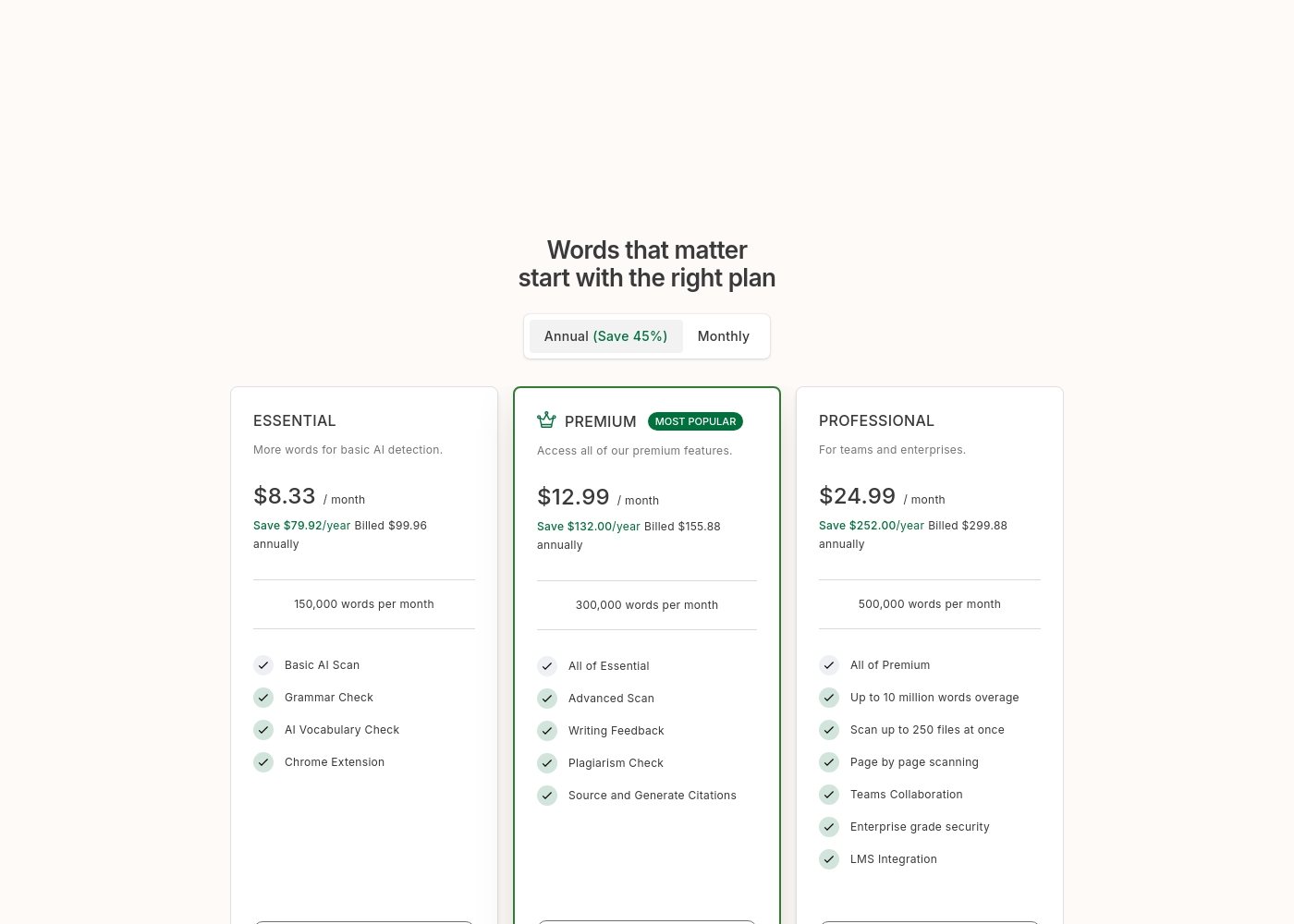
GPTZero costs between $8.33 and $24.99 per month (when billed annually) with three plans: Essential at $8.33, Premium at $12.99, and Professional at $24.99.
These prices reflect a significant discount when you choose annual billing. Let's explore the details of each tier and what you get.
ESSENTIAL
Price: $8.33/month (Billed $99.96 annually) Best For: More words for basic AI detection. Other Features:
- 150,000 words per month
- Basic AI Scan
- Grammar Check
- AI Vocabulary Check
- Chrome Extension
- 150,000 words per month
- Basic AI Scan
- Grammar Check
- AI Vocabulary Check
- Chrome Extension
- 300,000 words per month
- All Essential features included
- Advanced Scan
- Writing Feedback
- Plagiarism Check
- 500,000 words per month
- All Premium features included
- Up to 10 million words overage
- Scan up to 250 files at once
- Page by page scanning
Pricing Notes
- Copyleaks uses a credit-based system where one credit covers 250 words or less.
- GPTZero uses clear word count limits, offering up to 500,000 words monthly volume.
- GPTZero's pricing provides much higher word volume at a significantly lower monthly rate ($24.99 vs $99.99 max).
- Copyleaks reserves API and LMS integration for costly custom Enterprise and Education plans.
- GPTZero offers up to 45% savings for customers who choose annual billing over monthly payments.
Pricing Head-to-Head
User Reviews
Copyleaks reviews present a sharply divided user experience, reflected in its overall low Trustpilot score. The main criticism involves the tool's core function: accuracy.
Many users, including long-time professional writers, report frustrating experiences where clearly human-written content—even text drafted before LLMs existed—is flagged as 100% AI. These extremely high false-positive rates strongly undermine confidence in the tool’s reliability, causing users to call it a "fake AI detector." Furthermore, users highlight significant issues with the credit system and billing practices.
I have 35 years of writing experience, and when I put my journal entry into Copyleaks, it returned 100% AI content. Every other competing software says 100% Human. Copyleaks is an epic fail.
Users reviewing GPTZero present two distinct experiences. Positively, many educators and professionals find the tool quick, efficient, and useful for validation, noting its effectiveness in identifying purely machine-generated text or confirming genuine human submissions.
Some users praise the free plan for providing a valuable summary of potential AI use. However, a significant portion of feedback focuses on fundamental reliability and transparent business practices.
This detector is excellent and accurate. Text written from scratch is very rarely detected as AI, which is what I needed. I have tested it on different writing types and found it very reliable.
Our Verdict
Copyleaks and GPTZero both promise near-perfect AI detection rates. The choice really depends on your specific budget and operational needs. Generally, GPTZero wins on pure usage volume and transparent, low-cost entry. Copyleaks excels where security and regulatory compliance are essential for your business. It offers auditable SOC 2/3 and GDPR compliance for true enterprise users. Copyleaks provides better detection coverage, supporting over 100 languages and checking AI-generated code. GPTZero is superior for affordability and transparent results interpretation for high-volume users. Its usage tier pricing offers huge word counts for far less money than Copyleaks. GPTZero uniquely de-biases results for ESL writers, a major benefit for academics. The core deciding factor is compliance versus volume and fairness. If you require validated, hard-line corporate security standards, choose Copyleaks. If you need 500,000 words scanned monthly or fairness for diverse writers, GPTZero is the smarter financial choice. Choose Copyleaks for large, regulated institutions needing documented security and broad language coverage. Pick GPTZero if you are a high-volume writer or education provider prioritizing student fairness and lower monthly capital cost.
Frequently Asked Questions
Which offers better value for money, Copyleaks or GPTZero?
GPTZero offers significantly higher monthly word limits for a lower price. Its volume-based pricing is much clearer than the credit system of Copyleaks. Copyleaks can get expensive rapidly if you exceed your allotted credits.
Does GPTZero detect AI-generated code like Copyleaks?
No, GPTZero focuses strictly on identifying written text patterns from LLMs. Copyleaks specifically includes the capability to analyze and identify AI-generated code. This feature is crucial for development and compliance teams.
Which tool is safer for non-native English (ESL) writers?
GPTZero is explicitly de-biased for ESL learners to reduce false positives. It maintains an impressive 1% false positive rate for this specific group. Copyleaks does not feature this specialized protection.
Can I get API access with GPTZero without buying an expensive Enterprise plan?
Yes, GPTZero includes API access availability across all three of its public paid subscription plans. Copyleaks generally restricts its API integration to customized Enterprise or Education quotes.
Which has stronger security compliance for large businesses?
Copyleaks is superior, holding explicit GDPR, SOC 2, and SOC 3 certifications. These auditable standards are often mandatory for large, regulated enterprises. GPTZero only mentions 'Enterprise grade security' without specific certifications.
Can I scan full websites for AI content using Copyleaks or GPTZero?
Copyleaks supports scanning full websites, starting with its Pro plan ($74.99/mo). GPTZero does not list this specific content scanning capability within its public plan features.
Ready to Choose?
Both tools have their strengths. Choose based on your specific needs.